Page 1 of 23
System Requirements Document
1. Introduction
1.1 Purpose
This document specifies the requirements for Crown & Consequence, a small, polished browser game prototype that establishes the core gameplay loop for a series of simple historical dice-and-card games.
1.2 Scope
The prototype delivers a complete, playable reign of William I of England (William the Conqueror), beginning after the Norman Conquest has already succeeded (approximately 1067) and ending with William's death in 1087. The game is a compact, card-driven board/card game about ruling medieval England — explicitly not a detailed historical simulation in the style of Crusader Kings or Europa Universalis.
The prototype must also establish a framework that allows other monarchs to be added later, selected either by the player's choice of who to play or by who succeeds the monarch in the game.
1.3 Central Design Question
Can William hold together England and Normandy long enough to establish a stable succession?
Page 2 of 23
1.4 Core Design Philosophy
- Simple enough to understand in 5–10 minutes.
- Playable in roughly 20–30 minutes.
- Primarily card-driven.
- Dice introduce uncertainty rather than dominate the game.
- Historically flavoured but explicitly an alternate-history game.
- Decisions have consequences several turns later.
- The player frequently faces two or three imperfect choices rather than obvious "correct" answers.
- The player is never left with no possible choice — a fallback "do nothing" option must exist if no other way forward is possible.
- The game tells the story of a reign.
- The player is not overwhelmed with dozens of resources or modifiers.
2. System Overview
Crown & Consequence is a self-contained browser game structured as a sequence of historical periods/events covering William's reign from approximately 1067 to 1087. Each turn represents approximately 1–3 years, depending on the event.
The game is built around:
- A fixed chronological event deck drawn in historical order (not shuffled).
- Five principal player resources on simple 0–10 scales.
- Two realms (England and Normandy), each with a 0–5 Stability value.
- A succession system built around William's three surviving sons.
- A d6 dice mechanic for resolving uncertain actions.
- A memory of previous decisions that modifies later events.
The game engine is separated from the William I event data so that additional monarchs can be added later as separate event decks.
Page 3 of 23
3. Functional Requirements
3.1 Game Structure & Turn Loop
- As a player, I want the game divided into a sequence of historical periods/events covering William's reign from approximately 1067 to 1087, so that the game tells the story of a reign in historical order.
- As a player, I want each turn to represent approximately 1–3 years depending on the event, so that the pacing reflects the historical period.
- As a player, I want each turn to display the current year/period, so that I always know where I am in the reign.
- As a player, I want each turn to draw the next historical Event card, so that events arrive in historical sequence.
- As a player, I want each turn to present the situation to me, so that I understand the context before deciding.
- As a player, I want each turn to give me 2–3 possible responses, so that I face meaningful choices.
- As a player, I want each turn to resolve my response using resources and/or a dice roll, so that outcomes are uncertain but grounded.
- As a player, I want each turn to apply consequences, so that my decisions matter.
- As a player, I want each turn to update the kingdom state, so that the world reflects my choices.
- As a player, I want follow-up events to occasionally trigger, so that the game feels reactive.
- As a player, I want the game to continue until William dies or the succession is resolved, so that the reign has a defined arc.
- As a player, I want events to arrive in historical sequence rather than as a randomly generated generic medieval kingdom, so that the game feels historically grounded.
- As a player, I want a fallback "do nothing" option available whenever there are no other possible ways forward, so that I am never left with no possible choice.
Page 4 of 23
3.2 Player Resources
- As a player, I want a Treasury resource representing available royal money and extractive capacity, so that I can fund my decisions.
- As a player, I want Treasury to be usable for raising armies, buying loyalty, funding administration, building/repairing fortifications, and conducting major surveys/projects, so that money has clear strategic uses.
- As a player, I want an Authority resource representing the Crown's ability to impose decisions, so that I can manage the realm.
- As a player, I want Authority to be usable for suppressing rebellions, overruling nobles, implementing unpopular policies, and managing succession, so that it has clear strategic uses.
- As a player, I want a Military resource representing the effective military force immediately available to William, so that I can respond to threats.
- As a player, I want Military to be used primarily when dealing with rebellions, invasions, and major military decisions, so that it has clear strategic uses.
- As a player, I want a Noble Loyalty resource representing the willingness of England's powerful nobles to support William, so that I can gauge political risk.
- As a player, I want low Noble Loyalty to increase the chance of rebellion and succession problems, so that political neglect has consequences.
- As a player, I want a Legitimacy resource representing the perceived right and stability of William's rule, so that I can gauge the stability of my rule.
- As a player, I want low Legitimacy to create additional crises, so that legitimacy has consequences.
- As a player, I want all five resources to use simple 0–10 scales, so that the economy stays deliberately small.
- As a player, I want the game to avoid separate statistics for every county, noble, bishop, or army, so that I am not overwhelmed.
3.3 Two Realms
- As a player, I want William to rule two territories — England and Normandy — represented simply rather than as dozens of provinces, so that the game stays compact.
- As a player, I want England and Normandy each to have a value from 0–5 representing Stability, so that I can track the state of each realm.
- As a player, I want England to be the more difficult realm during the game, so that the challenge reflects the historical situation.
- As a player, I want Normandy to matter because the succession problem is fundamentally about whether my heirs inherit England, Normandy, both, neither, or some deliberately engineered arrangement, so that both realms carry strategic weight.
- As a player, I want to constantly feel that resources spent dealing with one realm may weaken the other, so that I face a persistent strategic tension.
Page 5 of 23
3.4 Succession System
- As a player, I want William's three surviving sons — Robert Curthose, William Rufus, and Henry Beauclerc — represented as three character cards, so that the succession is a tangible part of the game.
- As a player, I want each son to have a few simple attributes rather than a full RPG character sheet, so that the system stays light.
- As a player, I want Robert Curthose to have attributes such as claim strength in Normandy, noble support, and ambition, so that his character is distinct.
- As a player, I want William Rufus to have attributes such as English political support, military capability, and royal loyalty, so that his character is distinct.
- As a player, I want Henry Beauclerc to have attributes such as treasury/political flexibility, ambition, and ability to exploit opportunities, so that his character is distinct.
- As a player, I want the exact attribute values to be tunable during playtesting, so that balance can be refined.
- As a player, I want to gradually develop relationships and expectations around the three sons, so that the succession feels earned over the course of the game.
3.5 Succession Choices
- As a player, I want several succession decisions introduced during the later portion of the game, so that the succession becomes a major arc.
- As a player, I want to eventually decide what William intends to leave each son, so that my intentions shape the ending.
- As a player, I want a Traditional division arrangement (Robert receives Normandy, William receives England, Henry receives money/estates), so that I can follow the historical pattern.
- As a player, I want a Concentrate power arrangement (attempt to keep England and Normandy together under one heir), so that I can pursue a unified inheritance.
- As a player, I want a Divide deliberately arrangement (create a clear division between the two realms), so that I can engineer a clean split.
- As a player, I want a Keep the succession ambiguous arrangement (delay the decision and hope circumstances resolve it), so that I can gamble on events.
- As a player, I want a Favour a particular son arrangement (use William's personal authority to establish a preferred heir), so that I can impose my will.
- As a player, I want the game to avoid assuming a single correct historical solution, so that my choices produce different endings.
3.6 Historical Event Deck
- As a player, I want a fixed chronological deck drawn in historical order rather than shuffled, so that the sequence broadly follows William's reign.
- As a player, I want the exact historical dates to be approximate but the sequence to broadly follow William's reign, so that the game stays historically flavoured without being rigid.
Page 6 of 23
3.6.1 Early Consolidation, 1067–1070
- As a player, I want a Return from Normandy event in which William returns to England after the conquest, so that the basic mechanics are introduced.
- As a player, I want the Return from Normandy event to offer choices such as rewarding Norman followers with land, reconciling with English nobles, and strengthening royal administration, so that I establish my initial stance.
- As a player, I want the consequences of the Return from Normandy event to establish my initial relationship with English nobles, so that early choices carry forward.
3.6.2 The Rebellions
-
As a player, I want rebellion to be the main recurring threat, so that internal conflict drives the game.
-
As a player, I want several distinct rebellion cards/events rather than a generic random "rebellion" event, so that each rebellion feels specific.
-
As a player, I want an Exeter Rebellion (1068) event presenting the resistance at Exeter, so that I face an early test.
-
As a player, I want the Exeter Rebellion to offer choices such as besieging Exeter, negotiating, offering concessions, and making an example of the rebels, so that I have multiple approaches.
-
As a player, I want different approaches to the Exeter Rebellion to affect Authority, Military, Treasury, and Noble Loyalty, so that my choice has meaningful consequences.
-
As a player, I want a Northern Rebellion (1069) event treated as a major event, so that the north feels like a serious crisis.
-
As a player, I want the Northern Rebellion to offer a March north personally choice that is expensive, dangerous, and potentially restores Authority strongly, so that I weigh personal risk against reward.
-
As a player, I want the Northern Rebellion to offer a Send Norman commanders choice that is less expensive but risks commanders gaining too much independence, so that delegation carries risk.
-
As a player, I want the Northern Rebellion to offer a Negotiate with northern nobles choice that is cheap but risks appearing weak, so that diplomacy carries risk.
-
As a player, I want a Harrying of the North (1069–1070) event treated as an important consequence rather than simply a "victory," so that suppression has weight.
-
As a player, I want severe suppression in the Harrying of the North to grant +Authority and +short-term Stability but cost -Treasury, -Noble Loyalty, and -English Stability or long-term prosperity, so that harsh choices have trade-offs.
-
As a player, I want a less destructive approach in the Harrying of the North to make the immediate rebellion harder to suppress but produce different long-term consequences, so that restraint has its own trade-offs.
-
As a player, I want the game not to moralise about the choices in the Harrying of the North, presenting them as strategic consequences, so that the tone stays neutral.
-
As a player, I want a Danish invasion and rebellion event introducing the Danish threat alongside internal rebellion, so that I face external and internal pressure simultaneously.
-
As a player, I want the Danish invasion event to force choices between fighting rebels, defending against Denmark, buying off enemies, and dividing military forces, so that I cannot do everything.
-
As a player, I want the Danish invasion event to demonstrate the central mechanic that you cannot personally deal with every crisis, so that the game's core tension is reinforced.
-
As a player, I want a Hereward and Ely (1070–1071) event treated as a late pocket of resistance, so that resistance persists after the major rebellions.
-
As a player, I want the Hereward and Ely event to offer approaches such as military assault, siege/blockade, negotiation, and bribery, so that I have multiple tools.
-
As a player, I want the resolution of Hereward and Ely to contribute to the eventual pacification of England, so that late resistance has a payoff.
Page 7 of 23
3.6.3 The Revolt of the Earls — 1075
- As a player, I want a Revolt of the Earls (1075) event treated as another major event, so that noble threat persists after apparent pacification.
- As a player, I want the Revolt of the Earls to reveal that powerful nobles can become a threat even after England appears pacified, so that I stay vigilant.
- As a player, I want the Revolt of the Earls to offer choices such as rapid military response, political concessions, dividing the conspirators, and punishing the leaders harshly, so that I have multiple approaches.
- As a player, I want the Revolt of the Earls to introduce the concept that Noble Loyalty matters even when there is no open rebellion, so that political management is a constant concern.
3.6.4 Domesday — "The Great Survey"
- As a player, I want Domesday introduced approximately in 1085–1086 as one of the game's major non-military events, so that administration is a major arc.
- As a player, I want the Domesday card called "The Great Survey", so that it is clearly identified.
- As a player, I want the Great Survey to reflect William's desire to know who owns what, how much land is worth, who owes what, and what the Crown can actually extract, so that the survey has clear purpose.
- As a player, I want to choose how aggressively to conduct the survey, so that the survey is a decision rather than a fixed event.
- As a player, I want a Maximum extraction option granting a large immediate increase to Treasury with a potential decrease to Noble Loyalty, so that aggressive extraction has a cost.
- As a player, I want a Balanced assessment option granting a moderate Treasury increase and a small Authority increase, so that moderation has its own reward.
- As a player, I want an Administrative investment option that pays Treasury now to improve long-term revenue and Authority, so that long-term thinking is rewarded.
- As a player, I want Domesday to feel like an investment in the machinery of royal government rather than just a one-time money bonus, so that it has lasting significance.
- As a player, I want successful completion of Domesday to perhaps permanently increase the maximum Treasury or give a future income bonus, so that the investment pays off over time.
3.6.5 The Normandy Problem
- As a player, I want events in Normandy to occasionally demand attention, so that I cannot simply think of England in isolation.
- As a player, I want Normandy events to include Norman noble disputes, Robert's ambitions, external threats, and William needing to spend time in Normandy, so that the realm feels alive.
- As a player, I want a simple rule that when William personally travels to Normandy, Normandy Stability +1 but England Stability -1 unless I spend resources to compensate, so that travel carries a clear trade-off.
- As a player, I want staying in England for too long to potentially create Norman problems, so that neglect of Normandy has consequences.
- As a player, I want this to give me an interesting strategic dilemma without requiring a map simulation, so that the game stays compact.
Page 8 of 23
3.6.6 Robert Curthose
- As a player, I want Robert Curthose to gradually become a problem, so that the succession tension builds over time.
- As a player, I want Robert to be William's eldest surviving son with a natural claim to Normandy, so that his claim is grounded.
- As a player, I want a "The Heir's Frustration" card in which Robert feels insufficiently rewarded, so that his discontent is dramatised.
- As a player, I want "The Heir's Frustration" to offer a Give him estates choice, so that I can reward Robert with land.
- As a player, I want "The Heir's Frustration" to offer a Promise Normandy choice, so that I can commit the duchy to Robert.
- As a player, I want "The Heir's Frustration" to offer a Give him money choice, so that I can placate Robert financially.
- As a player, I want "The Heir's Frustration" to offer a Refuse choice, so that I can deny Robert's demands.
- As a player, I want a "Robert's Supporters" card in which Norman nobles begin rallying around him, so that his threat escalates.
- As a player, I want "Robert's Supporters" to offer a Conciliate Robert choice, so that I can attempt to reconcile with him.
- As a player, I want "Robert's Supporters" to offer a Confront him choice, so that I can directly oppose him.
- As a player, I want "Robert's Supporters" to offer a Strengthen William Rufus choice, so that I can build up a rival heir.
- As a player, I want "Robert's Supporters" to offer an Ignore the problem choice, so that I can choose to do nothing about it.
- As a player, I want the exact consequences of Robert's cards to depend on earlier choices, so that the game remembers my history.
3.6.7 Final Years
- As a player, I want the final phase to begin around 1085, so that the endgame has a defined start.
- As a player, I want England to be broadly pacified in the final phase but the succession to become increasingly important, so that the focus shifts.
- As a player, I want a series of increasingly consequential decisions involving Robert, William Rufus, Henry, Normandy, England, the Church, and the nobles, so that the endgame is rich.
- As a player, I want these decisions to reference previous choices, so that the game feels like a continuous story.
- As a player, I want the game to reflect that repeatedly rewarding Robert may give him substantial noble support, so that my history shapes the ending.
- As a player, I want the game to reflect that marginalising Robert may make him weaker but more hostile, so that neglect has consequences.
- As a player, I want the game to reflect that strengthening William Rufus may make England easier to transfer to him, so that investment in an heir pays off.
- As a player, I want the game to reflect that enriching Henry may give him fewer territorial claims but more resources, so that his role evolves.
Page 9 of 23
3.6.8 William's Death
- As a player, I want the game to end with William's death in 1087, so that the reign has a defined conclusion.
- As a player, I want the game NOT to simply display "You lose/win," so that the ending is nuanced.
- As a player, I want a Succession Outcome calculated based on the state of England, Normandy, the three sons, and William's final decisions, so that the ending reflects my play.
- As a player, I want possible outcomes to include stable division, peaceful English succession / Norman succession, rivalry between the brothers, immediate succession crisis, civil conflict, one son unexpectedly dominating, and a highly successful alternative settlement, so that endings are varied.
- As a player, I want the historical outcome to be one possible outcome, not the guaranteed one, so that the game is a counterfactual.
3.7 Dice Mechanics
- As a player, I want a simple d6 used for uncertain actions, so that the mechanic is easy to understand.
- As a player, I want most uncertain actions resolved by rolling 1d6 + relevant bonus, so that resolution is consistent.
- As a player, I want the interpretation to be: 1–2 Failure, 3–4 Partial success, 5–6 Success, 7+ Exceptional success, so that outcomes are clearly banded.
- As a player, I want the game to avoid excessive arithmetic, so that play stays fast.
- As a player, I want my resources to sometimes provide bonuses, but spending resources to generally be more important than stacking modifiers, so that resource management matters more than modifier stacking.
- As a player, I want a suppression example such as: roll dice + Military, with 1–2 Major setback, 3–4 Rebellion suppressed but cost 1 Stability, 5–6 Rebellion suppressed, 7+ Rebellion suppressed and Authority +1, so that the mechanic is concrete.
- As a player, I want numbers kept small, so that the game stays light.
Page 10 of 23
3.8 Cards Should Have Personality
- As a player, I want every major event card to contain a Year, so that I know when it occurs.
- As a player, I want every major event card to contain an Event title, so that it is identifiable.
- As a player, I want every major event card to contain a Short historical context, so that I understand why it matters.
- As a player, I want every major event card to contain the Current situation, so that I understand the stakes.
- As a player, I want every major event card to contain 2–3 choices, so that I have decisions to make.
- As a player, I want every major event card to contain Immediate consequences, so that I see the results of my choice.
- As a player, I want event cards to possibly contain an "If X happened earlier..." mechanic, so that the game remembers previous decisions.
- As a player, I want the game to remember previous decisions, so that the game feels like a story rather than a random card generator.
- As a player, I want the Northern Rebellion to grant +1 to negotiation if I previously chose reconciliation with northern nobles, so that earlier choices matter.
- As a player, I want the Northern Rebellion to make military action easier but the consequences of failure worse if I previously used harsh repression, so that earlier choices matter.
3.9 UI
- As a player, I want the interface to look like a beautifully simplified medieval strategy board game rather than a spreadsheet, so that the game feels polished.
- As a player, I want a top bar showing Year, England Stability, Normandy Stability, Treasury, Authority, Military, Noble Loyalty, and Legitimacy, so that I can see the full state at a glance.
- As a player, I want a large illustrated Event Card in the centre, so that the current event is the focus.
- As a player, I want two or three large decision buttons at the bottom, so that choices are prominent.
- As a player, I want a side panel with small portraits/cards for Robert, William Rufus, and Henry, so that the sons are visible.
- As a player, I want simple relationship indicators for the sons, so that I can gauge their standing.
- As a player, I want the game to avoid a giant map, so that the game works primarily through cards and numbers.
- As a player, I want a small decorative map of England and Normandy to be acceptable, so that the game has visual flavour without becoming a map simulation.
Page 11 of 23
3.10 Game Feel
- As a player, I want to repeatedly experience dilemmas like "I can solve this problem, but doing so will create another," so that the game rewards foresight.
- As a player, I want to face the dilemma of spending money to prevent rebellion, leaving less money for Domesday, so that resource allocation is tense.
- As a player, I want to face the dilemma of staying in England to maintain control while risking Normandy, so that realm management is tense.
- As a player, I want to face the dilemma of rewarding nobles (increasing loyalty but reducing royal resources), so that political management has costs.
- As a player, I want to face the dilemma of crushing a rebellion decisively (gaining Authority but creating resentment), so that decisive action has costs.
- As a player, I want to face the dilemma of investing in administration now, hoping the benefits arrive later, so that long-term planning is rewarded.
- As a player, I want to face the dilemma of giving Robert what he wants, potentially strengthening his eventual position, so that appeasement has risks.
- As a player, I want to face the dilemma of favouring William Rufus, potentially alienating Robert, so that favouritism has risks.
- As a player, I want to face the dilemma of enriching Henry, creating a third ambitious player in the succession, so that enrichment has risks.
- As a player, I want the game to reward thinking several turns ahead rather than simply choosing the option with the biggest immediate bonus, so that strategic play is rewarded.
3.11 Historical Accuracy
- As a player, I want the game to use real historical events and people where practical, so that the game is historically flavoured.
- As a player, I want the game to be a counterfactual game, not a historical reenactment, so that I can change outcomes.
- As a player, I want to be able to change outcomes, so that the game is not a fixed reenactment.
- As a player, I want the game not to force the historical result, so that my choices matter.
- As a player, I want short contextual text explaining why an event matters, so that I understand the historical flavour.
- As a player, I want the actual gameplay language to be concise, so that play stays fast.
- As a player, I want the game to avoid inventing detailed historical facts simply to create mechanics, so that the game stays honest.
- As a player, I want uncertain historical details to be simplified rather than fabricated, so that the game stays honest.
Page 12 of 23
3.12 Technical Requirements
- As a player, I want the game built as a self-contained browser game, so that I can play it immediately.
- As a player, I want the game to be playable immediately, so that there is no setup friction.
- As a player, I want the complete William I reign to be playable from start to finish, so that the prototype is complete.
- As a player, I want a restart button, so that I can replay.
- As a player, I want a clear explanation of the rules before the first game, so that I understand how to play.
- As a developer, I want the state to be deterministic enough that bugs are easy to reproduce, so that debugging is manageable.
- As a developer, I want the game state stored cleanly so that more monarchs can later be added as separate event decks, so that the framework is extensible.
- As a developer, I want the game engine separated from the William I event data, so that the engine can be reused.
- As a developer, I want the eventual architecture to allow adding any monarch, real or imagined (e.g. Robert Curthose, Empress Matilda), such as William I, Henry II, John, Edward III, Henry V, Henry VIII, Elizabeth I, etc., without rewriting the underlying game engine, so that the series can grow.
- As a developer, I want the player to be able to select who to play, so that the framework supports multiple monarchs.
- As a developer, I want the framework to support the next monarch being determined by who succeeds the monarch in the game, so that the series can chain reigns.
3.13 Most Important Prototype Goal
- As a developer, I want the first version to avoid spending most of the development effort on art, animations, or complex UI, so that the core question is answered first.
- As a developer, I want the first version to answer the question: "Is it fun to be William the Conqueror trying to keep England and Normandy under control while preparing for the succession?", so that the prototype validates the core experience.
- As a player, I want to finish a game thinking "That went completely differently from history" or "I managed to solve the rebellions, but then my succession plans came back to bite me," so that the core experience is established.
4. User Personas
4.1 The Player (Ruler)
The primary persona. A player who takes the role of William I of England (and later, potentially, other monarchs). They make decisions on event cards, manage the five resources, balance England and Normandy, manage the three sons, and steer the succession. Their accepted workflow is: read the event card, weigh 2–3 choices, resolve via resources and/or dice, absorb consequences, and continue until William's death.
Page 13 of 23
4.2 The Developer / Content Author
A persona who builds and extends the game. Their accepted workflow is: maintain the game engine, author new monarch event decks (e.g. Henry II, John, Edward III, Henry V, Henry VIII, Elizabeth I), and ensure the engine is separated from event data so new monarchs can be added without rewriting the engine.
4.3 System Actors
- The Game Engine — resolves turns, applies consequences, tracks state, and evaluates the Succession Outcome.
- The Event Deck (William I) — a fixed chronological data set of event cards drawn in historical order.
5. Core User Flows
5.1 Player — Playing a Turn
- The game displays the current year/period.
- The game draws the next historical Event card.
- The game presents the situation to the player.
- The game offers 2–3 possible responses.
- The player selects a response.
- The game resolves the response using resources and/or a dice roll (1d6 + relevant bonus).
- The game applies consequences.
- The game updates the kingdom state (resources, England Stability, Normandy Stability, son relationships).
- The game occasionally triggers a follow-up event.
- The game continues until William dies or the succession is resolved.
Page 14 of 23
5.2 Player — Managing the Two Realms
- The player observes England Stability and Normandy Stability.
- The player decides whether to travel to Normandy.
- If the player travels to Normandy, Normandy Stability +1 and England Stability -1 unless resources are spent to compensate.
- If the player stays in England too long, Norman problems may arise.
- The player weighs the trade-off and continues.
5.3 Player — Managing the Succession
- The player observes the three sons' cards and relationship indicators.
- The player responds to escalating Robert Curthose cards ("The Heir's Frustration," "Robert's Supporters").
- On "The Heir's Frustration," the player may give Robert estates, promise him Normandy, give him money, or refuse.
- On "Robert's Supporters," the player may conciliate Robert, confront him, strengthen William Rufus, or ignore the problem.
- The player makes succession decisions in the later portion of the game (Traditional division, Concentrate power, Divide deliberately, Keep ambiguous, Favour a particular son).
- The player's earlier choices shape the final years' decisions.
- At William's death in 1087, the game calculates a Succession Outcome.
5.4 Player — Starting and Restarting
- The player opens the browser game.
- The player reads a clear explanation of the rules before the first game.
- The player begins the reign of William I.
- At any point, the player may use the restart button to begin again.
5.5 Developer — Adding a New Monarch
- The developer authors a new event deck for a monarch (e.g. Henry II).
- The developer registers the new deck with the game engine.
- The engine runs the new reign without modification.
- The player may select the new monarch, or the new monarch may be reached via succession from a previous reign.
Page 15 of 23
6. Visuals, Colors and Theme
The interface must look like a beautifully simplified medieval strategy board game, not a spreadsheet. The project-wide creative direction is "a reign measured on dark titanium dials" — a luxury instrument aesthetic (MARQ by Garmin muse) in which the five resources and two realms read as instrument telemetry rather than a scoreboard. The emotional register is heavy, deliberate, and consequential: precision metal and cold light, not parchment pastiche or friendly illustration.
6.1 Palette (dark mode)
- Background:
#0E1114 (graphite/titanium dark ground).
- Surface:
#181D22 (raised instrument panels).
- Text:
#E8E3D9 (body text on #0E1114, ~13:1 contrast).
- Primary:
#C9A24B (warm champagne gold — crown, royal authority, active turn marker, primary CTA; used sparingly on dark so it reads as metal).
- Accent:
#2FB6A6 (teal — dice rolls, resolved outcomes, England's dial).
- Muted:
#7C848C (reserved for labels at 16px+ or bold small caps; never for body copy).
- Hairline strokes:
#2A3138.
- Normandy dial: cooler steel-blue-grey
#5E7A8C, so the two realms are distinguishable without competing with the crown.
- Forbidden: No blue-indigo primary anywhere; the generic indigo/blue-on-white SaaS template is forbidden for this project.
6.2 Typography
- Headings: Barlow Condensed — 600/700, uppercase, tight tracking (-0.01em) for display; 500 uppercase with wide tracking (0.14em) for micro-labels and resource names.
- Body: Saira 400/500 for body and event prose at 17–19px with 1.6 leading; Saira 600 tabular numerals for all dial values and year readouts.
- Scale: 1.25 modular — 76/61/49/39/31/25/20/17/15. Display
clamp(40px, 8vw, 92px); turn label clamp(28px, 5vw, 49px); event title clamp(24px, 4vw, 39px); body 17px; micro-label 12px uppercase.
- Forbidden fonts: Inter, Roboto, Arial, Helvetica, Poppins, or system-ui as heading or body fonts.
Page 16 of 23
6.3 Shape Language
- Instrument geometry: circular gauges with a 1px outer bezel ring and tick marks; ruled horizontal data rows with hairline separators; chamfered/beveled panel corners (2–3px radius, not pill); rectangular action plates with a 2px gold edge on the active choice.
- Dice are rounded squares with a subtle inner bevel and a teal pip glow.
- No blobs, no large soft radii, no sticker shapes, no rounded pill progress bars for the five resources (they must be ruled segmented strips).
6.4 Layout
- A single full-viewport instrument panel screen, not a scrolling marketing page.
- Left rail: the two realm dials (England and Normandy, 0–5) stacked as circular gauges with the realm name and a one-line status beneath.
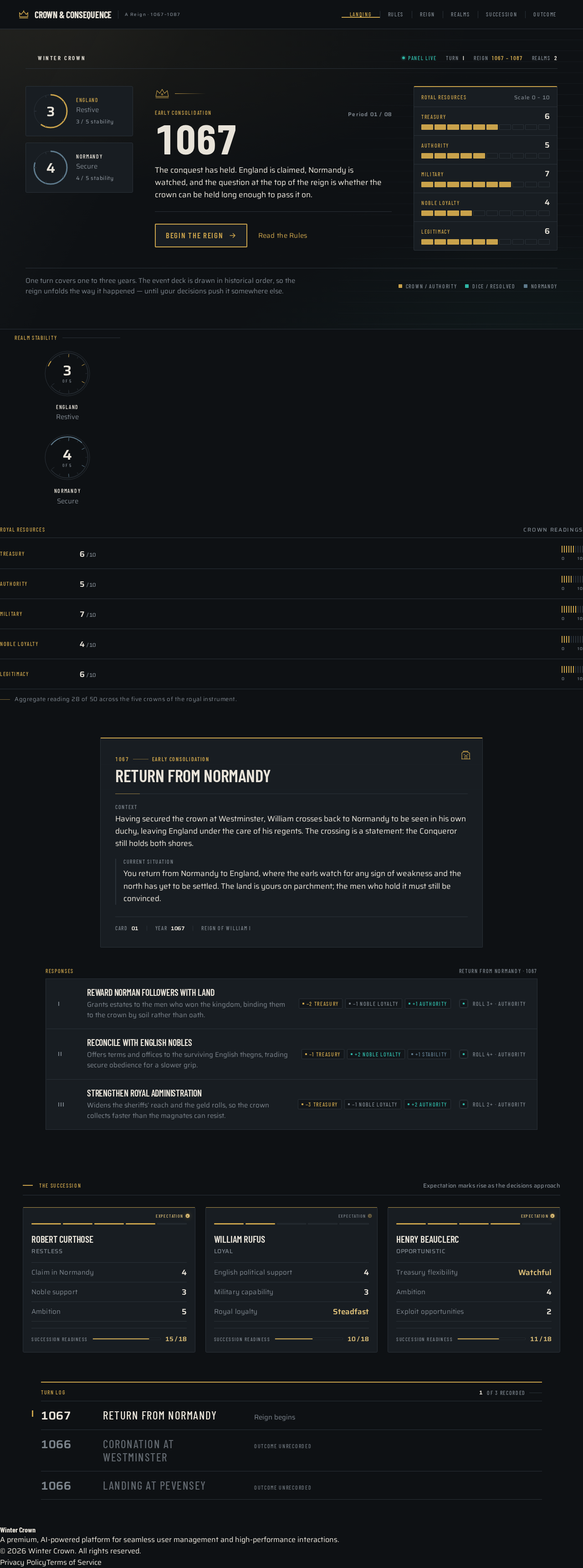
- Center column: the current year/period as the dominant readout, the Event card as a ruled panel with the situation text, then the 2–3 response plates stacked, each with its cost in gold/teal chips and its dice requirement.
- Right rail: the five resource strips on 0–10, each a horizontal ruled bar with a tabular numeral, plus the three son cards as small engraved plates.
- Bottom: a ruled turn log, newest first.
- Responsive: At 768px the rails collapse into a two-column band above and below the event card; at 375px everything becomes one column with the year readout at
clamp(40px, 8vw, 92px) and the dials in a 2-up row.
6.5 Imagery
- No photography of people, no clip art.
- Visual material is: ruled engraving-style line work (crown, sword, castle, ship) drawn as thin 1.5px strokes in champagne gold at 24–32px; a subtle topographic contour texture at 4% opacity on the background; the dice themselves as the only dimensional objects; circular gauges as the dominant motif.
- All iconography is stroke-based, geometric, and could sit on a watch dial.
6.6 Card Treatment
- Event cards presented as large, ruled panels with a 1px
#2A3138 border and a 2px gold top edge, a title band, and a clear choice area.
- Resource display: Top bar with small, consistent iconography for Year, England Stability, Normandy Stability, Treasury, Authority, Military, Noble Loyalty, and Legitimacy.
- Son portraits: Small engraved nameplate cards for Robert, William Rufus, and Henry with simple relationship indicators.
- Map: A small decorative map of England and Normandy is permitted, but the game must work primarily through cards and numbers — no giant map.
- Tone: Historically flavoured, restrained, and neutral — the game does not moralise about choices.
Page 17 of 23
6.7 Hero Direction
The first screen is a dark titanium instrument panel, not a centered SaaS hero. The dominant element is the year readout — '1067' set in Barlow Condensed 700 at clamp(40px, 8vw, 92px) in #E8E3D9, flush left in the center column, with 'EARLY CONSOLIDATION' in 12px gold uppercase tracked micro-label directly above it. To its left, two circular realm gauges (England 0–5, Normandy 0–5) sit as bezelled dials with gold and steel-blue arcs; to its right, five ruled resource strips with tabular numerals. The event card is a #181D22 panel with a 1px #2A3138 border and a 2px gold top edge, and beneath it the response plates are stacked as full-width ruled rows, each with its cost chips and dice requirement on the right. The whole composition reads like the face of a royal instrument, and the only warm light in the frame is the gold of the crown's authority.
6.8 Signature Moves
- Realm dials as bezelled circular gauges: England and Normandy each render as a 96px ring with 0–5 tick marks, the England arc in champagne gold (
#C9A24B) and the Normandy arc in steel blue-grey (#5E7A8C), with the stability numeral set in Saira 600 tabular inside the ring.
- Resource strips as ruled instrument rows: each of Treasury, Authority, Military, Noble Loyalty and Legitimacy is a full-width row with the label in 12px gold uppercase tracked micro-label on the left, a 0–10 segmented bar of 10 hairline cells in the middle, and the value as a tabular numeral in Saira 600 on the right — no rounded progress pills.
- Response plates cut like engraved action plates: each choice is a full-width
#181D22 row with a 2px gold left edge on hover/focus, the response title in Barlow Condensed 600 uppercase, the consequence preview as small ruled chips (e.g. '-2 TREASURY' in gold, '+1 AUTHORITY' in teal), and the dice requirement shown as a 20px rounded die glyph with a teal pip.
- The year readout as the hero: a single oversized condensed numeral that crossfades to the next period on turn resolution, with the period name tracked 0.14em above it in gold — the whole game's clock is the largest thing on screen.
- Son cards as engraved nameplates: Robert Curthose, William Rufus and Henry Beauclerc each render as a small dark plate with a thin gold rule, the name in Barlow Condensed 600 uppercase, and 2–3 attribute readings as ruled label/value pairs in Saira 600 tabular — they accumulate a visible 'expectation' mark as the succession decisions approach.
Page 18 of 23
6.9 Avoid
- Parchment, brown, or faux-medieval textures — this is a titanium instrument, not a scroll.
- Blue-indigo primary buttons or
#2563EB-family accents on white.
- Rounded pill progress bars for the five resources; they must be ruled segmented strips.
- Gradient-blob heroes, glassmorphism panels, and identical hover-lift card grids.
- Inter, Roboto, Arial, Helvetica, Poppins or system-ui as heading or body fonts.
- Centered headline + subtext + single CTA marketing composition.
- Bouncy or springy micro-interactions; motion must settle mechanically.
- Cropping or overlapping readable text, dial numerals, resource values, son-card names or response labels at any viewport.
6.10 Readable Text and Content Integrity
Readable text and needed content stay whole at every viewport: headlines, wordmarks, labels, numbers, item images, cards and controls stay entirely inside the viewport and their container at 375px, 768px and 1280px, wrapping or scaling (for example font-size: clamp(...) with its mobile size) to fit, and no other element covers any part of them. Crops, bleeds and off-edge placement are for decoration only: shapes, textures, rules and background art. The one exception is moving content: moving and scrollable content (marquees, tickers, carousels, horizontally scrollable rows) may cross the viewport or container edge by design — judge it by whether it actually moves or scrolls and whether every item becomes fully readable as it passes, never by the item cut at the edge in a still frame. With prefers-reduced-motion it stops and shows whole items: they wrap into rows, or sit in a horizontally scrollable row (overflow-x: auto) whose further items are reached by scrolling. Where a direction, requirement, brief or finding asks to crop, clip or run readable text or needed content off an edge, keep it whole and carry the gesture with decoration instead; this rule takes precedence.
Page 19 of 23
7. Signature Design Concept
The signature design concept is "the reign as a deck of decisions, read on a royal instrument panel." The entire experience is mediated through a fixed chronological sequence of ruled event cards, each carrying a year, a title, short historical context, the current situation, 2–3 choices, and immediate consequences — with occasional "If X happened earlier..." callbacks. The player's reign is literally the story of the cards they drew and the choices they made, with the five resources and two realm stabilities as the persistent instrument state that carries consequences forward. The three sons' engraved nameplate cards sit alongside as a constant reminder that the succession is the long arc behind every short-term decision.
The visual signature is the instrument panel: the year readout as the largest element on screen, two bezelled realm dials, five ruled resource strips, and response plates cut like engraved action plates — precision metal and cold light rather than parchment pastiche.
7.1 Landing Hero Motion Brief
- Motion tempo: restrained (per the creative direction's
Motion Tempo: line).
- Thesis (input → transformation → outcome): the player's arrival (input) is read as the opening of a reign — the instrument panel powers up and the year readout settles on 1067 (transformation) — leaving the player facing a live royal instrument with the first event card already dealt (outcome).
- Focal subject: the oversized year readout ('1067') in Barlow Condensed 700, with 'EARLY CONSOLIDATION' tracked 0.14em above it in gold.
- Visible layers: (1) background
#0E1114 with a 4%-opacity topographic contour texture; (2) two bezelled realm gauges (England gold arc, Normandy steel-blue arc) drawing their arcs from 0 to their starting values; (3) five ruled resource strips whose segmented cells fill to their starting values with counting tabular numerals; (4) the event card panel (#181D22, 1px #2A3138 border, 2px gold top edge) rising into place; (5) the response plates stacked beneath it.
- Loop: one contained loop at restrained tempo — the dial arcs and resource strips settle once, the year readout crossfades in, and the composition comes to rest; no continuous ambient animation.
- Composed first frame: the fully composed instrument panel at rest — year readout flush left in the center column, realm dials to its left, resource strips to its right, event card and response plates below — so the first frame is already the finished composition.
- Optional interaction: hovering or focusing a response plate lights its 2px gold left edge and reveals its cost chips and dice requirement; this is optional and never required to understand the screen.
- Responsive behavior: at 768px the rails collapse into a two-column band above and below the event card; at 375px everything becomes one column with the year readout at
clamp(40px, 8vw, 92px) and the dials in a 2-up row; all readable text stays whole inside its container at 375px, 768px and 1280px.
- Reduced-motion fallback: with
prefers-reduced-motion the entire sequence becomes an instant state change with the final numbers and the composed first frame shown immediately.
- Implementation: a product-specific 2D DOM/SVG/CSS composition implemented with Motion for React (
motion/react) or GSAP; no Canvas, WebGL, or 3D framework is required.
Page 20 of 23
8. Interaction Model & Motion Direction
- Interaction model: Card-driven and turn-based. The player reads a card, selects one of 2–3 large decision buttons, and the game resolves the outcome. A fallback "do nothing" option is always available if no other way forward exists.
- Motion direction: Restrained instrument motion. Dice tumble with a short mechanical settle (240ms) and land with a hairline flash; resource bars sweep to their new value with a counting numeral over 400ms; the year readout crossfades to the next period; unresolved consequence chips pulse once in teal. No bounce, no particles, no parallax. Card draws and resolutions should feel like dealing and turning over physical cards — a brief, satisfying transition rather than elaborate animation. Resource changes should be legible rather than flashy. The priority is clarity and immediacy over spectacle, consistent with the prototype goal of not spending most effort on art, animations, or complex UI.
- Reduced motion: With
prefers-reduced-motion all motion becomes an instant state change with the final numbers shown.
- Feedback: Immediate consequences are shown clearly after each resolution, and the kingdom state updates visibly in the top bar and side panel.
9. Non-Functional Requirements
- Playability: The game must be playable immediately in a browser with no setup friction.
- Completeness: The complete William I reign must be playable from start to finish.
- Session length: A full game should be playable in roughly 20–30 minutes.
- Learnability: The rules should be understandable in 5–10 minutes, with a clear explanation presented before the first game.
- Determinism: The state must be deterministic enough that bugs are easy to reproduce.
- Extensibility: The game state must be stored cleanly so more monarchs can later be added as separate event decks.
- Separation of concerns: The game engine must be separated from the William I event data.
- Restartability: A restart button must be available.
- Tone: Historically flavoured but explicitly alternate-history; the game must not moralise about choices and must not force the historical result.
- Restraint: The game must not overwhelm the player with dozens of resources or modifiers; numbers must be kept small.
- Fallback: The player must never be left with no possible choice — a fallback "do nothing" option must exist if there are no other possible ways forward.
Page 21 of 23
10. Tech Stack
The source material specifies a self-contained browser game and does not name specific technologies. The following layers are the minimum required by the accepted delivery shape (a self-contained, immediately playable browser game with a separated engine and event data):
- Runtime: A modern web browser (the game runs entirely client-side).
- Language: JavaScript (or TypeScript) for the game engine and event data.
- Rendering: HTML and CSS for the UI (top bar, event card, decision buttons, side panel), with a small amount of DOM-based rendering. No heavy game engine or 3D framework is required.
- Styling: CSS with the dark instrument-panel design tokens from Section 6 (background
#0E1114, surface #181D22, text #E8E3D9, primary #C9A24B, accent #2FB6A6, muted #7C848C, hairline #2A3138, Normandy steel-blue #5E7A8C); Barlow Condensed for headings and micro-labels, Saira for body and tabular numerals.
- Motion: Motion for React (
motion/react) or GSAP for the restrained instrument motion described in Section 8, with a prefers-reduced-motion fallback.
- State: In-memory game state, structured so that the engine is separated from the William I event data and so that additional monarch event decks can be registered without engine changes.
- Data: Event decks authored as structured data (e.g. JSON or JS modules) containing year, title, historical context, situation, choices, immediate consequences, and optional "If X happened earlier..." conditions.
- Randomness: A d6 roll (1d6 + relevant bonus) with deterministic seeding sufficient to make bugs reproducible.
- Persistence: Not required by the source material beyond the ability to restart; no server, database, or account system is specified.
No backend, database, authentication, admin panel, or integration layer is required by the source material.
11. Assumptions and Constraints
Assumptions
- The player has access to a modern web browser.
- The prototype focuses on William I; other monarchs are a framework goal, not a prototype deliverable.
- Attribute values for the three sons are tunable during playtesting.
- Historical dates are approximate; the sequence broadly follows William's reign.
Page 22 of 23
Constraints
- The game must NOT attempt to be Crusader Kings, Europa Universalis, or a detailed historical simulation.
- The economy must stay deliberately small — five principal values on 0–10 scales.
- The two realms must be represented simply, not as dozens of provinces.
- The game must not use a giant map.
- The game must not force the historical result.
- The game must not moralise about choices.
- The game must not invent detailed historical facts simply to create mechanics; uncertain details should be simplified rather than fabricated.
- Most development effort must not go into art, animations, or complex UI in the first version.
- The player must never be left with no possible choice.
Page 23 of 23
12. Glossary
- Crown & Consequence: The browser game prototype specified by this document.
- William I / William the Conqueror: The initial playable monarch, ruling from approximately 1067 to 1087.
- Reign: A single playthrough covering one monarch's rule from start to finish.
- Turn: A single cycle of the game loop, representing approximately 1–3 years.
- Event Card: A card containing a Year, Event title, Short historical context, Current situation, 2–3 choices, and Immediate consequences, and possibly an "If X happened earlier..." condition.
- Event Deck: A fixed chronological set of event cards for a monarch, drawn in historical order rather than shuffled.
- Treasury: Resource representing available royal money and extractive capacity (0–10).
- Authority: Resource representing the Crown's ability to impose decisions (0–10).
- Military: Resource representing the effective military force immediately available to William (0–10).
- Noble Loyalty: Resource representing the willingness of England's powerful nobles to support William (0–10).
- Legitimacy: Resource representing the perceived right and stability of William's rule (0–10).
- England Stability: A 0–5 value representing the stability of England.
- Normandy Stability: A 0–5 value representing the stability of Normandy.
- Robert Curthose: William's eldest surviving son, with a natural claim to Normandy.
- William Rufus: William's son, with English political support and military capability.
- Henry Beauclerc: William's son, with treasury/political flexibility and ambition.
- Succession Outcome: The calculated ending based on the state of England, Normandy, the three sons, and William's final decisions.
- d6: A six-sided die used for resolving uncertain actions (1d6 + relevant bonus).
- Game Engine: The reusable component that resolves turns, applies consequences, tracks state, and evaluates the Succession Outcome, separated from event data.
- Monarch Event Deck: A structured data set of event cards for a specific monarch, registerable with the engine without rewriting it.
- "If X happened earlier..." Mechanic: A card condition that modifies outcomes based on previous player decisions, making the game feel like a story rather than a random card generator.



No comments yet. Be the first!