



The rise of AI-powered content generation marks a turning point for the Indian digital media landscape. indigo-blog is at the forefront of this shift—automating the entire pipeline from topic discovery to publication, while ensuring every article is original, high-quality, and contextually relevant to readers across India and beyond.
🔗How AI-Powered Generation Works
At its core, indigo-blog leverages a multi-stage AI pipeline that begins with user-defined topics and trusted sources. The system searches each source for the latest content, synthesises the results using advanced language models, and generates a coherent, well-structured article story—tailored to the specified topic and tone.
What distinguishes indigo-blog from simple content scrapers is its commitment to originality. Before a full article is written, the system produces a concise summary and submits it to WeaviateDB—a vector database—for semantic deduplication. Only articles that pass this uniqueness check proceed to the full generation stage.
Key Insight
WeaviateDB’s vector search compares semantic meaning—not just keywords—ensuring that even paraphrased duplicates are caught before publication. This guarantees a consistently fresh content feed for readers.
Topic and Source Management
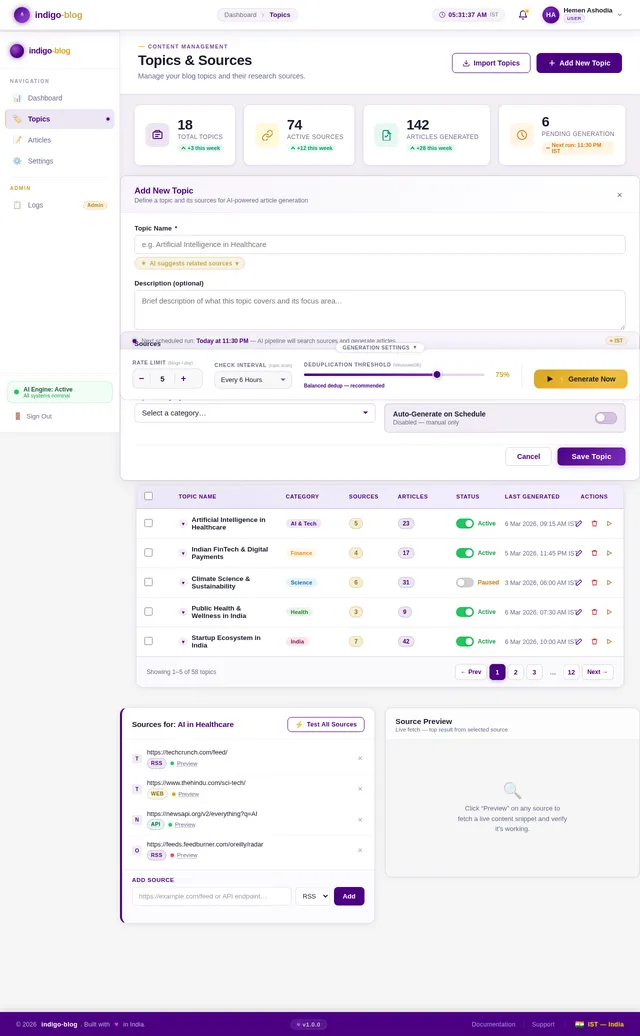
Users begin by curating a list of topics they want to write about—ranging from Technology and Finance to Health and Science. For each topic, one or more trusted sources are assigned. The system periodically crawls these sources based on the user-configured interval, ensuring articles reflect the most current developments.
🔗Deduplication with WeaviateDB
Content deduplication is one of the most critical challenges in automated publishing. indigo-blog solves this elegantly using WeaviateDB’s vector search capabilities. When a new article summary is generated, it is embedded into a high-dimensional vector and compared against the entire corpus of previously published articles.
“Semantic deduplication using vector embeddings is not just a feature—it is the foundation of content integrity in AI-driven publishing. Without it, automated systems risk flooding readers with redundant, low-value articles.
Hemen Ashodia, Vision of indigo-blog
If the cosine similarity between the new summary and any existing article exceeds a configurable threshold, the article is flagged as a duplicate and discarded. This process ensures that the indigo-blog content feed remains fresh, diverse, and valuable—day after day.
Vector Search Under the Hood
WeaviateDB stores each article’s embedding alongside its metadata—topic, source, publication date (IST), and author. When a query vector is submitted, WeaviateDB performs an approximate nearest-neighbour (ANN) search using HNSW indexing, returning the top-K most semantically similar articles in milliseconds. This performance is critical for maintaining low-latency generation intervals even at scale.
🔗Rate Limits and Generation Intervals
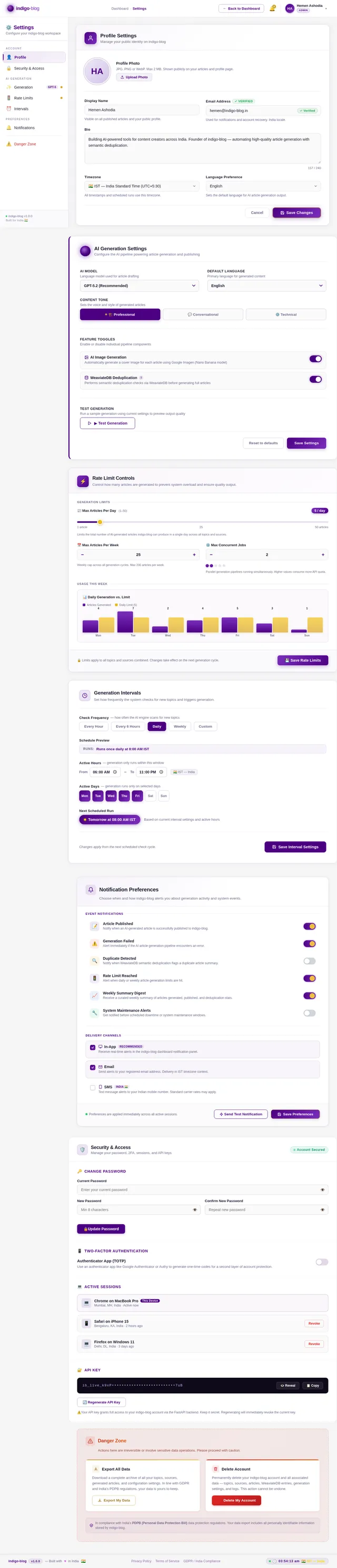
One of indigo-blog’s distinguishing features is user-level control over the generation cadence. Rather than running continuously, the system allows users to set precise rate limits—for example, no more than 5 articles per day—and intervals, such as checking for new topics every 6 hours. This prevents content flooding and keeps the publishing schedule aligned with audience expectations.
Pro Tip
Set your generation interval to align with peak reader traffic in IST—typically 7–9 AM and 8–10 PM. Articles published during these windows consistently see higher engagement across Indian audiences.
Admins have an additional layer of control: system-wide rate caps that override individual user settings when resource constraints require it. All rate limit events are logged and surfaced in the admin dashboard, providing full auditability of the generation pipeline.
🔗AI Image Generation for Every Article
Every article published by indigo-blog is paired with an AI-generated featured image, produced using state-of-the-art image synthesis models. The image prompt is derived from the article’s title and topic, ensuring visual relevance and aesthetic consistency across the platform.
Images are generated at high resolution, automatically cropped and optimised for web delivery, and stored alongside the article in the content database. The result is a visually rich reading experience that rivals human-curated publications—at a fraction of the cost and time.
The End-to-End Publishing Pipeline
Once an article clears the deduplication check and its image is generated, the system publishes it automatically to the indigo-blog platform. The article’s vector embedding is saved to WeaviateDB for future deduplication, and metadata—including topic, source, IST publication timestamp, and estimated read time—is indexed for search and filtering.
“The indigo-blog pipeline transforms a user-defined topic into a fully illustrated, deduplicated, and published article—end to end—without a single manual intervention. That is the power of intelligent automation for Indian content creators.
indigo-blog System Requirements Document
This closed-loop architecture means that indigo-blog continuously improves its content diversity over time: the more articles are published and indexed, the more effective the semantic deduplication becomes, and the higher the overall quality bar for new content entering the pipeline.
No comments yet. Be the first!