deep-tutor
create a fully function AI dsa tutor with the following functionalities Your project **“AI-Powered DSA Learning & Document Analysis Platform”** combines two major systems: * **DSA Tutor (Intelligent Learning Assistant)** * **Project SISO (RAG-based Document Intelligence System)** Together they form a **multi-capability AI platform** for learning, coding practice, and document analysis. Below is a **clear, structured list of the combined functionalities**. --- # Combined Functionalities of AI Tutor + Project SiSo ## 1. Intelligent DSA Learning System Provides **concept explanations for Data Structures and Algorithms**. **Capabilities** * Step-by-step explanations * Text-based diagrams * Concept breakdown from basic → advanced * Context-aware follow-up questions **Example** User asks: *“Explain Dynamic Programming”* System provides: * Definition * Intuition * Example problems * Diagram explanation * Complexity discussion --- # 2. Coding Practice & Evaluation Engine Users can **solve coding problems and receive automated evaluation**. ### Features * Multi-language coding support * Python * Java * C++ * JavaScript * Code analysis includes: * Correctness validation * Time complexity analysis * Space complexity analysis * Optimal vs brute-force detection * Improvement suggestions **Example** User submits solution for **Two Sum** System evaluates: ``` Correctness: Passed Time Complexity: O(n²) Optimal Solution: O(n) using HashMap ``` --- # 3. MCQ Test Generation & Knowledge Assessment System can generate **adaptive quizzes for concept reinforcement.** ### Capabilities * Dynamic MCQ generation * Difficulty levels (Easy / Medium / Hard) * Instant evaluation * Explanation for correct answer * Performance feedback --- # 4. Conversational AI Tutor Acts as a **general AI assistant for learning discussions.** ### Capabilities * Free chat mode * Doubt solving * Interview preparation * Concept comparisons Example queries: * “Difference between BFS and DFS” * “Explain heap vs priority queue” --- # 5. Intelligent Intent Detection The system automatically **detects what the user wants**. ### Possible intents | User Input | System Mode | | ---------------------- | ------------- | | Explain Graphs | Learning Mode | | Solve LeetCode problem | Coding Mode | | Give MCQs on Trees | Test Mode | | General question | Chat Mode | This routing ensures **correct handler execution**. --- # 6. Multi-Document Question Answering (RAG) Project SiSo allows users to **ask questions across multiple documents.** ### Supported documents * DOCX * Study material * Notes * Resume * Job descriptions ### Process ``` Document Upload → Parsing + OCR → Chunking → Embedding generation → Weaviate indexing → Retrieval → LLM answer generation ``` --- # 7. Citation-Based Answer Generation All answers from documents include **precise citations.** Format: ``` [doc_id:page_number:chunk_index] ``` Example: ``` The transformer architecture relies on self-attention [doc1:3:2] ``` This ensures **traceability and reliability of information**. --- # 8. Resume vs Job Description Analysis The system performs **career gap analysis**. ### Features * Resume parsing * JD parsing * Skill gap identification * Improvement suggestions Example output: ``` Missing Skills: - Kubernetes - Docker - GraphQL Recommendation: Learn container orchestration and API frameworks. ``` --- # 9. Study Material Question Answering Students can upload **lecture notes or textbooks**. Capabilities: * Ask conceptual questions * Extract summaries * Generate explanations * Retrieve exact references Example: ``` Q: Explain Gradient Descent ``` Answer retrieved from uploaded lecture notes. --- # 10. High-Availability AI Architecture System ensures **reliable LLM responses**. ### Model pipeline Primary model ``` Google Gemini ``` Fallback model ``` Ollama (Local Llama 3) ``` Mechanism: ``` Gemini request → if failure → automatic fallback to Ollama ``` --- # 11. Asynchronous Processing Pipeline Heavy tasks run **as background jobs**. Architecture: ``` User Request ↓ FastAPI API ↓ Redis Queue ↓ Worker ↓ Processing ↓ Result Retrieval ``` Benefits: * Scalable * Non-blocking API * Handles large documents --- # 12. Hybrid Search Retrieval System Uses **two retrieval methods together**. | Method | Purpose | | ------------- | ---------------- | | Vector Search | semantic meaning | | BM25 | keyword matching | This hybrid search improves **retrieval accuracy**. --- # 13. Multi-Document Knowledge Indexing The system supports **grouped document search**. Metadata stored in vector database: ``` doc_id doc_group_id source_file page_number chunk_index ``` This allows: * Cross-document answers * grouped search results --- # 14. Job Status Tracking System Users can track processing progress. Endpoints: ``` POST /submit_job GET /job_status/{job_id} GET /get_result/{doc_id} ``` Example status: ``` Processing: Chunking documents Processing: Generating embeddings Completed ``` --- # 15. Interactive Frontend Workflow The UI supports **three stages**: ### 1️⃣ Input Stage * Upload documents * Enter questions ### 2️⃣ Processing Stage * Progress polling * Loading indicators ### 3️⃣ Result Stage * AI generated answers * Citation references * Analysis reports --- # Final Combined Platform Vision The system ultimately acts as a **unified AI knowledge platform** capable of: | Domain | Capability | | ------------ | --------------------- | | Learning | DSA tutor | | Coding | Practice + evaluation | | Testing | MCQ quizzes | | Conversation | AI discussion | | Documents | RAG Q&A | | Career | Resume analysis | --- ✅ **In one sentence (interview ready):** > The platform integrates an AI-driven DSA tutoring system with a Retrieval-Augmented Generation (RAG) document intelligence engine, enabling interactive algorithm learning, automated code evaluation, adaptive testing, multi-document question answering with citations, and AI-based resume-job description gap analysis within a unified scalable architecture.
Comments (0)
Sign in to leave a comment
Project Tasks37
Implement LiteLLM Model Router
As an AI Engineer, I want to configure the LiteLLM routing layer with fallback priorities (GPT-5 → Claude 4.5 Opus → Gemini 3 Pro), per-feature model assignments, retry logic, and token cost-tracking hooks so that all Langchain chains use a single resilient model gateway with observable usage metrics.
Implement Design Theme Structure
As a Frontend Developer, I want to implement the theme and structural layout from all 15 mock-design pages (Home, Login, Dashboard, DSA Tutor, Coding Practice, MCQ Test, Chat Tutor, Document QA, Upload, Processing, Results, Job Tracker, Users, Settings, Admin Dashboard) into the scaffold project so that all pages match designs exactly, shared layout components (navbar, sidebar, footer) are in place, and any unneeded scaffold pages not present in the design specs are removed.
Align Color Theme Globally
As a Frontend Developer, I want to define and apply a unified color palette (#003366 primary, #FF6600 secondary, #66CC66 accent, #F5F5F5 background, #333333 text), typography scale, spacing tokens, and component variants (buttons, cards, inputs) across all 15 pages so that every screen has consistent visual alignment with the approved design system.
Implement DSA Explanation AI Chain
As an AI Engineer, I want to implement a Langchain DSA explanation chain that constructs structured prompts to produce step-by-step concept breakdowns with ASCII/text diagrams, maintains multi-turn follow-up context, and routes through LiteLLM model selection so that DSA Tutor responses are pedagogically sound and contextually aware.
Implement Adaptive MCQ AI Chain
As an AI Engineer, I want to implement a Langchain MCQ generation chain that accepts topic, difficulty level, and question count, constructs structured prompts for LiteLLM (GPT-5/Claude 4.5/Gemini 3 Pro), parses responses into validated question objects, and adapts difficulty based on prior answer history so that MCQ quality and difficulty adaptation are consistent.
Implement Code Evaluation AI Chain
As an AI Engineer, I want to implement a Langchain code evaluation chain that receives submitted code and language, prompts LiteLLM to assess correctness, identify edge-case failures, and estimate time/space complexity, then returns structured evaluation JSON so that Coding Practice auto-evaluation is accurate across Python, Java, C++, and JavaScript.
Implement Intent Detection Router
As an AI Engineer, I want to implement a Langchain intent-classification chain that analyses each incoming user message and routes it to the correct mode handler (DSA learning, coding practice, MCQ test, free chat) using LiteLLM so that users are seamlessly directed to the right AI feature without manual mode selection.
Build Dashboard Page UI
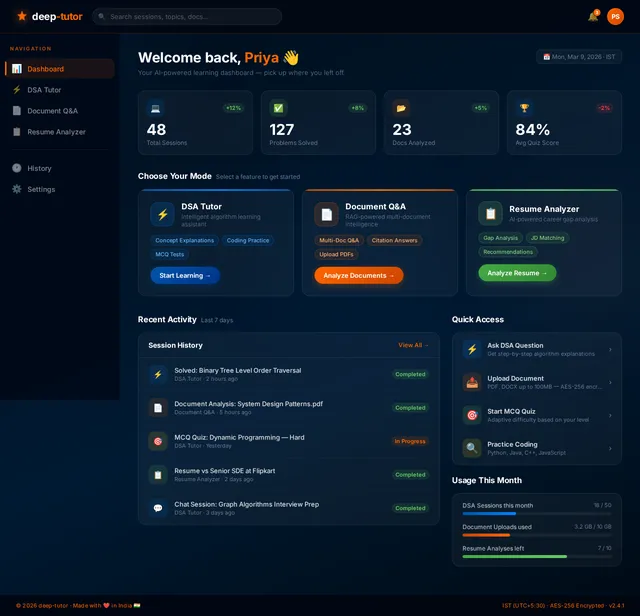
As a Frontend Developer, I want to implement the Dashboard v3 page so that it renders persona-aware widgets (recent activity, quick-launch cards for DSA Tutor, Upload, MCQ, Chat Tutor), progress summaries, and navigation tiles exactly as in the mock design. Users arrive here after Login and can navigate to DSA Tutor, Coding Practice, MCQ Test, Upload, Chat Tutor, and Document QA.
Build Home Page UI
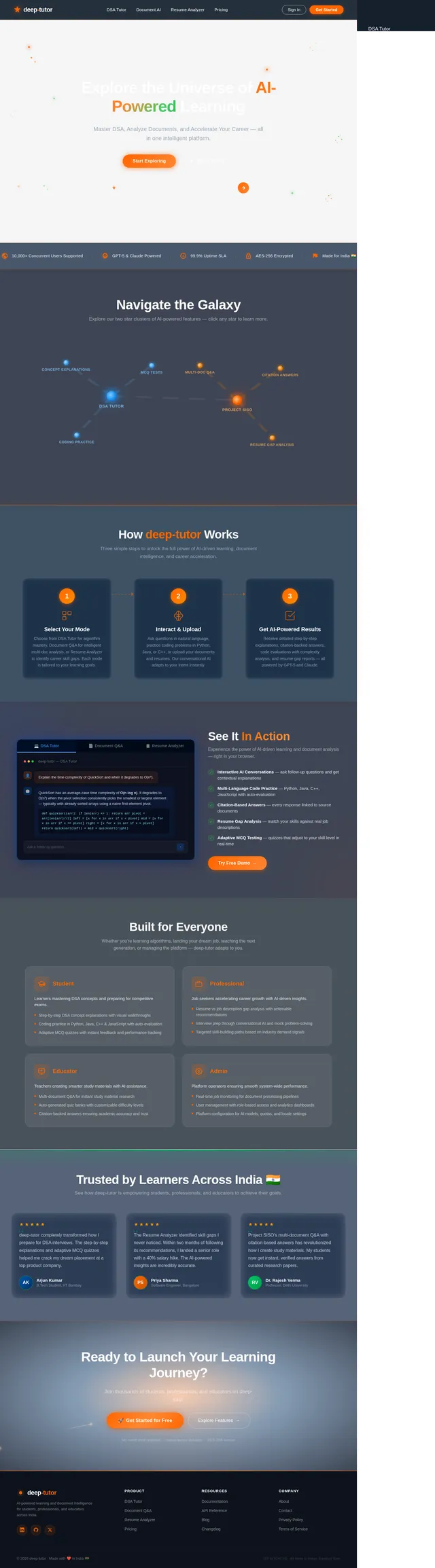
As a Frontend Developer, I want to implement the Home v3 page so that it renders the interactive galaxy map hero section, feature constellation highlights, trust badges, how-it-works steps, demo showcase, user persona cards, testimonials, call-to-action section, and footer exactly as specified in the mock design, enabling all personas (Student, Professional, Educator) to navigate to Login.
Build Settings Page UI
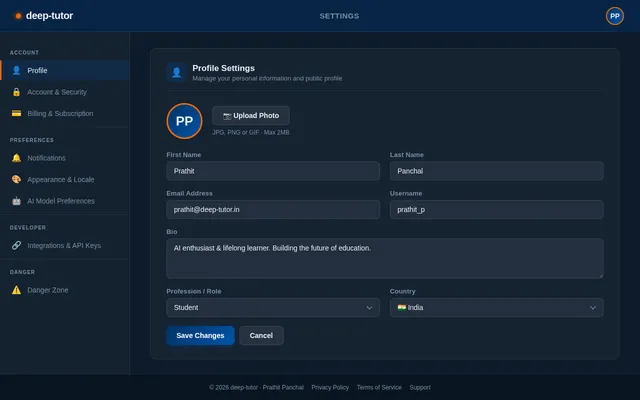
As a Frontend Developer, I want to implement the Settings v3 page so that it renders user profile fields, notification preferences, language/theme toggles (IST timezone, INR currency defaults), and save controls exactly as in the mock design. Accessible from Admin Dashboard and user navigation.
Build Login Page UI
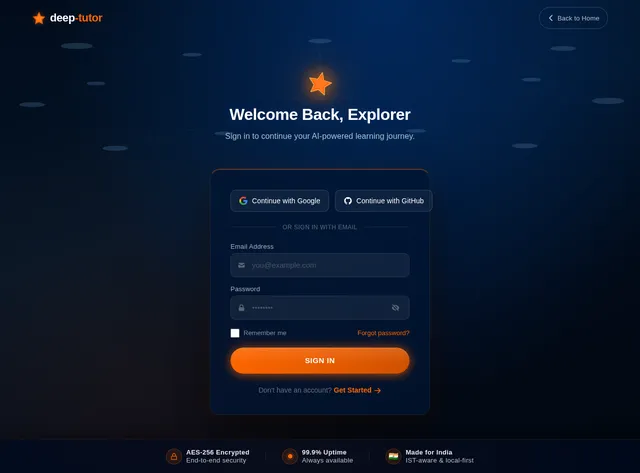
As a Frontend Developer, I want to implement the Login v3 page so that it renders the branded sign-in form, error states, and social login options exactly as in the mock design, wires up to the existing auth service, and redirects each persona (Student → Dashboard, Professional → Dashboard, Educator → Dashboard, Admin → Admin Dashboard) to the correct post-login destination.
Build Admin Dashboard Page UI
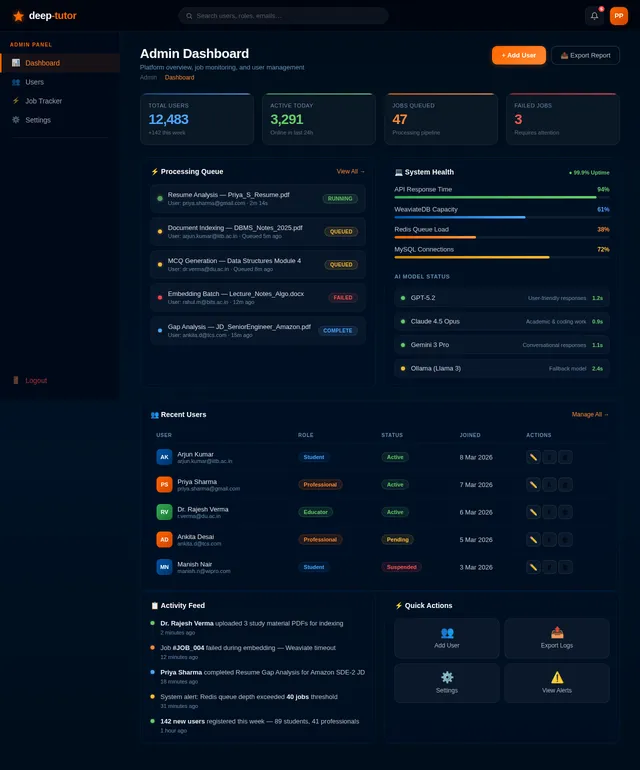
As a Frontend Developer, I want to implement the Admin Dashboard v4 page so that it renders platform KPI widgets, job queue summary, user activity charts, and quick-links to Job Tracker, Users, and Settings exactly as in the mock design. Admin users land here after Login and can navigate to Job Tracker, Users, and Settings.
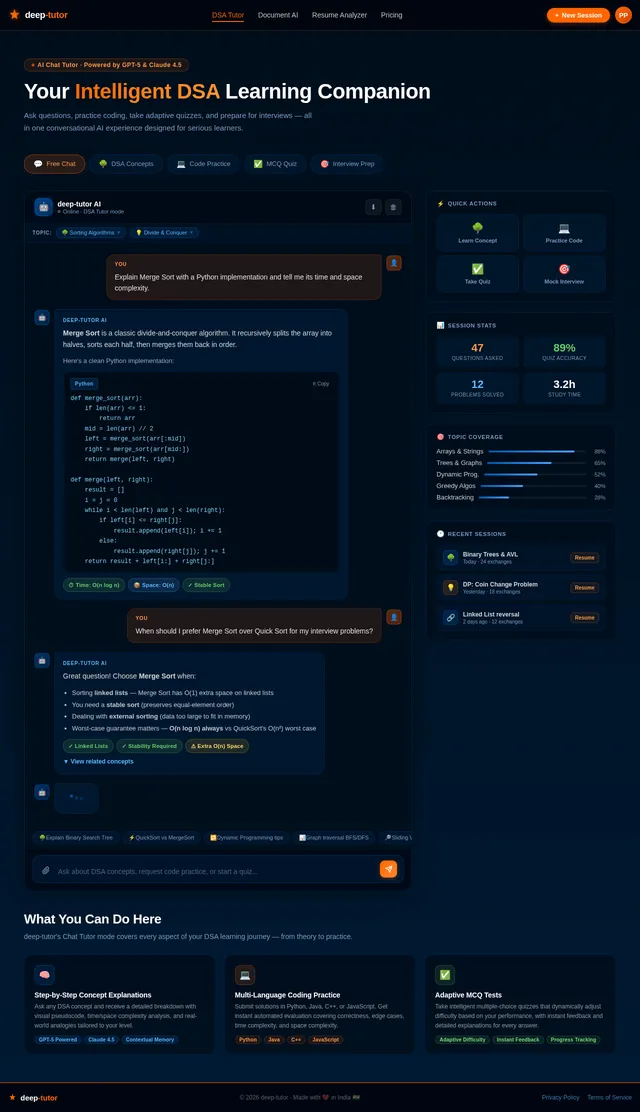
Build Chat Tutor Page UI
As a Frontend Developer, I want to implement the Chat Tutor v3 page so that it renders the conversational chat interface with message bubbles, mode indicators (doubt/interview/free-chat), intent-detection status, input bar, and session history exactly as in the mock design. Users navigate here from Dashboard for interview prep and doubt solving.
Build Platform Settings API
As a Backend Developer, I want to implement GET /api/settings and PATCH /api/settings endpoints that read and persist per-user and global platform settings (theme, language, notifications, IST timezone, INR currency) in MySQL so that the Settings page can load and save preferences.
Build Users Page UI
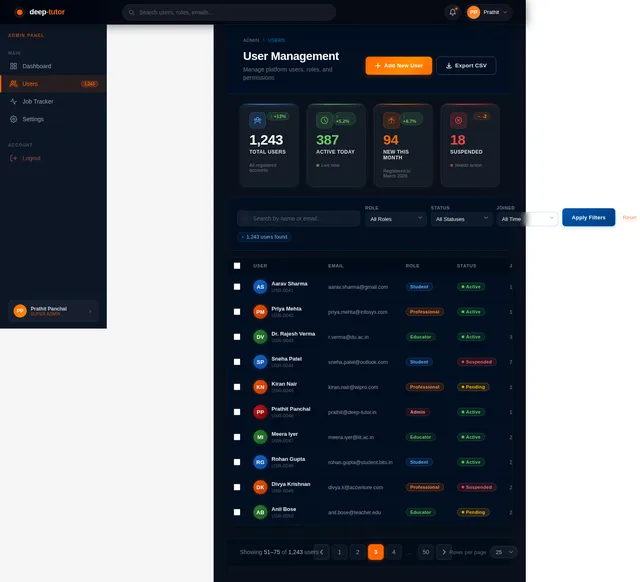
As a Frontend Developer, I want to implement the Users v3 page so that it renders the user management table with search, role filter (Student/Professional/Educator/Admin), permission toggles, and action menus (edit, delete) exactly as in the mock design. Accessible from Admin Dashboard via Manage Users flow.
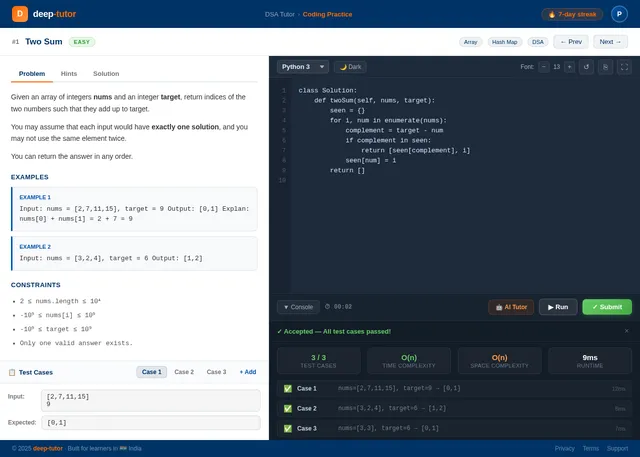
Build Coding Practice Page UI
As a Frontend Developer, I want to implement the Coding Practice v3 page so that it renders the multi-language code editor (Python, Java, C++, JavaScript selector), problem statement panel, run/submit controls, and evaluation output panel exactly as in the mock design. Users navigate here from Dashboard and proceed to Results after submission.
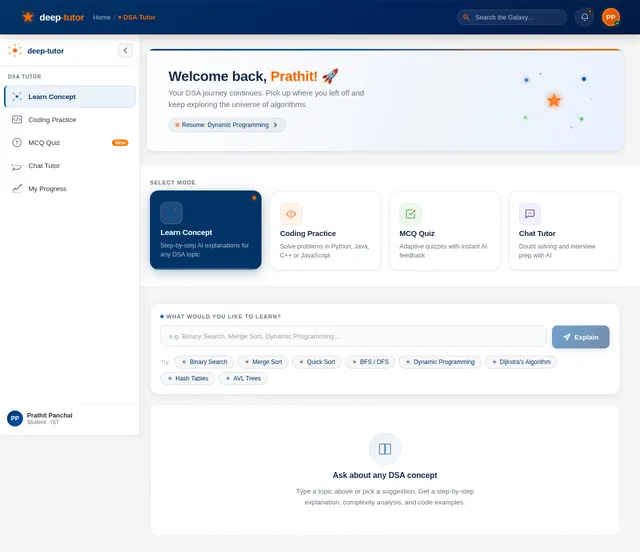
Build DSA Tutor Page UI
As a Frontend Developer, I want to implement the DSA Tutor v3 page so that it renders the concept selection panel, step-by-step explanation area with text-based diagram display, follow-up question input, and session context exactly as in the mock design. Users navigate here from Dashboard and can ask follow-up questions in a multi-turn flow.
Build Job Tracker Page UI
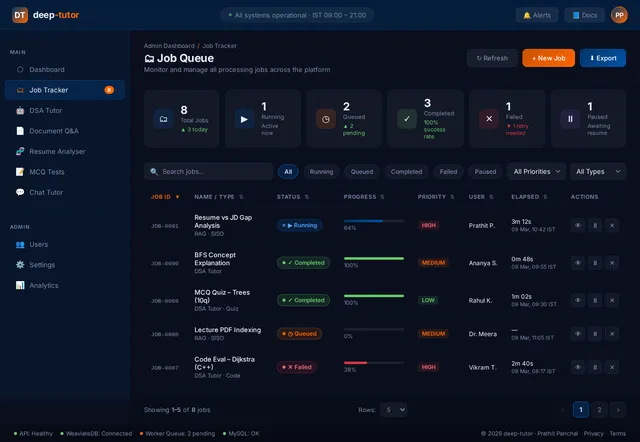
As a Frontend Developer, I want to implement the Job Tracker v3 page so that it renders the job queue table (job_id, status, type, timestamps, actions), status badges (pending/running/complete/failed), cancel/retry controls, and result-link drill-down exactly as in the mock design. Accessible from Admin Dashboard.
Build MCQ Test Page UI
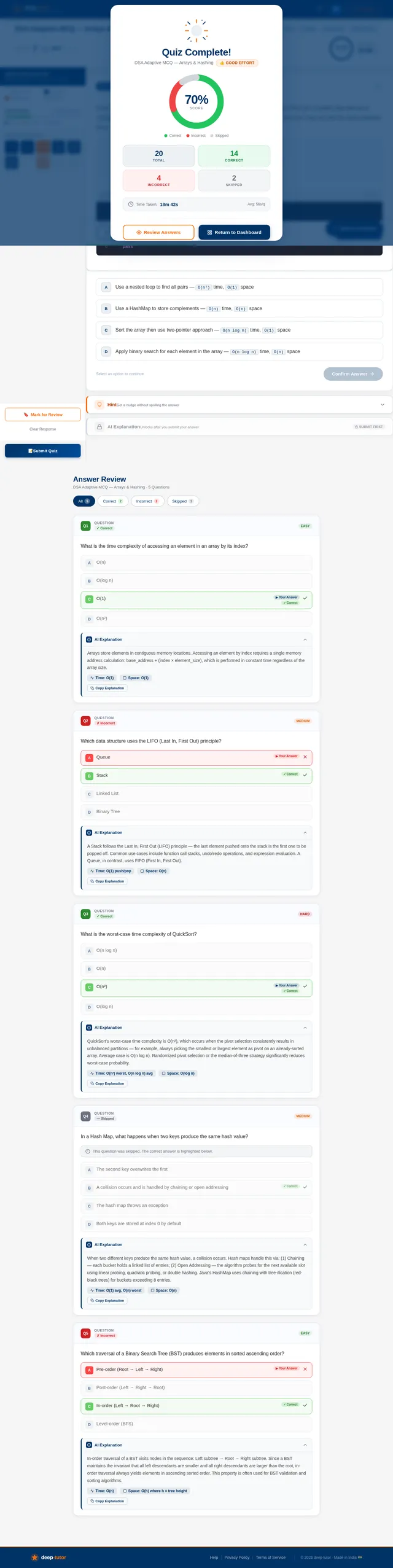
As a Frontend Developer, I want to implement the MCQ Test v3 page so that it renders the question display, difficulty badge (Easy/Medium/Hard), answer option cards, countdown timer, progress indicator, and instant-feedback overlay exactly as in the mock design. Users navigate here from Dashboard and proceed to Results after completion.
Build Upload Page UI
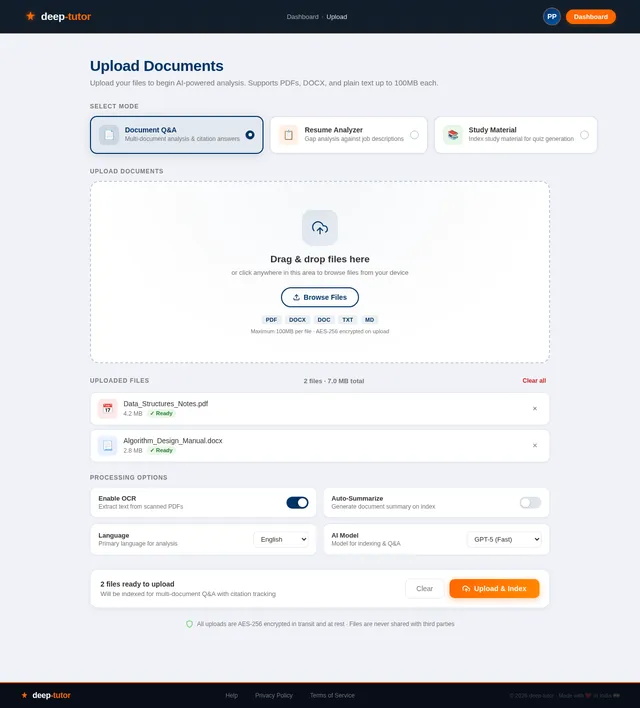
As a Frontend Developer, I want to implement the Upload v3 page so that it renders drag-and-drop file upload zones for PDF/DOCX (resume, job description, study material), file-type labels, upload progress indicators, 100MB limit validation, and submission controls exactly as in the mock design. Users navigate here from Dashboard and proceed to Processing after upload.
Build Dashboard Data API
As a Backend Developer, I want to implement GET /api/dashboard/summary endpoint that aggregates per-user recent activity, session counts, MCQ scores, job statuses, and quick-launch state from MySQL and returns structured JSON so that the Dashboard page widgets are data-driven.
Build Results Page UI
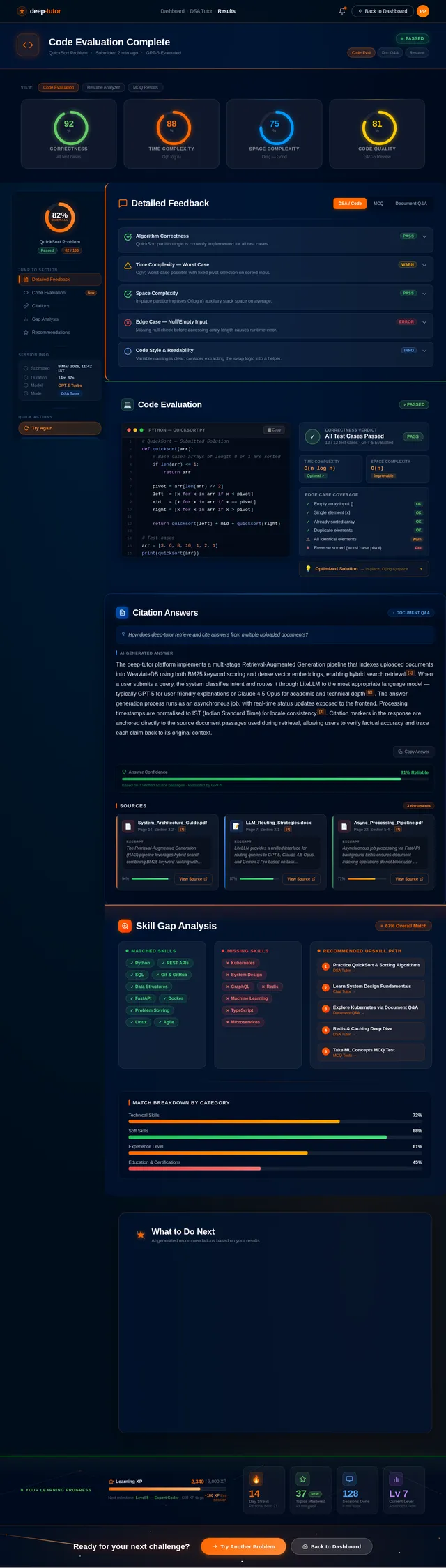
As a Frontend Developer, I want to implement the Results v3 page so that it renders multi-mode result views (MCQ score + answer feedback, code evaluation with complexity analysis, gap analysis with skill recommendations and improvement roadmap, document QA citation summary) with tabs or conditional sections exactly as in the mock design. Users arrive here from MCQ Test, Coding Practice, or Processing.
Build Chat Tutor API
As a Backend Developer, I want to implement POST /api/chat/message and GET /api/chat/history/{session_id} endpoints that maintain conversation context in MySQL, route to the AI layer via intent detection, and stream responses so that the Chat Tutor page delivers real-time conversational replies.
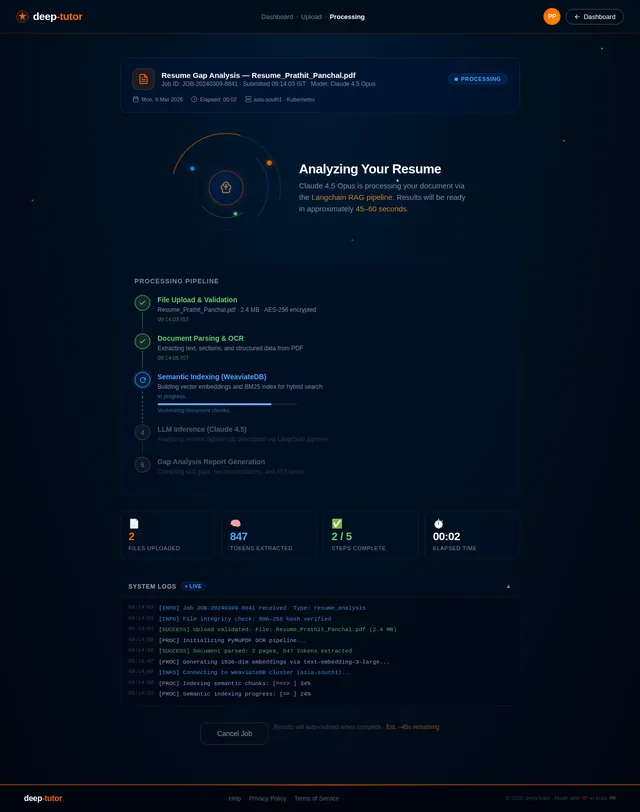
Build Processing Page UI
As a Frontend Developer, I want to implement the Processing v3 page so that it renders the async job status tracker (pending, running, complete, failed states), multi-stage pipeline progress bar (Upload → Parse → Index), ETA display, and job metadata exactly as in the mock design, polling the job-status API. Users arrive here from Upload and proceed to Document QA or Results on completion.
Build Document Upload API
As a Backend Developer, I want to implement POST /api/upload endpoints that accept PDF and DOCX files (resume, JD, study material), validate file type and size (max 100MB), store files to object storage, persist metadata to MySQL, and return a document_id so that the Upload page can trigger downstream processing jobs.
Build Admin User Management API
As a Backend Developer, I want to implement GET /api/admin/users, PATCH /api/admin/users/{user_id}/permissions, and DELETE /api/admin/users/{user_id} endpoints that read and mutate user records and roles in MySQL so that the Users page admin workflows are fully functional.
Build MCQ Generation API
As a Backend Developer, I want to implement POST /api/mcq/generate and POST /api/mcq/submit endpoints that accept topic, difficulty level, and question count, invoke the AI layer, persist questions and user answers to MySQL, and return scored results so that the MCQ Test and Results pages are fully functional.
Build DSA Tutor API
As a Backend Developer, I want to implement POST /api/dsa/explain and POST /api/dsa/followup endpoints that accept a concept name and optional follow-up question, persist session state to MySQL, and return step-by-step explanations with text diagrams so that the DSA Tutor page is fully functional.
Build Coding Evaluation API
As a Backend Developer, I want to implement POST /api/code/submit endpoint that accepts source code and language, executes it in a sandboxed environment, evaluates correctness against test cases, and returns time/space complexity analysis so that the Coding Practice page can display evaluation results.
Build Document QA Page UI
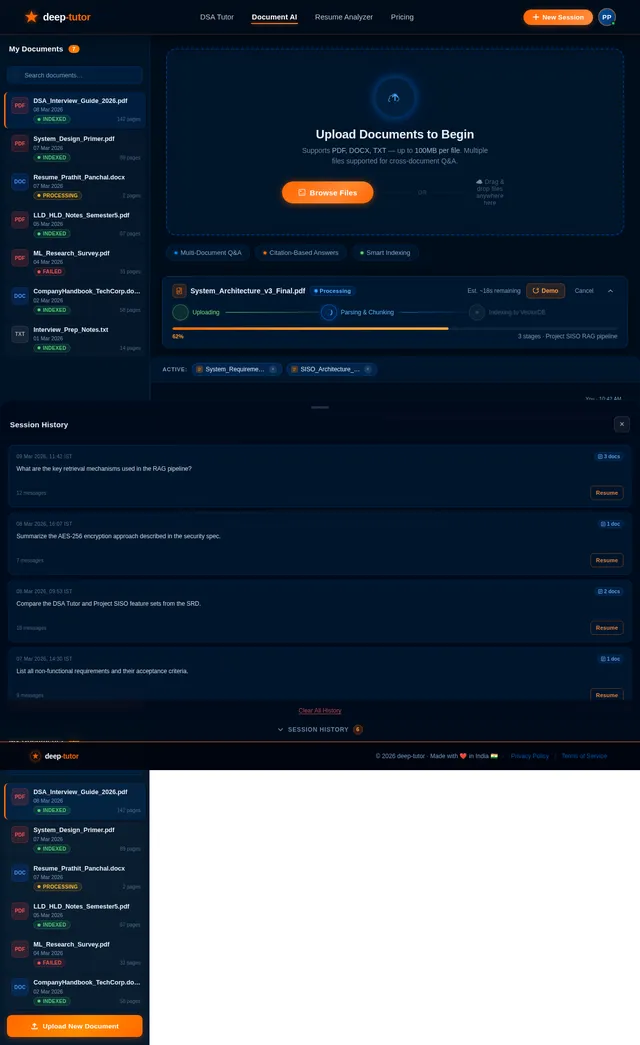
As a Frontend Developer, I want to implement the Document QA v3 page so that it renders the document sidebar (indexed documents list with status chips), upload zone, processing status bar, chat Q&A workspace with citation cards, citation detail panel (desktop side panel / mobile bottom sheet), and session history drawer exactly as in the mock design. Users navigate here from Dashboard or after Processing completes.
Build Async Job Pipeline API
As a Backend Developer, I want to implement POST /api/submit_job, GET /api/job_status/{job_id}, and GET /api/get_result/{doc_id} endpoints backed by Redis Queue and FastAPI background workers so that the Processing page can poll job state and the Results page can retrieve completed outputs.
Implement Document Chunking Pipeline
As an AI Engineer, I want to implement a document ingestion worker that parses uploaded PDF and DOCX files, splits content into semantic 512-token chunks with 64-token overlap, generates embeddings via LiteLLM, and indexes them into Weaviate with BM25 metadata so that hybrid search retrieval is accurate for Document QA and Gap Analysis.
Build Admin Job Queue API
As a Backend Developer, I want to implement GET /api/admin/jobs, POST /api/admin/jobs/{job_id}/cancel, and GET /api/admin/jobs/{job_id} endpoints that expose the Redis Queue state and job history from MySQL so that the Job Tracker and Admin Dashboard pages show live queue data.
Implement Hybrid Search Retrieval
As an AI Engineer, I want to implement a retrieval module using Langchain that performs hybrid search (Weaviate vector similarity + BM25 keyword) over indexed document chunks, applies a cross-encoder re-ranking step, and returns the top-k chunks with doc_id, page, and chunk position so that Document QA citations are accurate and traceable.
Build Document QA API
As a Backend Developer, I want to implement POST /api/docqa/query endpoint that accepts a question and list of doc_ids, retrieves relevant chunks from Weaviate using hybrid search, compiles context, invokes the AI layer, and returns an answer with citation tags ([doc_id:page:chunk]) so that the Document QA page is fully functional.
Implement Resume Gap Analysis Chain
As an AI Engineer, I want to implement a Langchain gap analysis chain that takes parsed resume text and job description text, prompts LiteLLM to identify missing skills, experience gaps, and improvement recommendations mapped to deep-tutor features, and returns a structured JSON report so that the Results page renders actionable gap analysis for Professional users.
Build Gap Analysis API
As a Backend Developer, I want to implement GET /api/results/gap_analysis/{job_id} endpoint that retrieves the AI-generated skill gap analysis and recommendations from MySQL and returns structured JSON so that the Results page can render gap analysis and recommendation sections for Professional users.
No comments yet. Be the first!