deep-tutor
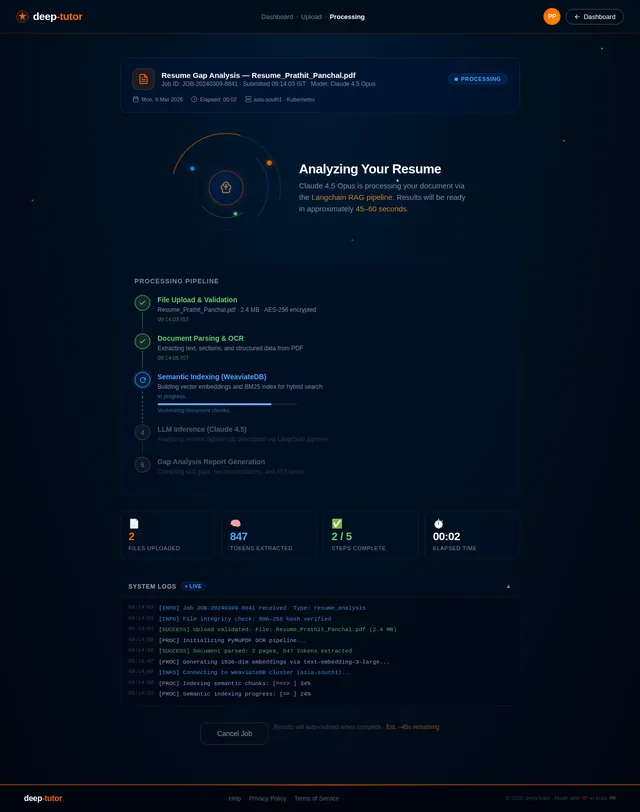
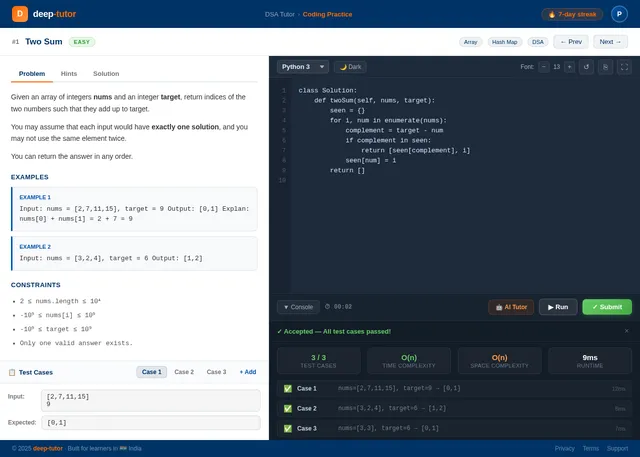
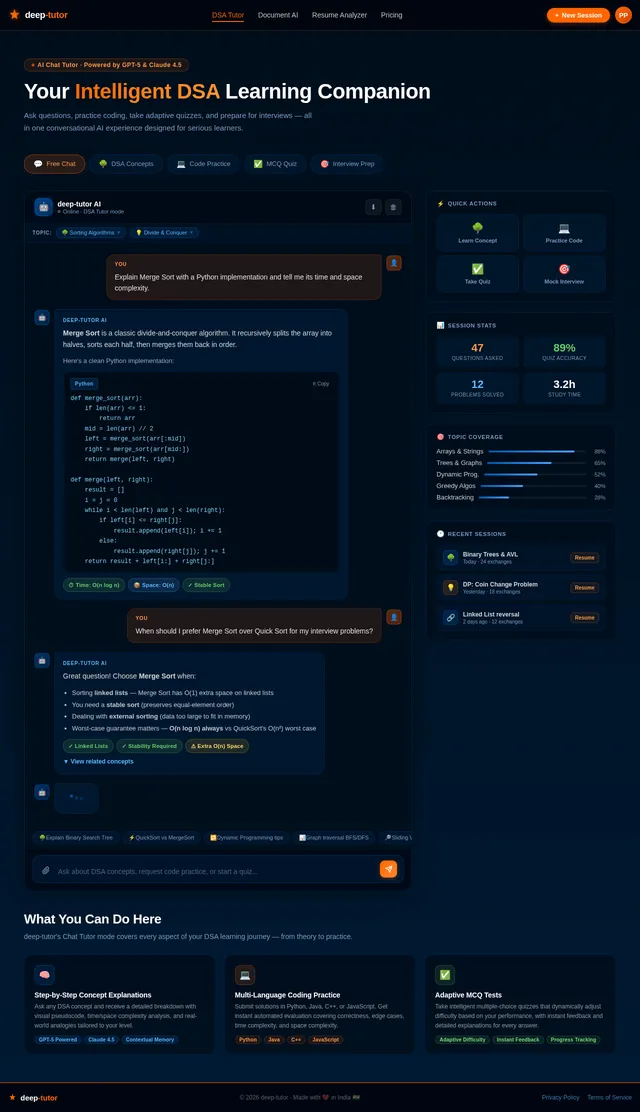
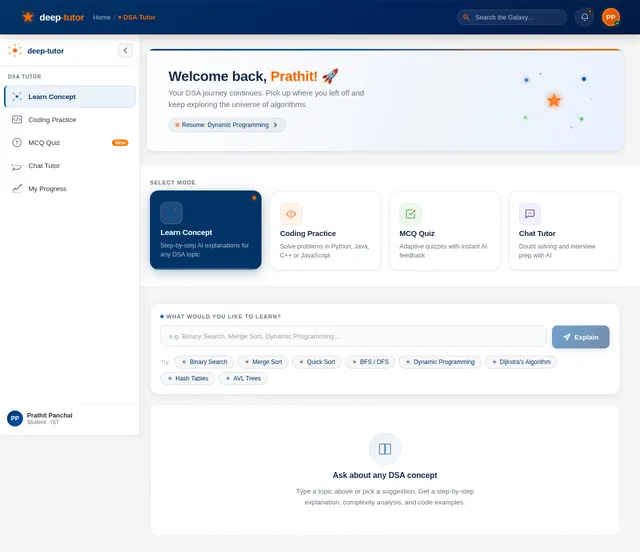
create a fully function AI dsa tutor with the following functionalities Your project **“AI-Powered DSA Learning & Document Analysis Platform”** combines two major systems: * **DSA Tutor (Intelligent Learning Assistant)** * **Project SISO (RAG-based Document Intelligence System)** Together they form a **multi-capability AI platform** for learning, coding practice, and document analysis. Below is a **clear, structured list of the combined functionalities**. --- # Combined Functionalities of AI Tutor + Project SiSo ## 1. Intelligent DSA Learning System Provides **concept explanations for Data Structures and Algorithms**. **Capabilities** * Step-by-step explanations * Text-based diagrams * Concept breakdown from basic → advanced * Context-aware follow-up questions **Example** User asks: *“Explain Dynamic Programming”* System provides: * Definition * Intuition * Example problems * Diagram explanation * Complexity discussion --- # 2. Coding Practice & Evaluation Engine Users can **solve coding problems and receive automated evaluation**. ### Features * Multi-language coding support * Python * Java * C++ * JavaScript * Code analysis includes: * Correctness validation * Time complexity analysis * Space complexity analysis * Optimal vs brute-force detection * Improvement suggestions **Example** User submits solution for **Two Sum** System evaluates: ``` Correctness: Passed Time Complexity: O(n²) Optimal Solution: O(n) using HashMap ``` --- # 3. MCQ Test Generation & Knowledge Assessment System can generate **adaptive quizzes for concept reinforcement.** ### Capabilities * Dynamic MCQ generation * Difficulty levels (Easy / Medium / Hard) * Instant evaluation * Explanation for correct answer * Performance feedback --- # 4. Conversational AI Tutor Acts as a **general AI assistant for learning discussions.** ### Capabilities * Free chat mode * Doubt solving * Interview preparation * Concept comparisons Example queries: * “Difference between BFS and DFS” * “Explain heap vs priority queue” --- # 5. Intelligent Intent Detection The system automatically **detects what the user wants**. ### Possible intents | User Input | System Mode | | ---------------------- | ------------- | | Explain Graphs | Learning Mode | | Solve LeetCode problem | Coding Mode | | Give MCQs on Trees | Test Mode | | General question | Chat Mode | This routing ensures **correct handler execution**. --- # 6. Multi-Document Question Answering (RAG) Project SiSo allows users to **ask questions across multiple documents.** ### Supported documents * DOCX * Study material * Notes * Resume * Job descriptions ### Process ``` Document Upload → Parsing + OCR → Chunking → Embedding generation → Weaviate indexing → Retrieval → LLM answer generation ``` --- # 7. Citation-Based Answer Generation All answers from documents include **precise citations.** Format: ``` [doc_id:page_number:chunk_index] ``` Example: ``` The transformer architecture relies on self-attention [doc1:3:2] ``` This ensures **traceability and reliability of information**. --- # 8. Resume vs Job Description Analysis The system performs **career gap analysis**. ### Features * Resume parsing * JD parsing * Skill gap identification * Improvement suggestions Example output: ``` Missing Skills: - Kubernetes - Docker - GraphQL Recommendation: Learn container orchestration and API frameworks. ``` --- # 9. Study Material Question Answering Students can upload **lecture notes or textbooks**. Capabilities: * Ask conceptual questions * Extract summaries * Generate explanations * Retrieve exact references Example: ``` Q: Explain Gradient Descent ``` Answer retrieved from uploaded lecture notes. --- # 10. High-Availability AI Architecture System ensures **reliable LLM responses**. ### Model pipeline Primary model ``` Google Gemini ``` Fallback model ``` Ollama (Local Llama 3) ``` Mechanism: ``` Gemini request → if failure → automatic fallback to Ollama ``` --- # 11. Asynchronous Processing Pipeline Heavy tasks run **as background jobs**. Architecture: ``` User Request ↓ FastAPI API ↓ Redis Queue ↓ Worker ↓ Processing ↓ Result Retrieval ``` Benefits: * Scalable * Non-blocking API * Handles large documents --- # 12. Hybrid Search Retrieval System Uses **two retrieval methods together**. | Method | Purpose | | ------------- | ---------------- | | Vector Search | semantic meaning | | BM25 | keyword matching | This hybrid search improves **retrieval accuracy**. --- # 13. Multi-Document Knowledge Indexing The system supports **grouped document search**. Metadata stored in vector database: ``` doc_id doc_group_id source_file page_number chunk_index ``` This allows: * Cross-document answers * grouped search results --- # 14. Job Status Tracking System Users can track processing progress. Endpoints: ``` POST /submit_job GET /job_status/{job_id} GET /get_result/{doc_id} ``` Example status: ``` Processing: Chunking documents Processing: Generating embeddings Completed ``` --- # 15. Interactive Frontend Workflow The UI supports **three stages**: ### 1️⃣ Input Stage * Upload documents * Enter questions ### 2️⃣ Processing Stage * Progress polling * Loading indicators ### 3️⃣ Result Stage * AI generated answers * Citation references * Analysis reports --- # Final Combined Platform Vision The system ultimately acts as a **unified AI knowledge platform** capable of: | Domain | Capability | | ------------ | --------------------- | | Learning | DSA tutor | | Coding | Practice + evaluation | | Testing | MCQ quizzes | | Conversation | AI discussion | | Documents | RAG Q&A | | Career | Resume analysis | --- ✅ **In one sentence (interview ready):** > The platform integrates an AI-driven DSA tutoring system with a Retrieval-Augmented Generation (RAG) document intelligence engine, enabling interactive algorithm learning, automated code evaluation, adaptive testing, multi-document question answering with citations, and AI-based resume-job description gap analysis within a unified scalable architecture.
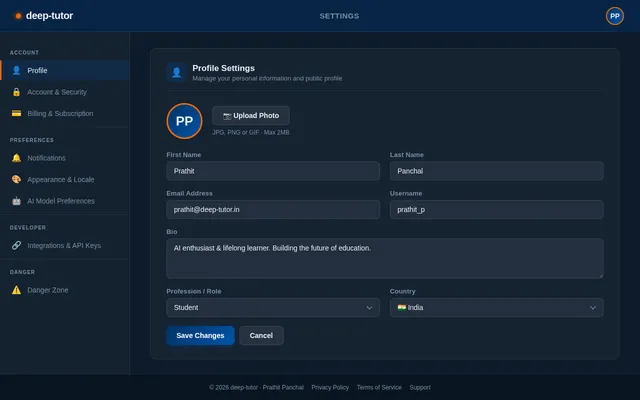
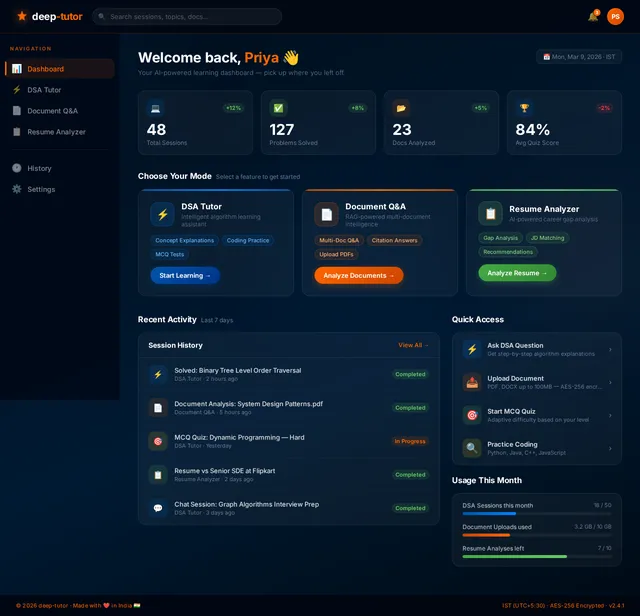
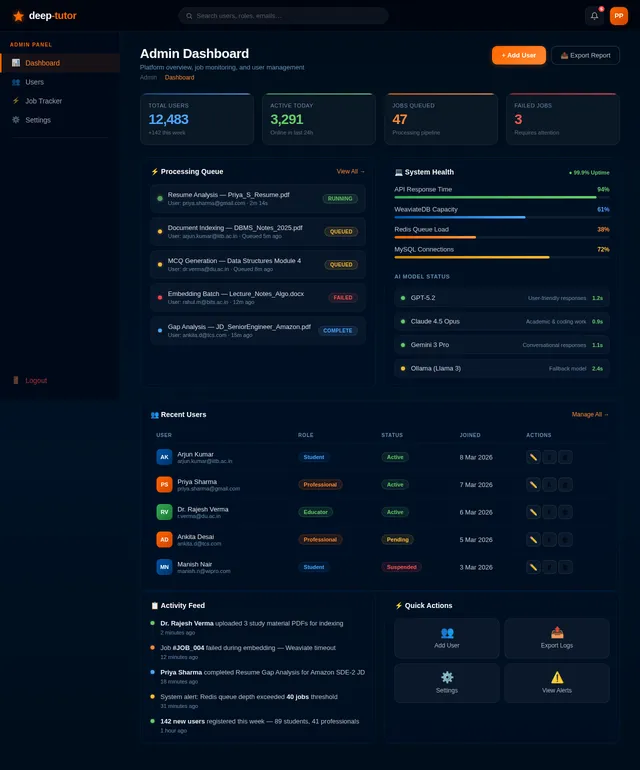
Comments (0)
Sign in to leave a comment
System Requirements
System Requirements Document (SRD)
Project Name: deep-tutor
1. Introduction
nach
The deep-tutor project is an AI-powered platform designed to revolutionize learning and document analysis. Combining a DSA Tutor (Intelligent Learning Assistant) with Project SISO (RAG-based Document Intelligence System), this platform offers a multi-capability AI experience for students, professionals, and educators. It enables interactive algorithm learning, automated code evaluation, adaptive testing, multi-document question answering with citations, and AI-based resume-job description gap analysis—all within a unified, scalable architecture.
This document outlines the system requirements for the deep-tutor project, ensuring clarity and alignment with the vision of Prathit Panchal from India. The platform will cater to Indian users with locale-specific defaults, such as IST timezone and INR currency where applicable.
2. System Overview
The deep-tutor platform integrates two major systems:
- DSA Tutor: An intelligent learning assistant for Data Structures and Algorithms (DSA), offering concept explanations, coding practice, and adaptive testing.
- Project SISO: A Retrieval-Augmented Generation (RAG) engine for document intelligence, enabling multi-document Q&A, citation-based answers, and career gap analysis.
The platform is designed to provide a seamless user experience with features like conversational AI, intelligent intent detection, and a hybrid search retrieval system. It ensures high availability, scalability, and reliability through asynchronous processing pipelines and a robust AI model pipeline.
3. Functional Requirements as Story Points
- As a User, I should be able to ask for step-by-step explanations of DSA concepts.
- As a User, I should be able to practice coding problems in multiple languages (Python, Java, C++, JavaScript).
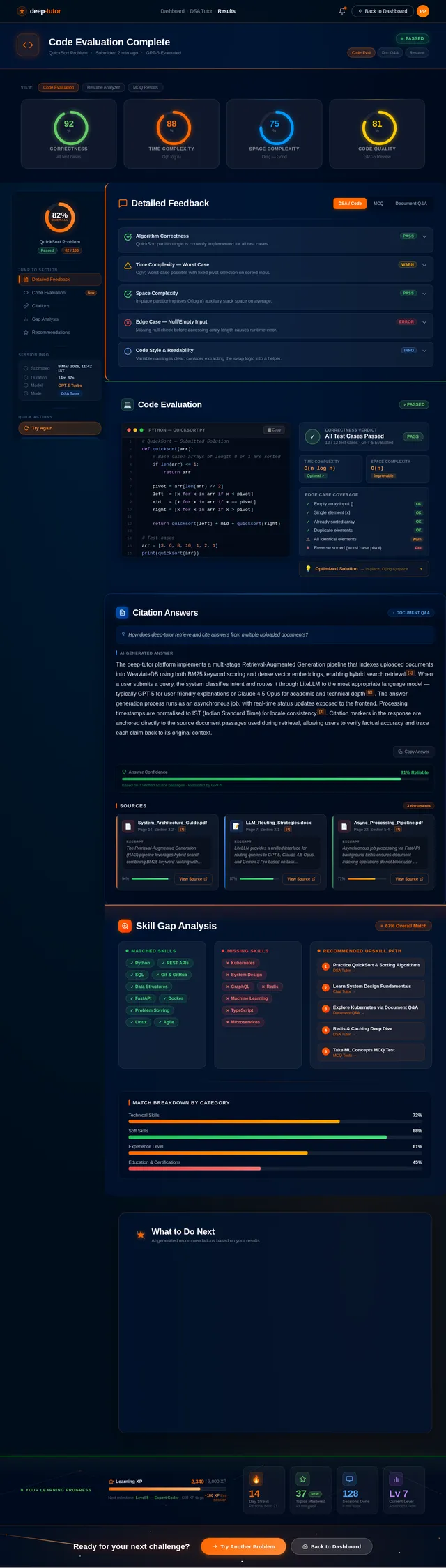
- As a User, I should receive automated evaluations of my code, including correctness, time complexity, and space complexity.
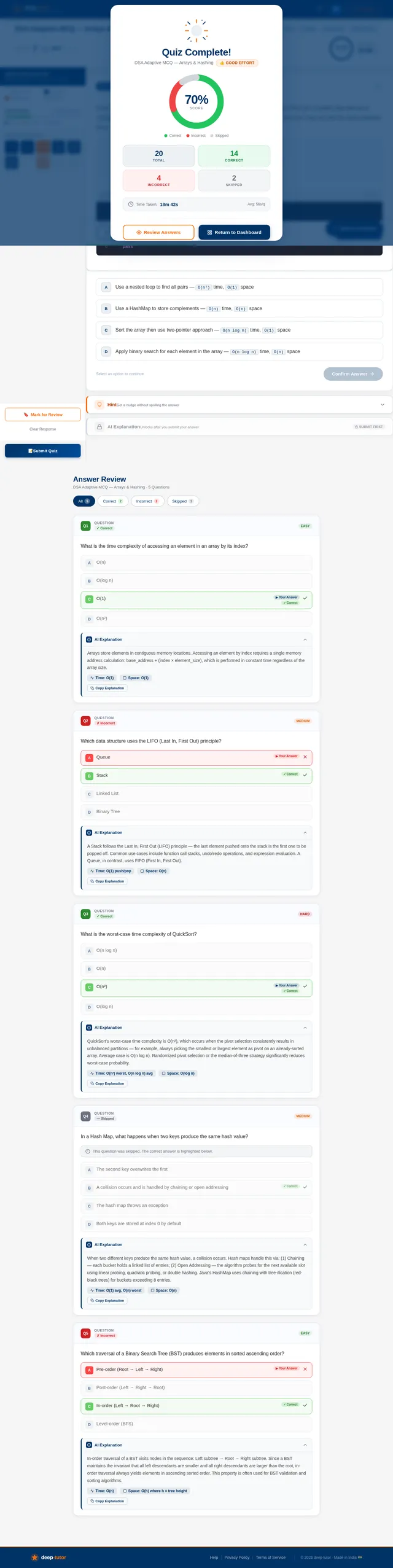
- As a User, I should be able to take adaptive MCQ quizzes with instant feedback and explanations.
- As a User, I should be able to engage in free chat mode for doubt solving and interview preparation.
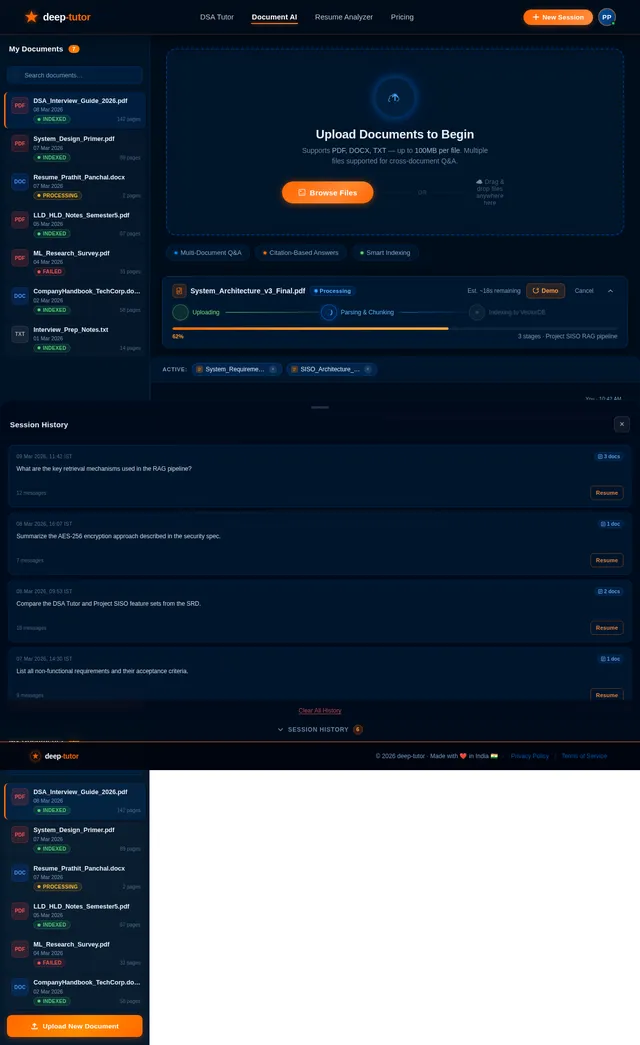
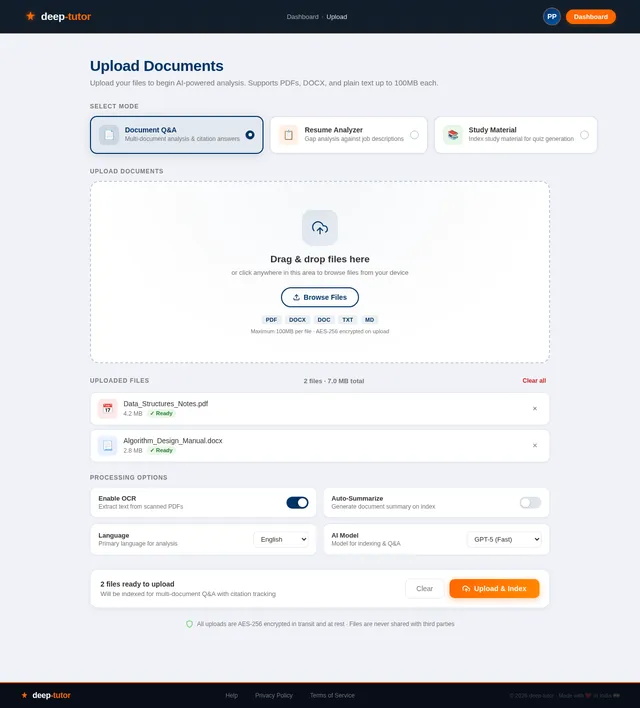
- As a User, I should be able to upload documents (DOCX, PDFs, etc.) for multi-document Q&A.
- As a User, I should receive citation-based answers for document-related queries.
- As a User, I should be able to analyze my resume against job descriptions for skill gap identification.
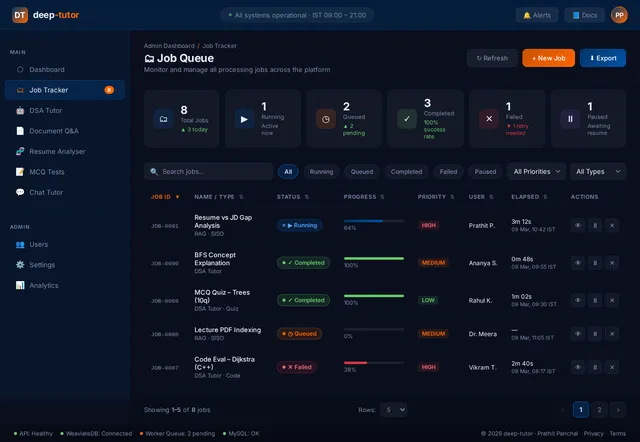
- As a User, I should be able to track the status of document processing jobs.
- As a User, I should experience a smooth, interactive frontend workflow for input, processing, and result stages.
4. User Personas
- Student: Learners seeking to understand DSA concepts, practice coding, and prepare for exams.
- Professional: Job seekers analyzing resumes against job descriptions and improving their skills.
- Educator: Teachers creating adaptive quizzes and analyzing study materials.
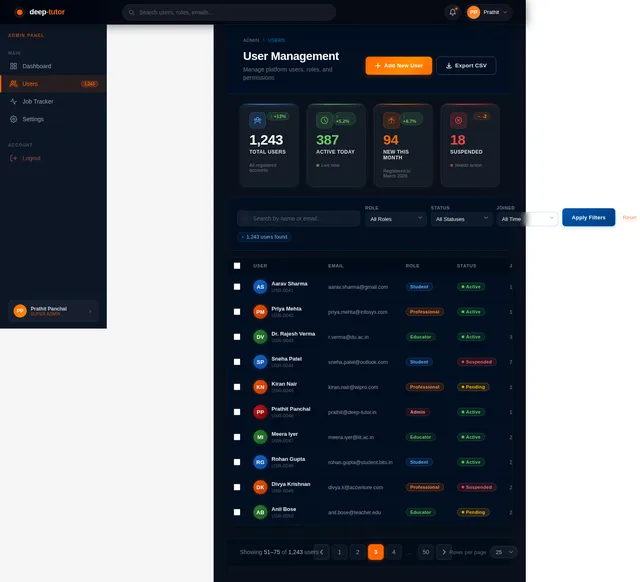
- Admin: System administrators managing backend operations and ensuring platform reliability.
5. Visuals Colors and Theme
The visual theme for deep-tutor will focus on a modern, tech-savvy aesthetic with the following color palette:
- Primary Color: Deep Blue (#003366) – Represents intelligence and trust.
- Secondary Color: Vibrant Orange (#FF6600) – Adds energy and focus.
- Accent Color: Soft Green (#66CC66) – Symbolizes growth and learning.
- Background: Light Grey (#F5F5F5) – Ensures readability and a clean interface.
- Text: Dark Grey (#333333) – Provides high contrast for text elements.
The UI will incorporate subtle gradients, rounded edges, and smooth transitions to create a user-friendly experience.
6. Signature Design Concept
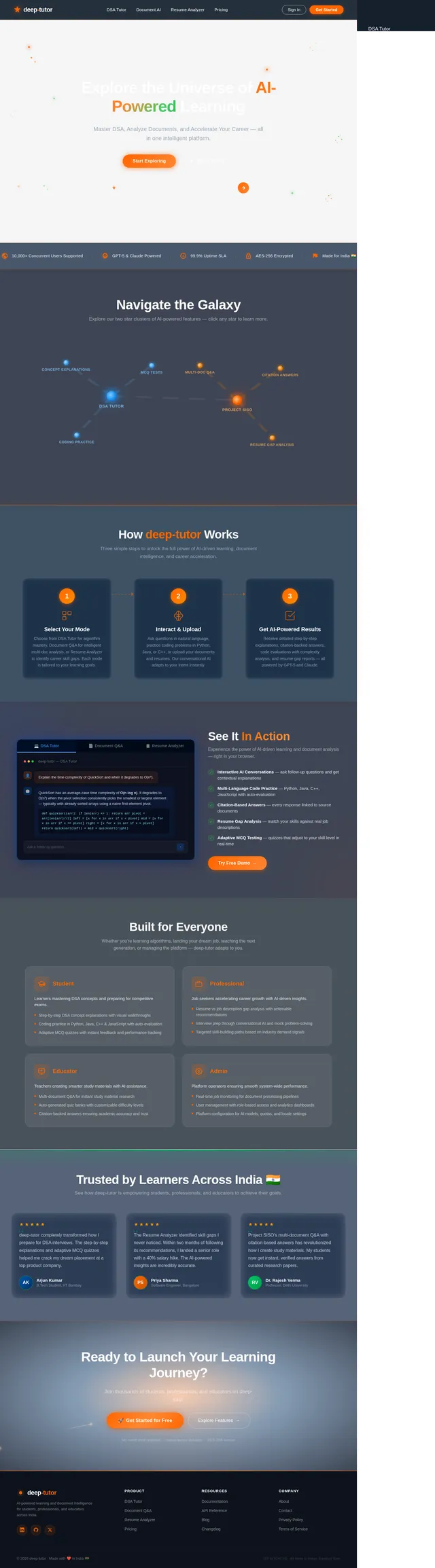
Interactive Algorithm Galaxy Homepage
The homepage of deep-tutor will feature an interactive galaxy map where each star represents a key feature or section of the platform. Users will navigate through the galaxy by clicking on stars, which will expand into constellations representing related functionalities. For example:
- Clicking on the "DSA Tutor" star will reveal constellations for "Concept Explanations," "Coding Practice," and "MCQ Tests."
- Hovering over a star will display a glowing animation and a brief description of the feature.
- The galaxy will have a dynamic background that shifts colors based on the time of day (e.g., warm tones in the morning, cool tones at night).
Micro-interactions will include:
- Stars pulsing gently to indicate interactivity.
- Smooth zoom-in and zoom-out transitions as users explore the galaxy.
- A "Search the Galaxy" bar for quick navigation to specific features.
This design will create a memorable first impression and encourage users to explore the platform's capabilities.
7. Non-Functional Requirements
- Scalability: The system must handle up to 10,000 concurrent users.
- Reliability: Ensure 99.9% uptime with robust failover mechanisms.
- Performance: Responses for user queries should be generated within 2 seconds on average.
- Security: Implement data encryption (AES-256) for document uploads and user data.
- Localization: Support Indian locale defaults, including IST timezone and INR currency.
8. Tech Stack
- Frontend: React for web interface.
- Backend: Python with FastAPI for API development.
- Database:
- RDBMS: MySQL with Alembic for migrations.
- VectorDB: WeaviateDB for semantic search and indexing.
- AI Models:
- GPT 5.2 for user-friendly responses.
- Claude 4.5 Opas for academic and coding work.
- Gemini 3 Pro for conversational responses.
- Google Nano Banana for image generation.
- AI Tools:
- Litellm for LLM routing.
- Langchain for AI workflow orchestration.
- Orchestration:
- Docker and docker-compose for local development.
- Kubernetes for server-side orchestration.
9. Assumptions and Constraints
- Users will primarily access the platform from India, so the system will default to IST timezone and INR currency.
- The platform will support English as the primary language for interactions.
- Document uploads will be limited to 100MB per file to ensure efficient processing.
- The system will rely on cloud-based infrastructure for scalability and reliability.
10. Glossary
- DSA: Data Structures and Algorithms.
- RAG: Retrieval-Augmented Generation.
- LLM: Large Language Model.
- OCR: Optical Character Recognition.
- BM25: Best Matching 25, a ranking function for information retrieval.
- VectorDB: A database optimized for storing and querying vector embeddings.
This document serves as the foundation for the development of the deep-tutor platform, ensuring alignment with the vision and goals of Prathit Panchal. Let's bring this innovative AI-powered tutor to life!
No comments yet. Be the first!