pure-system
 Jatin Yadav
You are an expert Solution Architect and Senior Full Stack + AI Engineer. Design and generate a complete end-to-end production-ready system for an AI-powered furniture quotation generator. The system should: Accept product image and/or description Extract features using Computer Vision + NLP Perform similarity search on historical dataset (Excel with images, descriptions, pricing) Use RAG (Retrieval-Augmented Generation) with LLM to generate pricing Output a structured quotation (JSON + downloadable PDF) Provide: System architecture (frontend, backend, AI layer) Tech stack (React, FastAPI/Node, Vector DB, etc.) Database schema (PostgreSQL + vector DB) AI pipeline (image embeddings, text embeddings, RAG flow) API design (endpoints with request/response) Folder structure (production-ready) Sample code for: Image processing Embedding generation Vector search RAG pipeline Quotation generation Deployment setup (Docker + cloud) Keep it modular, scalable, and production-ready with best practices.
Comments (0)
Sign in to leave a comment
System Requirements
System Requirements Document (SRD)
1. Introduction
Document Title: pure-system
This document outlines the system requirements for the pure-system project, an AI-powered furniture quotation generator. The system is designed to accept product images and/or PDFs containing product lists and descriptions, extract features using Computer Vision and NLP, perform similarity searches on historical datasets, and generate structured quotations using Retrieval-Augmented Generation (RAG). The output will be available in both JSON format and as a downloadable PDF. This document provides a comprehensive overview of the system's functionality, architecture, and design.
The project is tailored to meet the needs of Jatin Yadav, based in India (IN), ensuring locale-specific considerations such as currency (INR) and timezone (IST) are incorporated.
2. System Overview
The pure-system project is a modular, scalable, and production-ready platform that leverages state-of-the-art AI technologies to simplify furniture quotation generation. The system will:
- Accept product images and/or PDFs containing product lists and descriptions as input.
- Extract features using Computer Vision and NLP models.
- Perform similarity searches on a historical dataset containing images, descriptions, and pricing.
- Use Retrieval-Augmented Generation (RAG) to generate accurate pricing.
- Output structured quotations in JSON format and as a downloadable PDF.
The system architecture is designed to ensure high performance, scalability, and ease of use, with a focus on modularity and best practices.
3. Functional Requirements
The functional requirements are outlined as user stories:
- As a User, I should be able to upload a product image or a PDF containing product lists and descriptions for quotation generation.
- As a User, I should be able to view a JSON output of the generated quotation.
- As a User, I should be able to download the generated quotation as a PDF.
- As a User, I should be able to view the status of my quotation generation request.
- As a User, I should be able to selectively re-run the quotation generation process for specific uploaded files.
- As an Admin, I should be able to upload and manage the historical dataset (images, descriptions, pricing).
- As an Admin, I should be able to monitor system performance and logs.
4. User Personas
1. User
- Primary user of the system.
- Uploads product images or PDFs containing product lists and descriptions.
- Views and downloads generated quotations.
- Can selectively re-run the quotation generation process for specific files.
2. Admin
- Manages the historical dataset.
- Monitors system performance and logs.
- Ensures the system operates smoothly.
5. Creative Reference Stories (AI Inspiration)
For the pure-system project, the design inspiration is drawn from the "Pure Form Pure Space" story. This design approach emphasizes minimalism, precision, and calmness, aligning with the project's focus on clarity and functionality.
6. Visuals Colors and Theme
Mood: Minimal, Calm, Precise, Confident
Unique Color Palette:
- Background: #F4F7FA (Soft Cool White)
- Surface: #FFFFFF (Clean White)
- Text: #2C2C38 (Deep Charcoal Gray)
- Accent: #4A90E2 (Muted Steel Blue)
- Muted Tones: #D9E2EC (Light Cool Gray)
Typography:
- Heading: Clean modern sans-serif, thin weight (300), generous line height.
- Body: Clean sans-serif, weight (400).
Layout:
- Density: Very low, with maximum negative space.
- Spacing: Generous and precise.
- Hero Section: Vast open space with light typography placed with precision.
Motion:
- Speed: Ultra subtle.
- Style: Almost invisible.
- Effects: Opacity fade, gentle drift.
7. Signature Design Concept
Floating Blueprint Interface
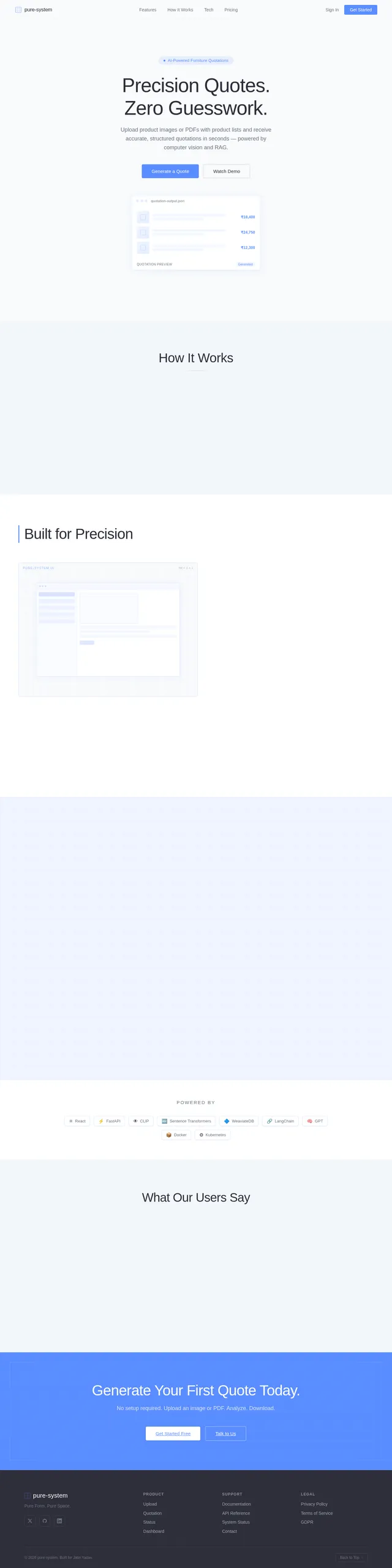
The homepage will feature a floating blueprint aesthetic, where the interface resembles a technical drawing or architectural plan. Key elements include:
- Interactive Blueprint Background: The background will display a subtle, animated grid that mimics a blueprint. As users hover over sections, the grid will highlight and animate with a faint glow.
- Dynamic Product Cards: Product cards will "float" slightly above the blueprint, with smooth hover effects that create a sense of depth.
- Interactive Upload Zone: The upload area will resemble a drafting table. Users can drag and drop images or PDFs into a central "upload zone," which will animate like a blueprint being drawn.
- Selective Re-run Feature: Users can click on previously uploaded files to trigger a re-run of the quotation generation process. This will animate like a blueprint being redrawn.
- Animated Transitions: As users navigate the site, transitions will mimic the unfolding of a technical drawing, with lines and shapes animating into place.
- Call-to-Action (CTA): The primary CTA buttons will appear as precise, glowing elements, inviting users to interact.
This design concept will make the system feel modern, precise, and professional, while maintaining a sense of calm and clarity.
8. Non-Functional Requirements
- Performance: The system should generate quotations within 5 seconds for 90% of requests.
- Scalability: The system must handle up to 10,000 concurrent users.
- Availability: The system should have 99.9% uptime.
- Security: All data must be encrypted in transit and at rest.
- Localization: The system should support INR as the default currency and IST as the default timezone.
9. Tech Stack
Frontend:
- React.js (TypeScript) for web interface.
Backend:
- FastAPI (Python) for API development.
Database:
- Relational: MySQL for structured data (e.g., historical records).
- Vector: WeaviateDB for storing embeddings.
AI Models:
- Computer Vision: CLIP for image embeddings.
- NLP: Sentence Transformers for text embeddings.
- RAG: GPT 5.2 for pricing generation.
AI Tools:
- LangChain for RAG orchestration.
- LiteLLM for LLM routing.
Deployment:
- Docker and Kubernetes for containerization and orchestration.
10. Assumptions and Constraints
Assumptions:
- Users will primarily upload images and PDFs in English.
- The historical dataset will be provided in Excel format with images, descriptions, and pricing.
Constraints:
- The system must operate within the constraints of cloud infrastructure (e.g., AWS, GCP).
- The system must comply with data privacy regulations (e.g., GDPR).
11. Glossary
- RAG (Retrieval-Augmented Generation): A method that combines retrieved data with generative AI to produce outputs.
- Vector DB: A database optimized for storing and querying vector embeddings.
- Embedding: A numerical representation of data (e.g., images, text) used for similarity search.
- LLM (Large Language Model): An AI model trained on vast amounts of text data to generate human-like responses.
This document provides a comprehensive roadmap for the pure-system project. Let me know if you'd like to refine any section further, Jatin!
No comments yet. Be the first!