azure-hi
hi


Comments (0)
Sign in to leave a comment
Project Tasks19
Implement Theme & Design System
As a frontend developer, I want to implement the global theme, color tokens, typography, and design system for azure-hi so that all pages inherit the correct visual language. Set up CSS custom properties for primary (#007FFF), bg (#0A0F1E), surface, text, text_muted, border, and font_family tokens. Implement the animated background (deep navy radial gradient pulse, faint azure grid overlay). Remove any scaffold pages not present in the design pages list. This task must be completed before any page implementation begins.
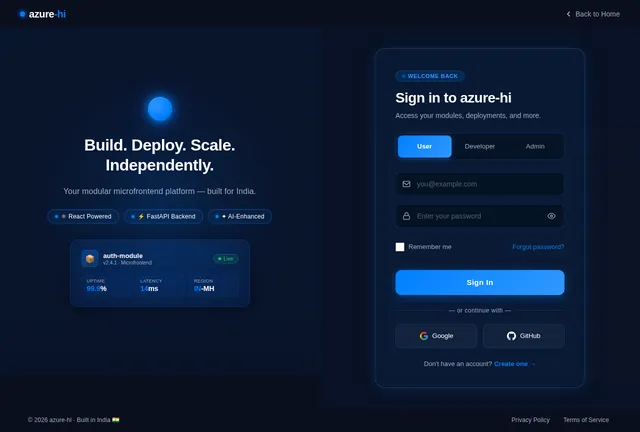
Build Login Page
As a user, I want to use the Login page to sign in to azure-hi so that I can access my dashboard or dev portal. Implement the full Login page based on the existing v2 JSX design including: frosted-glass card, email/password fields with floating labels and azure focus glow, 'Sign In' CTA with loading state, 'or continue with' social divider, link to Signup. Connects from Landing and leads to Dashboard (Admin/Developer) or Home (User).
Build Landing Page
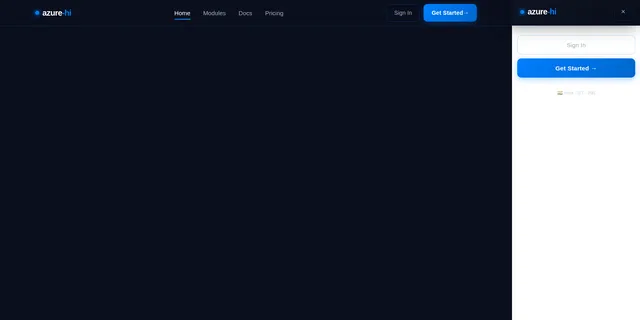
As a user, I want to see the Landing page with the 3D interactive floating module design so that I get an unforgettable first impression of azure-hi. Implement the full Landing page based on the existing v2 JSX design including: hero section with animated azure gradient background, interactive floating module cards with hover rotation/glow pulse, navigation bar, CTA buttons linking to Login and Signup, and responsive layout. Follows the User flow: Landing → Login / Landing → Register.
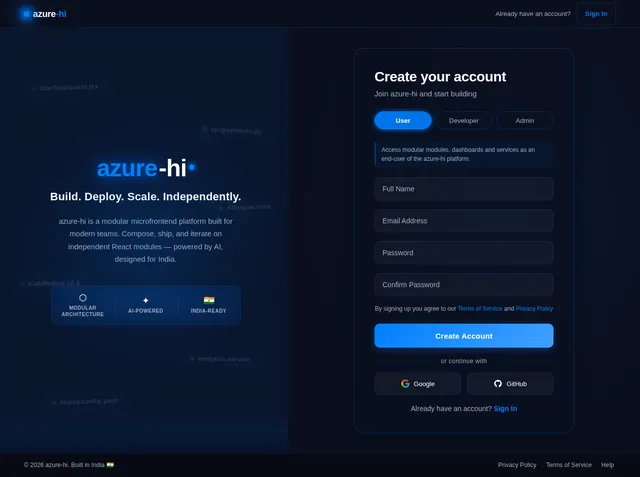
Build Signup Page
As a user, I want to use the Signup page to create a new azure-hi account so that I can start using the platform. Implement the full Signup page based on the existing v2 JSX design including: two-panel layout (branding panel left 45%, form panel right 55%), role selector pills (User/Developer/Admin), Full Name, Email, Password with strength indicator, Confirm Password fields, terms note, CTA with loading spinner, Google/GitHub social signup buttons, and Sign In link. User flow: Landing → Register → Signup → Login.
Build DevPortal Page
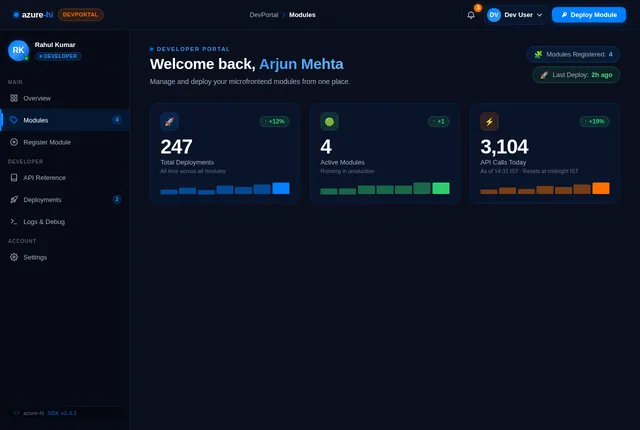
As a developer, I want to use the DevPortal page to browse the component registry and register new microfrontend modules so that I can independently manage deployments. Implement the full DevPortal page based on the existing v2 JSX design including: component browser grid, search and category filters, module registration flow, API documentation links, and navigation to Module Editor. User flow: Login → DevPortal → Register Module → Module Editor.
Build Home Page
As a user, I want to see the Home page after login so that I can browse all available microfrontend modules. Implement the full Home page based on the existing v2 JSX design including: welcome banner with IST greeting, module browsing grid with interactive floating cards, search/filter capability, and navigation to individual Module pages. User flow: Login → Home → Module Interact.
Build Dashboard Page
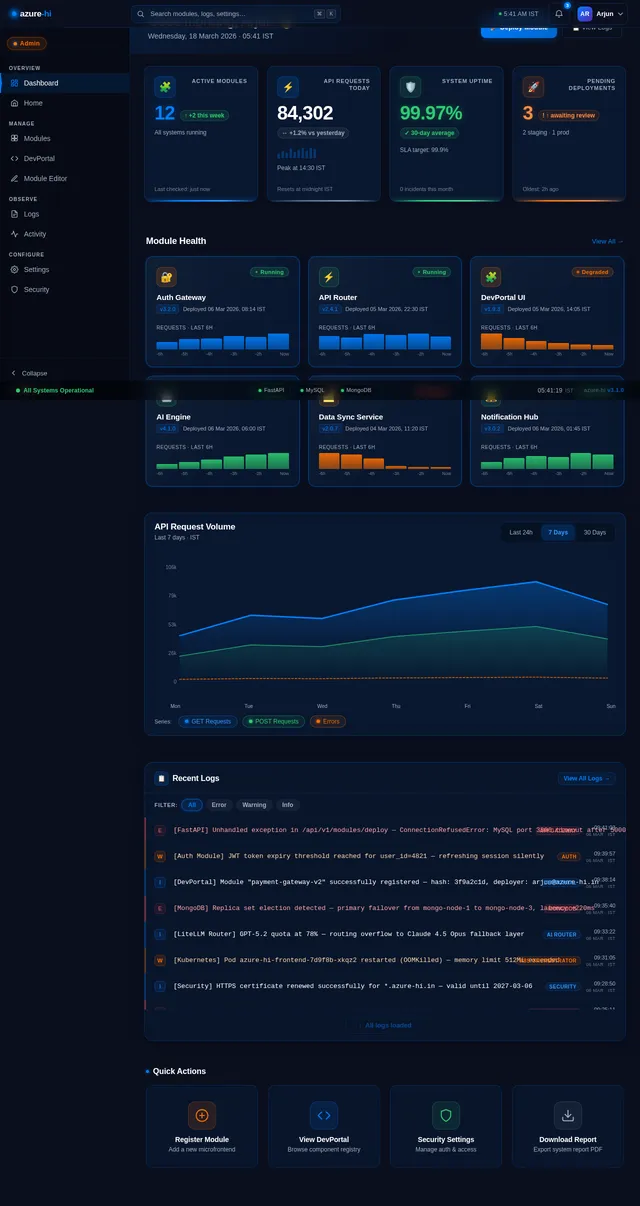
As an admin or developer, I want to use the Dashboard page to monitor module health, API metrics, recent logs, and system stats so that I can oversee platform performance. Implement the full Dashboard page based on the existing v2 JSX design including: TopBar with IST clock and search, Sidebar navigation with role badge, WelcomeBanner, StatsCards (Active Modules, API Requests, Uptime, Pending Deployments), ModuleStatusGrid with sparklines, ActivityChart with SVG area chart, RecentLogs panel, QuickActions grid, and StatusBar. User flow: Login → Dashboard → Monitor Modules / Monitor Deployment.
Build Logs Page
As an admin or developer, I want to use the Logs page to view, filter, and debug system logs so that I can diagnose issues quickly. Implement the full Logs page based on the existing v2 JSX design including: filter pills (All/Error/Warning/Info), scrollable log entries with severity icons, mono-font log messages, module source tags, IST timestamps, color-coded severity rows, and Load More button. User flow: Dashboard → View Logs → Filter Logs / Developer → Debug Logs.
Build Settings Page
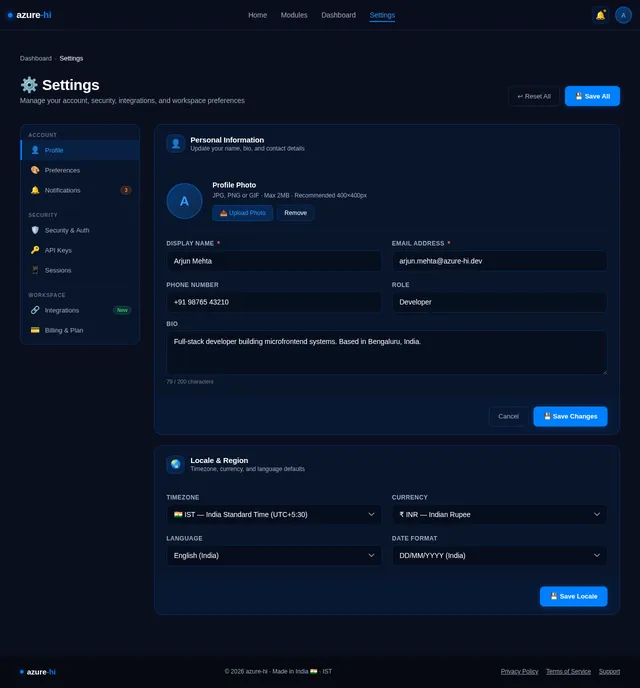
As an admin, I want to use the Settings page to configure security, access control, and system preferences so that the platform remains secure and properly configured. Implement the full Settings page based on the existing v2 JSX design including: security settings panel, role-based access control configuration, notification preferences, localization settings (IST/INR defaults), and danger zone (reset/delete) section. User flow: Manage Modules → Configure Security.
Build Module Editor Page
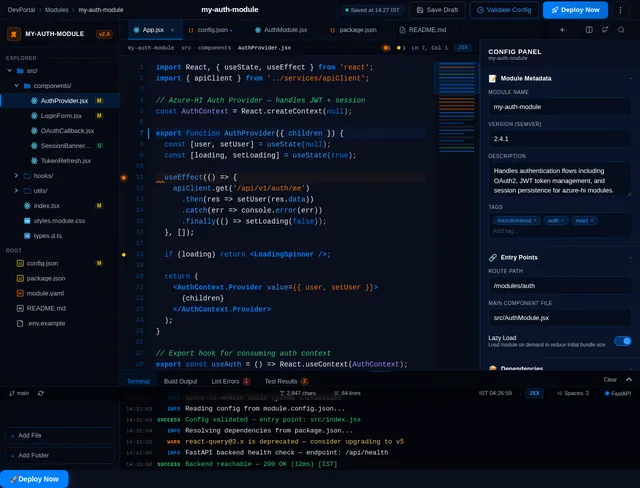
As a developer, I want to use the Module Editor page to configure and deploy microfrontend modules so that I can push updates independently. Implement the full Module Editor page based on the existing v2 JSX design including: configuration form (module name, entry point, routes, permissions), live preview panel, version management, deploy button with progress feedback, and IST deployment timestamp display. User flow: DevPortal → Register Module → Module Editor → Deploy Module → Dashboard.
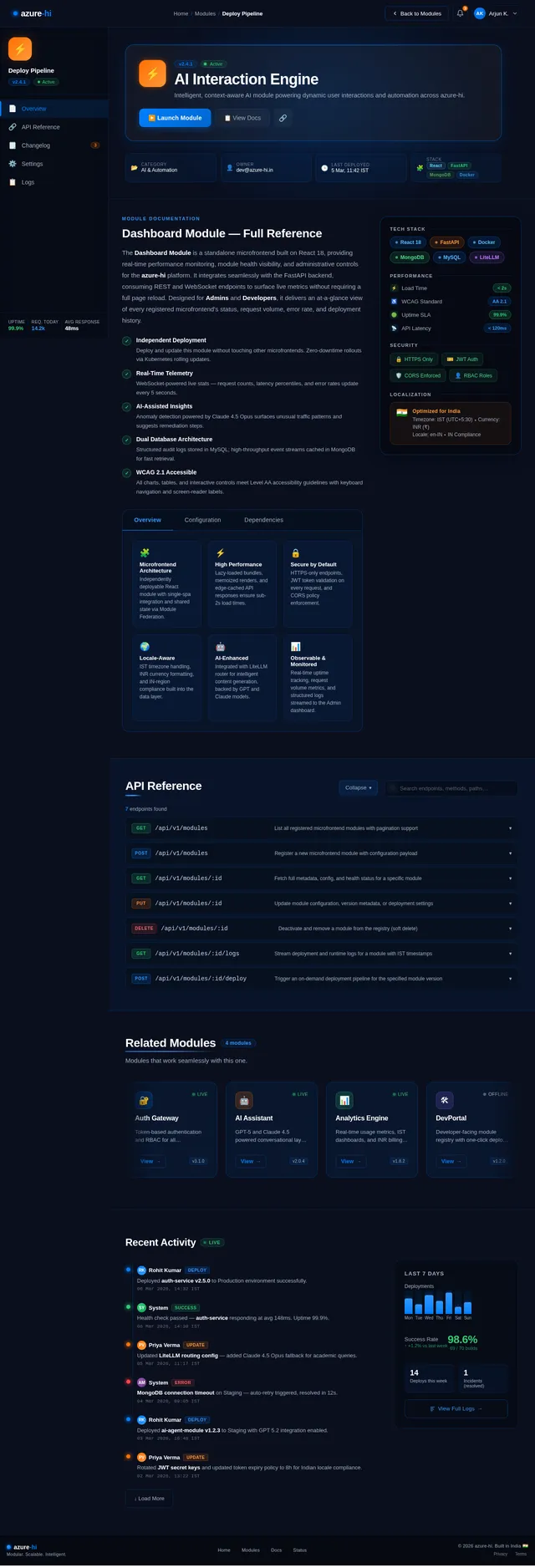
Build Module Detail Page
As a user, I want to interact with a Module detail page so that I can view and use individual microfrontend module content. Implement the full Module page based on the existing v2 JSX design including: 3D card zoom-in transition from Home, module content area, breadcrumb navigation, module metadata (version, status, IST last updated), and back navigation to Home. User flow: Home → Module Interact → Module View Content → Profile.
Build Modules Management Page
As an admin, I want to use the Modules page to view, manage, and control all registered microfrontend modules so that I can maintain platform integrity. Implement the full Modules page based on the existing v2 JSX design including: module listing table/grid with status indicators, search and filter controls, action buttons (enable/disable/delete), module detail drawer or modal, and links to Module Editor. User flow: Dashboard → Manage Modules → Settings.
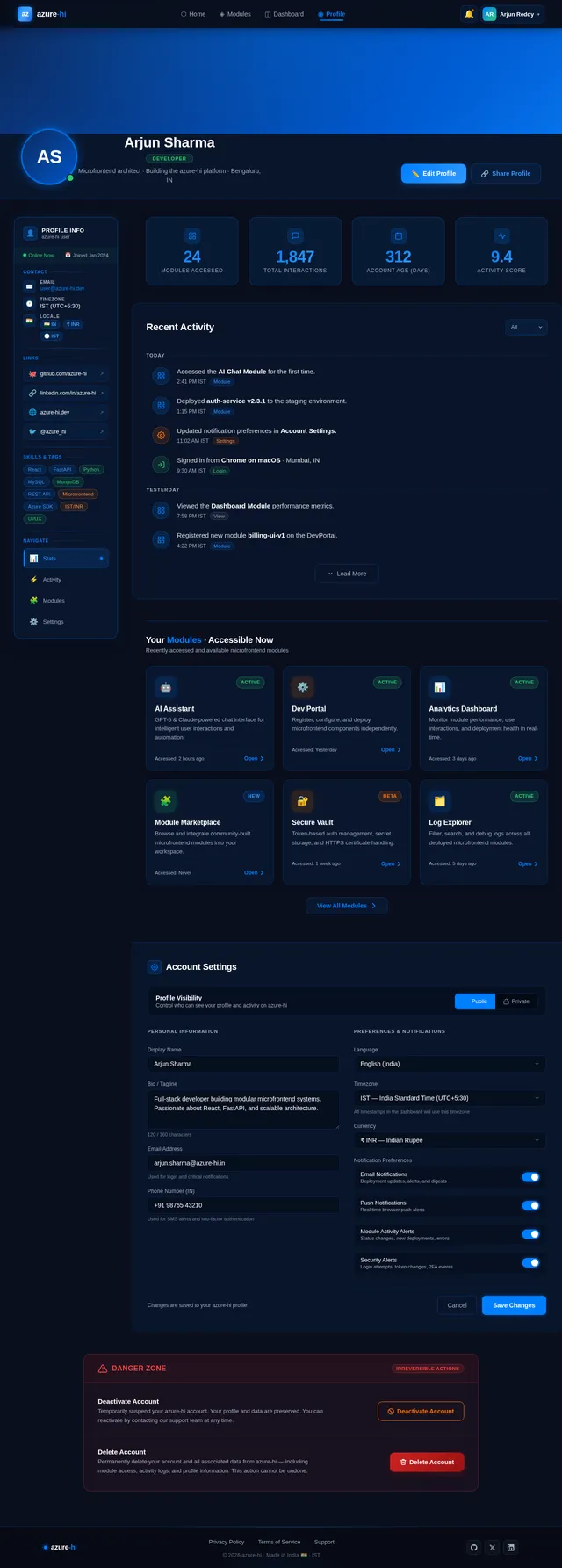
Build Profile Page
As a user, I want to view and edit my Profile page so that I can manage my personal information and preferences on azure-hi. Implement the full Profile page based on the existing v2 JSX design including: avatar section, personal details form (name, email, role, IST timezone, INR locale), edit mode with save/cancel, account activity summary, and navigation back to Home or Dashboard. User flow: Module View Content → Profile.
Implement AI Assistant Integration
As an AI engineer, I want to integrate LiteLLM routing with GPT-5.2 and Claude Opus 4.5 via Langchain so that the dashboard AI assistant can respond to user queries intelligently. Implement: LiteLLM router config selecting GPT-5.2 for conversational and Claude Opus 4.5 for coding/academic queries, FastAPI endpoint POST /ai/chat with streaming SSE response, conversation history in MongoDB.
Implement Dashboard Stats API
As a backend developer, I want to implement FastAPI endpoints for dashboard statistics so that the Dashboard page can display active module count, API request volume, system uptime, and pending deployments. Endpoints: GET /dashboard/stats, GET /dashboard/module-health, GET /dashboard/activity (time-series data for chart). Aggregate data from MySQL and MongoDB.
Implement Modules Backend API
As a backend developer, I want to implement FastAPI endpoints for microfrontend module management so that the frontend can register, list, update, enable/disable, and delete modules. Endpoints: GET /modules, POST /modules, PUT /modules/{id}, DELETE /modules/{id}, GET /modules/{id}/status. Include MySQL persistence for module metadata and MongoDB for module configuration blobs.
Implement User Profile API
As a backend developer, I want to implement FastAPI endpoints for user profile management so that users can view and update their personal information and locale preferences. Endpoints: GET /users/me, PUT /users/me, GET /users/me/activity. Store profile data in MySQL with IST timezone and INR locale defaults.
Implement Logs Backend API
As a backend developer, I want to implement FastAPI endpoints for log retrieval and filtering so that admins and developers can query system logs in real time. Endpoints: GET /logs (with query params: severity, module, from_ts, to_ts, limit, offset), GET /logs/stream (SSE for live tail). Store logs in MongoDB with IST timestamp indexing.
Implement Module Deploy API
As a backend developer, I want to implement FastAPI endpoints for module deployment so that developers can deploy configured microfrontend modules and track deployment status. Endpoints: POST /modules/{id}/deploy, GET /modules/{id}/deployments, GET /modules/{id}/deployments/{deploy_id}/status. Record deployment history in MySQL with IST timestamps.
No comments yet. Be the first!