space-hui
 Nodir Rakhmanov
Hui
Comments (0)
Sign in to leave a comment
System Requirements
System Requirements Document (SRD)
Project Name: space-hui
1. Introduction
The space-hui project is an ambitious initiative envisioned by Nodir Rakhmanov, based in the United Arab Emirates (AE). This document outlines the system requirements for the project, which aims to leverage cutting-edge technologies, including artificial intelligence (AI), to deliver a unique and impactful solution. The project will incorporate AI functionality to enhance user experiences and provide intelligent features tailored to the needs of its audience.
2. System Overview
The space-hui project is designed to be an AI-powered platform that combines advanced machine learning models with intuitive user interfaces. The system will cater to a diverse range of users, offering intelligent interactions, data-driven insights, and personalized experiences. The platform will be accessible via both web and mobile applications, ensuring seamless usability across devices.
Key features include:
- AI-driven functionalities for user engagement and problem-solving.
- Scalable architecture to support future growth and feature expansion.
- Localization tailored to the UAE, including timezone (Gulf Standard Time) and cultural considerations.
3. Functional Requirements
As User:
- As User, I should be able to interact with an AI chatbot for assistance.
- As User, I should be able to receive personalized recommendations based on my preferences.
- As User, I should be able to upload images for AI-based analysis.
- As User, I should be able to access a dashboard summarizing AI-generated insights.
As Admin:
- As Admin, I should be able to manage AI models and their configurations.
- As Admin, I should be able to monitor system performance and user interactions.
- As Admin, I should be able to update training datasets for AI models.
As Guest:
- As Guest, I should be able to explore basic features without creating an account.
- As Guest, I should be able to interact with a limited version of the AI chatbot.
4. User Personas
1. User
- Description: Registered users who interact with the platform for personalized AI-driven features.
- Goals: Receive intelligent assistance, recommendations, and insights.
- Pain Points: Need for intuitive interfaces and accurate AI responses.
2. Admin
- Description: Administrators responsible for managing the platform and AI functionalities.
- Goals: Ensure system reliability, update AI models, and monitor user engagement.
- Pain Points: Complexity in managing AI configurations and datasets.
3. Guest
- Description: Unregistered users exploring the platform's basic features.
- Goals: Evaluate the platform's capabilities before registering.
- Pain Points: Limited access to advanced features.
5. Visuals Colors and Theme
Color Palette:
The space-hui project will feature a futuristic and cosmic-inspired color palette:
- Background: #0D1B2A (Deep Space Blue)
- Surface: #1B263B (Midnight Navy)
- Text: #E0E1DD (Starlight White)
- Accent: #FF6F61 (Mars Red)
- Muted Tones: #778DA9 (Nebula Gray)
This palette evokes the vastness of space while maintaining a sleek and modern aesthetic.
6. Signature Design Concept
Concept: Interactive Galaxy Map Homepage
The homepage of space-hui will feature an interactive galaxy map that immerses users in a cosmic experience.
- Visuals: A 3D-rendered galaxy with stars, planets, and nebulae representing different sections of the platform.
- Interaction: Users can navigate the galaxy by clicking on stars or planets, which expand into feature-specific content areas.
- Animations: Smooth transitions as users "zoom in" on celestial objects, accompanied by subtle particle effects.
- Micro-interactions: Hovering over stars reveals tooltips with feature descriptions.
- Color Shifts: The galaxy's colors subtly morph based on the time of day (e.g., warmer tones during the day, cooler tones at night).
- Sound Design: Ambient space sounds enhance the immersive experience.
This bold design will make the platform unforgettable and set the tone for its futuristic identity.
7. Non-Functional Requirements
- Performance: The system must handle up to 10,000 concurrent users without degradation.
- Scalability: The architecture should support future AI model integrations and feature expansions.
- Security: Implement robust encryption for user data and AI model configurations.
- Localization: Default settings tailored to the UAE, including Gulf Standard Time and Arabic language support.
8. Tech Stack
Frontend:
- React for Web
- React Native for Mobile App
Backend:
- Python
- FastAPI
Database:
- MySQL or MariaDB (preferred for relational data)
- MongoDB (for unstructured data)
- WeaviateDB (for vector-based AI data)
AI Models:
- GPT 5.2 for user-friendly responses
- Claude 4.5 Opas for academic or coding work
- Gemini 3 Pro for friendly interactions
- Google Nano Banana for image generation
AI Tools:
- Litellm for LLM Routing
- Langchain
Orchestration:
- Docker and docker-compose for local development
- Kubernetes for server-side orchestration
9. Assumptions and Constraints
Assumptions:
- Users in the UAE will primarily access the platform during Gulf Standard Time hours.
- AI models will require periodic retraining to maintain accuracy.
Constraints:
- Limited initial budget may restrict the scope of AI functionalities.
- Compliance with UAE data protection laws is mandatory.
10. Glossary
- AI (Artificial Intelligence): Technology enabling machines to mimic human intelligence.
- LLM (Large Language Model): Advanced AI models capable of understanding and generating human-like text.
- VectorDB: A database optimized for storing and querying vector embeddings used in AI applications.
- Docker: A tool for containerizing applications to ensure consistent environments.
- Kubernetes: A system for automating deployment, scaling, and management of containerized applications.
This updated SRD reflects the incorporation of AI functionality into the space-hui project, aligning with Nodir's vision for an innovative and futuristic platform.
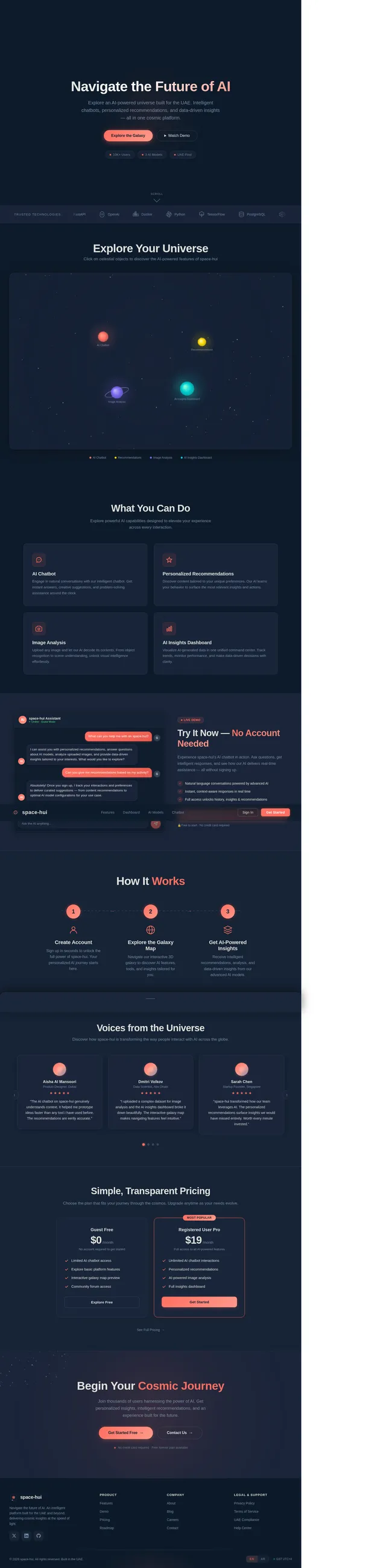
Navigate the Future of AI
Explore an AI-powered universe built for the UAE. Intelligent chatbots, personalized recommendations, and data-driven insights — all in one cosmic platform.
Explore Your Universe
Click on celestial objects to discover the AI-powered features of space-hui
What You Can Do
Explore powerful AI capabilities designed to elevate your experience across every interaction.
Engage in natural conversations with our intelligent chatbot. Get instant answers, creative suggestions, and problem-solving assistance around the clock.
Discover content tailored to your unique preferences. Our AI learns your behavior to surface the most relevant insights and actions.
Upload any image and let our AI decode its contents. From object recognition to scene understanding, unlock visual intelligence effortlessly.
Visualize AI-generated data in one unified command center. Track trends, monitor performance, and make data-driven decisions with clarity.
Try It Now — No Account Needed
Experience space-hui's AI chatbot in action. Ask questions, get intelligent responses, and see how our AI delivers real-time assistance — all without signing up.
- Natural language conversations powered by advanced AI
- Instant, context-aware responses in real time
- Full access unlocks history, insights & recommendations
🔒Free to start · No credit card required
How It Works
Create Account
Sign up in seconds to unlock the full power of space-hui. Your personalized AI journey starts here.
Explore the Galaxy Map
Navigate our interactive 3D galaxy to discover AI features, tools, and insights tailored for you.
Get AI-Powered Insights
Receive intelligent recommendations, analysis, and data-driven insights from our advanced AI models.
Voices from the Universe
Discover how space-hui is transforming the way people interact with AI across the globe.
Aisha Al Mansoori
Product Designer, Dubai
"The AI chatbot on space-hui genuinely understands context. It helped me prototype ideas faster than any tool I have used before. The recommendations are eerily accurate."
Dmitri Volkov
Data Scientist, Abu Dhabi
"I uploaded a complex dataset for image analysis and the AI insights dashboard broke it down beautifully. The interactive galaxy map makes navigating features feel intuitive."
Sarah Chen
Startup Founder, Singapore
"space-hui transformed how our team leverages AI. The personalized recommendations surface insights we would have missed entirely. Worth every minute invested."
Omar Khaled
Software Engineer, Sharjah
"As someone working in the UAE tech scene, having a platform with GST timezone support and local considerations is a game changer. The AI models are incredibly responsive."
Priya Sharma
ML Researcher, Bangalore
"The admin panel for managing AI model configurations is clean and powerful. Updating training datasets is seamless. This platform sets a new standard for AI tooling."
James Mitchell
Creative Director, London
"I started as a guest and was immediately hooked by the limited chatbot demo. After signing up, the full platform exceeded every expectation. Truly cosmic design."
Simple, Transparent Pricing
Choose the plan that fits your journey through the cosmos. Upgrade anytime as your needs evolve.
Guest Free
No account required to get started
- Limited AI chatbot access
- Explore basic platform features
- Interactive galaxy map preview
- Community forum access
Registered User Pro
Full access to all AI-powered features
- Unlimited AI chatbot interactions
- Personalized recommendations
- AI-powered image analysis
- Full insights dashboard
Begin Your Cosmic Journey
Join thousands of users harnessing the power of AI. Get personalized insights, intelligent recommendations, and an experience built for the future.
No comments yet. Be the first!