smart-yes
 Dhanalaxmi Rakham
Yes — if you want something that can stay relevant for 15 years, you should aim for deep-tech hardware with a strong moat: IP, manufacturing know-how, testing data, regulatory approval, and system integration. That kind of business is much harder to copy than a simple gadget, and deep-tech hardware typically has long development cycles and durable competitive advantages �. What “15-year good” means A truly long-life hardware startup should have: A problem that does not disappear quickly. High switching cost for customers. Deep engineering or scientific barriers. Regulatory, manufacturing, or data advantages. A path to recurring revenue, not only one-time sales. India is also moving toward supporting longer-horizon deep-tech companies, which fits this kind of ambition �. Best revolutionary hardware categories Best revolutionary bets The three most revolutionary options are: Modular home energy OS. Water intelligence platform. Smart power electronics stack. These are not just products; they are platforms. A platform can expand into multiple device categories, service contracts, software, and ecosystem partnerships, which makes it harder to replace later �. Strongest moat If your goal is something that is “not changed for 15 years,” the moat should come from: Physical integration into homes, buildings, or machines. Data accumulation over time. Certification/regulatory approvals. Replacement cost for the customer. Local manufacturing and service network. That combination is much stronger than a single standalone gadget, because the product becomes infrastructure rather than a consumer accessory �. My top recommendation If I had to choose one idea with the best chance of being both revolutionary and very hard to displace, I would pick: Modular home energy OS Why: It can start with one device, like a smart controller. It can expand into solar, battery, EV charger, inverter, fan, pump, and appliance control. It has recurring revenue from software, maintenance, and upgrades. It can become a household infrastructure layer instead of a gadget. That is the kind of business that can still matter in 2040. Practical startup path A good way to start: Build one highly reliable core device. Make it work with existing Indian homes and appliances. Add software and predictive control. Expand into apartment buildings, MSMEs, and builders. Lock in recurring service and energy savings. I can now give you a ranked list of 10 revolutionary hardware startup ideas with estimated market size, moat strength, and build difficulty.

Comments (0)
Sign in to leave a comment
Project Tasks
No tasks generated yet.
Tasks will appear here as requirements are defined.
Founder Vision
Durable Deep-Tech for the 15-Year Horizon
A revolutionary Modular Home Energy OS built to last, designed to defend through IP, manufacturing know-how, testing data, regulatory approval, and system integration.
smart-yes is not building a single gadget. It is planning the infrastructure layer for the Indian home — a platform-first approach where one highly reliable smart controller becomes the entry point into solar, battery, EV charger, inverter, fan, pump, and appliance control.
The founder's role is planning and decision-making over a long horizon: choosing which category to enter first, which integrations to defend with engineering depth, and which recurring service and upgrade relationships turn a household device into infrastructure that is expensive to replace and hard to copy.
Every expansion — into apartment buildings, MSMEs, and builders — compounds the same defensibility rather than starting over, so the platform, not any one product, is what remains relevant in 2040.
- Intellectual property moat
- Manufacturing know-how
- Accumulated testing data
- Regulatory approval pathway
- Deep system integration
- Local service network
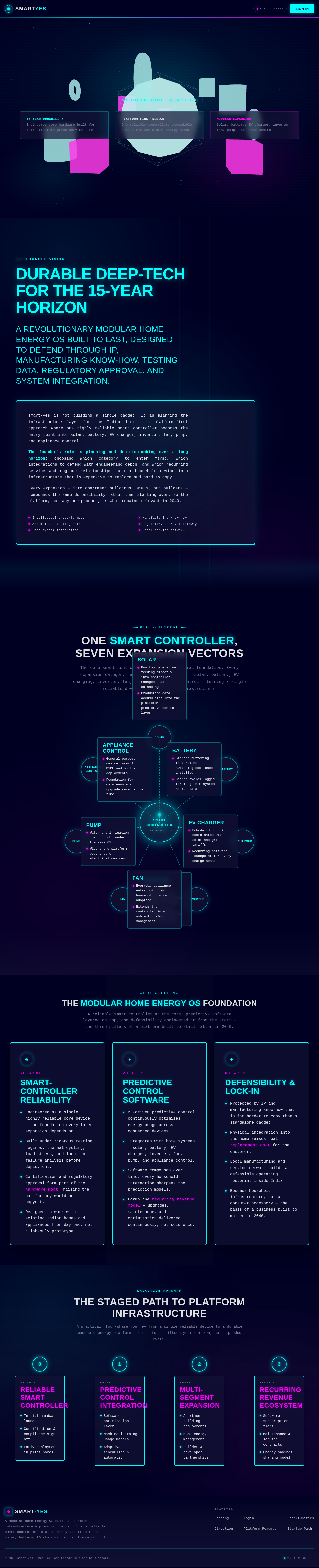
One Smart Controller, Seven Expansion Vectors
The core smart-controller is the architectural foundation. Every expansion category radiates outward from it — solar, battery, EV charging, inverter, fan, pump and appliance control — turning a single reliable device into household infrastructure.
Solar
- Rooftop generation feeding directly into controller-managed load balancing
- Production data accumulates into the platform’s predictive control layer
Battery
- Storage buffering that raises switching cost once installed
- Charge cycles logged for long-term system health data
EV Charger
- Scheduled charging coordinated with solar and grid tariffs
- Recurring software touchpoint for every charge session
Inverter
- Core power-conversion link between generation, storage and load
- Deepens system integration across the energy stack
Fan
- Everyday appliance entry point for household control adoption
- Extends the controller into ambient comfort management
Pump
- Water and irrigation load brought under the same OS
- Widens the platform beyond pure electrical devices
Appliance Control
- General-purpose device layer for MSME and builder deployments
- Foundation for maintenance and upgrade revenue over time
Solar
- Rooftop generation feeding directly into controller-managed load balancing
- Production data accumulates into the platform’s predictive control layer
Battery
- Storage buffering that raises switching cost once installed
- Charge cycles logged for long-term system health data
EV Charger
- Scheduled charging coordinated with solar and grid tariffs
- Recurring software touchpoint for every charge session
Inverter
- Core power-conversion link between generation, storage and load
- Deepens system integration across the energy stack
Fan
- Everyday appliance entry point for household control adoption
- Extends the controller into ambient comfort management
Pump
- Water and irrigation load brought under the same OS
- Widens the platform beyond pure electrical devices
Appliance Control
- General-purpose device layer for MSME and builder deployments
- Foundation for maintenance and upgrade revenue over time
The Modular Home Energy OS Foundation
A reliable smart controller at the core, predictive software layered on top, and defensibility engineered in from the start — the three pillars of a platform built to still matter in 2040.
Smart-Controller Reliability
- Engineered as a single, highly reliable core device — the foundation every later expansion depends on.
- Built under rigorous testing regimes: thermal cycling, load stress, and long-run failure analysis before deployment.
- Certification and regulatory approval form part of the hardware moat, raising the bar for any would-be copycat.
- Designed to work with existing Indian homes and appliances from day one, not a lab-only prototype.
Predictive Control Software
- ML-driven predictive control continuously optimizes energy usage across connected devices.
- Integrates with home systems — solar, battery, EV charger, inverter, fan, pump, and appliance control.
- Software compounds over time: every household interaction sharpens the prediction models.
- Forms the recurring revenue model — upgrades, maintenance, and optimization delivered continuously, not sold once.
Defensibility & Lock-in
- Protected by IP and manufacturing know-how that is far harder to copy than a standalone gadget.
- Physical integration into the home raises real replacement cost for the customer.
- Local manufacturing and service network builds a defensible operating footprint inside India.
- Becomes household infrastructure, not a consumer accessory — the basis of a business built to matter in 2040.
Execution Roadmap
The Staged Path to Platform Infrastructure
A practical, four-phase journey from a single reliable device to a durable household energy platform — built for a fifteen-year horizon, not a product cycle.
Phase 0
Reliable Smart-Controller
- Initial hardware launch
- Certification & compliance sign-off
- Early deployment in pilot homes
Phase 1
Predictive Control Integration
- Software optimization layer
- Machine learning usage models
- Adaptive scheduling & automation
Phase 2
Multi-Segment Expansion
- Apartment building deployments
- MSME energy management
- Builder & developer partnerships
Phase 3
Recurring Revenue Ecosystem
- Software subscription tiers
- Maintenance & service contracts
- Energy savings sharing model
Founder Vision
Durable Deep-Tech for the 15-Year Horizon
A revolutionary Modular Home Energy OS built to last, designed to defend through IP, manufacturing know-how, testing data, regulatory approval, and system integration.
smart-yes is not building a single gadget. It is planning the infrastructure layer for the Indian home — a platform-first approach where one highly reliable smart controller becomes the entry point into solar, battery, EV charger, inverter, fan, pump, and appliance control.
The founder's role is planning and decision-making over a long horizon: choosing which category to enter first, which integrations to defend with engineering depth, and which recurring service and upgrade relationships turn a household device into infrastructure that is expensive to replace and hard to copy.
Every expansion — into apartment buildings, MSMEs, and builders — compounds the same defensibility rather than starting over, so the platform, not any one product, is what remains relevant in 2040.
- Intellectual property moat
- Manufacturing know-how
- Accumulated testing data
- Regulatory approval pathway
- Deep system integration
- Local service network
One Smart Controller, Seven Expansion Vectors
The core smart-controller is the architectural foundation. Every expansion category radiates outward from it — solar, battery, EV charging, inverter, fan, pump and appliance control — turning a single reliable device into household infrastructure.
Solar
- Rooftop generation feeding directly into controller-managed load balancing
- Production data accumulates into the platform’s predictive control layer
Battery
- Storage buffering that raises switching cost once installed
- Charge cycles logged for long-term system health data
EV Charger
- Scheduled charging coordinated with solar and grid tariffs
- Recurring software touchpoint for every charge session
Inverter
- Core power-conversion link between generation, storage and load
- Deepens system integration across the energy stack
Fan
- Everyday appliance entry point for household control adoption
- Extends the controller into ambient comfort management
Pump
- Water and irrigation load brought under the same OS
- Widens the platform beyond pure electrical devices
Appliance Control
- General-purpose device layer for MSME and builder deployments
- Foundation for maintenance and upgrade revenue over time
Solar
- Rooftop generation feeding directly into controller-managed load balancing
- Production data accumulates into the platform’s predictive control layer
Battery
- Storage buffering that raises switching cost once installed
- Charge cycles logged for long-term system health data
EV Charger
- Scheduled charging coordinated with solar and grid tariffs
- Recurring software touchpoint for every charge session
Inverter
- Core power-conversion link between generation, storage and load
- Deepens system integration across the energy stack
Fan
- Everyday appliance entry point for household control adoption
- Extends the controller into ambient comfort management
Pump
- Water and irrigation load brought under the same OS
- Widens the platform beyond pure electrical devices
Appliance Control
- General-purpose device layer for MSME and builder deployments
- Foundation for maintenance and upgrade revenue over time
The Modular Home Energy OS Foundation
A reliable smart controller at the core, predictive software layered on top, and defensibility engineered in from the start — the three pillars of a platform built to still matter in 2040.
Smart-Controller Reliability
- Engineered as a single, highly reliable core device — the foundation every later expansion depends on.
- Built under rigorous testing regimes: thermal cycling, load stress, and long-run failure analysis before deployment.
- Certification and regulatory approval form part of the hardware moat, raising the bar for any would-be copycat.
- Designed to work with existing Indian homes and appliances from day one, not a lab-only prototype.
Predictive Control Software
- ML-driven predictive control continuously optimizes energy usage across connected devices.
- Integrates with home systems — solar, battery, EV charger, inverter, fan, pump, and appliance control.
- Software compounds over time: every household interaction sharpens the prediction models.
- Forms the recurring revenue model — upgrades, maintenance, and optimization delivered continuously, not sold once.
Defensibility & Lock-in
- Protected by IP and manufacturing know-how that is far harder to copy than a standalone gadget.
- Physical integration into the home raises real replacement cost for the customer.
- Local manufacturing and service network builds a defensible operating footprint inside India.
- Becomes household infrastructure, not a consumer accessory — the basis of a business built to matter in 2040.
Execution Roadmap
The Staged Path to Platform Infrastructure
A practical, four-phase journey from a single reliable device to a durable household energy platform — built for a fifteen-year horizon, not a product cycle.
Phase 0
Reliable Smart-Controller
- Initial hardware launch
- Certification & compliance sign-off
- Early deployment in pilot homes
Phase 1
Predictive Control Integration
- Software optimization layer
- Machine learning usage models
- Adaptive scheduling & automation
Phase 2
Multi-Segment Expansion
- Apartment building deployments
- MSME energy management
- Builder & developer partnerships
Phase 3
Recurring Revenue Ecosystem
- Software subscription tiers
- Maintenance & service contracts
- Energy savings sharing model
No comments yet. Be the first!