smart-yes
 Dhanalaxmi Rakham
Yes — if you want something that can stay relevant for 15 years, you should aim for deep-tech hardware with a strong moat: IP, manufacturing know-how, testing data, regulatory approval, and system integration. That kind of business is much harder to copy than a simple gadget, and deep-tech hardware typically has long development cycles and durable competitive advantages �. What “15-year good” means A truly long-life hardware startup should have: A problem that does not disappear quickly. High switching cost for customers. Deep engineering or scientific barriers. Regulatory, manufacturing, or data advantages. A path to recurring revenue, not only one-time sales. India is also moving toward supporting longer-horizon deep-tech companies, which fits this kind of ambition �. Best revolutionary hardware categories Best revolutionary bets The three most revolutionary options are: Modular home energy OS. Water intelligence platform. Smart power electronics stack. These are not just products; they are platforms. A platform can expand into multiple device categories, service contracts, software, and ecosystem partnerships, which makes it harder to replace later �. Strongest moat If your goal is something that is “not changed for 15 years,” the moat should come from: Physical integration into homes, buildings, or machines. Data accumulation over time. Certification/regulatory approvals. Replacement cost for the customer. Local manufacturing and service network. That combination is much stronger than a single standalone gadget, because the product becomes infrastructure rather than a consumer accessory �. My top recommendation If I had to choose one idea with the best chance of being both revolutionary and very hard to displace, I would pick: Modular home energy OS Why: It can start with one device, like a smart controller. It can expand into solar, battery, EV charger, inverter, fan, pump, and appliance control. It has recurring revenue from software, maintenance, and upgrades. It can become a household infrastructure layer instead of a gadget. That is the kind of business that can still matter in 2040. Practical startup path A good way to start: Build one highly reliable core device. Make it work with existing Indian homes and appliances. Add software and predictive control. Expand into apartment buildings, MSMEs, and builders. Lock in recurring service and energy savings. I can now give you a ranked list of 10 revolutionary hardware startup ideas with estimated market size, moat strength, and build difficulty.

Comments (0)
Sign in to leave a comment
System Requirements
System Requirements Document for smart-yes
1. Introduction
The smart-yes project aims to develop a revolutionary deep-tech hardware platform, specifically a Modular Home Energy OS, intended to remain relevant over a 15-year horizon. This platform will focus on creating a durable competitive advantage through intellectual property, manufacturing know-how, testing data, regulatory approval, and system integration. The target audience is founders and product planners evaluating and choosing a durable deep-tech hardware startup direction.
2. System Overview
The smart-yes platform will deliver a Modular Home Energy OS that integrates deeply into homes, providing a foundation for expanding into solar, battery, EV charger, inverter, fan, pump, and appliance control. The system will support compatibility with existing Indian homes and appliances, predictive control software, and expansion to apartment buildings, MSMEs, and builders. The platform will generate recurring revenue through software, maintenance, upgrades, and energy savings.
2a. Product Interpretation and Delivery Boundary
The product is designed to be a long-lasting infrastructure-like platform rather than a standalone gadget. It will require application-owned identity for founders to manage durable opportunity evaluations and roadmap planning. The system will include backend integration for persistent planning state and retrieval. The delivery is focused on the Indian market, with a path to recurring revenue and high customer switching costs.
2b. Source Content Inventory
Not applicable as there is no explicit content_source directive.
2c. Page Content and Component Coverage
Landing
- Purpose: Introduce the durable deep-tech hardware planning product, its founder audience, and its opportunity-to-roadmap workflow.
- Components:
- Introduction to the platform and its long-term vision.
- Overview of the Modular Home Energy OS and its potential expansion.
- Explanation of the founder's role in planning and decision-making.
Login
- Purpose: Provide access for returning users to resume and protect durable opportunity and roadmap planning.
- Components:
- User authentication interface.
- Access to saved evaluations and planning records.
Opportunities
- Purpose: Compare modular home energy OS, water intelligence platform, and smart power electronics stack against source criteria.
- Components:
- Criteria-based comparison tools.
- Data visualization of potential opportunities.
- Access to detailed reports and analysis.
Direction
- Purpose: Elaborate on the recommended modular home energy OS direction.
- Components:
- Detailed description of the modular home energy OS.
- Strategic planning tools for direction selection.
- Interactive elements for exploring expansion possibilities.
Platform Roadmap
- Purpose: Define the core smart-controller and expansion plan across devices, software, customer segments, and recurring services.
- Components:
- Roadmap visualization tools.
- Expansion strategy documentation.
- Integration planning with existing infrastructure.
Startup Path
- Purpose: Guide the staged practical journey from reliable initial hardware through predictive control, wider Indian deployment, and recurring offerings.
- Components:
- Step-by-step startup path guidance.
- Predictive control software integration.
- Deployment strategies for various market segments.
3. Functional Requirements
-
As a Founder / Product Planner, I should be able to explore a durable, revolutionary deep-tech hardware startup opportunity intended to remain relevant over a 15-year horizon.
- Provenance: Explicit
- Lifecycle: Initiation through the Landing page, exploration in Opportunities, decision-making in Direction, and planning in Platform Roadmap and Startup Path.
- Acceptance: Successful navigation and understanding of the platform's potential.
-
As a Founder / Product Planner, I should prioritize strong defensibility through IP, manufacturing know-how, testing data, regulatory approval, system integration, physical integration, accumulated data, certification, replacement cost, and local manufacturing/service capability.
- Provenance: Explicit
- Lifecycle: Integrated throughout the platform's planning and execution stages.
- Acceptance: Evidence of defensibility in planning documents and strategic decisions.
-
As a Founder / Product Planner, I should focus on platform opportunities rather than standalone gadgets, with potential to expand across device categories, services, software, and ecosystem partnerships.
- Provenance: Explicit
- Lifecycle: Initiation in Opportunities, elaboration in Direction, and execution in Platform Roadmap.
- Acceptance: Platform-centric planning and expansion strategies.
-
As a Founder / Product Planner, I should consider the three highlighted categories: modular home energy OS, water intelligence platform, and smart power electronics stack.
- Provenance: Explicit
- Lifecycle: Exploration in Opportunities and decision-making in Direction.
- Acceptance: Comprehensive evaluation and selection of the most viable category.
-
As a Founder / Product Planner, I should use modular home energy OS as the top recommended direction: begin with a highly reliable smart controller and expand toward solar, battery, EV charger, inverter, fan, pump, and appliance control.
- Provenance: Explicit
- Lifecycle: Initiation in Direction, planning in Platform Roadmap, and execution in Startup Path.
- Acceptance: Detailed planning and initial implementation of the smart controller.
-
As a Founder / Product Planner, I should support compatibility with existing Indian homes and appliances, predictive control software, expansion to apartment buildings, MSMEs, and builders, and recurring revenue through software, maintenance, upgrades, and energy savings.
- Provenance: Explicit
- Lifecycle: Execution in Platform Roadmap and Startup Path.
- Acceptance: Evidence of compatibility and revenue generation in planning documents.
4. User Personas
- Founder / Product Planner: Responsible for evaluating and choosing a durable deep-tech hardware startup direction, including the recommended modular home energy OS and its practical startup path. This persona will engage with all aspects of the platform, from initial exploration to detailed planning and execution.
5. Core User Flows
-
Exploration and Evaluation:
- Initiator: Founder / Product Planner
- Entry: Landing page
- Steps:
- Access the Landing page to understand the platform's vision.
- Navigate to Opportunities to explore potential categories.
- Use comparison tools to evaluate modular home energy OS, water intelligence platform, and smart power electronics stack.
- Select the most promising category for further exploration.
- Outcome: Informed decision on the direction to pursue.
-
Direction Selection and Elaboration:
- Initiator: Founder / Product Planner
- Entry: Opportunities page
- Steps:
- Navigate to Direction to explore the recommended modular home energy OS.
- Use strategic planning tools to elaborate on the chosen direction.
- Explore expansion possibilities and integration strategies.
- Outcome: Detailed understanding and planning of the chosen direction.
-
Platform Roadmap Development:
- Initiator: Founder / Product Planner
- Entry: Direction page
- Steps:
- Access Platform Roadmap to define the core smart-controller.
- Plan expansion across devices, software, customer segments, and services.
- Document integration plans with existing infrastructure.
- Outcome: Comprehensive roadmap for platform development.
-
Startup Path Execution:
- Initiator: Founder / Product Planner
- Entry: Platform Roadmap page
- Steps:
- Access Startup Path for step-by-step guidance.
- Integrate predictive control software.
- Deploy strategies for various market segments.
- Outcome: Successful execution of the startup path with evidence of progress.
6. Visuals Colors and Theme
- Muse: Gleb Kuznetsov
- Palette:
- Background: #000022
- Surface: #111133
- Text: #E0E0E0
- Primary: #00FFFF
- Accent: #FF00FF
- Muted: #444466
- Typography:
- Headings: Space Grotesk — Wide, uppercase, large scale, tight tracking
- Body: Orbitron
- Scale: 1.414 modular, 64/45/32/22/16
- Shape Language: Floating glass panels and thin luminous strokes, with radial and HUD layouts
- Layout: Full-bleed 3D scenes, floating panels, and radial layouts
- Motion: Continuous slow orbit/parallax, light sweeps, and data streams
- Motion Tempo: Cinematic
- Hero Dimensionality: WebGL
- Imagery: Abstract 3D objects, particle fields, and product holograms
7. Signature Design Concept
The public entry page will feature a full-bleed 3D scene with a central glowing modular home energy system, set against a deep navy background with electric cyan highlights and magenta accents. Glowing, floating glass panels will overlay the hero scene with key data points, and slow, sweeping motions will transition between sections, emphasizing the platform's depth.
8. Interaction Model & Motion Direction
- Interaction Model: Animated
- Motion Tempo: Cinematic
- Hero Dimensionality: WebGL
- Landing Hero Motion Brief: The hero will feature a rotating 3D model of the modular home energy system. As the user interacts, glowing data points and radial visualizations will animate, providing an immersive experience. A reduced-motion state will offer a static view with key information highlighted.
9. Non-Functional Requirements
- Scalability: The system must support expansion across multiple device categories and customer segments.
- Reliability: The core smart-controller must be highly reliable to ensure customer trust and satisfaction.
- Security: User data and planning records must be protected with robust authentication and encryption measures.
- Performance: The platform must deliver smooth and responsive interactions, even with complex data visualizations.
10. Tech Stack
- Frontend: React
- Backend: Python/FastAPI
- Storage: Appropriate storage solutions for planning state persistence
- Deployment: Docker/docker-compose, Kubernetes (if required for deployment)
11. Assumptions and Constraints
- The platform will primarily target the Indian market, with compatibility for existing homes and appliances.
- The business model will focus on recurring revenue through software, maintenance, and upgrades.
- The system will require application-owned identity for managing durable planning records.
12. Glossary
- Modular Home Energy OS: A platform that integrates various energy management devices and systems within a home.
- MSMEs: Micro, Small, and Medium Enterprises.
- Predictive Control Software: Software that uses data and algorithms to predict and optimize energy usage.
- Recurring Revenue: Income generated on a regular basis from ongoing services or subscriptions.
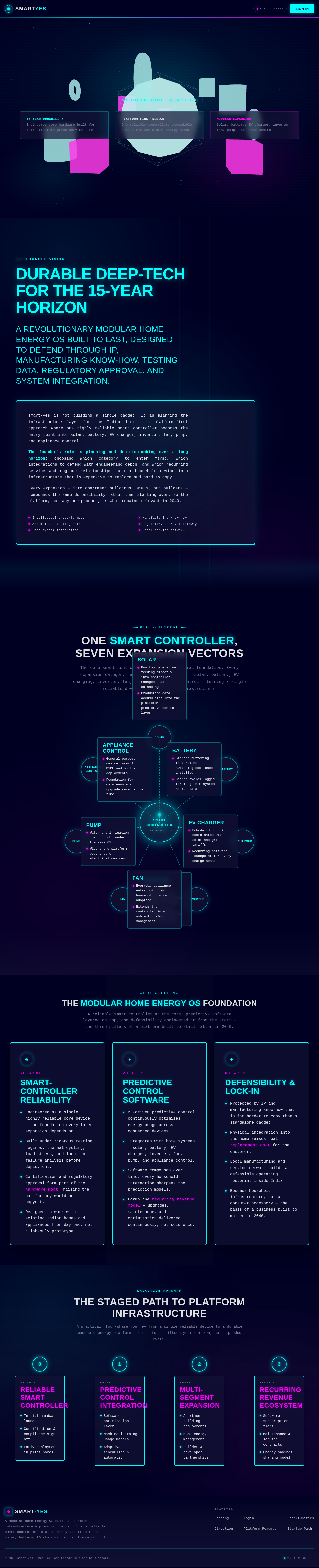
Founder Vision
Durable Deep-Tech for the 15-Year Horizon
A revolutionary Modular Home Energy OS built to last, designed to defend through IP, manufacturing know-how, testing data, regulatory approval, and system integration.
smart-yes is not building a single gadget. It is planning the infrastructure layer for the Indian home — a platform-first approach where one highly reliable smart controller becomes the entry point into solar, battery, EV charger, inverter, fan, pump, and appliance control.
The founder's role is planning and decision-making over a long horizon: choosing which category to enter first, which integrations to defend with engineering depth, and which recurring service and upgrade relationships turn a household device into infrastructure that is expensive to replace and hard to copy.
Every expansion — into apartment buildings, MSMEs, and builders — compounds the same defensibility rather than starting over, so the platform, not any one product, is what remains relevant in 2040.
- Intellectual property moat
- Manufacturing know-how
- Accumulated testing data
- Regulatory approval pathway
- Deep system integration
- Local service network
One Smart Controller, Seven Expansion Vectors
The core smart-controller is the architectural foundation. Every expansion category radiates outward from it — solar, battery, EV charging, inverter, fan, pump and appliance control — turning a single reliable device into household infrastructure.
Solar
- Rooftop generation feeding directly into controller-managed load balancing
- Production data accumulates into the platform’s predictive control layer
Battery
- Storage buffering that raises switching cost once installed
- Charge cycles logged for long-term system health data
EV Charger
- Scheduled charging coordinated with solar and grid tariffs
- Recurring software touchpoint for every charge session
Inverter
- Core power-conversion link between generation, storage and load
- Deepens system integration across the energy stack
Fan
- Everyday appliance entry point for household control adoption
- Extends the controller into ambient comfort management
Pump
- Water and irrigation load brought under the same OS
- Widens the platform beyond pure electrical devices
Appliance Control
- General-purpose device layer for MSME and builder deployments
- Foundation for maintenance and upgrade revenue over time
Solar
- Rooftop generation feeding directly into controller-managed load balancing
- Production data accumulates into the platform’s predictive control layer
Battery
- Storage buffering that raises switching cost once installed
- Charge cycles logged for long-term system health data
EV Charger
- Scheduled charging coordinated with solar and grid tariffs
- Recurring software touchpoint for every charge session
Inverter
- Core power-conversion link between generation, storage and load
- Deepens system integration across the energy stack
Fan
- Everyday appliance entry point for household control adoption
- Extends the controller into ambient comfort management
Pump
- Water and irrigation load brought under the same OS
- Widens the platform beyond pure electrical devices
Appliance Control
- General-purpose device layer for MSME and builder deployments
- Foundation for maintenance and upgrade revenue over time
The Modular Home Energy OS Foundation
A reliable smart controller at the core, predictive software layered on top, and defensibility engineered in from the start — the three pillars of a platform built to still matter in 2040.
Smart-Controller Reliability
- Engineered as a single, highly reliable core device — the foundation every later expansion depends on.
- Built under rigorous testing regimes: thermal cycling, load stress, and long-run failure analysis before deployment.
- Certification and regulatory approval form part of the hardware moat, raising the bar for any would-be copycat.
- Designed to work with existing Indian homes and appliances from day one, not a lab-only prototype.
Predictive Control Software
- ML-driven predictive control continuously optimizes energy usage across connected devices.
- Integrates with home systems — solar, battery, EV charger, inverter, fan, pump, and appliance control.
- Software compounds over time: every household interaction sharpens the prediction models.
- Forms the recurring revenue model — upgrades, maintenance, and optimization delivered continuously, not sold once.
Defensibility & Lock-in
- Protected by IP and manufacturing know-how that is far harder to copy than a standalone gadget.
- Physical integration into the home raises real replacement cost for the customer.
- Local manufacturing and service network builds a defensible operating footprint inside India.
- Becomes household infrastructure, not a consumer accessory — the basis of a business built to matter in 2040.
Execution Roadmap
The Staged Path to Platform Infrastructure
A practical, four-phase journey from a single reliable device to a durable household energy platform — built for a fifteen-year horizon, not a product cycle.
Phase 0
Reliable Smart-Controller
- Initial hardware launch
- Certification & compliance sign-off
- Early deployment in pilot homes
Phase 1
Predictive Control Integration
- Software optimization layer
- Machine learning usage models
- Adaptive scheduling & automation
Phase 2
Multi-Segment Expansion
- Apartment building deployments
- MSME energy management
- Builder & developer partnerships
Phase 3
Recurring Revenue Ecosystem
- Software subscription tiers
- Maintenance & service contracts
- Energy savings sharing model
Founder Vision
Durable Deep-Tech for the 15-Year Horizon
A revolutionary Modular Home Energy OS built to last, designed to defend through IP, manufacturing know-how, testing data, regulatory approval, and system integration.
smart-yes is not building a single gadget. It is planning the infrastructure layer for the Indian home — a platform-first approach where one highly reliable smart controller becomes the entry point into solar, battery, EV charger, inverter, fan, pump, and appliance control.
The founder's role is planning and decision-making over a long horizon: choosing which category to enter first, which integrations to defend with engineering depth, and which recurring service and upgrade relationships turn a household device into infrastructure that is expensive to replace and hard to copy.
Every expansion — into apartment buildings, MSMEs, and builders — compounds the same defensibility rather than starting over, so the platform, not any one product, is what remains relevant in 2040.
- Intellectual property moat
- Manufacturing know-how
- Accumulated testing data
- Regulatory approval pathway
- Deep system integration
- Local service network
One Smart Controller, Seven Expansion Vectors
The core smart-controller is the architectural foundation. Every expansion category radiates outward from it — solar, battery, EV charging, inverter, fan, pump and appliance control — turning a single reliable device into household infrastructure.
Solar
- Rooftop generation feeding directly into controller-managed load balancing
- Production data accumulates into the platform’s predictive control layer
Battery
- Storage buffering that raises switching cost once installed
- Charge cycles logged for long-term system health data
EV Charger
- Scheduled charging coordinated with solar and grid tariffs
- Recurring software touchpoint for every charge session
Inverter
- Core power-conversion link between generation, storage and load
- Deepens system integration across the energy stack
Fan
- Everyday appliance entry point for household control adoption
- Extends the controller into ambient comfort management
Pump
- Water and irrigation load brought under the same OS
- Widens the platform beyond pure electrical devices
Appliance Control
- General-purpose device layer for MSME and builder deployments
- Foundation for maintenance and upgrade revenue over time
Solar
- Rooftop generation feeding directly into controller-managed load balancing
- Production data accumulates into the platform’s predictive control layer
Battery
- Storage buffering that raises switching cost once installed
- Charge cycles logged for long-term system health data
EV Charger
- Scheduled charging coordinated with solar and grid tariffs
- Recurring software touchpoint for every charge session
Inverter
- Core power-conversion link between generation, storage and load
- Deepens system integration across the energy stack
Fan
- Everyday appliance entry point for household control adoption
- Extends the controller into ambient comfort management
Pump
- Water and irrigation load brought under the same OS
- Widens the platform beyond pure electrical devices
Appliance Control
- General-purpose device layer for MSME and builder deployments
- Foundation for maintenance and upgrade revenue over time
The Modular Home Energy OS Foundation
A reliable smart controller at the core, predictive software layered on top, and defensibility engineered in from the start — the three pillars of a platform built to still matter in 2040.
Smart-Controller Reliability
- Engineered as a single, highly reliable core device — the foundation every later expansion depends on.
- Built under rigorous testing regimes: thermal cycling, load stress, and long-run failure analysis before deployment.
- Certification and regulatory approval form part of the hardware moat, raising the bar for any would-be copycat.
- Designed to work with existing Indian homes and appliances from day one, not a lab-only prototype.
Predictive Control Software
- ML-driven predictive control continuously optimizes energy usage across connected devices.
- Integrates with home systems — solar, battery, EV charger, inverter, fan, pump, and appliance control.
- Software compounds over time: every household interaction sharpens the prediction models.
- Forms the recurring revenue model — upgrades, maintenance, and optimization delivered continuously, not sold once.
Defensibility & Lock-in
- Protected by IP and manufacturing know-how that is far harder to copy than a standalone gadget.
- Physical integration into the home raises real replacement cost for the customer.
- Local manufacturing and service network builds a defensible operating footprint inside India.
- Becomes household infrastructure, not a consumer accessory — the basis of a business built to matter in 2040.
Execution Roadmap
The Staged Path to Platform Infrastructure
A practical, four-phase journey from a single reliable device to a durable household energy platform — built for a fifteen-year horizon, not a product cycle.
Phase 0
Reliable Smart-Controller
- Initial hardware launch
- Certification & compliance sign-off
- Early deployment in pilot homes
Phase 1
Predictive Control Integration
- Software optimization layer
- Machine learning usage models
- Adaptive scheduling & automation
Phase 2
Multi-Segment Expansion
- Apartment building deployments
- MSME energy management
- Builder & developer partnerships
Phase 3
Recurring Revenue Ecosystem
- Software subscription tiers
- Maintenance & service contracts
- Energy savings sharing model
No comments yet. Be the first!