ruby-presentation
 Roaa Foqhaa
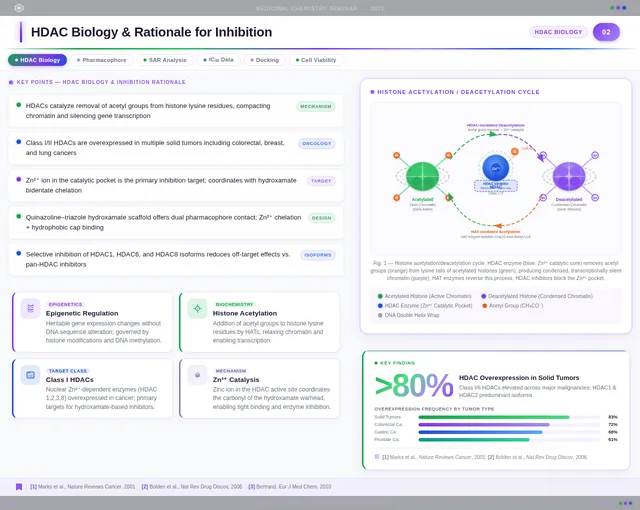
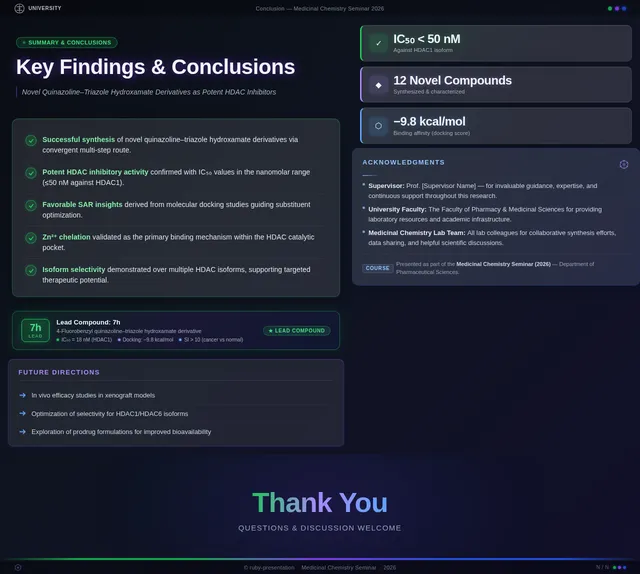
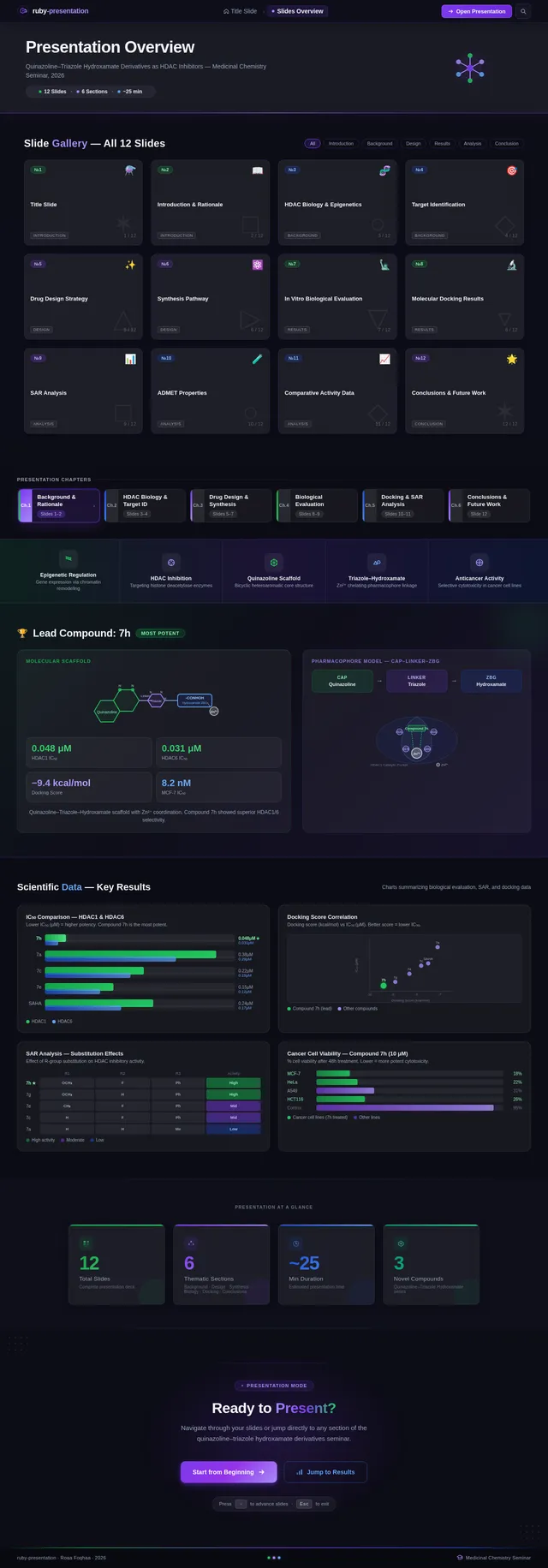
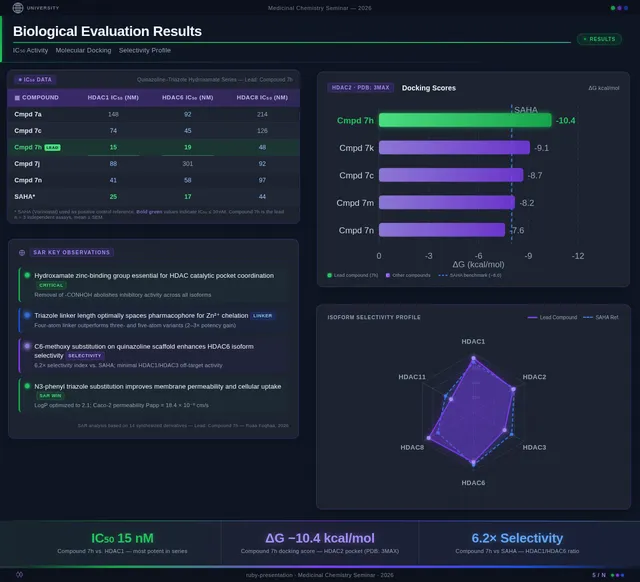
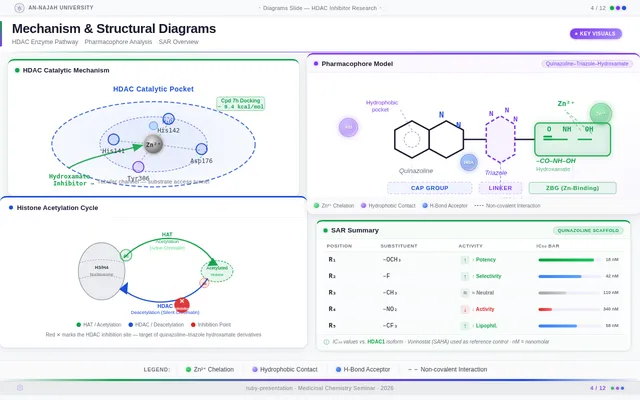
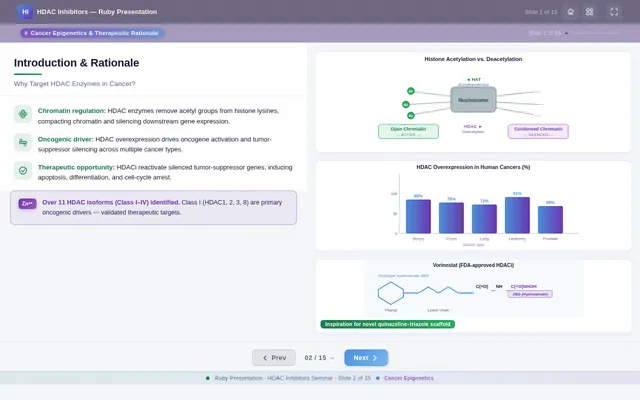
Create a clean academic PowerPoint presentation suitable for a medicinal chemistry seminar. Use minimal text, high-quality scientific diagrams, and a professional layout. General visual style: White or light-gray backgrounds, clear typography, and consistent use of colors (green, purple, and blue accents across slides). 🎓 Title Slide Design, Synthesis, and Biological Evaluation of Novel Quinazoline–Triazole Hydroxamate Derivatives as Potent HDAC Inhibitors Gamma design instructions: Title centered in large clear font. Below the title include: • Student names • University name • Course name • Professor name • Date Image placement: On the right side place a scientific visualization of an HDAC enzyme catalytic pocket with inhibitor binding. Ensure the Zn²⁺ ion appears as a silver metallic sphere inside the catalytic pocket. Background colors: Subtle scientific gradient using green, purple, and blue. --- 🟢 Slide 1 – Cancer Epigenetics & Therapeutic Rationale • Cancer progression involves both genetic mutations and epigenetic dysregulation. • Histone acetylation promotes transcriptional activation, while deacetylation induces gene repression. • Overexpression of several HDAC isoforms (HDAC1, 2, 3, 6, and 8) has been strongly associated with tumor progression. • Clinically approved hydroxamate-based inhibitors such as Vorinostat demonstrate potent activity but limited isoform selectivity and potential systemic toxicity. 🔎 Therefore, structural optimization of HDAC inhibitors remains a critical medicinal chemistry challenge. Gamma layout instructions: Divide the slide into two halves. Left side: Current text. Right side: Two scientific illustrations. Image 1: Histone acetylation vs deacetylation diagram showing open chromatin vs closed chromatin and gene expression. Image 2: Illustration showing HDAC overexpression leading to cancer progression. Below the images add a small visual: Chemical structure of Vorinostat. --- 🟢 Slide 2 – Structural Biology of HDAC Enzymes • HDACs are Zn²⁺-dependent metalloenzymes. • The catalytic Zn²⁺ ion is located at the base of a narrow hydrophobic channel. • A surface recognition pocket stabilizes ligand binding. • Effective inhibition requires precise Zn²⁺ chelation combined with optimal surface interactions. • HDAC1 was selected as the representative Class I isoform for computational docking studies. Gamma instructions: Large scientific diagram on the right: HDAC catalytic pocket with Zn²⁺ ion. Ensure the diagram clearly shows: • Zn²⁺ ion • catalytic tunnel • binding pocket Add arrows labeling: Zn²⁺ ion catalytic channel surface pocket. Text on the left. --- 🟢 Slide 3 – Classical HDAC Pharmacophore Model HDAC inhibitors share a conserved pharmacophore model: • Zinc Binding Group (ZBG) → coordinates catalytic Zn²⁺ • Hydrophobic linker → spans the catalytic tunnel • Cap group → interacts with surface residues This model guided the rational design of the new scaffold. Gamma instructions: Create a pharmacophore diagram showing: Cap group Linker Zinc Binding Group Color scheme: Cap group – blue Linker – gray ZBG – red Place diagram in the center of the slide. --- 🟢 Slide 4 – Lead Compound Identification & Medicinal Chemistry Rationale Design Rationale • Hydroxamate inhibitors show strong potency but suboptimal selectivity. • Structural refinement aimed to improve binding orientation, electronic balance, and isoform selectivity. Hybrid Lead Design A quinazoline–triazole–hydroxamate scaffold was selected. Functional Contributions • Hydroxamic acid (Zinc-Binding Functional Group) → bidentate Zn²⁺ chelation • Triazole → conformational rigidity & hydrogen bonding • Quinazoline → hydrophobic cap interaction & π–π stacking • Substituent tuning → steric and electronic optimization Gamma instructions: Display labeled chemical structure: quinazoline–triazole–hydroxamate scaffold. Add arrows pointing to: Hydroxamic acid Triazole Quinazoline Use standard atom colors: N blue O red C gray Ensure bromine (Br) at position 7 appears reddish-brown. Place structure in the center. --- 🟢 Slide 5 – Research Objective & Experimental Workflow Objective To design, synthesize, and biologically evaluate novel quinazoline–triazole hydroxamate derivatives as potent and selective HDAC inhibitors. Workflow • Rational scaffold design • Multi-step synthesis • Structural confirmation (¹H NMR, ¹³C NMR, HRMS) • HDAC inhibition assay (IC₅₀ determination) • Anticancer activity evaluation • Molecular docking for SAR validation Gamma instructions: Create a scientific workflow diagram: Design ↓ Synthesis ↓ Characterization ↓ HDAC assay ↓ Anticancer assay ↓ Docking study Add scientific icons for each step. --- 🟣 Slide 6 – Rational Drug Design Strategy • Hybridization of pharmacophoric fragments • Quinazoline (cap) + Triazole (linker) + Hydroxamic acid (ZBG) • Two linker series developed: – Series 7: N-hydroxybenzamides – Series 11: N-hydroxypropenamides • Systematic substitution at positions 6 and 7 of quinazoline core Gamma instructions: Create fragment-based drug design diagram. Show three fragments: Quinazoline structure Triazole structure Hydroxamic acid structure Arrows leading to hybrid molecule. --- 🟣 Slide 7 – Structural Mapping • Hydroxamic acid → Zn²⁺ chelation • Triazole → orientation control within the catalytic channel • Quinazoline → surface hydrophobic interaction and π–π stacking • Halogen or alkyl substituents → electronic and steric modulation Gamma instructions: Annotated chemical structure with arrows showing: Zn²⁺ chelation Catalytic channel orientation Cap interaction. --- 🟣 Slide 8 – Synthetic Overview • Quinazoline core formation via cyclization • Cu(I)-catalyzed azide–alkyne cycloaddition (“click chemistry”) • Final hydroxaminolysis to generate active hydroxamic acid ZBG • Target compounds 7a–i and 11a–i obtained and fully characterized Gamma instructions: Show synthetic reaction scheme: Step 1 – cyclization Step 2 – click chemistry Step 3 – hydroxaminolysis. --- 🟣 Slide 9 – SAR: Linker Optimization • Series 7 (benzamide) showed stronger HDAC inhibition. • The rigid benzamide linker allows optimal Zn²⁺ alignment within the catalytic tunnel. • Series 11 (propenamide) demonstrated slightly weaker enzymatic inhibition but notable antiproliferative effects. • Increased linker flexibility may reduce optimal Zn²⁺ coordination geometry. Gamma instructions: Create comparison table and bar chart: Series | Linker | HDAC activity Series 7 | Benzamide | Strong Series 11 | Propenamide | Moderate --- 🟣 Slide 10 – SAR: Substituent Effects • 7-Br substitution (Compound 7h) → IC₅₀ = 0.142 µM • 7-CH₃ substitution (Compound 7c) → IC₅₀ = 0.146 µM • 6-Cl derivatives (7d, 11d) showed strongest cytotoxicity • Halogen substitution enhanced hydrophobic pocket interaction Gamma instructions: Create SAR table and IC50 bar chart. Add diagram highlighting quinazoline substitution positions 6 and 7. --- 🔵 Slide 11 – Enzymatic Inhibition Results • Several compounds exhibited submicromolar HDAC inhibition. • Compound 7h exhibited the strongest enzymatic inhibition (IC₅₀ = 0.142 µM), demonstrating comparable and slightly improved potency relative to Vorinostat (IC₅₀ ≈ 0.160 µM) under identical assay conditions. • These findings confirm enhanced enzymatic inhibition within the optimized Series 7 derivatives. Gamma instructions: Create bar chart comparing IC50 values of compounds vs Vorinostat. Highlight compound 7h. --- 🔵 Slide 12 – Anticancer Activity • Compounds were evaluated against SW620 and MDA-MB-231 cancer cell lines. • Compound 7h exhibited the highest cytotoxic potency. • Compounds 7d and 11d induced G2/M cell cycle arrest. • Significant apoptosis induction was observed. • Favorable selectivity toward cancer cells over normal MRC-5 fibroblasts was confirmed. Gamma instructions: Create bar chart showing cell viability. Add small apoptosis microscopy illustration. --- 🔵 Slide 13 – Molecular Docking • Docking was performed against the HDAC1 isoform catalytic pocket. • Compound 7h demonstrated the most stable binding conformation with a docking score of –9.4 kcal/mol. • Vorinostat exhibited a docking score of –8.6 kcal/mol under identical computational conditions. • Hydroxamic acid formed strong bidentate coordination with Zn²⁺ (~2.0 Å). Gamma instructions: Show docking visualization inside HDAC1 catalytic pocket. Ensure image clearly shows: Zn²⁺ ion hydroxamate coordination binding pocket. Display coordination bonds (~2.0 Å) as yellow dashed lines. Add small table: Compound | Docking score 7h | −9.4 Vorinostat | −8.6 --- 🔵 Slide 14 – Functional Group–Docking Correlation • Docking score of compound 7h (–9.4 kcal/mol) correlates with its lower IC₅₀ value (0.142 µM). • This agreement validates the rational drug design strategy. • Enhanced Zn²⁺ chelation and hydrophobic stabilization explain improved inhibition. Gamma instructions: Create correlation scatter plot: Docking score vs IC50. Add interaction diagram showing: Zn²⁺ coordination hydrophobic interactions. --- 🔵 Slide 15 – Conclusion • A novel quinazoline–triazole–hydroxamate series was developed. • Several derivatives demonstrated superior activity compared with Vorinostat. • Compound 7h emerged as the lead candidate. Reasons: – Highest HDAC inhibition (IC₅₀ = 0.142 µM) – Superior docking score (–9.4 kcal/mol) – Potent anticancer activity – Favorable selectivity profile Gamma instructions: Display chemical structure of compound 7h at center. Add highlight box: Lead compound: 7h IC50 = 0.142 µM Docking score = −9.4 kcal/mol Bottom note: Future perspective: next-generation isoform-selective HDAC inhibitors.


Comments (0)
Sign in to leave a comment
System Requirements
System Requirements Document (SRD)
Project Name: ruby-presentation
1. Introduction
The ruby-presentation project is a high-quality academic PowerPoint presentation tailored for a medicinal chemistry research seminar. The presentation will focus on the design, synthesis, and biological evaluation of novel quinazoline–triazole hydroxamate derivatives as potent HDAC inhibitors. This document outlines the system requirements for creating a clean, visually engaging, and scientifically accurate presentation.
The presentation will be delivered in English, as requested by Roaa Foqhaa, and will adhere to a professional academic style suitable for an international audience. The design will incorporate minimal text, high-quality scientific diagrams, and a consistent color theme of green, purple, and blue accents.
2. System Overview
The ruby-presentation project aims to deliver a visually appealing and scientifically rigorous PowerPoint presentation. The presentation will include:
- Minimal text for clarity and focus.
- High-quality scientific diagrams and illustrations, comparable to those in Nature Reviews Drug Discovery and Journal of Medicinal Chemistry.
- A professional layout with consistent use of green, purple, and blue accents.
- A clean and academic design suitable for medicinal chemistry seminars.
The final deliverable will be a PowerPoint file (.pptx) that is ready for presentation.
3. Functional Requirements
- As a User, I should be able to present the slides in English with a professional academic style.
- As a User, I should see minimal text and high-quality scientific diagrams on each slide.
- As a User, I should have consistent green, purple, and blue accents across all slides.
- As a User, I should see a clean and professional layout suitable for medicinal chemistry seminars.
- As a User, I should have a title slide that includes the title, student names, university name, course name, professor name, and date.
- As a User, I should see scientific visualizations, such as HDAC enzyme catalytic pockets, histone acetylation diagrams, and molecular docking results.
- As a User, I should see SAR charts, IC50 comparisons, docking score correlations, and cancer cell viability charts.
- As a User, I should see compound 7h highlighted as the lead compound in the presentation.
- As a User, I should see a synthetic scheme for the quinazoline–triazole–hydroxamate scaffold.
- As a User, I should see a pharmacophore model diagram (Cap–Linker–ZBG).
4. User Personas
-
Presenter (Roaa Foqhaa)
- Role: Graduate student or researcher presenting the seminar.
- Needs: A professional and visually engaging PowerPoint presentation that effectively communicates complex scientific concepts.
-
Audience
- Role: Professors, researchers, and students attending the seminar.
- Needs: Clear and concise slides with minimal text and high-quality visuals to understand the research findings.
5. Visuals Colors and Theme
The presentation will use a white or light-gray background with the following accent colors:
- Green: To represent growth, health, and medicinal themes.
- Purple: To convey creativity and academic sophistication.
- Blue: To symbolize trust, professionalism, and scientific rigor.
Typography:
- Clear and professional fonts such as Arial or Calibri for readability.
- Consistent font sizes for titles, subtitles, and body text.
6. Signature Design Concept
Dynamic Molecular Visualization Landing Slide
The title slide will feature a dynamic molecular visualization of an HDAC enzyme catalytic pocket. The visualization will include:
- A 3D rotating model of the HDAC enzyme with a bound inhibitor.
- The Zn²⁺ ion will appear as a silver metallic sphere, dynamically reflecting light as the model rotates.
- The background will feature a gradient blend of green, purple, and blue, subtly shifting as the molecule rotates.
- The title will be centered in a large, bold font, with the student names, university name, course name, professor name, and date displayed below in smaller, clean text.
This dynamic and visually striking design will immediately captivate the audience and set the tone for the presentation.
7. Non-Functional Requirements
- The presentation must be visually appealing and professional.
- The file must be delivered in English.
- The PowerPoint file should be compatible with Microsoft PowerPoint 2016 or later.
- The presentation should be optimized for display on a standard 16:9 aspect ratio screen.
8. Tech Stack
-
Design Tools:
- Microsoft PowerPoint for slide creation.
- Adobe Illustrator or ChemDraw for creating high-quality scientific diagrams.
- PyMOL or Chimera for molecular visualizations.
-
File Format:
- PowerPoint (.pptx).
9. Assumptions and Constraints
- The presentation will be delivered in English only.
- The presentation will be designed for an academic audience with a background in medicinal chemistry.
- The diagrams and visuals will be scientifically accurate and sourced from reliable tools or literature.
- The project assumes access to molecular visualization tools and scientific diagram software.
10. Glossary
- HDAC: Histone Deacetylase, an enzyme involved in epigenetic regulation.
- Zn²⁺: Zinc ion, a key component of the HDAC catalytic pocket.
- IC₅₀: Half-maximal inhibitory concentration, a measure of the potency of a substance in inhibiting a specific biological or biochemical function.
- SAR: Structure-Activity Relationship, the relationship between the chemical structure of a molecule and its biological activity.
- Pharmacophore: The part of a molecule responsible for its biological activity.
This document outlines the requirements for the ruby-presentation project and ensures that the final deliverable meets the expectations of Roaa Foqhaa and the intended audience. The presentation will be delivered in English and will adhere to the highest standards of academic and scientific communication.

Design, Synthesis, and Biological Evaluation of Novel Quinazoline–Triazole Hydroxamate Derivatives as Potent HDAC Inhibitors
Exploring next-generation epigenetic modulators for targeted cancer therapy
No comments yet. Be the first!