project-84291e4c
🚀 HACKATHON PROJECT BRIEF: PROJECT LOCALSYNC The Real-Time Field Operations & Command Center Ecosystem (8-Hour Sprint) 📋 1. PROJECT OVERVIEW Your team is tasked with building LocalSync, a cross-platform logistics and coordination ecosystem designed for fast-paced field operations. Due to the aggressive 8-hour timeline, the team must focus strictly on the Core Real-Time Loop: building an API that instantly links a lightweight Mobile tracking interface with a Desktop monitoring dashboard. 🛠️ 2. MINIMAL VIABLE PRODUCT (MVP) REQUIREMENTS A. The Backend API (The Brain) Live Stream: Implement a simple WebSockets or Server-Sent Events (SSE) server to receive and broadcast coordinates.Volatile In-Memory Storage: Skip complex database migrations. Store active user locations in global memory arrays or a simple JSON file for instant speed.Single Dispatch Endpoint: A basic HTTP POST endpoint to assign a task ID to an agent ID.B. The Mobile App (The Field Agent) Coordinate Ping: A single screen with a "Go Online" toggle button that sends simulated or real location updates every 3 seconds via WebSockets.Task Alert: A simple pop-up or layout change that flashes when a task is pushed to them from the desktop command center, with a single button to click "Complete".C. The Desktop App (The Command Center) The Live Map: A layout rendering a map web-view showing the live, moving point of the mobile user.Instant Dispatch Button: Next to the map, a list of available agents with a manual button next to their name that instantly pushes a task to their phone. ⚠️ 3. STRICT 8-HOUR CONSTRAINTS & RULES Code Sharing is Mandatory: The team must use a single language or framework ecosystem across all environments (e.g., Flutter for both apps, or a TypeScript Monorepo for Node/React/Electron) to eliminate context switching.No Advanced Polish: Do not waste time on secure user registration, forgot password loops, cloud media storage, or complex CSS styling. Use raw UI components or a basic component library.The "One-Device" Demo Rule: Because time is short, the mobile app can be run inside an emulator on the exact same computer running the desktop app to simplify deployment and testing. ⏱️ 4. CRITICAL 8-HOUR SPRINT MILESTONES Hour 0–1 (The Blueprint): Initialize your monorepo. Define your shared JSON payload interface (what does a location update look like?). Boot up a skeleton backend server.Hour 1–3 (The Data Bridge): Establish the raw WebSocket connection. Verify that typing mock coordinates into a mobile text-box prints them live in the desktop terminal console.Hour 3–5 (The Visual Loop): Hook up the map library on the Desktop app to show the pin moving visually. Hook up the simple task push button.Hour 5–7 (The Workflow & Integration): Verify the entire end-to-end loop: Dispatch from Desktop ➡️ Alert pops up on Mobile ➡️ Click complete on Mobile ➡️ Desktop updates.Hour 7–8 (The Freeze & Demo prep): Hard code-freeze. Do not touch any core files. Practice the 3-minute live presentation run-through to make sure it functions perfectly for the judges. 📊 5. JUDGING & EVALUATION CRITERIA CriteriaWeightWhat Judges Look ForReal-Time Data Flow40%Does moving the mobile client immediately update the desktop dashboard without refreshing?End-to-End Workflow30%Can you successfully push a task to the mobile app and see it get completed?Speed & Resourcefulness20%How smartly did the team cut scope and reuse code to match the 8-hour limit?Pitch & Demo Stability10%A working, live, crash-free presentation. 📤 6. SUBMISSION TEMPLATE Repository Link:[Insert Code URL here]Tech Stack Used:[Frontend, Backend, Desktop, Mobile]How to run it in under 60 seconds:[Provide exactly 2 or 3 terminal terminal commands to boot the whole stack up for the judges] Good luck, team! Under an 8-hour constraint, a dirty, working prototype is 100 times better than beautiful, broken code.


Comments (0)
Sign in to leave a comment
System Requirements
project-84291e4c System Requirements Document
1. Introduction
The purpose of this document is to outline the system requirements for project-84291e4c, a cross-platform logistics and coordination ecosystem named LocalSync. This project is designed for fast-paced field operations and must be completed within an aggressive 8-hour timeline. The focus is on building a real-time API that links a mobile tracking interface with a desktop monitoring dashboard.
2. System Overview
LocalSync is a real-time field operations and command center ecosystem. It consists of a backend API, a mobile application for field agents, and a desktop application for command center operations. The system is designed to facilitate seamless communication and coordination between field agents and command center operators.
2a. Source Content Inventory
- Backend API: WebSockets or Server-Sent Events (SSE) server for real-time data transmission.
- Mobile App: Single screen interface with location updates and task alerts.
- Desktop App: Live map view and task dispatch functionality.
3. Functional Requirements as Story Points
- As a Developer, I should be able to initialize a monorepo to manage shared code across environments.
- As a Backend Developer, I should be able to implement a WebSockets or SSE server to handle real-time data transmission.
- As a Mobile User, I should be able to toggle "Go Online" to send location updates every 3 seconds.
- As a Mobile User, I should receive a task alert with an option to mark it as complete.
- As a Command Center Operator, I should be able to view a live map with real-time location updates.
- As a Command Center Operator, I should be able to dispatch tasks to mobile users instantly.
4. User Personas
- Developer: Responsible for setting up the monorepo and ensuring code consistency across platforms.
- Backend Developer: Focuses on implementing the real-time API and managing data flow.
- Mobile User: Field agent using the mobile app to send location updates and receive tasks.
- Command Center Operator: Uses the desktop app to monitor field operations and dispatch tasks.
5. Core User Flows
- Developer initializes monorepo -> Backend Developer sets up WebSockets/SSE -> Mobile User goes online -> Command Center Operator dispatches task -> Mobile User completes task -> Desktop updates.
6. Visuals Colors and Theme
- primary: #1E90FF (Dodger Blue)
- primary_light: #63B8FF (Light Sky Blue)
- secondary: #FF6347 (Tomato)
- accent: #32CD32 (Lime Green)
- highlight: #FFD700 (Gold)
- bg: #F0F8FF (Alice Blue)
- surface: rgba(255, 255, 255, 0.8)
- text: #000000 (Black)
- text_muted: #696969 (Dim Gray)
- border: rgba(0, 0, 0, 0.1)
7. Signature Design Concept
Interactive Command Center Map
The homepage will feature an interactive map that serves as the command center's focal point. The map will display real-time movements of field agents as dynamic, animated pins. Users can click on these pins to view agent details and dispatch tasks. The map will have a fluid zoom and pan feature, allowing operators to focus on specific areas. The task dispatch button will animate with a ripple effect when clicked, providing visual feedback. The map will be built using motion/react for smooth animations and transitions.
Landing Hero Motion Brief
The landing hero will depict a real-time transformation of field operations. As agents move, their paths will illuminate on the map, showcasing the dynamic nature of the operations. The animation will loop every 10 seconds, highlighting the seamless coordination between mobile and desktop applications. The animation will pause when the user interacts with the map, providing a clear view of the operations.
8. Interaction Model & Motion Direction
- Intended Interaction Model: Animated
- The landing page will feature moderate scroll-triggered reveals and hover transitions. Interactive elements will have spring physics for a polished user experience. The map will have layered depth with animated pins and task dispatch interactions.
9. Non-Functional Requirements
- The system must support real-time data flow with minimal latency.
- The application should be lightweight to ensure quick deployment and testing.
- Code sharing across platforms is mandatory to reduce context switching.
10. Tech Stack
- Frontend: React for Web
- Backend: Node.js with WebSockets or SSE
- Mobile: React Native
- Desktop: Electron
11. Assumptions and Constraints
- The project must be completed within an 8-hour timeframe.
- The mobile app can be run inside an emulator on the same computer as the desktop app.
- No advanced polish or complex features are required beyond the MVP.
12. Glossary
- WebSockets: A protocol for full-duplex communication channels over a single TCP connection.
- SSE (Server-Sent Events): A server push technology enabling a server to push real-time updates to a client.
- Monorepo: A single repository containing multiple projects, allowing for shared code and resources.
- MVP (Minimal Viable Product): The most basic version of a product that can be released to test a new business idea.
WebSocket-Powered
Field Operations
Coordinate mobile field agents and command center operators in real time with a WebSocket and SSE backend built for zero-latency dispatch.
Everything Your Backend Needs
Four pillars that power real-time field coordination — from connection to verification.
WebSocket Server
Full-duplex, bidirectional communication channel enabling instant data exchange between field agents and command centers with sub-100ms latency.
SSE Broadcast
Server-Sent Events stream live location updates and task status changes to every connected desktop client simultaneously.
Task Dispatch API
REST endpoint for command operators to create and assign tasks instantly. Pushed to the nearest available agent via WebSocket.
Data Flow Verification
End-to-end testing harness validates the full pipeline — from mobile location ping through server processing to desktop map update.
Built for Real-Time
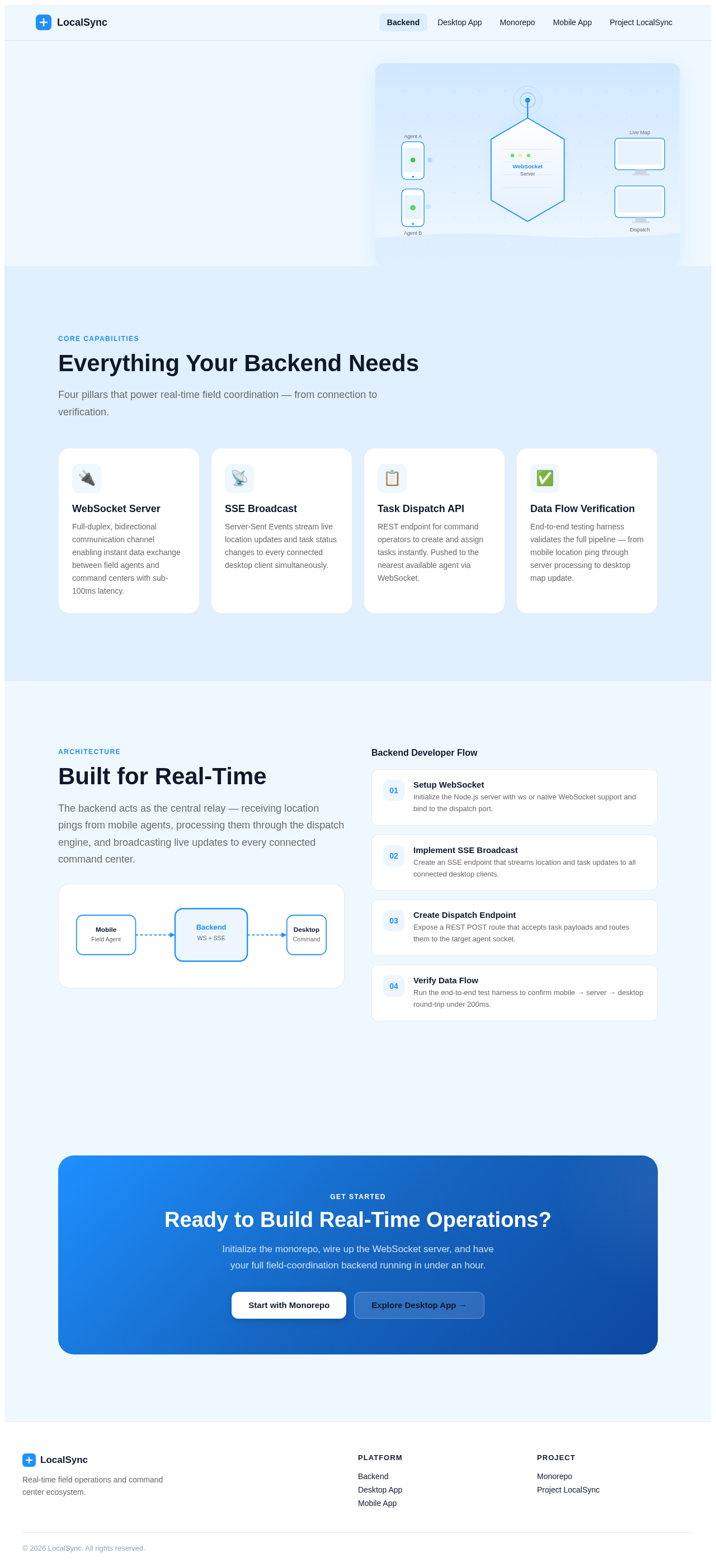
The backend acts as the central relay — receiving location pings from mobile agents, processing them through the dispatch engine, and broadcasting live updates to every connected command center.
Backend Developer Flow
Setup WebSocket
Initialize the Node.js server with ws or native WebSocket support and bind to the dispatch port.
Implement SSE Broadcast
Create an SSE endpoint that streams location and task updates to all connected desktop clients.
Create Dispatch Endpoint
Expose a REST POST route that accepts task payloads and routes them to the target agent socket.
Verify Data Flow
Run the end-to-end test harness to confirm mobile → server → desktop round-trip under 200ms.
Ready to Build Real-Time Operations?
Initialize the monorepo, wire up the WebSocket server, and have your full field-coordination backend running in under an hour.
WebSocket-Powered
Field Operations
Coordinate mobile field agents and command center operators in real time with a WebSocket and SSE backend built for zero-latency dispatch.
Everything Your Backend Needs
Four pillars that power real-time field coordination — from connection to verification.
WebSocket Server
Full-duplex, bidirectional communication channel enabling instant data exchange between field agents and command centers with sub-100ms latency.
SSE Broadcast
Server-Sent Events stream live location updates and task status changes to every connected desktop client simultaneously.
Task Dispatch API
REST endpoint for command operators to create and assign tasks instantly. Pushed to the nearest available agent via WebSocket.
Data Flow Verification
End-to-end testing harness validates the full pipeline — from mobile location ping through server processing to desktop map update.
Built for Real-Time
The backend acts as the central relay — receiving location pings from mobile agents, processing them through the dispatch engine, and broadcasting live updates to every connected command center.
Backend Developer Flow
Setup WebSocket
Initialize the Node.js server with ws or native WebSocket support and bind to the dispatch port.
Implement SSE Broadcast
Create an SSE endpoint that streams location and task updates to all connected desktop clients.
Create Dispatch Endpoint
Expose a REST POST route that accepts task payloads and routes them to the target agent socket.
Verify Data Flow
Run the end-to-end test harness to confirm mobile → server → desktop round-trip under 200ms.
Ready to Build Real-Time Operations?
Initialize the monorepo, wire up the WebSocket server, and have your full field-coordination backend running in under an hour.
No comments yet. Be the first!