prime-ai
 Janvi S
Scope of Work (SOW) Project: AI-Based Design & Schematic Generation Platform 1. Objective To develop an AI-powered chat-based application that enables users to describe ideas via text, image, or video and receive design schematics, 2D/3D models, and build guidance for real-world product creation. 2. Scope Overview The system will function as an AI Design Assistant, capable of: Understanding user intent through conversational interaction Processing multi-modal inputs (text, image, video) Generating conceptual and semi-technical design outputs Delivering structured outputs such as schematics, models, and step-by-step instructions 3. Input Modes (Core Differentiator) The platform will support three types of user inputs: 1. Text-Based Input (ChatGPT-style) Users describe ideas via text AI interprets and generates design outputs Iterative refinement via conversation 2. Image-Based Input Users upload reference images AI analyzes structure, components, and form Generates similar or improved design schematics 3. Video-Based Input (Phase-wise) Users upload short videos for reference AI extracts frames and key elements Generates structured design outputs based on motion/structure understanding 4. Key Modules & Features 4.1 Chat Interface Conversational UI (ChatGPT-like) Multi-modal input: text, image, video Context-aware interactions Iterative design refinement 4.2 AI Processing Engine LLM integration for reasoning and interaction Prompt orchestration and memory management Multi-step design reasoning workflows 4.3 Vision Processing Module Image and video frame analysis Object detection and feature extraction Reference-based design interpretation 4.4 Design Generation Module Conceptual design generation 2D schematics (diagrams, layouts) Basic 3D model generation (STL/OBJ) System architecture diagrams 4.5 Output & Export Module Export formats: STL / OBJ / PDF / Images Bill of Materials (basic) Step-by-step build instructions Downloadable design reports 4.6 Iteration & Customization Modify designs via prompts Adjust constraints (size, cost, materials) Version history of designs 4.7 Admin Panel User management Usage monitoring File and output tracking Basic analytics 5. Technology Stack (Indicative) Frontend: Web-based application Backend: Python / Node.js AI Models: LLM + Vision models Database: PostgreSQL / NoSQL Storage: Cloud storage Optional: Vector DB for contextual retrieval 6. Deliverables Web-based AI chat platform Text + Image + (Phase-wise) Video input support Design generation (2D + basic 3D outputs) File export (STL/OBJ/PDF) Admin panel Cloud deployment 7. Project Timeline (Refined) Phase 1 – MVP (6–8 Weeks) Chat interface (text-based) Basic AI design generation 2D schematic outputs Initial 3D model generation (basic STL/OBJ) File export (PDF/images) Phase 2 – Vision Integration (4–6 Weeks) Image input processing Reference-based design generation Improved 3D outputs Basic BOM + structured outputs Phase 3 – Advanced Capabilities (6–8 Weeks) Video input processing (frame extraction + interpretation) Enhanced AI reasoning and iteration Improved accuracy and customization Performance optimization Phase 4 – Scaling & Enhancements (Optional | 4–6 Weeks) UI/UX improvements Advanced export formats System optimization and scalability Domain-specific enhancements 8. Assumptions Initial outputs will be conceptual to semi-technical High-precision CAD outputs require advanced integrations (future phase) Third-party AI models/APIs may be used 9. Out of Scope (Initial Phases) Certified engineering-grade schematics Advanced simulations (stress, thermal, etc.) Manufacturing validation 10. Summary Multi-modal AI system (Text + Image + Video) Converts ideas → buildable designs Phased approach for faster launch and scalability

Comments (0)
Sign in to leave a comment
System Requirements
System Requirements Document (SRD)
Project Name: prime-ai
1. Introduction
Welcome to the System Requirements Document (SRD) for prime-ai, an innovative AI-powered design and schematic generation platform. This document outlines the requirements, features, and technical specifications for the development of the MVP phase of the project. The platform aims to empower users to describe their ideas via text, image, or video and receive design schematics, 2D/3D models, and build guidance for real-world product creation.
This document has been tailored for Janvi S, based in India, ensuring locale-specific considerations such as currency (INR), timezone (IST), and user preferences are incorporated.
2. System Overview
prime-ai is envisioned as a multi-modal AI Design Assistant that enables users to interact conversationally and provide inputs in text, image, or video formats. The platform will process these inputs to generate conceptual and semi-technical design outputs, including schematics, 2D layouts, and basic 3D models.
The MVP phase will focus on:
- A web-based AI chat platform supporting text-based inputs.
- Basic AI design generation with 2D schematic outputs.
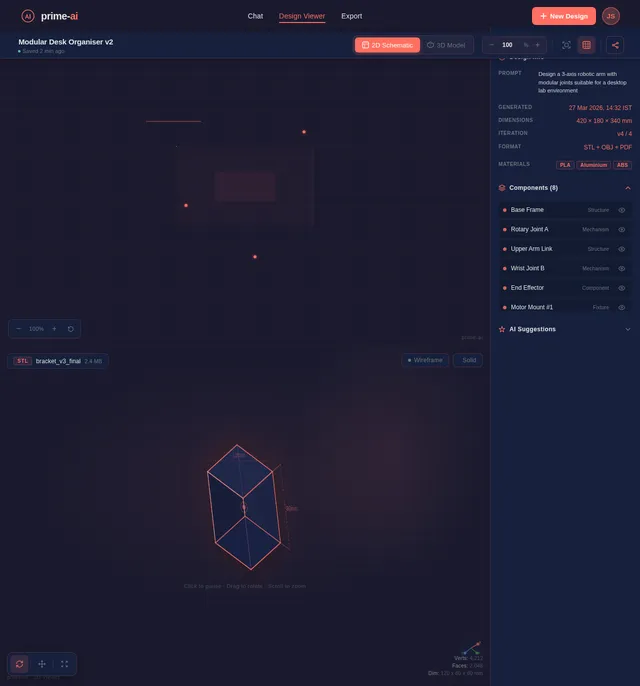
- Initial 3D model generation (STL/OBJ).
- File export capabilities (PDF/images).
Future phases will expand functionality to include image and video input processing, enhanced AI reasoning, and advanced customization options.
3. Functional Requirements
As User:
- I should be able to describe my ideas via text and receive design schematics.
- I should be able to refine designs iteratively through conversational prompts.
- I should be able to export generated designs in formats like STL, OBJ, and PDF.
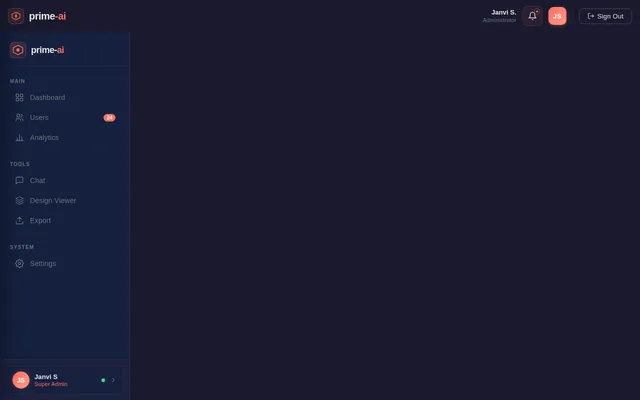
As Admin:
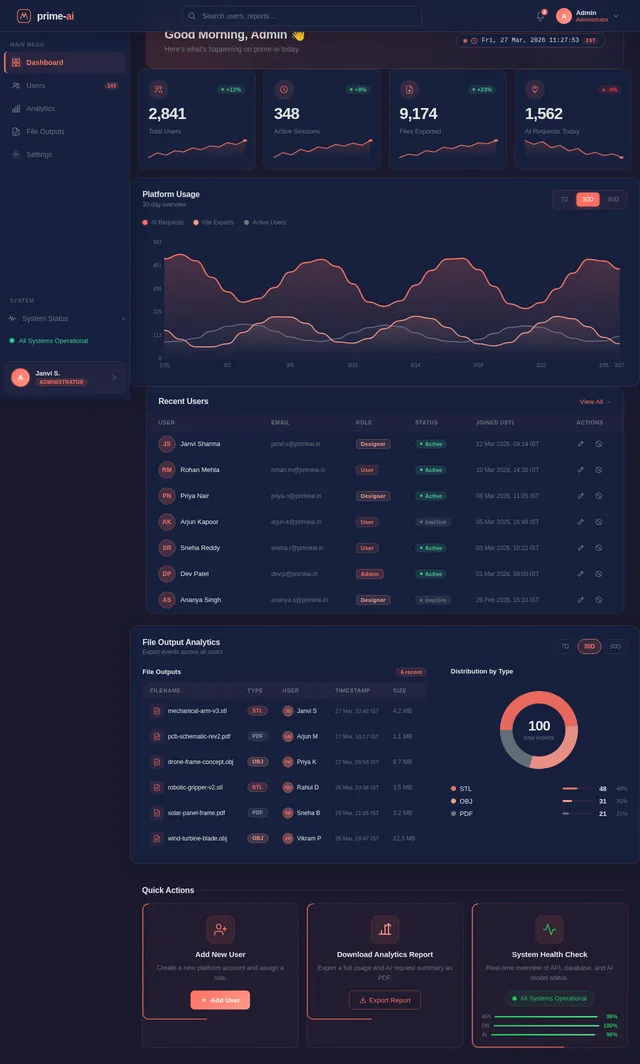
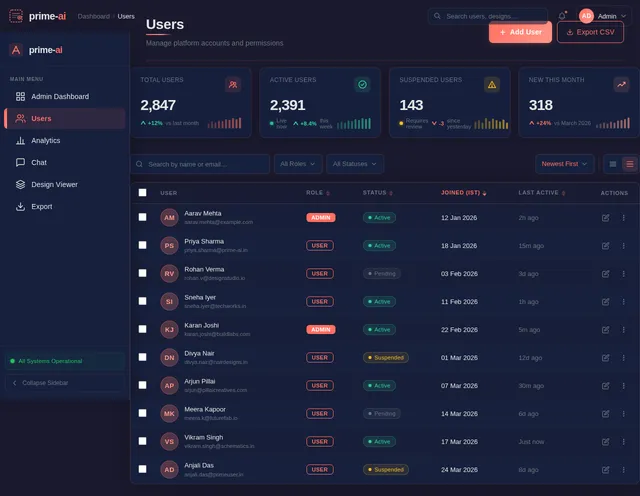
- I should be able to manage users and monitor platform usage.
- I should be able to track file outputs and generate basic analytics reports.
4. User Personas
1. User
- Description: Individuals or teams looking to convert ideas into design schematics and models.
- Goals: Generate conceptual designs, refine outputs iteratively, and export files for further use.
- Needs: Easy-to-use conversational interface, accurate design outputs, and export options.
2. Admin
- Description: Platform managers responsible for overseeing user activity and system performance.
- Goals: Manage users, monitor usage, and ensure smooth operation of the platform.
- Needs: Admin panel with user management, file tracking, and analytics capabilities.
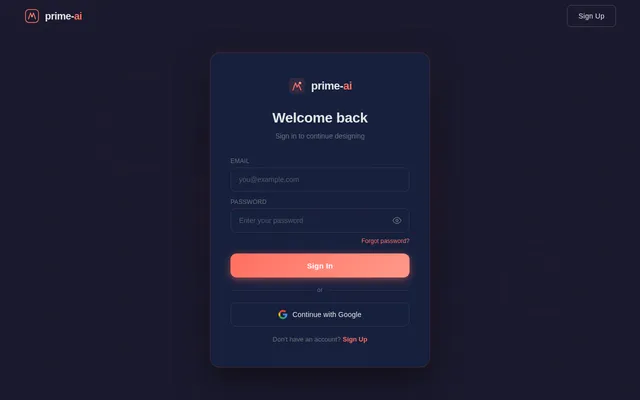
5. Visuals Colors and Theme
Color Palette:
The prime-ai platform will feature a modern, futuristic theme with a focus on creativity and innovation.
- Background: #1A1A2E (Deep Midnight Blue)
- Surface: #16213E (Dark Navy)
- Text: #E5E5E5 (Soft White)
- Accent: #FF6F61 (Vivid Coral)
- Muted Tones: #6C757D (Slate Gray)
This palette reflects the platform's cutting-edge AI capabilities while maintaining a professional and approachable aesthetic.
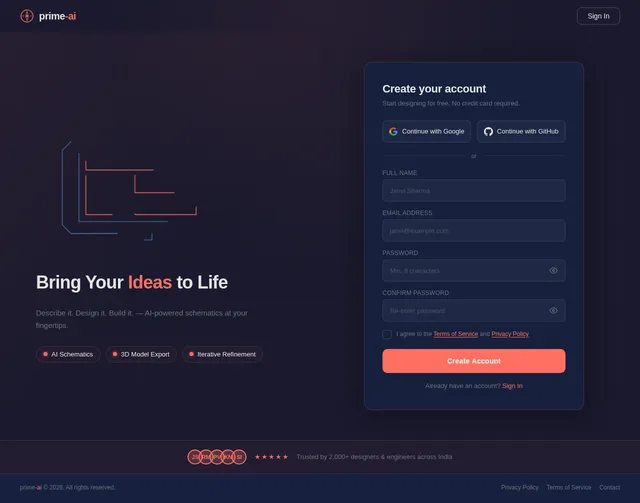
6. Signature Design Concept
Interactive Blueprint Landing Page
The homepage of prime-ai will feature a dynamic, interactive blueprint aesthetic. Upon landing, users will see a pencil-sketch animation of a blank blueprint gradually filling with design elements (lines, shapes, and annotations) as they scroll.
Key features:
- Animation: Pencil-sketch elements animate in real-time, creating a "design in progress" feel.
- Interactive Sections: Hovering over different parts of the blueprint reveals tooltips explaining platform features.
- Color Shifts: The blueprint transitions from monochrome to the platform's accent colors (#FF6F61) as users interact.
- Micro-Interactions: Clicking on elements triggers subtle animations, such as zoom-ins or section highlights.
- Call-to-Action: A glowing "Start Designing" button pulsates at the center of the blueprint, inviting users to begin their journey.
This concept ensures a memorable first impression, immersing users in the creative process from the moment they arrive.
7. Non-Functional Requirements
- Performance: The platform should respond to user inputs within 2 seconds for conversational interactions.
- Scalability: The system must support up to 10,000 concurrent users during peak usage.
- Security: User data and design outputs must be encrypted using industry-standard protocols (AES-256).
- Availability: The platform should maintain 99.9% uptime.
- Localization: Support for Indian timezone (IST) and currency (INR).
8. Tech Stack
Frontend:
- React for Web
Backend:
- Python
- FastAPI
Database:
- MySQL (with Alembic for migrations)
AI Models:
- GPT 5.2 for user-friendly responses
- Claude 4.5 Opas for academic or coding work
AI Tools:
- Litellm for LLM Routing
- Langchain
Local Orchestration:
- Docker
- docker-compose
Server-Side Orchestration:
- Kubernetes
9. Assumptions and Constraints
Assumptions:
- Initial outputs will be conceptual to semi-technical.
- High-precision CAD outputs will be considered in future phases.
- Third-party AI models/APIs may be used for enhanced functionality.
Constraints:
- Certified engineering-grade schematics are out of scope for the MVP phase.
- Advanced simulations (stress, thermal, etc.) are not included in the initial phases.
- Manufacturing validation will require external integrations in later phases.
10. Glossary
- LLM: Large Language Model, used for conversational AI interactions.
- STL/OBJ: File formats for 3D models.
- BOM: Bill of Materials, a structured list of components required for a design.
- AES-256: Advanced Encryption Standard, a secure encryption protocol.
- Docker: A platform for containerized application deployment.
- Kubernetes: A system for automating deployment, scaling, and management of containerized applications.
This document provides a comprehensive overview of the requirements for the prime-ai platform, ensuring clarity and alignment for the development team. Let me know if there are any additional changes or refinements needed, Janvi!
No comments yet. Be the first!