pearl-pdf
 msk ahmad
ملف pdf هذا يحوي برميت انشاء تطبيق قم بفتحه وفهم المطلوب والعمل عليه


Comments (0)
Sign in to leave a comment
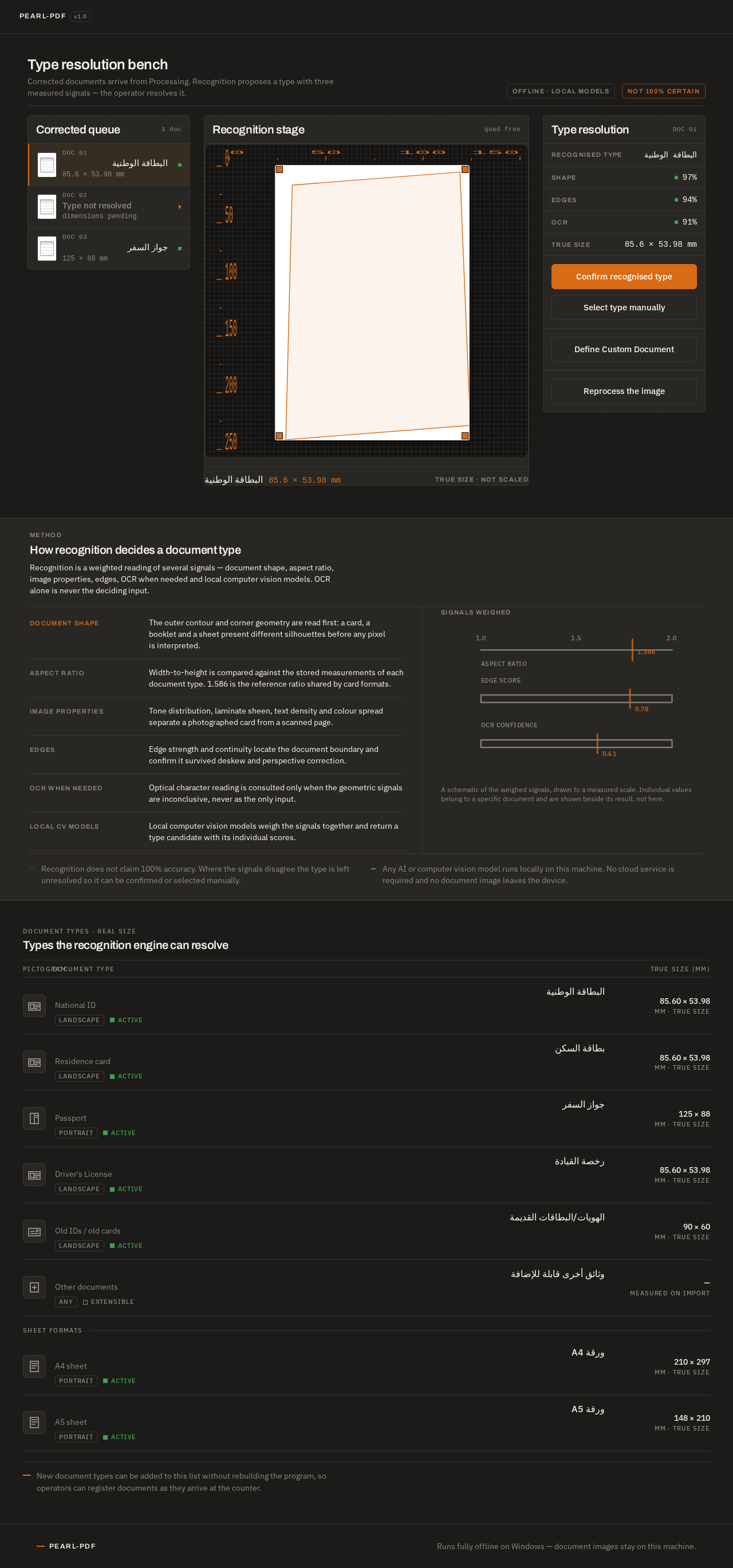
Type resolution bench
Corrected documents arrive from Processing. Recognition proposes a type with three measured signals — the operator resolves it.
Corrected queue
3 docRecognition stage
quad freeType resolution
DOC 01- Recognised typeالبطاقة الوطنية
- Shape97%
- Edges94%
- OCR91%
- True size85.6 × 53.98 mm
How recognition decides a document type
Recognition is a weighted reading of several signals — document shape, aspect ratio, image properties, edges, OCR when needed and local computer vision models. OCR alone is never the deciding input.
- Document shape
The outer contour and corner geometry are read first: a card, a booklet and a sheet present different silhouettes before any pixel is interpreted.
- Aspect ratio
Width-to-height is compared against the stored measurements of each document type. 1.586 is the reference ratio shared by card formats.
- Image properties
Tone distribution, laminate sheen, text density and colour spread separate a photographed card from a scanned page.
- Edges
Edge strength and continuity locate the document boundary and confirm it survived deskew and perspective correction.
- OCR when needed
Optical character reading is consulted only when the geometric signals are inconclusive, never as the only input.
- Local CV models
Local computer vision models weigh the signals together and return a type candidate with its individual scores.
Recognition does not claim 100% accuracy. Where the signals disagree the type is left unresolved so it can be confirmed or selected manually.
Any AI or computer vision model runs locally on this machine. No cloud service is required and no document image leaves the device.
Types the recognition engine can resolve
- البطاقة الوطنيةNational ID85.60 × 53.98mm · true size
- بطاقة السكنResidence card85.60 × 53.98mm · true size
- جواز السفرPassport125 × 88mm · true size
- رخصة القيادةDriver's License85.60 × 53.98mm · true size
- الهويات/البطاقات القديمةOld IDs / old cards90 × 60mm · true size
- وثائق أخرى قابلة للإضافةOther documents—measured on import
- ورقة A4A4 sheet210 × 297mm · true size
- ورقة A5A5 sheet148 × 210mm · true size
New document types can be added to this list without rebuilding the program, so operators can register documents as they arrive at the counter.
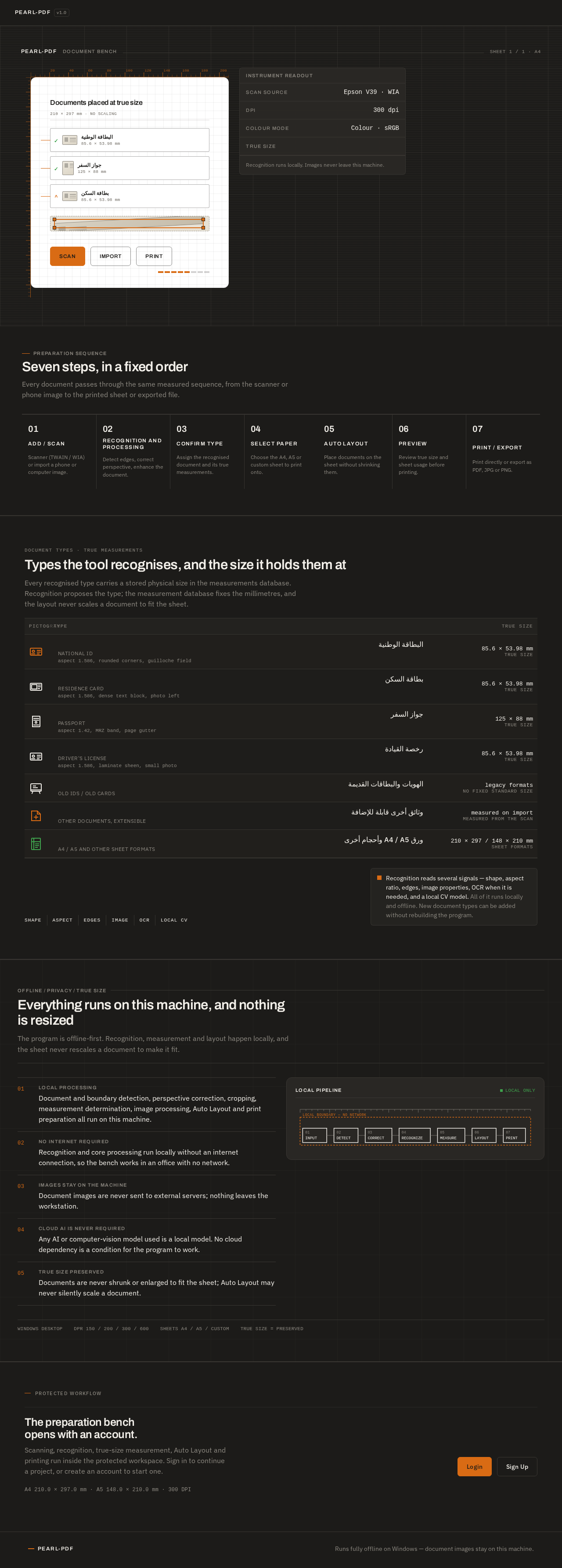
Recognition runs locally. Images never leave this machine.
Seven steps, in a fixed order
Every document passes through the same measured sequence, from the scanner or phone image to the printed sheet or exported file.
- 01Add / ScanScanner (TWAIN / WIA) or import a phone or computer image.
- 02Recognition and ProcessingDetect edges, correct perspective, enhance the document.
- 03Confirm TypeAssign the recognised document and its true measurements.
- 04Select PaperChoose the A4, A5 or custom sheet to print onto.
- 05Auto LayoutPlace documents on the sheet without shrinking them.
- 06PreviewReview true size and sheet usage before printing.
- 07Print / ExportPrint directly or export as PDF, JPG or PNG.
DOCUMENT TYPES · TRUE MEASUREMENTS
Types the tool recognises, and the size it holds them at
Every recognised type carries a stored physical size in the measurements database. Recognition proposes the type; the measurement database fixes the millimetres, and the layout never scales a document to fit the sheet.
Recognition reads several signals — shape, aspect ratio, edges, image properties, OCR when it is needed, and a local CV model. All of it runs locally and offline. New document types can be added without rebuilding the program.
Everything runs on this machine, and nothing is resized
The program is offline-first. Recognition, measurement and layout happen locally, and the sheet never rescales a document to make it fit.
- 01Local processing
Document and boundary detection, perspective correction, cropping, measurement determination, image processing, Auto Layout and print preparation all run on this machine.
- 02No internet required
Recognition and core processing run locally without an internet connection, so the bench works in an office with no network.
- 03Images stay on the machine
Document images are never sent to external servers; nothing leaves the workstation.
- 04Cloud AI is never required
Any AI or computer-vision model used is a local model. No cloud dependency is a condition for the program to work.
- 05True size preserved
Documents are never shrunk or enlarged to fit the sheet; Auto Layout may never silently scale a document.
No comments yet. Be the first!