pearl-disasters
 Vedant Mhatre
Description Urban regions frequently face localized disasters such as floods, heatwaves, and infrastructure failures. However, existing systems lack timely, community-driven prediction and response mechanisms, leading to delayed actions and increased damage. There is a need for a platform that enables better awareness, reporting, and response using available or simulated data. Objective To develop a platform that predicts and manages localized disasters using available or simulated data and community participation. Key Features Real-time disaster prediction using multiple data sources (or simulated inputs) Geo-tagged community-based incident reporting system Alert and notification system for risk zones Visualization of affected areas on interactive maps Quick reporting interface for users Integration-ready architecture for external data sources Offline-capable functionality for low-connectivity scenarios Expected Impact Enables faster disaster response Improves preparedness and awareness Reduces potential damage and risks make me creative website for this for my offline hackathon build an web app

Comments (0)
Sign in to leave a comment
Project Tasks20
Implement Theme & Structure
As a developer, I want to implement the pearl-disasters design system (color palette: #F5F9FF bg, #FF6B6B accent, #1A1A1A text, #34A853 secondary, #1A73E8 primary) and global layout structure across all scaffold pages. Remove pages not needed (signup, welcome, ai-assistant, settings if not in flow). Set up CSS custom properties, Inter font, shared NavBar/Footer components, and ensure all existing scaffold pages match the mock-design token system. This is a prerequisite for all other UI tasks.
Implement Incidents API
As a backend developer, I want to build FastAPI endpoints for incident management: POST /incidents (create geo-tagged report), GET /incidents (list with filters: type, severity, status, location), GET /incidents/{id} (detail), PUT /incidents/{id}/verify (admin verification), DELETE /incidents/{id}. Includes MySQL models with Alembic migrations, geo-coordinates storage, and status state machine (pending → in_review → verified/rejected).
Implement Alerts API
As a backend developer, I want to build FastAPI endpoints for alerts: POST /alerts (admin broadcast), GET /alerts (list active alerts by zone/severity), GET /alerts/{id}, PUT /alerts/{id}/acknowledge, DELETE /alerts/{id}/dismiss. Includes severity levels (critical, high, medium, low), zone targeting, issued_time, and recommendation fields. Supports push notification subscription management.
Implement Predictions API
As a backend developer, I want to build FastAPI endpoints for disaster predictions: GET /predictions (list predicted events with type, confidence, date range, affected zone), POST /predictions/data-sources (admin toggle data source), GET /predictions/model-accuracy. Integrates simulated input data pipeline and confidence scoring. Uses Litellm/Langchain for LLM-assisted prediction summaries.
Implement Map Zones API
As a backend developer, I want to build FastAPI endpoints for map data: GET /zones (disaster-prone zones with geo-boundaries and severity), GET /zones/{id}/incidents (incidents in zone), GET /zones/heatmap (aggregated risk density for map overlay). Supports filtering by disaster type, time range, and severity. Returns GeoJSON-compatible data for Leaflet integration.
Build Home Page
As a community member, I want to use the Home page to view the interactive disaster timeline, explore past/present/predicted events as clickable animated nodes, and navigate to Map and Alerts. Implement based on existing Home (v2) JSX design. Includes: NavBar, interactive disaster timeline with ripple animations, color-shifting background by disaster type, hero section, and Footer. Links to: Map, Alerts.
Build Login Page
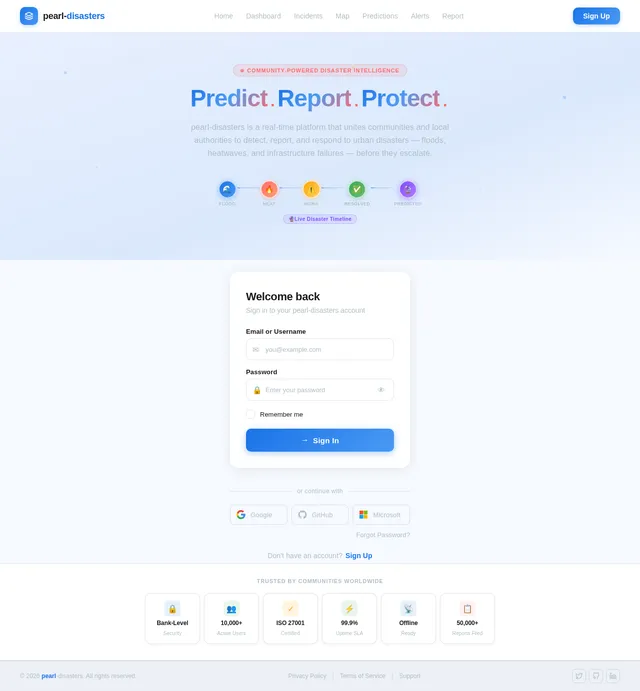
As an administrator, I want to use the Login page to sign in securely and be redirected to the Dashboard. Implement based on existing Login (v2) JSX design. Includes: sign-in form, email/password fields, primary CTA button, error states, and pearl-disasters branding. Links to: Dashboard (on success).
Implement AI Prediction Engine
As an AI engineer, I want to build the disaster prediction pipeline using Litellm for LLM routing and Langchain for orchestration. Ingest simulated or real disaster data inputs, run prediction logic, generate confidence scores per zone and disaster type, and expose results via the Predictions API. Integrate GPT for generating user-friendly prediction summaries and recommendations.
Build Dashboard Page
As an administrator, I want to use the Dashboard page to view an overview of active disasters, incident statistics, alert summaries, and quick navigation to Incidents and Map. Implement based on existing Dashboard (v1) JSX design. Includes: TopNavigation, Sidebar, WelcomeBanner, DisasterTimeline preview, AlertsSummary, InteractiveMap panel, RiskZoneStats, PredictionPanel, RecentIncidents, NotificationCenter, ActionButtons, Footer. Links to: Incidents, Map.
Build Map Page
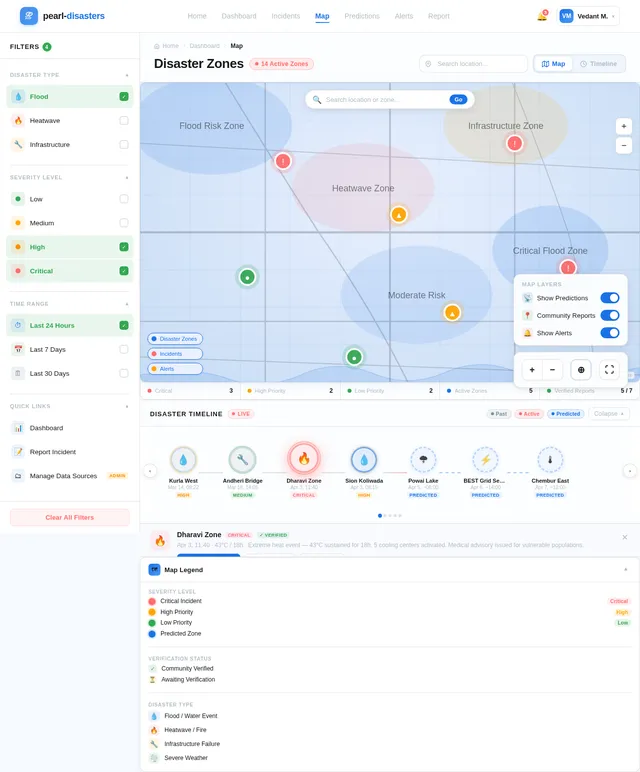
As a user, I want to use the Map page to explore disaster zones on an interactive map with geo-tagged markers, heat map overlays, and real-time alerts. Implement based on existing Map (v2) JSX design. Includes: NavBar, Sidebar with filters, MapHeader, InteractiveMap with Leaflet, MapControls (layer toggles, zoom), DisasterTimeline, IncidentLegend, AlertPanel (slide-out with severity badges, pulse animations), Footer. Marker colors: critical=#FF6B6B, high=#FFA500, low=#34A853. Links to: Report. Navigated from: Home, Dashboard, Alerts.
Build Alerts Page
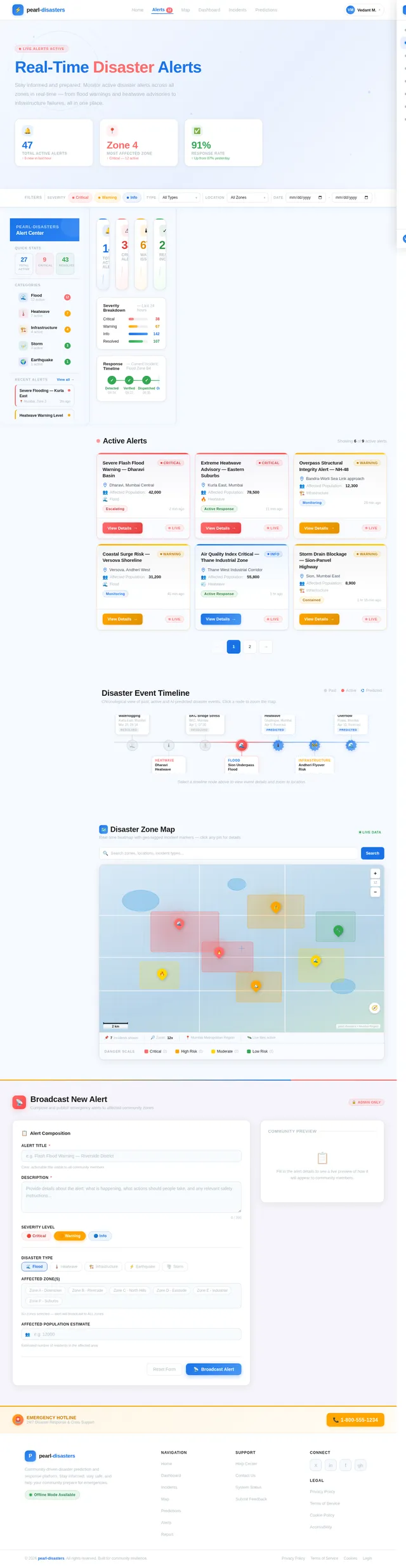
As a community member, I want to use the Alerts page to view active notifications and alerts for risk zones, acknowledge or dismiss alerts, and navigate to the Map. Implement based on existing Alerts (v1) JSX design. Includes: alert list with severity badges (Critical=#FF6B6B, High=#FFA500), pulsing animations for active alerts, acknowledge/dismiss/share actions, push notification subscribe toggle, and breadcrumb back to Map. Links from: Home, Map. Links to: Map.
Build Incidents Page
As an administrator, I want to use the Incidents page to view, manage, and verify community-reported incident reports. Implement based on existing Incidents (v1) JSX design. Includes: incident list with filters (type, severity, status), verification controls, approve/reject actions, incident detail panel, pagination, and search. Links from: Dashboard. Links to: Incident detail/verify view.
Build Predictions Page
As an administrator, I want to use the Predictions page to manage external data sources, view real-time disaster predictions with confidence scores, and configure the prediction model. Implement based on existing Predictions (v1) JSX design. Includes: data source toggle management, predicted high-risk periods list, model accuracy gauge, confidence bars, and navigation to Alerts. Links from: Map. Links to: Alerts.
Build Report Page
As a community member, I want to use the Report page to submit an incident report with a geo-tagged location, add media, specify disaster type and severity, and proceed to Confirmation. Implement based on existing Report (v1) JSX design. Includes: multi-step form (incident details → geo-tag map picker → media upload → review & submit), progress indicator, offline support notice, and submit CTA. Links from: Map. Links to: Confirmation.
Integrate Map API with Frontend
As a frontend developer, I want to connect the Map page to the backend zones and incidents APIs, rendering real geo-tagged markers and heat map overlays using Leaflet. Replace mock data with live API calls, wire up filter controls (disaster type, severity, time range) to API query params, and implement marker click → incident detail popup. Handle loading and error states.
Integrate Alerts API with Frontend
As a frontend developer, I want to connect the Alerts page and Dashboard AlertsSummary to the backend alerts API. Render live alert data with severity badges, wire up acknowledge/dismiss/broadcast actions, and implement push notification subscribe toggle. Real-time polling or WebSocket for active alert updates.
Build Confirmation Page
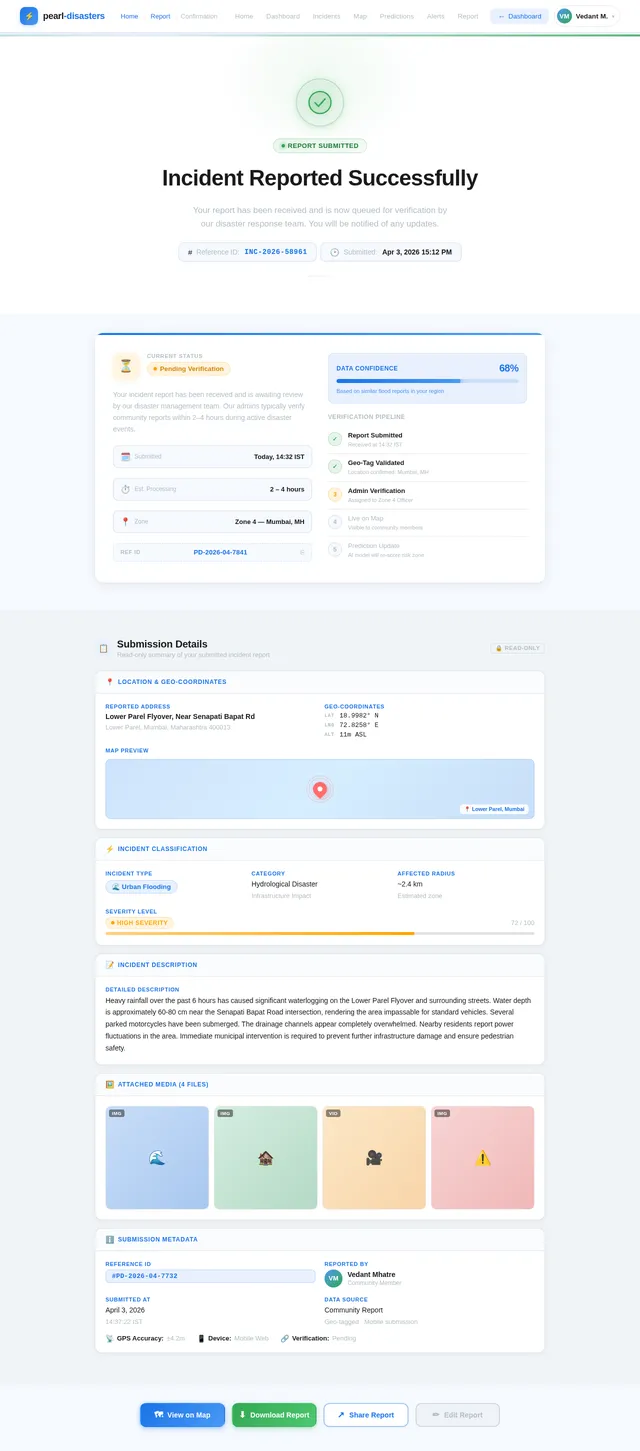
As a community member, I want to use the Confirmation page to view the status of my submitted incident report, see my report details, and take follow-up actions. Implement based on existing Confirmation (v2) JSX design. Includes: NavBar, Hero (success icon + reference ID + submission time), StatusCard (Pending/Verified/In Review badge), DetailsPanel (readonly geo-coordinates, type, severity, media), ActionButtons (View on Map, Download Report, Share, Edit), TimelinePreview (3-5 nodes showing incident placement), NextSteps (numbered verification steps), SupportSection, Footer. Links from: Report.
Integrate Predictions API with Frontend
As a frontend developer, I want to connect the Predictions page to the backend predictions API. Render live predicted high-risk periods, confidence scores, model accuracy gauge, and data source toggle controls using real API responses. Show LLM-generated prediction summaries where applicable.
Implement Offline PWA Support
As a community member, I want to use the platform offline to submit incident reports and view cached maps when connectivity is unavailable. Implement service worker with cache-first strategy for map tiles and static assets, IndexedDB queue for offline incident submissions that sync when online, and offline status indicator in the UI.
Integrate Incidents API with Frontend
As a frontend developer, I want to connect the Incidents page and Report page to the backend incidents API. Wire up incident list with live data, implement verification actions (approve/reject) calling PUT /incidents/{id}/verify, and connect the Report page form submission to POST /incidents. Show real reference IDs and status on the Confirmation page.

Predict. Report. Respond.
Real-time disaster prediction and community-driven response. Stay informed, report incidents, and help protect your community from floods, heatwaves, and infrastructure failures.
Track Events as They Unfold
Explore past incidents, monitor active disasters in real-time, and stay ahead with AI-driven predictions for your region.
Mumbai Coastal Flooding
📍Andheri West, Zone 4
Aug 12, 2024
Powai Heatwave Event
📍Powai, Zone 2
May 03, 2025
Sion Bridge Collapse Risk
📍Sion, Zone 5
Nov 18, 2025
Dadar Waterlogging
📍Dadar East, Zone 3
Feb 27, 2026
Bandra Drainage Overflow
📍Bandra West, Zone 1
Apr 02, 2026
Thane Heat Alert
📍Thane West, Zone 6
Apr 03, 2026
Kurla Flyover Stress
📍Kurla, Zone 3
Apr 10, 2026
Worli Flood Forecast
📍Worli, Zone 2
Apr 18, 2026
Interactive Disaster Map
Explore disaster-prone areas and real-time incident locations across your region
Zone 3 Flood Risk
72% probability in 48hrs
High SeverityCentral Heat Surge
45% probability this week
Medium SeverityEastern Bridge Stress
28% failure risk detected
Low SeverityLegend
3
Active
1
Floods
1
Heatwaves
1
Infrastructure
Active Alerts6
Real-time notifications for disaster events in your area
Andheri East, Zone 5
Severe flooding reported near Mithi River banks. Water levels have breached danger mark. Residents advised to evacuate low-lying areas immediately.
View on Map→Dadar West, Zone 2
Infrastructure failure detected. Major water pipeline burst causing road collapse on SV Road. Avoid area and use alternate routes.
View on Map→Bandra Kurla Complex
Heatwave advisory in effect. Temperature expected to exceed 42°C over the next 6 hours. Stay hydrated and avoid outdoor activity.
View on Map→Chembur, Zone 7
Waterlogging on key arterial roads following heavy rainfall. Traffic diversions active. Emergency crews deployed.
View on Map→Powai Lake Area
Water level monitoring underway at Powai Lake. Authorities have increased patrols. No immediate risk but stay alert for further updates.
View on Map→Thane District, Zone 12
Prediction model indicates elevated flood risk in the next 48 hours. Precautionary sandbagging recommended for ground-floor establishments.
View on Map→Platform Overview
Real-time metrics powering community disaster response
Recent Verified Reports
Real-time incident reports submitted and verified by community members across the city. Stay informed about local conditions.
Heavy waterlogging reported near the Andheri subway. Road access is severely limited and vehicles are stranded. Residents advised to avoid the area until drainage is restored.
Temperatures exceeding 42°C recorded near Shivaji Park. Multiple cases of heat exhaustion reported at local clinics. Water tankers have been requested by community leaders.
Large pothole and road surface cracks forming on the westbound lane after recent rainfall. Traffic has been diverted to a single lane causing major congestion during peak hours.
Drainage overflow near Kurla railway station affecting commuter movement. Local train services on the central line are experiencing 20-minute delays due to waterlogged tracks.
Strong gusts and heavy rainfall causing tree falls along Colaba Causeway. Power outages reported in surrounding residential areas. Emergency crews are on-site clearing debris.
Sustained high temperatures have led to water supply disruptions across Thane. Municipal authorities are distributing emergency water supplies to affected neighborhoods.
Disaster Risk Predictions
Our AI-driven prediction model analyzes real-time environmental data, historical patterns, and community reports to forecast localized disaster risks for your region.
Ready to Contribute?
Join thousands of community members helping predict and respond to localized disasters. Your reports make neighborhoods safer and response times faster.
No comments yet. Be the first!