pearl-disasters
 Vedant Mhatre
Description Urban regions frequently face localized disasters such as floods, heatwaves, and infrastructure failures. However, existing systems lack timely, community-driven prediction and response mechanisms, leading to delayed actions and increased damage. There is a need for a platform that enables better awareness, reporting, and response using available or simulated data. Objective To develop a platform that predicts and manages localized disasters using available or simulated data and community participation. Key Features Real-time disaster prediction using multiple data sources (or simulated inputs) Geo-tagged community-based incident reporting system Alert and notification system for risk zones Visualization of affected areas on interactive maps Quick reporting interface for users Integration-ready architecture for external data sources Offline-capable functionality for low-connectivity scenarios Expected Impact Enables faster disaster response Improves preparedness and awareness Reduces potential damage and risks make me creative website for this for my offline hackathon build an web app

Comments (0)
Sign in to leave a comment
System Requirements
System Requirements Document (SRD)
Project Name: pearl-disasters
1. Introduction
Urban regions frequently face localized disasters such as floods, heatwaves, and infrastructure failures. However, existing systems lack timely, community-driven prediction and response mechanisms, leading to delayed actions and increased damage. The pearl-disasters project aims to address this gap by developing a platform that predicts and manages localized disasters using available or simulated data and community participation.
This document outlines the system requirements for pearl-disasters, a web application designed for Vedant Mhatre's offline hackathon. The platform will focus on real-time disaster prediction, community-based reporting, and interactive visualization tools to enhance disaster preparedness and response.
2. System Overview
The pearl-disasters platform will serve as a centralized hub for disaster prediction, reporting, and response. It will leverage real-time data, community inputs, and advanced visualization techniques to provide actionable insights to both local authorities and the general public.
Key features include:
- Real-time disaster prediction using multiple data sources or simulated inputs.
- Geo-tagged, community-based incident reporting system.
- Alert and notification system for risk zones.
- Interactive maps for visualizing affected areas.
- Offline-capable functionality for low-connectivity scenarios.
The platform will be designed to operate seamlessly across devices, ensuring accessibility and usability for all stakeholders.
3. Functional Requirements
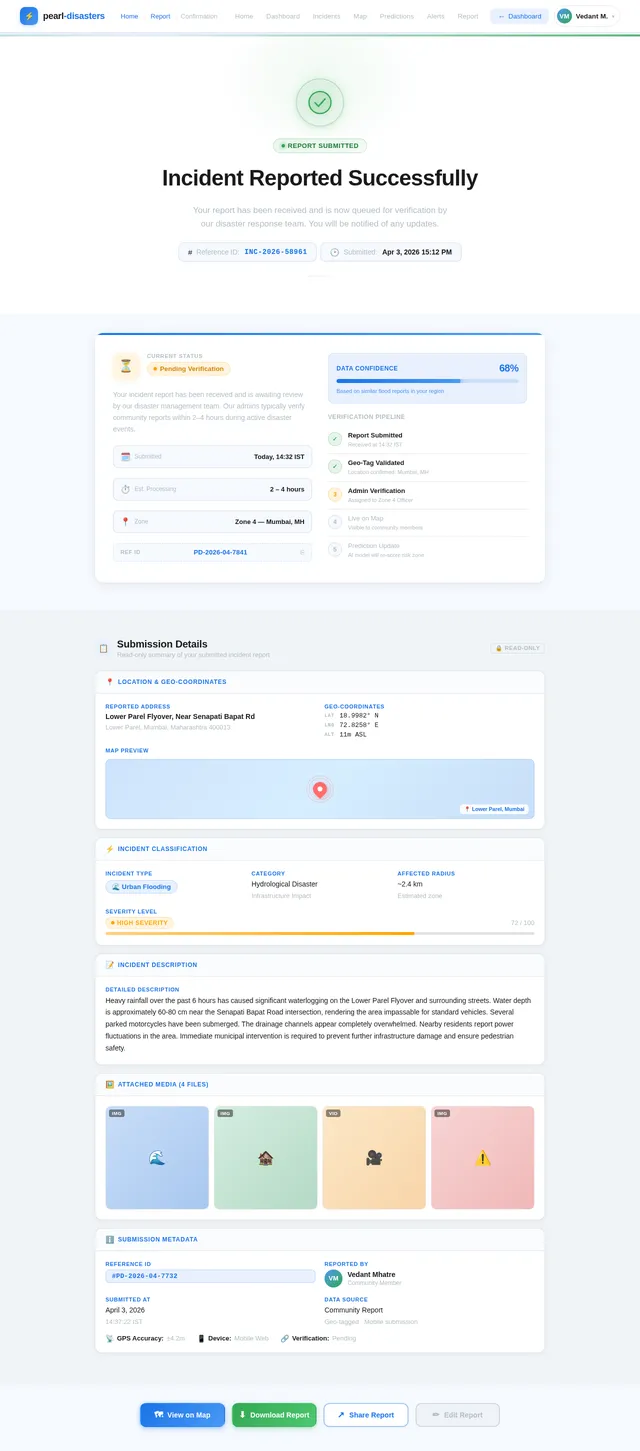
- As a User, I should be able to report incidents with geo-tagged locations.
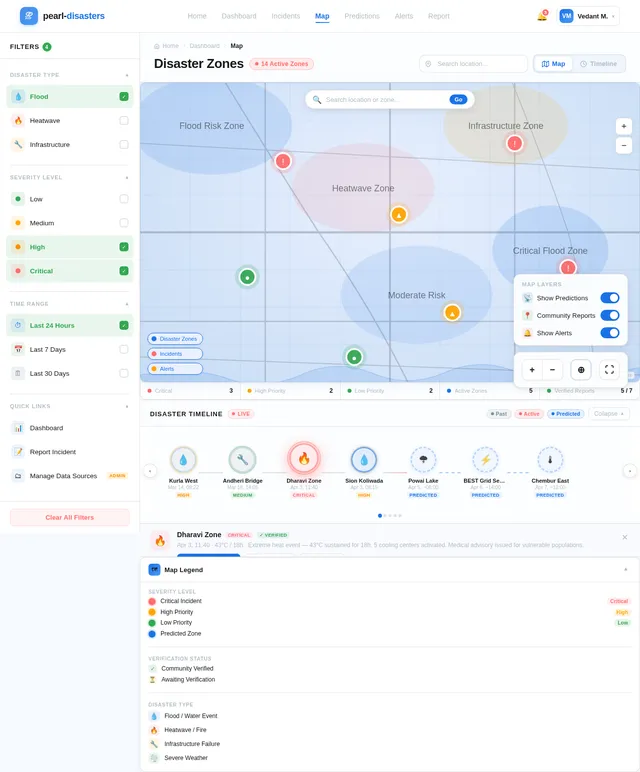
- As a User, I should be able to view disaster-prone areas on an interactive map.
- As a User, I should receive alerts and notifications for risk zones.
- As an Admin, I should be able to manage and verify community-reported incidents.
- As an Admin, I should be able to integrate external data sources for disaster prediction.
- As a User, I should be able to access basic functionalities offline during low-connectivity scenarios.
- As a User, I should be able to view real-time disaster predictions based on available data.
4. User Personas
4.1 Community Member
- Role: General public user.
- Goals: Report incidents, stay informed about disaster-prone areas, and receive timely alerts.
- Technical Proficiency: Basic.
4.2 Administrator
- Role: Local authority or disaster management personnel.
- Goals: Manage incident reports, verify data, and oversee disaster prediction systems.
- Technical Proficiency: Intermediate to advanced.
5. Visuals Colors and Theme
The visual identity of pearl-disasters will reflect urgency, clarity, and community collaboration. Below is the unique color palette for the project:
- Background: #F5F9FF (Soft Sky Blue)
- Surface: #FFFFFF (Pure White)
- Text: #1A1A1A (Deep Charcoal)
- Accent: #FF6B6B (Emergency Red)
- Muted Tones: #B0BEC5 (Calm Gray)
This palette ensures readability and conveys a sense of urgency while maintaining a professional and approachable aesthetic.
6. Signature Design Concept
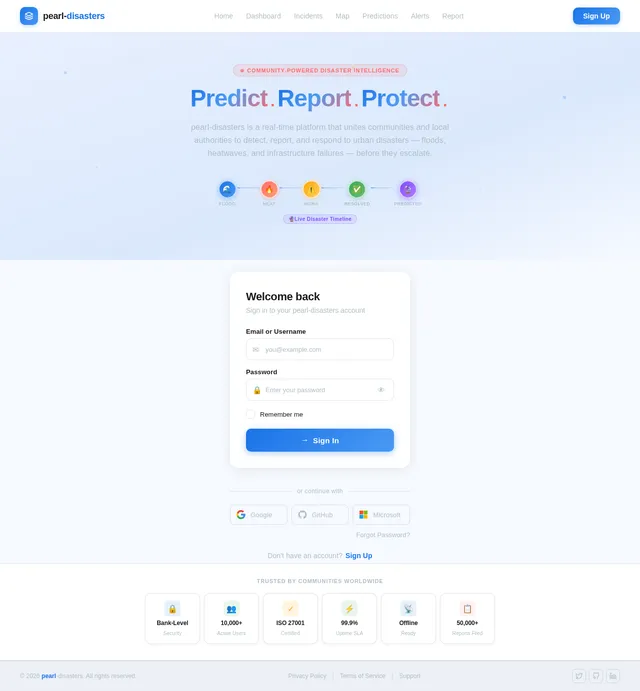
The homepage of pearl-disasters will feature an interactive disaster timeline.
Concept Details:
- Visual Design: A dynamic, scrollable timeline that showcases past, present, and predicted disasters in the user's region. Each disaster event will appear as a clickable node on the timeline, with animations that simulate ripples or shockwaves when hovered over.
- Interactive Map Integration: The timeline will be paired with an interactive map that highlights affected areas in real-time. Clicking on a timeline node will zoom the map to the corresponding location.
- Micro-Interactions: Subtle animations, such as pulsing alerts for active disasters and fading transitions for resolved incidents, will enhance user engagement.
- Color Shifts: The background of the homepage will subtly change based on the type of disaster being viewed (e.g., blue for floods, red for heatwaves).
This design will make the platform visually striking and immediately engaging, leaving a lasting impression on users.
7. Non-Functional Requirements
- The system should support at least 10,000 concurrent users.
- The platform must be optimized for both desktop and mobile devices.
- The system should ensure data security and comply with local data protection regulations in India.
- The platform should load within 3 seconds on a standard 4G connection.
- Offline functionality should allow users to report incidents and view cached maps.
8. Tech Stack
Frontend
- React for Web
Backend
- Python
- FastAPI
Database
- MySQL (with Alembic for migrations)
AI Models
- GPT 5.4 for user-friendly responses
- Google Nano Banana for image generation
AI Tools
- Litellm for LLM Routing
- Langchain
Orchestration
- Docker for local orchestration
- Kubernetes for server-side orchestration
9. Assumptions and Constraints
- The platform assumes access to reliable disaster data sources or simulated inputs.
- Community members will have basic familiarity with smartphones and web applications.
- The system will initially target urban regions in India, with potential scalability to other regions.
- Offline functionality will be limited to reporting and viewing cached data.
10. Glossary
- Geo-tagging: Associating data with a specific geographic location.
- Interactive Map: A digital map that allows users to interact with data points, zoom, and navigate.
- Simulated Inputs: Artificially generated data used for testing or prediction purposes.
- LLM Routing: The process of directing queries to the most appropriate large language model.
- Orchestration: The automated arrangement and coordination of systems and services.

Predict. Report. Respond.
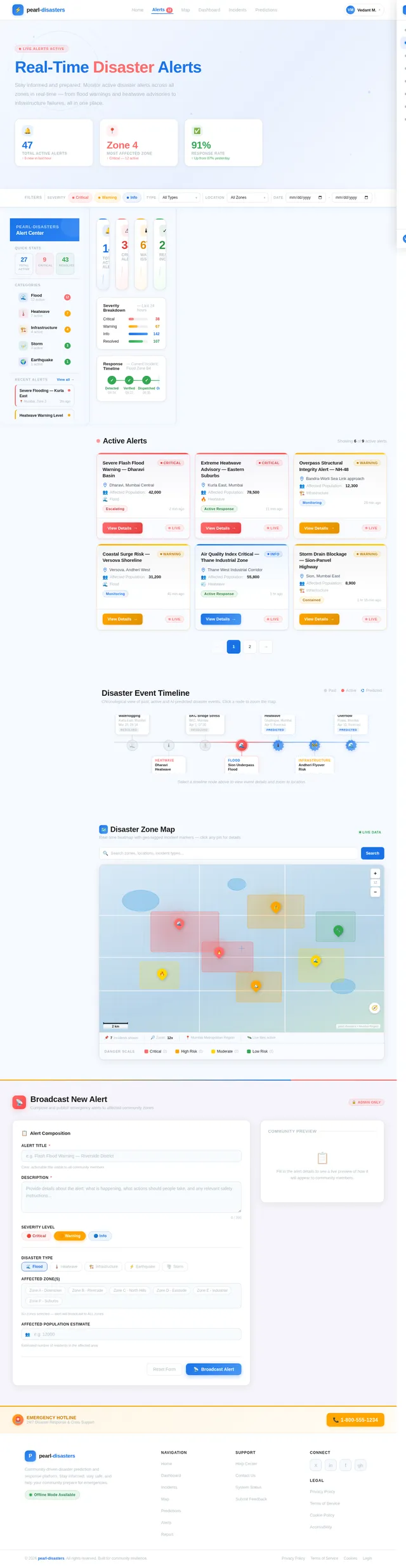
Real-time disaster prediction and community-driven response. Stay informed, report incidents, and help protect your community from floods, heatwaves, and infrastructure failures.
Track Events as They Unfold
Explore past incidents, monitor active disasters in real-time, and stay ahead with AI-driven predictions for your region.
Mumbai Coastal Flooding
📍Andheri West, Zone 4
Aug 12, 2024
Powai Heatwave Event
📍Powai, Zone 2
May 03, 2025
Sion Bridge Collapse Risk
📍Sion, Zone 5
Nov 18, 2025
Dadar Waterlogging
📍Dadar East, Zone 3
Feb 27, 2026
Bandra Drainage Overflow
📍Bandra West, Zone 1
Apr 02, 2026
Thane Heat Alert
📍Thane West, Zone 6
Apr 03, 2026
Kurla Flyover Stress
📍Kurla, Zone 3
Apr 10, 2026
Worli Flood Forecast
📍Worli, Zone 2
Apr 18, 2026
Interactive Disaster Map
Explore disaster-prone areas and real-time incident locations across your region
Zone 3 Flood Risk
72% probability in 48hrs
High SeverityCentral Heat Surge
45% probability this week
Medium SeverityEastern Bridge Stress
28% failure risk detected
Low SeverityLegend
3
Active
1
Floods
1
Heatwaves
1
Infrastructure
Active Alerts6
Real-time notifications for disaster events in your area
Andheri East, Zone 5
Severe flooding reported near Mithi River banks. Water levels have breached danger mark. Residents advised to evacuate low-lying areas immediately.
View on Map→Dadar West, Zone 2
Infrastructure failure detected. Major water pipeline burst causing road collapse on SV Road. Avoid area and use alternate routes.
View on Map→Bandra Kurla Complex
Heatwave advisory in effect. Temperature expected to exceed 42°C over the next 6 hours. Stay hydrated and avoid outdoor activity.
View on Map→Chembur, Zone 7
Waterlogging on key arterial roads following heavy rainfall. Traffic diversions active. Emergency crews deployed.
View on Map→Powai Lake Area
Water level monitoring underway at Powai Lake. Authorities have increased patrols. No immediate risk but stay alert for further updates.
View on Map→Thane District, Zone 12
Prediction model indicates elevated flood risk in the next 48 hours. Precautionary sandbagging recommended for ground-floor establishments.
View on Map→Platform Overview
Real-time metrics powering community disaster response
Recent Verified Reports
Real-time incident reports submitted and verified by community members across the city. Stay informed about local conditions.
Heavy waterlogging reported near the Andheri subway. Road access is severely limited and vehicles are stranded. Residents advised to avoid the area until drainage is restored.
Temperatures exceeding 42°C recorded near Shivaji Park. Multiple cases of heat exhaustion reported at local clinics. Water tankers have been requested by community leaders.
Large pothole and road surface cracks forming on the westbound lane after recent rainfall. Traffic has been diverted to a single lane causing major congestion during peak hours.
Drainage overflow near Kurla railway station affecting commuter movement. Local train services on the central line are experiencing 20-minute delays due to waterlogged tracks.
Strong gusts and heavy rainfall causing tree falls along Colaba Causeway. Power outages reported in surrounding residential areas. Emergency crews are on-site clearing debris.
Sustained high temperatures have led to water supply disruptions across Thane. Municipal authorities are distributing emergency water supplies to affected neighborhoods.
Disaster Risk Predictions
Our AI-driven prediction model analyzes real-time environmental data, historical patterns, and community reports to forecast localized disaster risks for your region.
Ready to Contribute?
Join thousands of community members helping predict and respond to localized disasters. Your reports make neighborhoods safer and response times faster.
No comments yet. Be the first!