neon-engine
Build fully functional 3d game engine



Comments (0)
Sign in to leave a comment
System Requirements
System Requirements Document (SRD) for neon-engine
1. Introduction
The neon-engine is a fully functional 3D game engine designed to empower developers to create immersive and visually stunning games. This project aims to deliver a cross-platform solution, enabling game developers to deploy their creations seamlessly across PC, mobile, and console platforms. By focusing on cutting-edge rendering, physics, and scripting capabilities, neon-engine will serve as a versatile tool for both indie developers and large studios.
This document outlines the system requirements for neon-engine, ensuring it meets the needs of its users while maintaining high performance and compatibility across platforms.
2. System Overview
The neon-engine will provide a comprehensive suite of tools and features for game development, including:
- A high-performance rendering engine supporting advanced graphics techniques.
- A robust physics engine for realistic simulations.
- Scripting support for game logic and customization.
- Asset import/export tools for seamless integration with external design software.
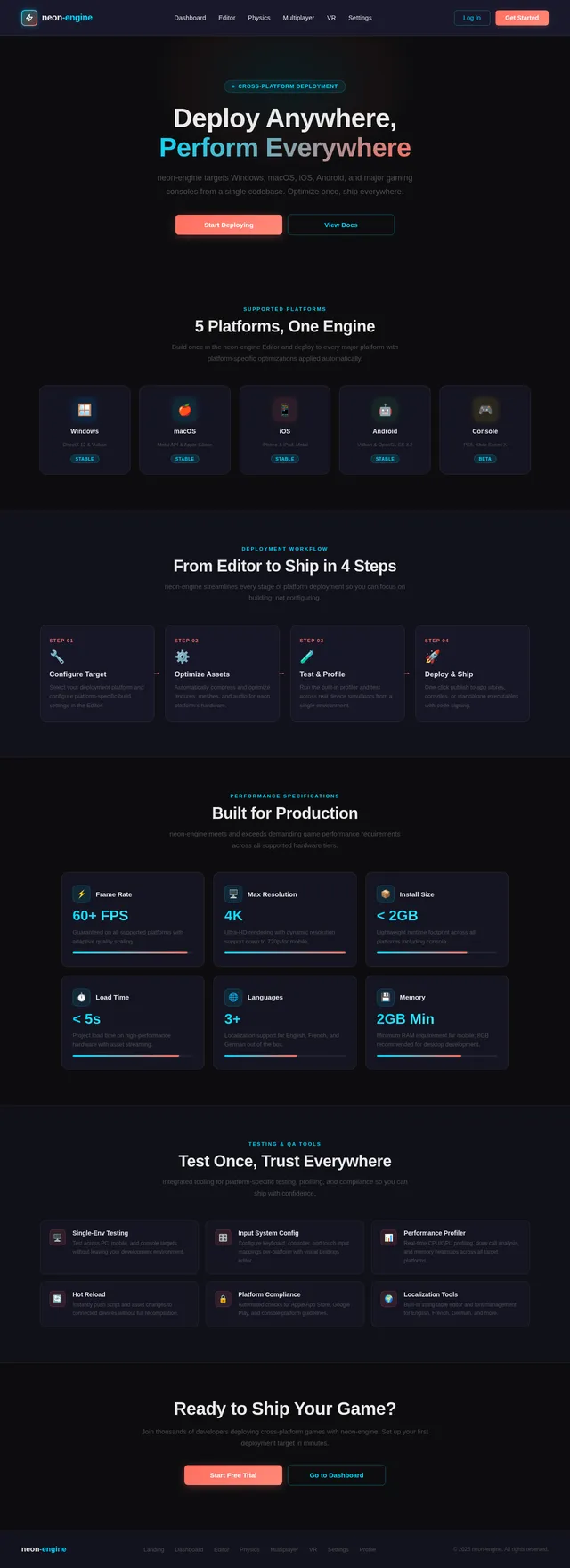
- Cross-platform compatibility for PC, mobile, and console platforms.
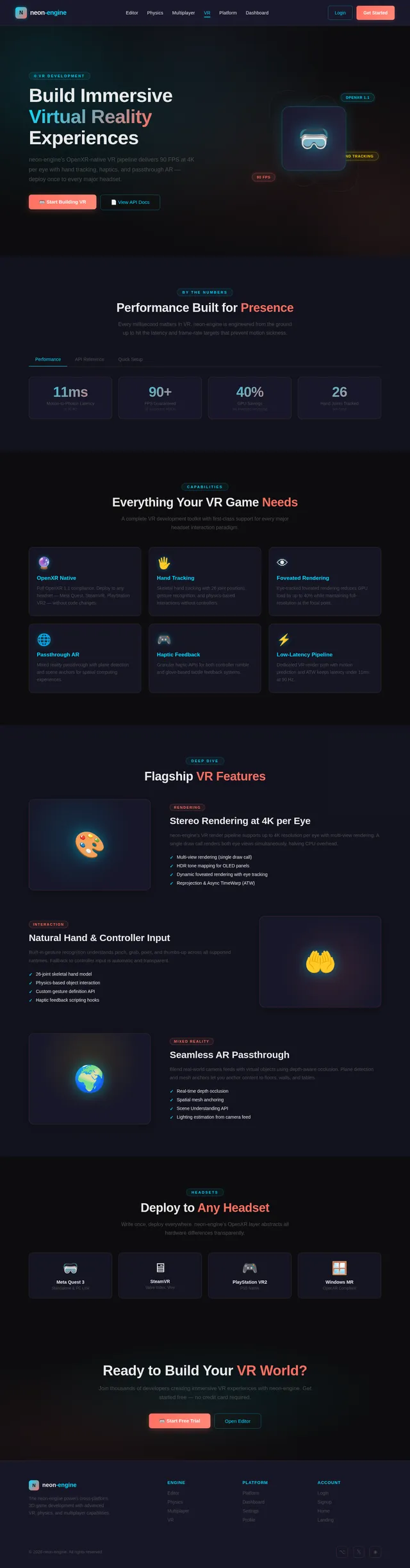
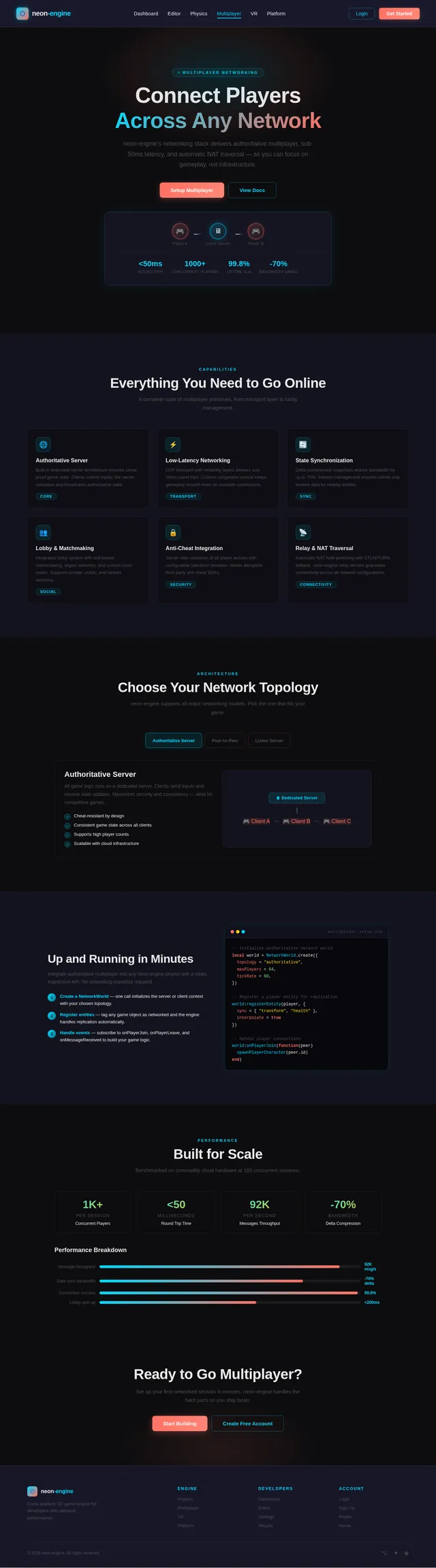
- Support for multiplayer and VR capabilities to cater to modern gaming trends.
The engine will prioritize ease of use, scalability, and performance, making it suitable for projects of varying complexity.
3. Functional Requirements
Core Features
- As a Developer, I should be able to create 3D environments with advanced rendering capabilities.
- As a Developer, I should be able to implement realistic physics simulations.
- As a Developer, I should be able to write and execute scripts for game logic.
- As a Developer, I should be able to import and export assets in standard formats (e.g., FBX, OBJ).
- As a Developer, I should be able to deploy games on PC, mobile, and console platforms.
- As a Developer, I should be able to integrate multiplayer functionality.
- As a Developer, I should be able to develop VR-compatible games.
Cross-Platform Specific
- As a Developer, I should be able to test games on multiple platforms from a single development environment.
- As a Developer, I should be able to optimize performance for platform-specific hardware constraints.
- As a Developer, I should be able to configure input systems for different devices (e.g., keyboard, controller, touch).
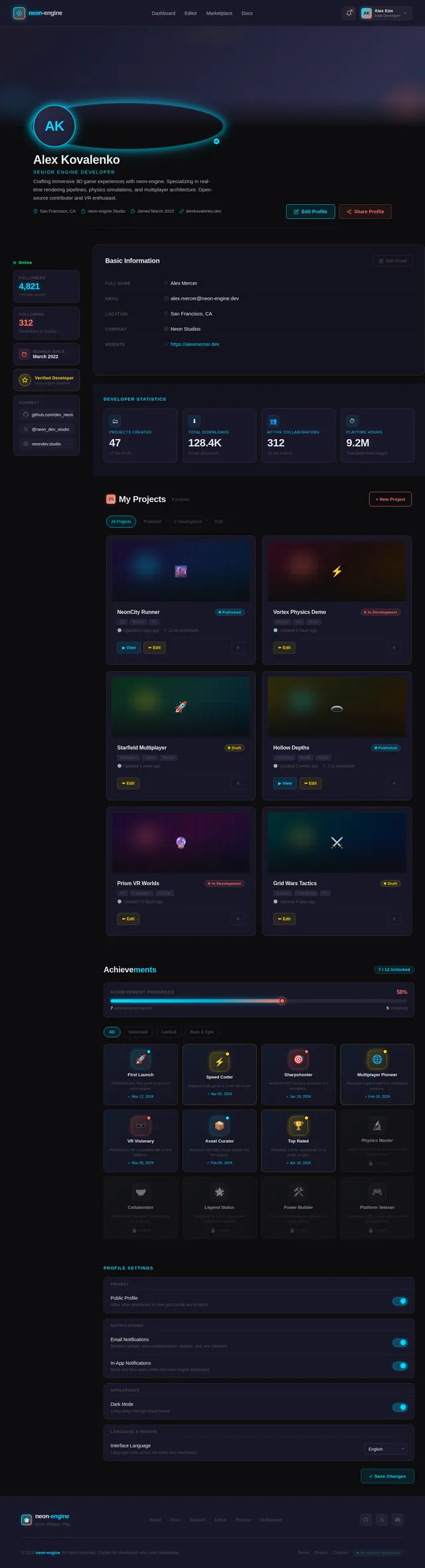
4. User Personas
Developer
- Description: Game developers ranging from indie creators to large studios.
- Goals: Build high-quality 3D games efficiently, deploy across multiple platforms, and leverage advanced features like multiplayer and VR.
- Pain Points: Complexity of cross-platform development, performance optimization, and asset compatibility.
Player (End-User)
- Description: Gamers who will experience the games created using neon-engine.
- Goals: Enjoy immersive, high-performance games on their preferred platform.
- Pain Points: Poor performance, lack of platform support, and inconsistent experiences.
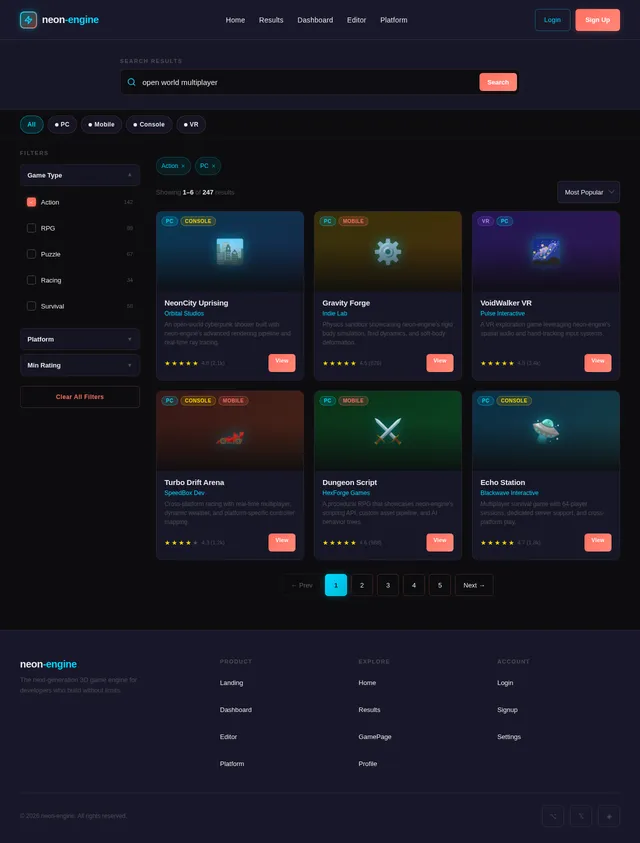
5. Visuals Colors and Theme
The neon-engine will adopt a futuristic and vibrant aesthetic to reflect its cutting-edge capabilities. Below is the unique color palette:
- Background: #0D0D0F (Deep Midnight Black)
- Surface: #1A1A2E (Dark Indigo)
- Text: #EAEAEA (Soft White)
- Accent: #FF6F61 (Neon Coral)
- Muted Tones: #4E4E50 (Graphite Gray)
This palette conveys a modern, high-tech feel while maintaining readability and visual appeal.
6. Signature Design Concept
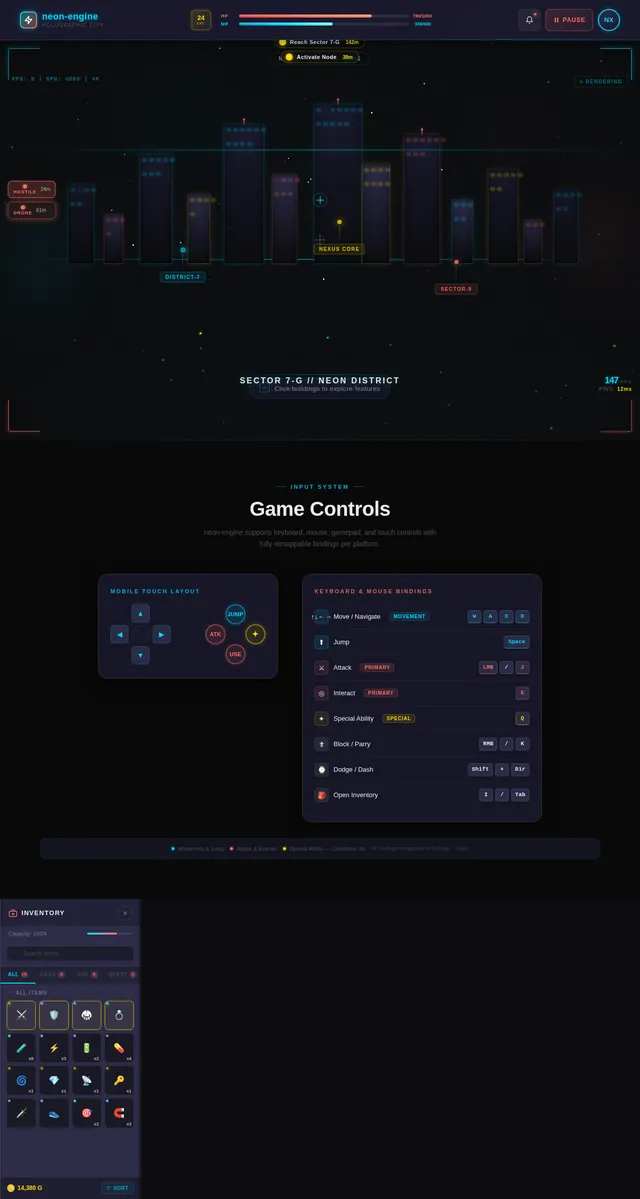
The neon-engine homepage will feature an interactive 3D holographic interface. Upon landing, users will see a rotating 3D model of a futuristic cityscape, symbolizing the limitless possibilities of the engine. Key features of the design include:
- Dynamic Interaction: Users can click on different buildings in the cityscape to explore specific features of the engine (e.g., rendering, physics, scripting).
- Neon Glow Effects: The cityscape will have glowing neon lights that pulse subtly, creating a sense of energy and innovation.
- Parallax Scrolling: As users scroll, the camera will zoom into different parts of the city, revealing more details about the engine's capabilities.
- Micro-Animations: Hovering over elements will trigger smooth animations, such as lights flickering or holographic panels appearing.
- Sound Design: Subtle ambient sounds and futuristic tones will enhance the immersive experience.
This bold and memorable design will immediately captivate users and set the tone for the engine's innovative spirit.
7. Non-Functional Requirements
- The engine must maintain a frame rate of at least 60 FPS on supported platforms.
- The engine must support resolutions up to 4K.
- The engine must load projects within 5 seconds on high-performance hardware.
- The engine must provide comprehensive documentation and tutorials.
- The engine must support localization for multiple languages, including English (default), French, and German.
8. Tech Stack
Frontend
- React for the web-based development environment.
Backend
- Python with FastAPI for backend services.
Database
- MySQL for relational data storage, using Alembic for migrations.
- MongoDB for NoSQL storage of unstructured data.
AI Models
- GPT 5.4 for user-friendly responses in the development environment.
- Claude 4.6 Opas for coding assistance.
- Google Nano Banana for generating visual assets.
AI Tools
- Litellm for LLM routing.
- Langchain for AI-driven workflows.
Orchestration
- Docker and docker-compose for local development.
- Kubernetes for server-side orchestration.
9. Assumptions and Constraints
Assumptions
- Developers will have access to modern hardware for development.
- Target platforms will include Windows, macOS, iOS, Android, and major gaming consoles.
- Users will have basic knowledge of game development.
Constraints
- The engine must adhere to platform-specific guidelines (e.g., Apple App Store, Google Play).
- The engine must not exceed 2GB in installation size.
- The engine must operate within the constraints of mobile hardware.
10. Glossary
- Rendering Engine: Software responsible for generating images from 3D models.
- Physics Engine: Software that simulates physical interactions in a virtual environment.
- Scripting: Writing code to control game logic and behavior.
- Cross-Platform: Compatibility with multiple operating systems and devices.
- VR: Virtual Reality, a simulated experience that can be similar to or completely different from the real world.

Build Limitless Games
Cross-platform 3D game engine with cutting-edge rendering, physics, and VR. Empower your studio to deploy immersive experiences across PC, mobile, and console.
Explore the Engine
Interactive 3D Holographic Interface
Advanced Rendering
Real-time ray tracing, dynamic lighting, and 4K support
Rendering Pipeline
Harness GPU-accelerated rendering with PBR materials, global illumination, and volumetric effects for photorealistic visuals.
Open Editor →Physics Engine
Rigid body dynamics, collision detection, and soft body simulation
Physics System
Built-in rigid and soft body dynamics with continuous collision detection, joints, constraints, and GPU-accelerated particle physics.
Explore Physics →Scripting Support
Native script language, hot reload, and full IDE integration
Script Engine
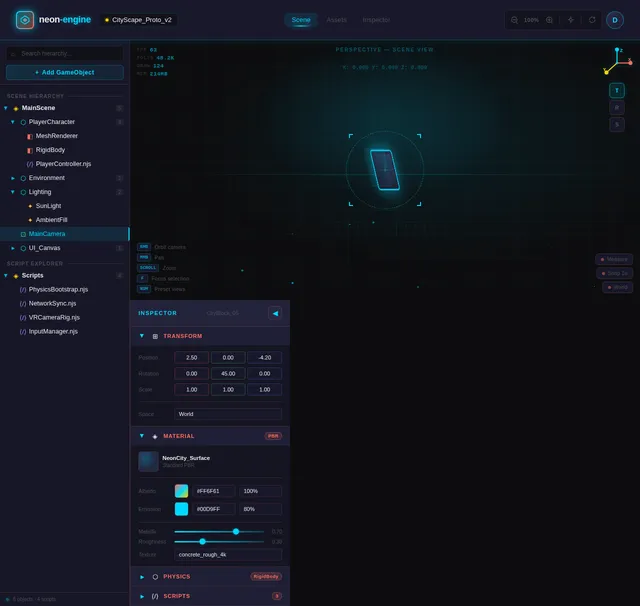
Write game logic with our expressive scripting language. Hot reload changes instantly, debug in real-time with integrated IDE tools.
View Documentation →Cross-Platform Deploy
Ship to PC, mobile, console, and VR from a single codebase
Deployment
One-click builds for Windows, macOS, iOS, Android, and major consoles. Automatic platform-specific optimizations included.
View Platforms →Click a building to explore
Everything You Need to Build
Four powerful pillars that form the foundation of neon-engine, giving developers complete creative control.
Advanced Rendering
Harness real-time ray tracing, dynamic global illumination, and 4K viewport support to create visually stunning worlds with cinematic fidelity.
Learn More→Physics Engine
Simulate rigid body dynamics, soft body deformation, and precise collision detection for realistic interactions that bring your game worlds to life.
Learn More→Scripting Support
Write game logic with a native scripting language, enjoy instant hot reload, and leverage full IDE integration for rapid iteration cycles.
Learn More→Asset Tools
Import and export assets in standard formats like FBX and OBJ. Streamlined pipeline tools ensure seamless integration with your design workflow.
Learn More→Advanced Rendering
- Real-time Ray TracingPhotorealistic reflections, global illumination, and soft shadows computed in real time for cinematic-quality visuals.
- Dynamic LightingHundreds of dynamic light sources with volumetric fog, area lights, and real-time shadow cascades across massive environments.
- 4K SupportNative 4K rendering pipeline with temporal upscaling, adaptive resolution, and HDR output for stunning visual fidelity.
Simulate Real-World Physics
A robust physics engine powering realistic simulations — from rigid body collisions to soft body deformations, all running at high performance across platforms.
- Rigid Body DynamicsAccurate mass, inertia, and force simulations for realistic object interactions and collisions.
- Collision DetectionBroad-phase and narrow-phase detection with continuous collision for fast-moving objects.
- Soft Body SimulationDeformable meshes, cloth physics, and fluid-like behaviors for organic visual effects.
1// Game controller script2class PlayerController extends Entity {3 speed = 12.5;4 jumpForce = 8.0;56 @hotReload7 fn onUpdate(dt) {8 let vel = this.input.axis("move");9 this.transform.translate(10 vel * this.speed * dt11 );12 }13}
Powerful Scripting
Write game logic with an expressive, high-performance scripting system designed for rapid iteration.
- Native Script LanguagePurpose-built scripting with type safety, auto-completion, and zero-overhead interop with the engine core.
- Hot ReloadInstantly see script changes reflected in your running game — no recompilation, no restart required.
- Full IDE IntegrationFirst-class support for VS Code, JetBrains, and the built-in neon-engine Editor with breakpoints and profiling.
Deploy Everywhere
One engine, infinite platforms
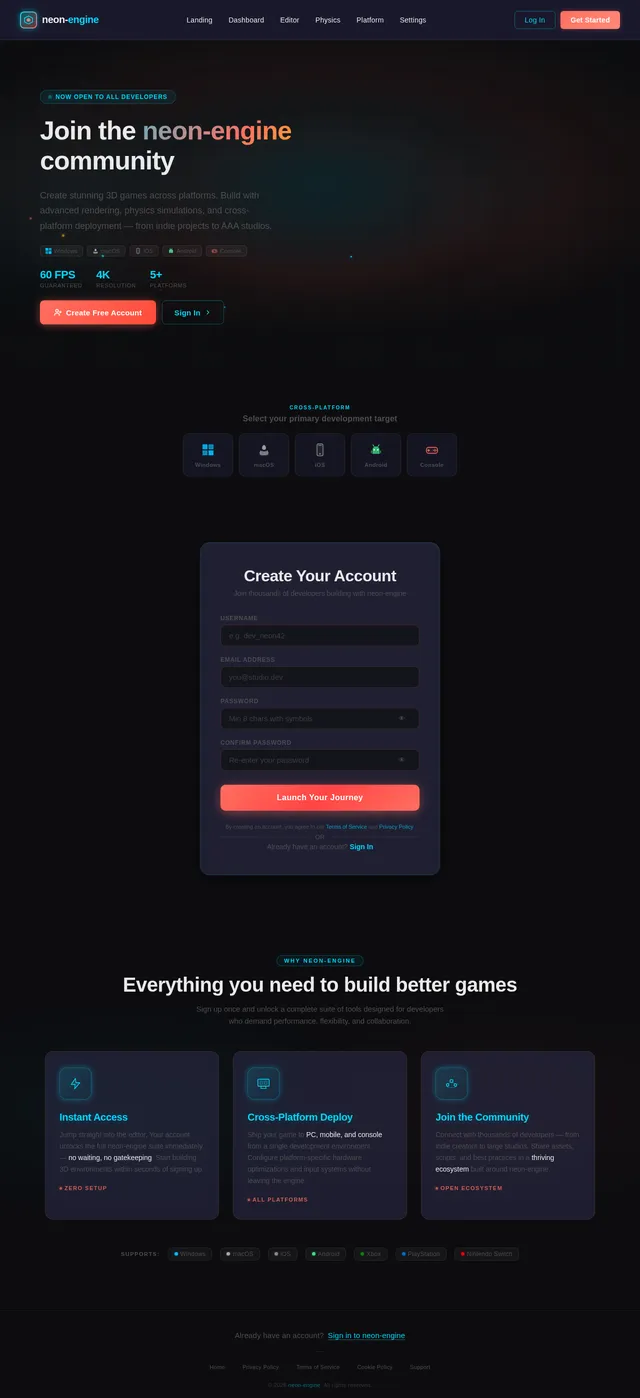
Ready to Build?
Join thousands of developers creating with neon-engine
Your Development Journey
From first spark to global launch — six steps to ship your game
Discover
Explore the engine capabilities on the landing page and see what neon-engine can do for your project.
Sign Up
Create your free developer account in seconds and unlock full access to the development suite.
Dashboard
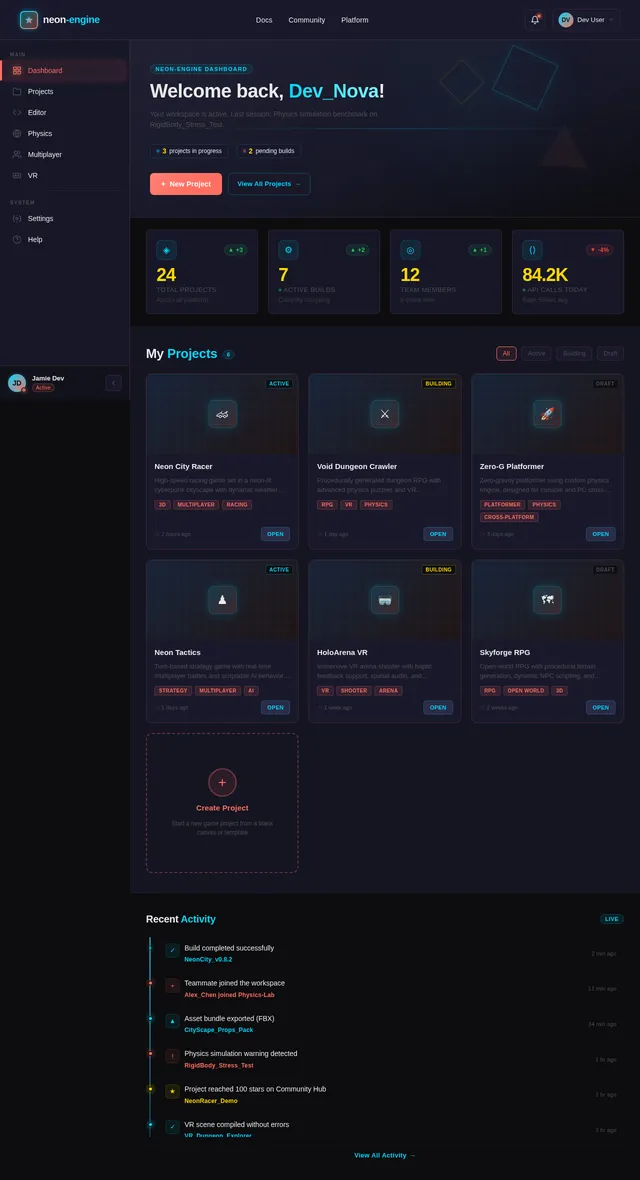
Manage your projects, track progress, and access all engine tools from a unified workspace.
Build
Design 3D environments, write scripts, and import assets using the powerful visual editor.
Deploy
Compile and publish your game across PC, mobile, and console platforms with one click.
Launch
Ship your game to players worldwide and monitor performance analytics in real time.
No comments yet. Be the first!