meta-assessment
 F(x) Data Labs Pvt Ltd
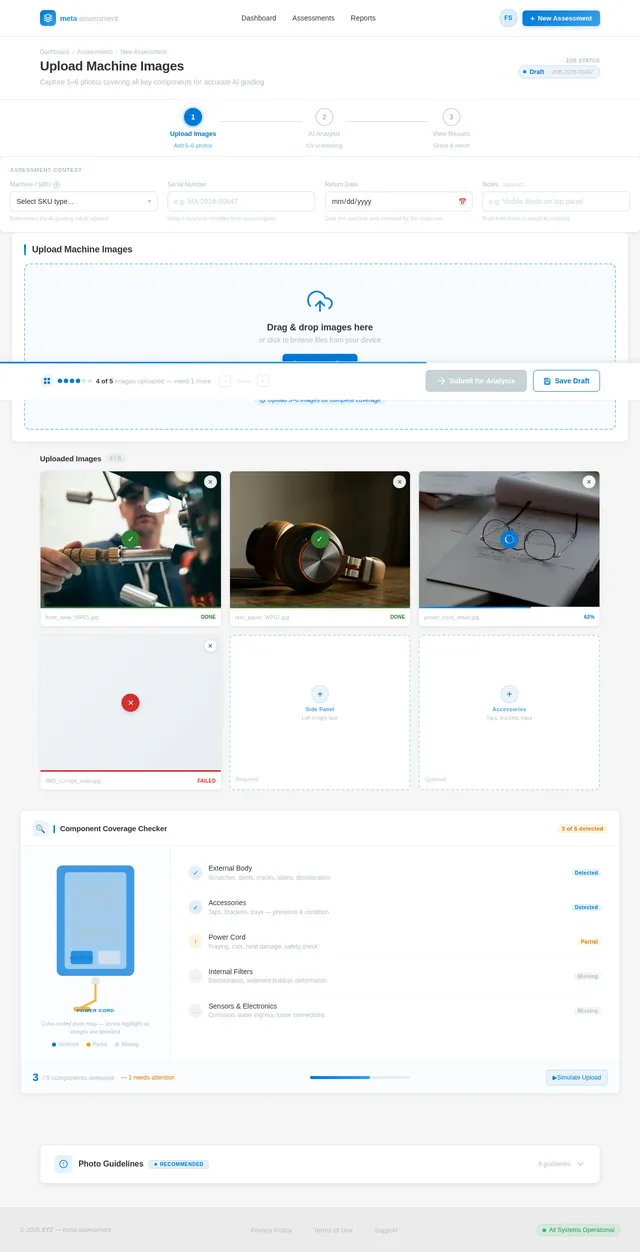
Use Case: Automated Rental Machine Condition Assessment The customer operates a subscription model where domestic appliances are deployed at customer homes. When machines are returned (cancellation, upgrade, relocation), they need to assess the condition to determine refurbishment eligibility, required repairs, and damage accountability. Current state: Manual assessment by warehouse staff — slow, inconsistent, and doesn't scale. What they need: An AI/CV system where end-users or field staff capture 5-6 photographs of the returned machine, and the system automatically evaluates: External body condition — scratches, dents, cracks, stains, discoloration Accessories — presence/absence and condition of detachable components (taps, brackets, trays) Power cord — fraying, cuts, heat damage, safety assessment Internal components & filters — discoloration, sediment buildup, deformation, leakage marks Sensors & electronics — corrosion, water ingress, loose connections The system should output a composite condition grade per machine with component-level breakdown, annotated images, and a refurbishment recommendation. Scale: 8,000 — 10,000 machines returned per month 5-6 images per machine (~50,000-60,000 images/month) 4 SKU types to assess Real-time or near-real-time processing required Relevant AWS services: Amazon Lookout for Vision, Amazon Rekognition Custom Labels, Amazon SageMaker, Amazon A2I, AWS Lambda, Amazon S3, Amazon QuickSight.

Comments (0)
Sign in to leave a comment
System Requirements
System Requirements Document (SRD)
Project Name: meta-assessment
1. Introduction
The meta-assessment project is an AI-powered backend platform designed to automate the condition assessment of rental machines returned by customers. XYZ, based in India, operates a subscription model for domestic appliances, and this project aims to streamline the evaluation process for returned machines. By leveraging computer vision (CV) and artificial intelligence (AI), the system will replace the current manual assessment process, ensuring consistency, scalability, and efficiency.
This document outlines the system requirements for the meta-assessment project, including functional and non-functional specifications, user personas, design concepts, and technical considerations.
2. System Overview
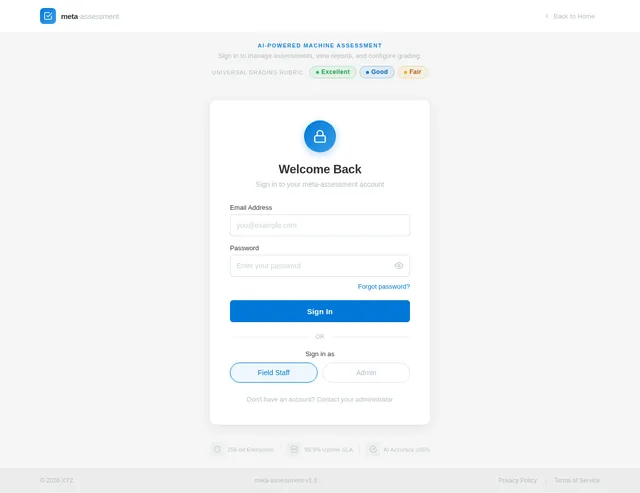
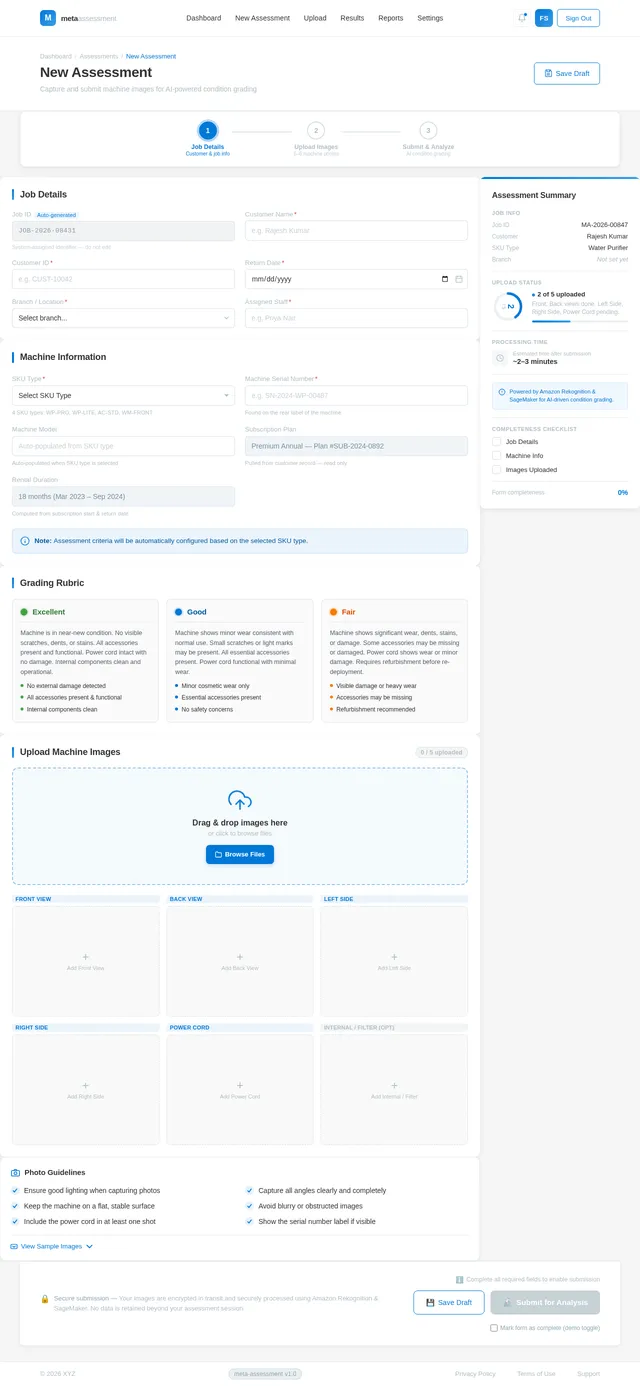
The meta-assessment system will enable end-users or field staff to capture 5–6 photographs of returned machines. Using AI and CV technologies, the system will automatically evaluate the condition of the machines and provide a composite condition grade based on a universal grading rubric: Excellent, Good, or Fair. The system will also generate annotated images, component-level breakdowns, and refurbishment recommendations.
Key features include:
- Assessment of external body condition (scratches, dents, cracks, stains, discoloration).
- Evaluation of accessories (presence/absence and condition of detachable components like taps, brackets, trays).
- Inspection of power cords (fraying, cuts, heat damage, safety assessment).
- Analysis of internal components and filters (discoloration, sediment buildup, deformation, leakage marks).
- Examination of sensors and electronics (corrosion, water ingress, loose connections).
- Real-time or near-real-time processing of 50,000–60,000 images per month for 8,000–10,000 machines across 4 SKU types.
3. Functional Requirements
- As a User, I should be able to upload 5–6 images of a returned machine for condition assessment.
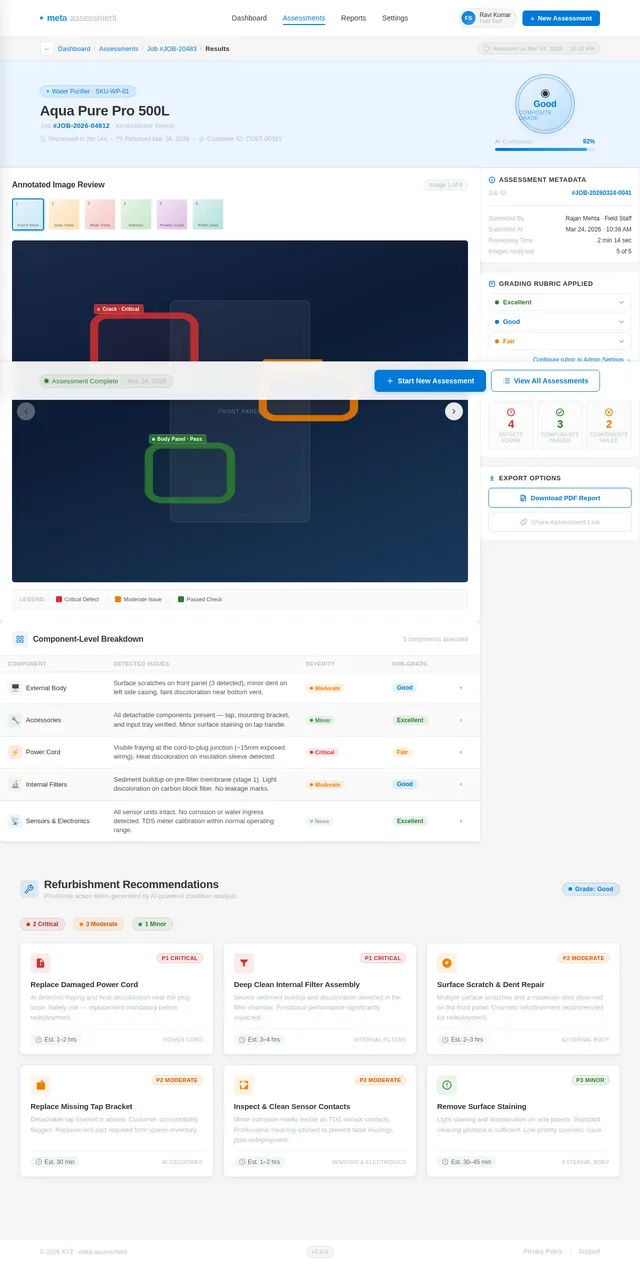
- As a User, I should receive a composite condition grade (Excellent, Good, Fair) based on the universal grading rubric.
- As a User, I should be able to view annotated images highlighting detected issues (e.g., scratches, dents, corrosion).
- As a User, I should receive a detailed component-level breakdown of the machine's condition.
- As a User, I should receive refurbishment recommendations based on the machine's condition grade.
- As an Admin, I should be able to configure the grading rubric and thresholds for condition categories.
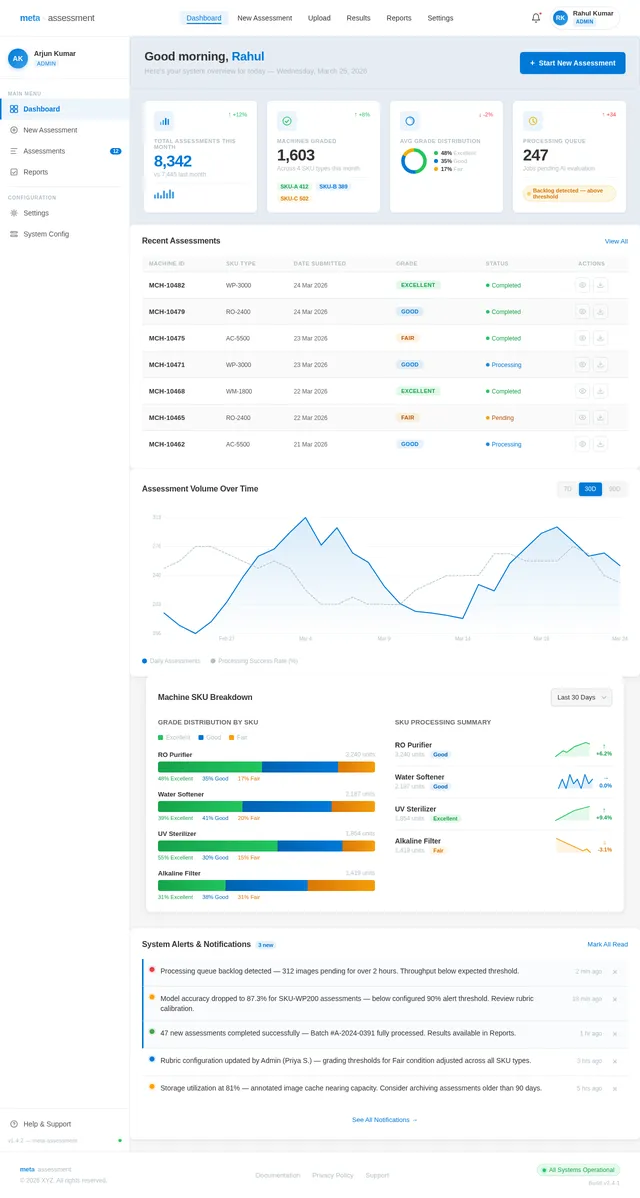
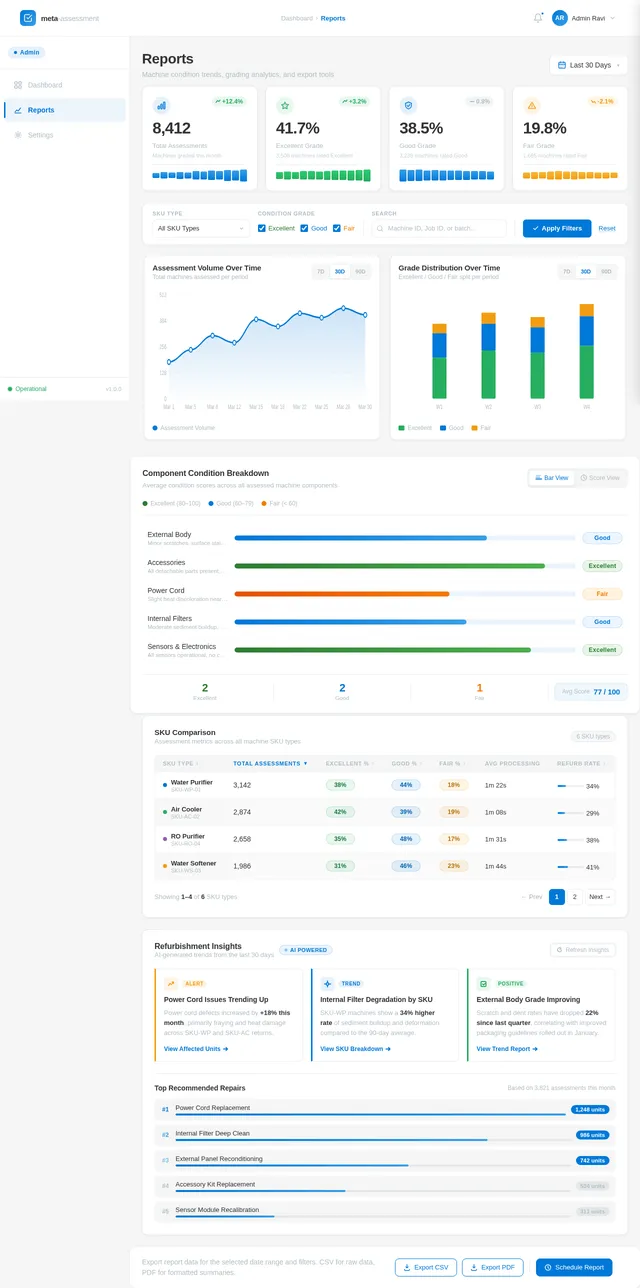
- As an Admin, I should be able to monitor system performance and processing metrics.
- As an Admin, I should be able to generate reports on machine condition trends and refurbishment statistics.
- As an Admin, I should be able to manually trigger selective re-run capability for SRD regeneration.
4. User Personas
1. End-User
- Role: Field staff or warehouse personnel responsible for capturing machine images and uploading them to the system.
- Goals: Quickly assess machine condition and receive actionable insights for refurbishment or accountability.
- Pain Points: Manual assessments are slow, inconsistent, and prone to human error.
2. Admin
- Role: Supervisors or managers overseeing the assessment process and system performance.
- Goals: Ensure the system operates efficiently, monitor trends, and generate reports for business insights.
- Pain Points: Difficulty in scaling manual processes and ensuring consistent grading across SKU types.
5. Visuals Colors and Theme
Color Palette:
The color palette for meta-assessment reflects professionalism, precision, and clarity, aligning with the project's focus on automated assessments.
- Background: #EAEFF2 (Soft Sky Gray)
- Surface: #FFFFFF (Pure White)
- Text: #2C3E50 (Deep Navy)
- Accent: #3498DB (Vivid Cerulean Blue)
- Muted Tones: #95A5A6 (Neutral Slate Gray)
This palette ensures a clean, modern interface that emphasizes clarity and ease of use.
6. Signature Design Concept
Interactive Machine Anatomy Dashboard
The homepage of the meta-assessment system will feature an Interactive Machine Anatomy Dashboard. Users will see a 3D model of a generic rental machine that dynamically highlights different components (e.g., external body, accessories, power cord, internal filters, sensors) as they hover over or click on sections.
Key features:
- Dynamic Highlighting: When users hover over a section (e.g., power cord), the corresponding area on the 3D model lights up and displays a brief description of what the system assesses.
- Annotated Image Carousel: Below the 3D model, users can scroll through sample annotated images showcasing detected issues like scratches, dents, or corrosion.
- Color Transitions: The background subtly shifts between shades of Cerulean Blue (#3498DB) and Neutral Slate Gray (#95A5A6) to create a calming yet professional atmosphere.
- Micro-Interactions: Clicking on a component triggers a smooth zoom-in animation, revealing detailed information about the assessment criteria for that part.
- Real-Time Grading Simulation: A demo feature allows users to upload a sample image and see how the system grades it in real-time.
This bold design concept ensures the homepage is both visually striking and functionally informative, leaving a lasting impression on users.
7. Non-Functional Requirements
- Performance: The system must process 50,000–60,000 images per month with real-time or near-real-time results.
- Scalability: The system should handle increasing volumes of returned machines without degradation in performance.
- Accuracy: The AI models must achieve at least 95% accuracy in detecting and grading machine conditions.
- Security: All uploaded images and assessment data must be securely stored and transmitted using encryption protocols.
- Availability: The system must maintain 99.9% uptime to ensure continuous operation.
8. Tech Stack
Backend:
- Python
- FastAPI
Database:
- MySQL or MariaDB (preferred for relational data)
- MongoDB (for unstructured image metadata)
- Alembic for database migrations
AI Models:
- GPT 5.2 for user-friendly responses
- Claude 4.5 Opas for academic or coding work
- Google Nano Banana for image generation
AI Tools:
- Litellm for LLM Routing
- Langchain
Local Orchestration:
- Docker
- docker-compose
Server-Side Orchestration:
- Kubernetes
Relevant AWS Services:
- Amazon Lookout for Vision
- Amazon Rekognition Custom Labels
- Amazon SageMaker
- Amazon A2I
- AWS Lambda
- Amazon S3
- Amazon QuickSight
9. Assumptions and Constraints
Assumptions:
- Users will provide clear, high-quality images of returned machines.
- The universal grading rubric will remain consistent across all SKU types.
- AWS services will be used for AI model deployment and data storage.
Constraints:
- Processing time for each machine must not exceed 5 minutes.
- The system must operate within the budget allocated for AWS services and infrastructure.
10. Glossary
- SKU: Stock Keeping Unit, a unique identifier for a product type.
- AI: Artificial Intelligence, used for automating machine condition assessment.
- CV: Computer Vision, a field of AI focused on image analysis.
- Annotated Images: Images with visual markers highlighting detected issues.
- Refurbishment Recommendation: Suggestions for repairing or reconditioning returned machines.
This document provides a comprehensive overview of the meta-assessment project requirements. Let me know if there are additional details you'd like to refine, XYZ!
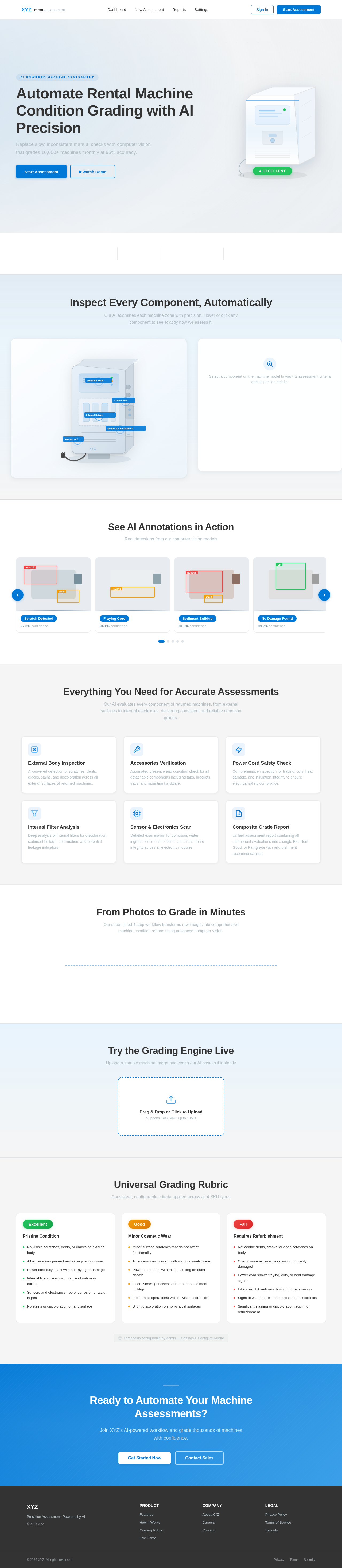
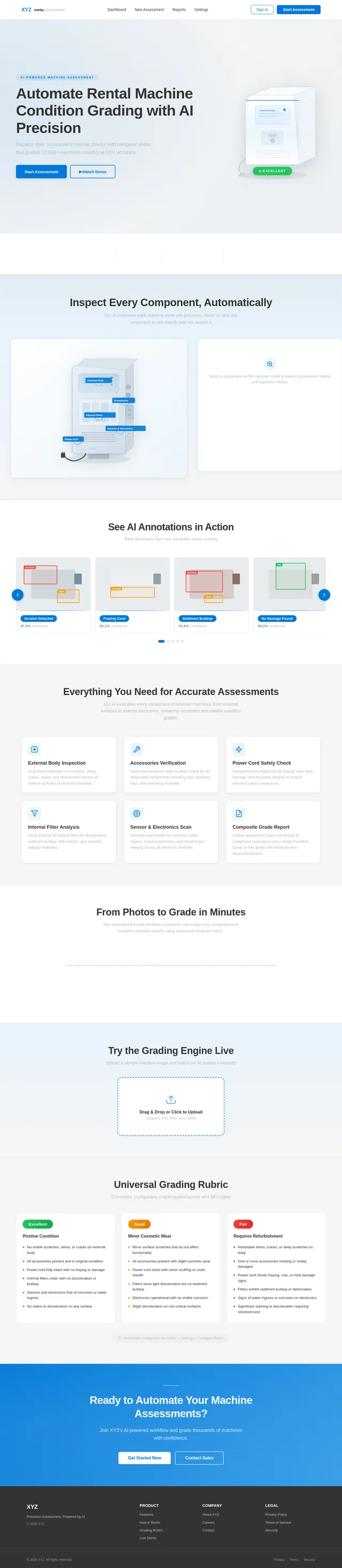
Automate Rental Machine Condition Grading with AI Precision
Replace slow, inconsistent manual checks with computer vision that grades 10,000+ machines monthly at 95% accuracy.
Inspect Every Component, Automatically
Our AI examines each machine zone with precision. Hover or click any component to see exactly how we assess it.
Select a component on the machine model to view its assessment criteria and inspection details.
See AI Annotations in Action
Real detections from our computer vision models
Everything You Need for Accurate Assessments
Our AI evaluates every component of returned machines, from external surfaces to internal electronics, delivering consistent and reliable condition grades.
External Body Inspection
AI-powered detection of scratches, dents, cracks, stains, and discoloration across all exterior surfaces of returned machines.
Accessories Verification
Automated presence and condition check for all detachable components including taps, brackets, trays, and mounting hardware.
Power Cord Safety Check
Comprehensive inspection for fraying, cuts, heat damage, and insulation integrity to ensure electrical safety compliance.
Internal Filter Analysis
Deep analysis of internal filters for discoloration, sediment buildup, deformation, and potential leakage indicators.
Sensor & Electronics Scan
Detailed examination for corrosion, water ingress, loose connections, and circuit board integrity across all electronic modules.
Composite Grade Report
Unified assessment report combining all component evaluations into a single Excellent, Good, or Fair grade with refurbishment recommendations.
From Photos to Grade in Minutes
Our streamlined 4-step workflow transforms raw images into comprehensive machine condition reports using advanced computer vision.
Try the Grading Engine Live
Upload a sample machine image and watch our AI assess it instantly
Drag & Drop or Click to Upload
Supports JPG, PNG up to 10MB
Universal Grading Rubric
Consistent, configurable criteria applied across all 4 SKU types
Pristine Condition
- No visible scratches, dents, or cracks on external body
- All accessories present and in original condition
- Power cord fully intact with no fraying or damage
- Internal filters clean with no discoloration or buildup
- Sensors and electronics free of corrosion or water ingress
- No stains or discoloration on any surface
Minor Cosmetic Wear
- Minor surface scratches that do not affect functionality
- All accessories present with slight cosmetic wear
- Power cord intact with minor scuffing on outer sheath
- Filters show light discoloration but no sediment buildup
- Electronics operational with no visible corrosion
- Slight discoloration on non-critical surfaces
Requires Refurbishment
- Noticeable dents, cracks, or deep scratches on body
- One or more accessories missing or visibly damaged
- Power cord shows fraying, cuts, or heat damage signs
- Filters exhibit sediment buildup or deformation
- Signs of water ingress or corrosion on electronics
- Significant staining or discoloration requiring refurbishment
Ready to Automate Your Machine Assessments?
Join XYZ’s AI-powered workflow and grade thousands of machines with confidence.
No comments yet. Be the first!