mellow-literature
 Cyril Marcus
Can you explain why this is a bad litrature review A Bad Example of a Literature Review This literature review will cover the themes which are most useful for my dissertation; this is because it will help to guide my analysis chapter. Men and Masculinity This section will outline the work on gender which I think is interesting. Hegemonic theorising will be introduced because it is important for my work. Hegemonic masculinity theorising and its critiques Theorising on hegemonic masculinity dominates. This is also talked about a lot in work on men and sport. I am going to look at men and how they think about hegemonic masculinity. I want to know if they get it. Because of this, I will start with talking about the theory. Hegemonic masculinity is quite new and people might argue what it means. But a certain thing is that it comes from work of people who are Marxists. Gramsci talked about hegemony first of all and this has been borrowed in masculinity work. He says hegemony helps to understand power. Connell does agree with this too and says that there are some groups and institutes in society which make the masculinity dominant. The term hegemonic masculinity arrived late. It has been described by Connell (2005) to be a ‘synthesis’ of lots of things. Even though there have been people who disagree with the theory and who say it has lots of issues and problems which make it difficult to use it still seems to be used by lots of people. But all of these people using it means that it is difficult to find one definition as people like to disagree and argue. Having said all this, a definition is that it can be the same as what Connell page 832 in 2005 argued ‘the pattern of practice that allowed men’s dominance over women to continue’. Currently Hearn (2004) has said that hegemonic masculinity ideas are still useful and that they can still be applied in research. The newest thinking on this theory states that the concept is changeable and that it is useful because of the way it can be adapted and applied. Not everyone agrees with some criticisms of this theory starting too. Mckay and others say that men do not experience things the same, especially in sport so they suggest that more work and attention needs to be looked at in relation to men and their experiences especially seeing if men follow hegemonic masculinity. Ian Wellard is a person who says some more about this in his discussion of ‘exclusive’ masculinity. He is different from the others as he brings in new themes such as resistance and agency. He tells us that men can make choices. So in conclusion where does this leave us? Hegemonic masculinity is still useable even though it has some problems with it. I can use this but with caution. This is what I will do in my project

Comments (0)
Sign in to leave a comment
Project Tasks28
Implement Theme & Global Styles
As a frontend developer, I want to implement the global theme, color tokens, typography, and shared layout structure so that all pages reflect the mellow-literature design system. This includes: Soft Blue (#6C9BCF), Light Gray (#F5F5F5), Deep Navy (#2A3D66), Warm Beige (#F2E6D9), Georgia serif headings, Open Sans body text, CSS custom properties, paper-texture overlay, and shared layout wrappers. Remove any scaffold pages not present in the design (welcome page, ai-assistant page if not in user flows). This task must be completed before all page implementation tasks.
Implement Upload Review API
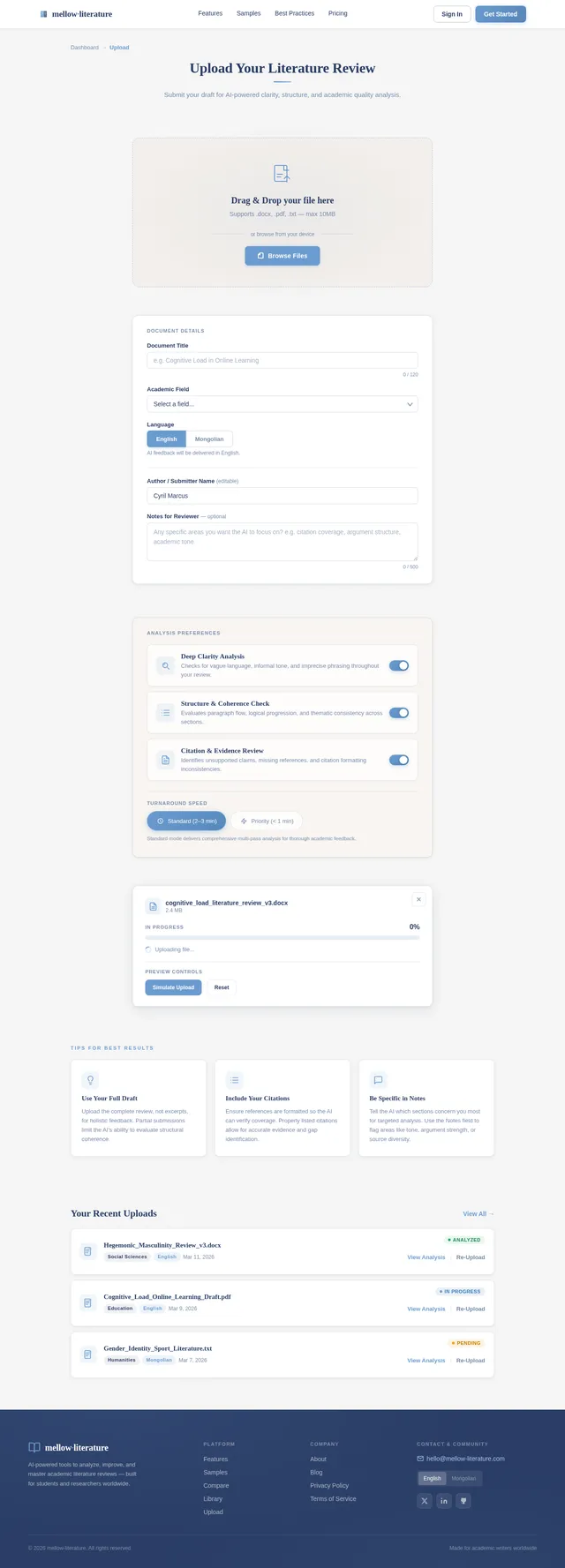
As a backend developer, I want to implement a FastAPI endpoint to accept literature review uploads (text/file) so that users can submit content for AI analysis. Includes: file/text ingestion, metadata storage (user ID, title, language, timestamp UTC+8), validation, and trigger for AI analysis pipeline. Supports English and Mongolian.
Implement Samples & Compare API
As a backend developer, I want to implement FastAPI endpoints for sample reviews and side-by-side comparisons so that the Samples and Compare pages can fetch curated before/after content. Includes: GET /samples (with filters: discipline, search), GET /samples/{id}/analysis, GET /compare/{id} returning annotated before/after text pairs with highlights.
Implement Best Practices Library API
As a backend developer, I want to implement FastAPI endpoints to serve best practices library resources so that the Library page can display categorized academic writing guides. Includes: GET /library (with category/search filters), GET /library/{id} for full guide content, bilingual support (English/Mongolian), content stored in MySQL.
Implement User Management API
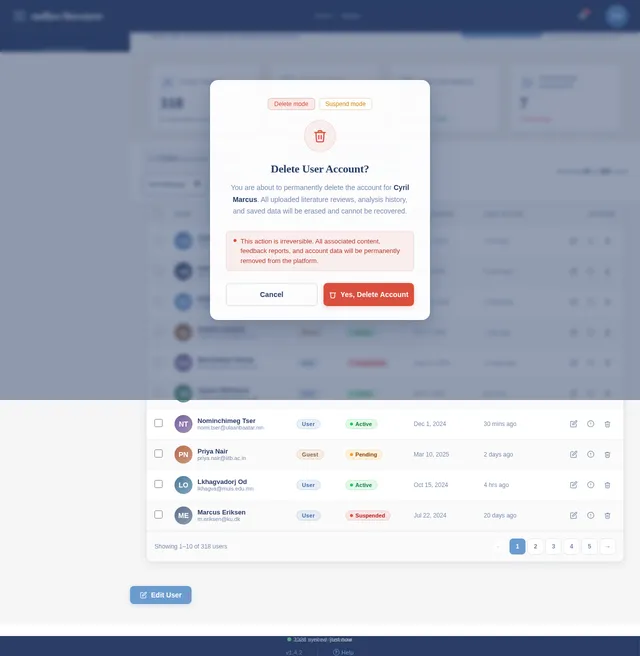
As a backend developer, I want to implement FastAPI admin endpoints for user management so that the Users page can list, search, filter, edit, suspend, and delete user accounts. Includes: GET /admin/users (paginated, with search/role/status filters), PUT /admin/users/{id} (edit role, status, notes, timezone), DELETE /admin/users/{id} (with confirmation), POST /admin/users (create new user), GET /admin/stats (total, active, new, suspended counts).
Build Landing Page
As a frontend developer, I want to implement the Landing page based on the existing JSX design (v2) so that guests and users see the interactive literature review journey timeline. Includes: NavBar, Hero with radial gradient, TrustBadges band, InteractiveTimeline signature section (scroll-driven text rewrite animation, annotations, parallax), FeatureHighlights 3-column grid, SideBySidePreview, HowItWorks steps, BestPracticesTeaser, Testimonials, CallToAction, Footer. Links to: Samples, Signup, Login pages. Fully responsive, mobile-first.
Build Login Page
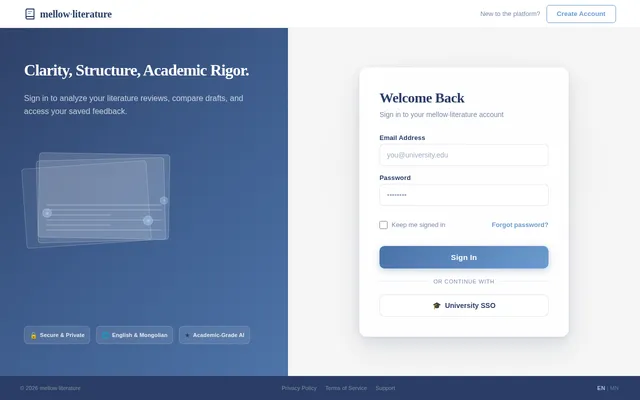
As a frontend developer, I want to implement the Login page based on the existing JSX design (v2) so that users and admins can sign in. Includes: centered card layout, email/password fields, 'Sign In' CTA, link to Signup, error states, and branding. Connects to: Admin Dashboard (admin), User Dashboard (user). Responsive for mobile.
Build Signup Page
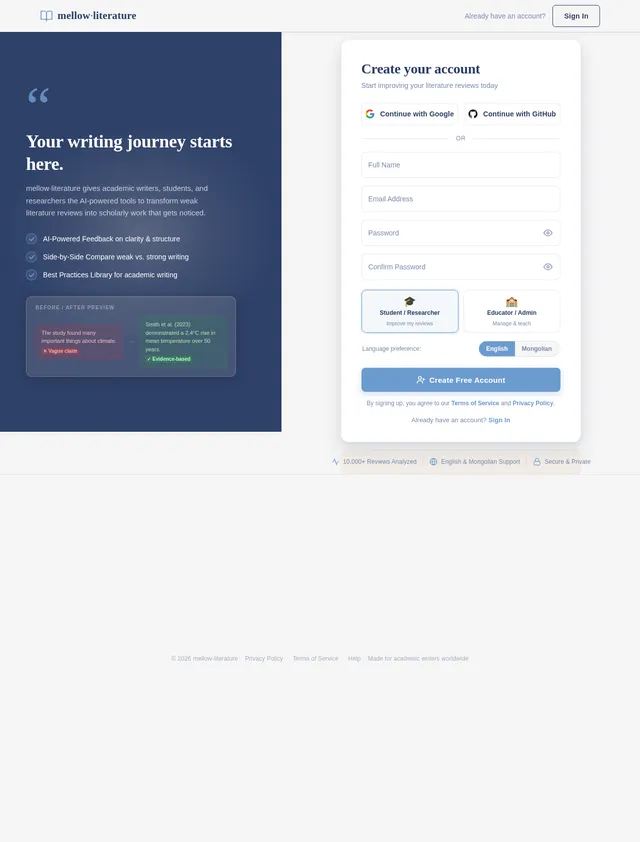
As a frontend developer, I want to implement the Signup page based on the existing JSX design (v2) so that new users can create an account. Includes: full name, email, password fields, role selection, CTA, link to Login, inline validation. Connects from: Landing, Samples pages. Responsive for mobile.
Build Samples Page
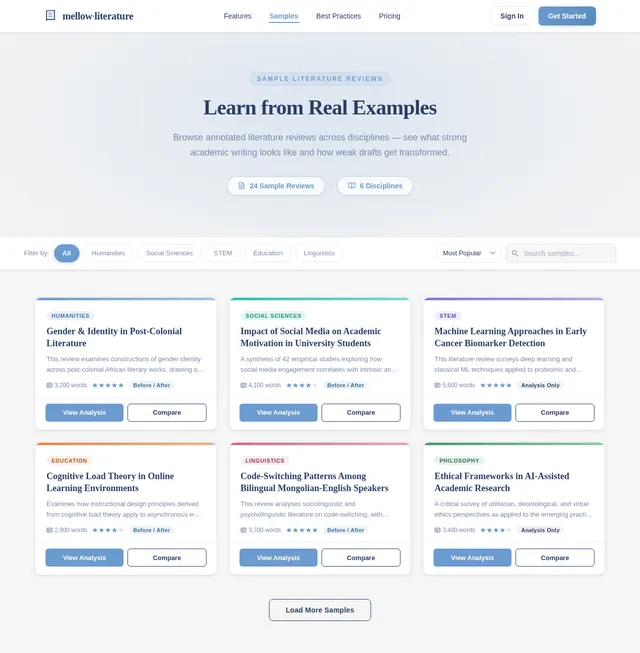
As a frontend developer, I want to implement the Samples page based on the existing JSX design (v2) so that guests can browse annotated sample literature reviews. Includes: SamplesHero, FilterToolbar (discipline chips, sort, search), SamplesGrid (cards with before/after badge, role-colored discipline tags, 'View Analysis' and 'Compare' actions), FeaturedSample with annotated doc card and flaw callouts, AnalysisPreview score panel, CompareTeaser split card, SignupNudge CTA band, Footer. Links to: Analysis, Compare, Signup pages.
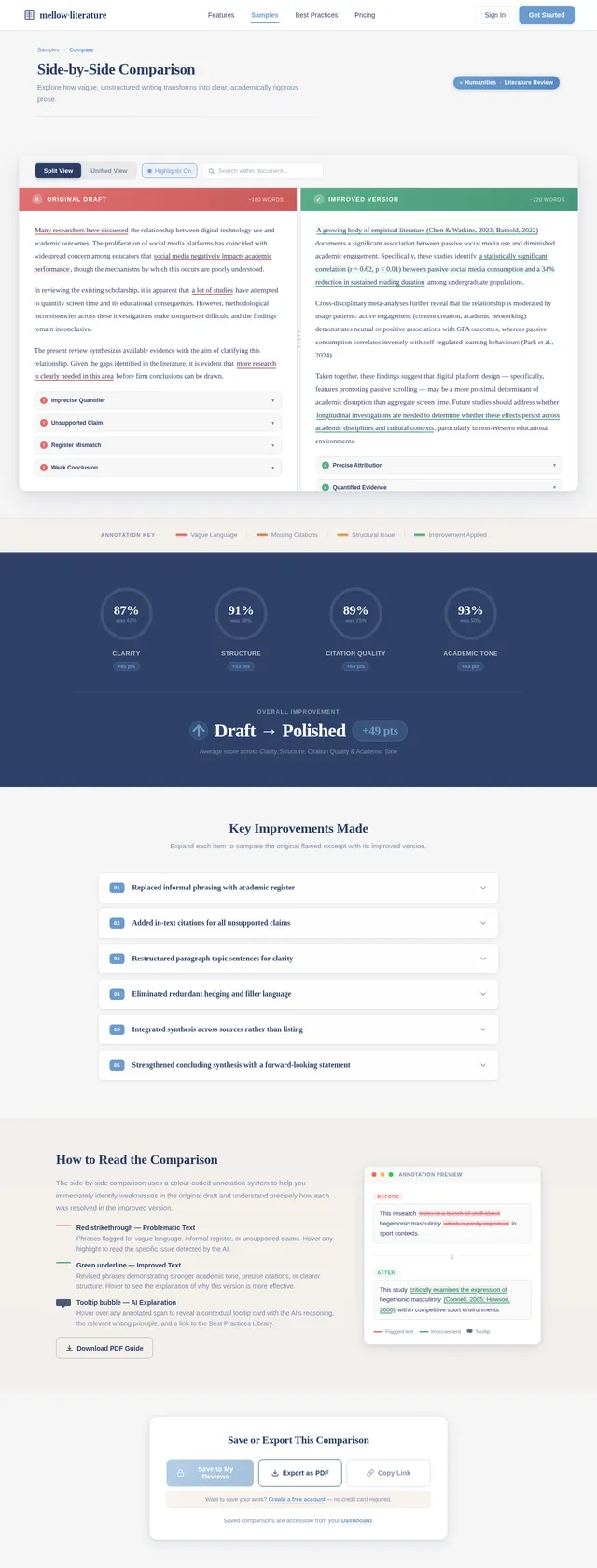
Build Compare Page
As a frontend developer, I want to implement the Compare page based on the existing JSX design (v2) so that users and guests can view side-by-side comparisons of poor vs. improved literature reviews. Includes: two-panel split layout (Before/After with color-coded headers), inline red strikethrough / green underline highlights, annotation tooltips, swap icon divider, filter/select controls to choose sample or uploaded review. Links from: Analysis, Samples pages.
Implement AI Analysis Pipeline
As an AI engineer, I want to implement the AI analysis workflow using Langchain with GPT and Claude so that submitted literature reviews receive structured feedback on clarity, structure, and academic quality. Includes: Langchain orchestration, GPT for user-friendly feedback, Claude for academic analysis, output schema (scores 0-100 per dimension, annotated text, improvement suggestions), bilingual support (English/Mongolian).
Implement Content Moderation API
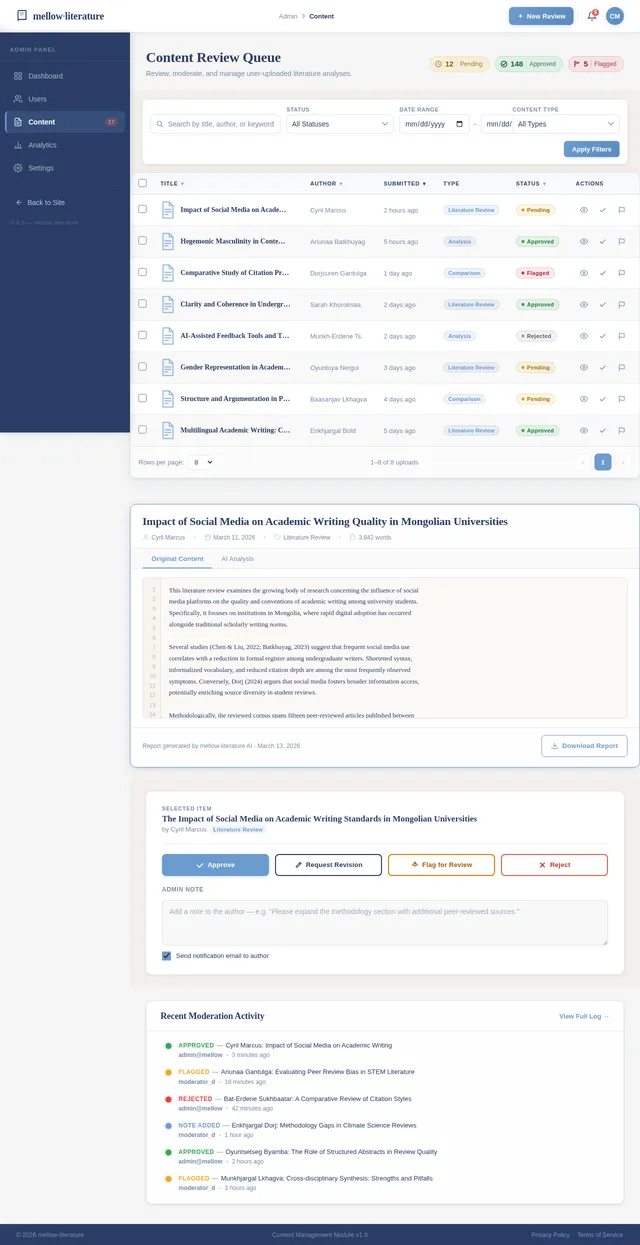
As a backend developer, I want to implement FastAPI admin endpoints for content moderation so that the Content page can list flagged uploads and allow admins to approve, request revision, or remove content. Includes: GET /admin/content (paginated, filter by status: Analyzed/Pending/Flagged), PUT /admin/content/{id}/approve, PUT /admin/content/{id}/request-revision, DELETE /admin/content/{id}/remove, audit logging of moderation actions.
Build Dashboard Page
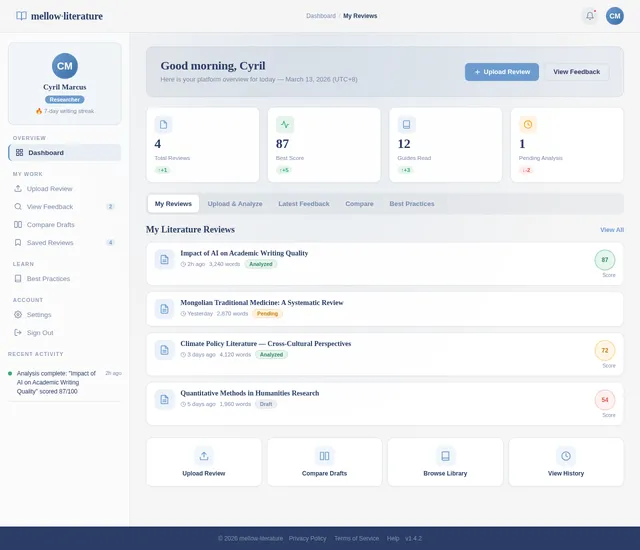
As a frontend developer, I want to implement the User Dashboard page based on the existing JSX design (v2) so that logged-in users can view and manage their literature reviews. Includes: NavBar, sidebar navigation, WelcomeBanner, stats cards (total reviews, analyses, saved, streak), ReviewsGrid with saved/analyzed cards, QuickActions (Upload, Compare, Library), RecentActivity feed. Links to: Upload, Analysis, Compare, Library pages. Responsive: sidebar collapses to hamburger drawer on mobile.
Build Admin Dashboard Page
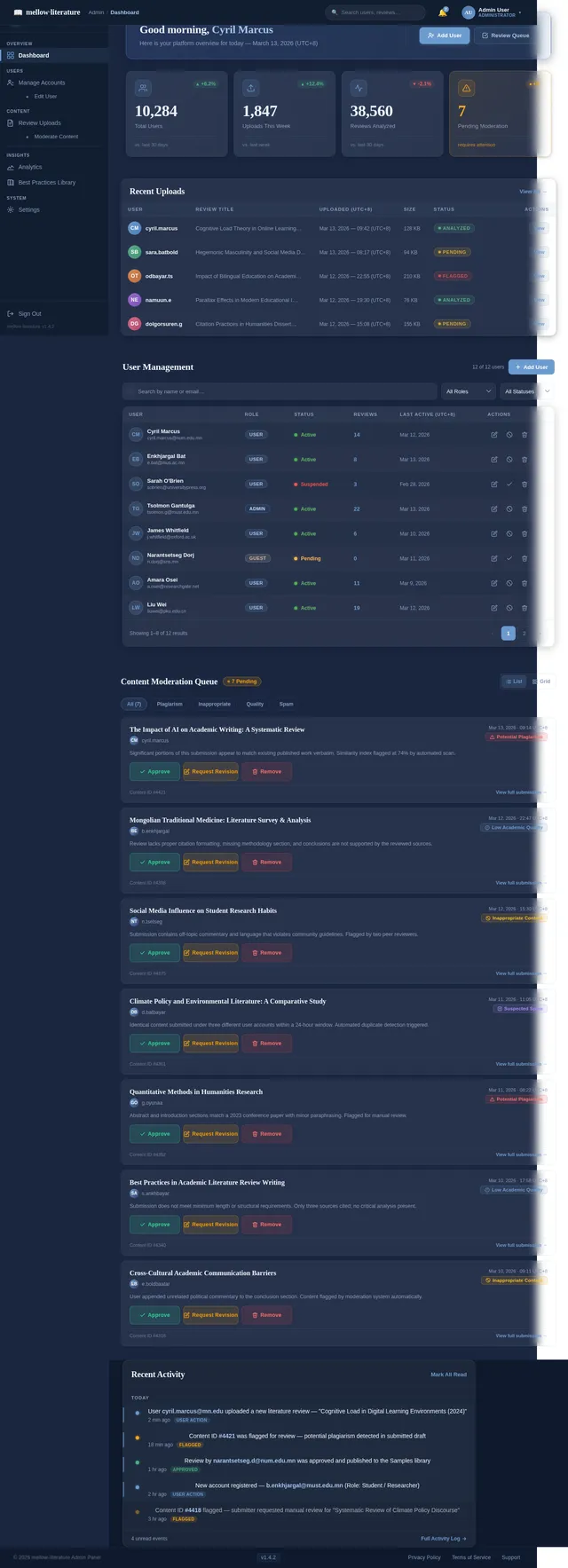
As a frontend developer, I want to implement the Admin Dashboard page based on the existing JSX design (v2) so that admins can view a platform overview. Includes: TopBar with breadcrumb, Sidebar with nav sections (Overview, Users, Content, Analytics, Settings), WelcomeBanner with quick actions, StatsOverview (4 stat cards with countUp), RecentUploads compact table, UserManagementTable with search/filter/pagination/delete modal, ContentModerationQueue kanban/list, ActivityFeed, AdminFooter. Fully responsive with sidebar drawer on mobile.
Implement Analysis Results API
As a backend developer, I want to implement FastAPI endpoints to retrieve and store AI analysis results so that the Analysis page can display structured feedback. Includes: GET /analysis/{review_id} returning scores, annotations, feedback cards; POST to save/persist results; association with user account for revisit functionality.
Wire Frontend Samples to API
As a frontend developer, I want to connect the Samples and Compare pages to the samples/compare API so that guests and users see real curated before/after content with filters. Includes: dynamic filter/search integration, paginated loading, analysis score display, side-by-side diff rendering from API data.
Build Upload Page
As a frontend developer, I want to implement the Upload page based on the existing JSX design (v2) so that users can submit literature reviews for AI analysis. Includes: drag-and-drop file upload zone, text paste area, review title/metadata fields, language selection (English/Mongolian), submission CTA with loading state. Connects from Dashboard, leads to Analysis page after submission.
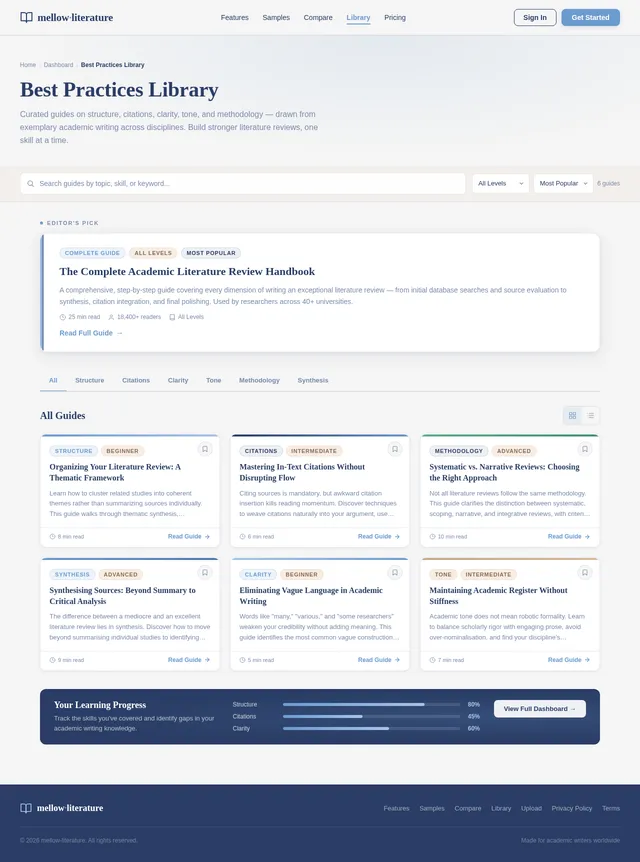
Build Library Page
As a frontend developer, I want to implement the Library (Best Practices) page based on the existing JSX design (v2) so that users can browse curated academic writing guides. Includes: LibraryHero, category filter chips (Structure, Citations, Clarity, Tone, etc.), resource cards grid (title, category tag, preview text, 'Read More' link), featured guide spotlight, search input. Links from: Dashboard; Connects to individual guide detail views.
Build Users Management Page
As a frontend developer, I want to implement the Users page based on the existing JSX design (v2) so that admins can manage all user accounts. Includes: PageHeader with 'Add New User' and 'Export CSV', UserStatsBar (4 stat cards), UserFiltersToolbar (search, role filter, status filter, date range), UserTable (avatar, name, email, role badge, status toggle, reviews count, last active, action icons), UserEditDrawer (slide-in form with validation), ConfirmationModal for delete/suspend, StatusBar. Pagination controls. Mobile: card-list layout.
Build Content Moderation Page
As a frontend developer, I want to implement the Content page based on the existing JSX design (v2) so that admins can review uploads and moderate flagged content. Includes: content uploads table (user, title, timestamp, status badge: Analyzed/Pending/Flagged), moderation queue with Approve/Request Revision/Remove actions, slide-out/animate-out on action, empty state illustration, filter/search controls. Links from: Admin Dashboard. Mobile: full-width stacked cards.
Implement Dashboard Data API
As a backend developer, I want to implement FastAPI endpoints to serve user dashboard data so that the Dashboard page can display a user's saved reviews, stats, and recent activity. Includes: GET /dashboard/stats (review count, analyses run, saved count), GET /dashboard/reviews (paginated list of user's saved/analyzed reviews), GET /dashboard/activity (recent actions feed, UTC+8 timestamps).
Implement i18n English & Mongolian
As a frontend developer, I want to implement bilingual support (English and Mongolian) across all pages so that users in Mongolia can use the platform in their native language. Includes: i18n library setup (react-i18next or similar), translation JSON files for all UI strings, language toggle in NavBar and Footer, locale-aware date/time formatting (UTC+8 default for Mongolian locale).
Implement Role-Based Route Guards
As a frontend developer, I want to implement route guards and role-based access control on the frontend so that admin pages are only accessible to admins, user dashboard is protected for authenticated users, and public pages (Landing, Samples, Compare) remain accessible to guests. Includes: auth context, protected route components, redirect logic on unauthorized access.
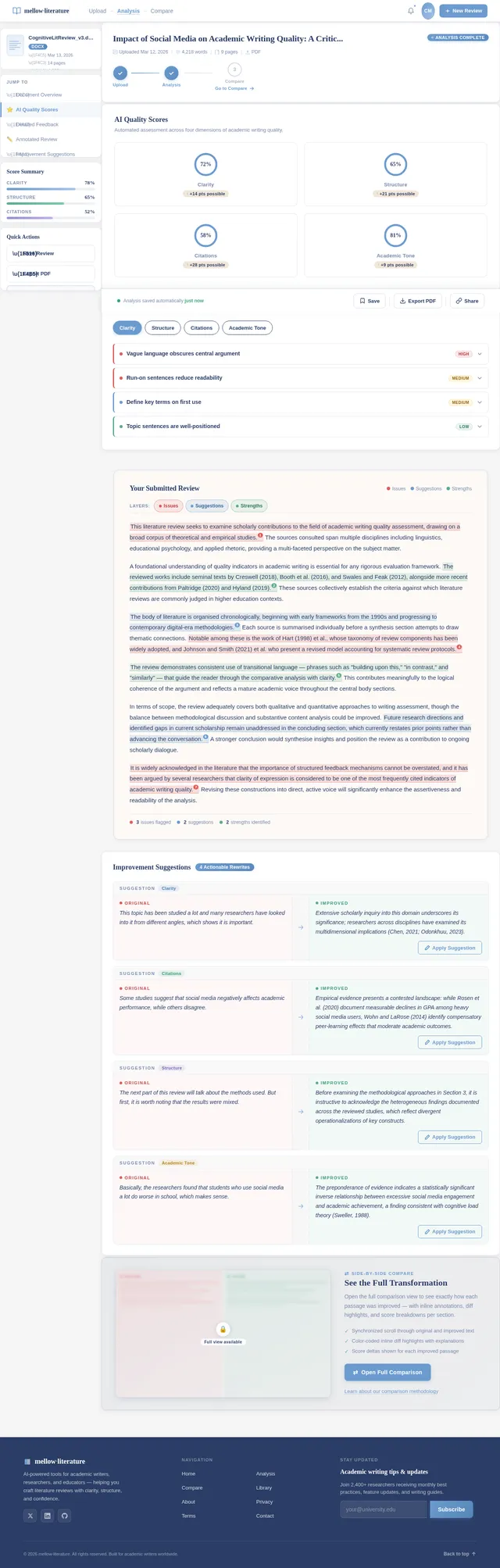
Build Analysis Page
As a frontend developer, I want to implement the Analysis page based on the existing JSX design (v2) so that users can view detailed AI feedback on their submitted literature review. Includes: score overview panel (Clarity, Structure, Academic Quality bars), annotated text viewer with inline highlights, feedback cards per dimension, 'View Side-by-Side' CTA linking to Compare page, save/revisit action. Connects from Upload; links to Compare.
Wire Frontend Upload to API
As a frontend developer, I want to connect the Upload page to the backend upload API so that user submissions are processed end-to-end. Includes: form submission handler, progress/loading states, error handling, redirect to Analysis page on success with review ID. Depends on Upload API and Upload page UI.
Wire Frontend Dashboard to API
As a frontend developer, I want to connect the User Dashboard page to the dashboard data API so that users see their real saved reviews, stats counters, and activity feed. Includes: stats countUp from API, reviews grid from API with pagination, activity feed with relative timestamps (UTC+8).
Wire Admin Pages to APIs
As a frontend developer, I want to connect the Admin Dashboard, Users, and Content pages to their respective backend APIs so that admins see live data and can perform real CRUD operations. Includes: admin stats live data, user table pagination/search/filter wired to API, edit drawer save to API, delete confirmation wired to API, content moderation actions wired to API, activity feed live data.
Wire Frontend Analysis to API
As a frontend developer, I want to connect the Analysis page to the analysis results API so that users see real AI-generated feedback scores, annotations, and improvement suggestions. Includes: data fetching on page load, loading skeleton states, error boundary, save review action wired to backend.

Transform Your Literature Reviews
Upload, analyze, and refine your academic writing with intelligent feedback and side-by-side comparisons.
Watch Your Writing Transform
Drag the slider to see how mellow·literature refines vague drafts into precise, citation-rich academic prose.
Literature Review: Impact of Peer Feedback on Academic Writing Quality
The original phrasing uses hedging words like "many" and "various" without providing specific evidence, weakening the academic rigor.
Claims of effectiveness lack quantitative evidence. "Works well" and "better" are subjective without measurable benchmarks.
The conclusion is a generic placeholder that adds no insight. It fails to specify what research is needed or why the area matters.
Everything You Need to Master Academic Writing
Powerful tools designed to elevate your literature reviews from draft to publication-ready.
Upload & Analyze
Submit your literature review in any common format and receive a comprehensive analysis of clarity, structure, and academic rigor within seconds.
Side-by-Side Compare
View your original draft alongside an improved version with highlighted differences, so you can see exactly where and how your writing evolves.
AI Feedback
Get detailed, actionable feedback powered by AI on tone, citation quality, argument flow, and academic conventions tailored to your discipline.
Best Practices Library
Explore curated guides on structure, citations, clarity, and tone drawn from exemplary academic writing across multiple fields and journals.
Save & Revisit
Keep a history of every analysis and revision. Return to previous drafts at any time to track your progress and refine your work iteratively.
Bilingual Support
Write and analyze in both English and Mongolian. Our platform adapts its feedback engine to support academic conventions in either language.
See the Difference Instantly
Watch how AI-powered analysis transforms vague, unsupported writing into precise, well-cited academic prose.
The authors talked about a lot of thingsvague related to the topic. Their research was kind of importantweak claim and contributed to the field in some waysimprecise.
Many studies have been doneno citations on this subject. The findings basically show that it worksinformal and further research might be needed or somethinguncertain.
The authors conducted a comprehensive meta-analysis of 42 peer-reviewed studiesspecific related to cognitive load theory. Their research established a statistically significant correlation (p < 0.01)precise and contributed to the field by introducing a novel framework for multimedia learning assessmentclear.
Prior empirical studies (Chen et al., 2022; Batbold & Erdenebat, 2023)cited examined this subject extensively. The findings demonstrate a 34% improvement in retention outcomes across three controlled experimentsevidence, warranting longitudinal studies to assess sustained impact over academic semestersactionable.
No account required • Instant results
How It Works — Three Simple Steps
From draft to polished prose in minutes. Our streamlined process makes academic writing improvement effortless.
Upload
Submit your literature review or academic draft in any common format. Our platform securely processes your document in seconds.
Analyze
Our AI engine evaluates clarity, structure, citations, and academic quality, highlighting areas that need attention.
Improve
Receive actionable feedback with side-by-side comparisons and best practice suggestions to elevate your writing.
Learn from the Best — Curated Academic Writing Guides
Explore our hand-picked collection of writing guides designed to help you craft stronger, clearer literature reviews.
Organizing Your Literature Review
Learn how to build a coherent narrative that connects themes, identifies gaps, and guides the reader through your research landscape.
Read More→Mastering Academic Citations
Best practices for integrating sources seamlessly, avoiding over-reliance on direct quotes, and maintaining scholarly credibility.
Read More→Writing with Precision & Clarity
Techniques to eliminate vague language, strengthen your arguments, and communicate complex ideas in accessible academic prose.
Read More→Finding Your Academic Voice
Strike the right balance between formal rigor and engaging writing while maintaining objectivity throughout your review.
Read More→Browse Full Library
Access our complete collection of academic writing guides and best practices.
Explore All →Trusted by Academic Writers Worldwide
See how researchers and students are elevating their literature reviews with mellow-literature.
mellow-literature completely transformed how I approach my thesis. The AI feedback pinpointed exactly where my arguments lacked clarity, and the side-by-side comparison showed me how to strengthen every paragraph.
As a PhD candidate, I struggled with structuring my literature reviews. This platform not only identified my weaknesses but taught me best practices through real examples. My supervisor noticed the improvement immediately.
The bilingual support is a game-changer for our students in Mongolia. Being able to analyze reviews in both English and Mongolian means no one gets left behind. The best practices library alone is worth it.
Ready to Elevate Your Literature Review?
Join thousands of researchers and students improving their academic writing today.
No credit card required. Supports English & Mongolian.
No comments yet. Be the first!