mellow-literature
 Cyril Marcus
Can you explain why this is a bad litrature review A Bad Example of a Literature Review This literature review will cover the themes which are most useful for my dissertation; this is because it will help to guide my analysis chapter. Men and Masculinity This section will outline the work on gender which I think is interesting. Hegemonic theorising will be introduced because it is important for my work. Hegemonic masculinity theorising and its critiques Theorising on hegemonic masculinity dominates. This is also talked about a lot in work on men and sport. I am going to look at men and how they think about hegemonic masculinity. I want to know if they get it. Because of this, I will start with talking about the theory. Hegemonic masculinity is quite new and people might argue what it means. But a certain thing is that it comes from work of people who are Marxists. Gramsci talked about hegemony first of all and this has been borrowed in masculinity work. He says hegemony helps to understand power. Connell does agree with this too and says that there are some groups and institutes in society which make the masculinity dominant. The term hegemonic masculinity arrived late. It has been described by Connell (2005) to be a ‘synthesis’ of lots of things. Even though there have been people who disagree with the theory and who say it has lots of issues and problems which make it difficult to use it still seems to be used by lots of people. But all of these people using it means that it is difficult to find one definition as people like to disagree and argue. Having said all this, a definition is that it can be the same as what Connell page 832 in 2005 argued ‘the pattern of practice that allowed men’s dominance over women to continue’. Currently Hearn (2004) has said that hegemonic masculinity ideas are still useful and that they can still be applied in research. The newest thinking on this theory states that the concept is changeable and that it is useful because of the way it can be adapted and applied. Not everyone agrees with some criticisms of this theory starting too. Mckay and others say that men do not experience things the same, especially in sport so they suggest that more work and attention needs to be looked at in relation to men and their experiences especially seeing if men follow hegemonic masculinity. Ian Wellard is a person who says some more about this in his discussion of ‘exclusive’ masculinity. He is different from the others as he brings in new themes such as resistance and agency. He tells us that men can make choices. So in conclusion where does this leave us? Hegemonic masculinity is still useable even though it has some problems with it. I can use this but with caution. This is what I will do in my project

Comments (0)
Sign in to leave a comment
System Requirements
System Requirements Document (SRD)
Project Name: mellow-literature
1. Introduction
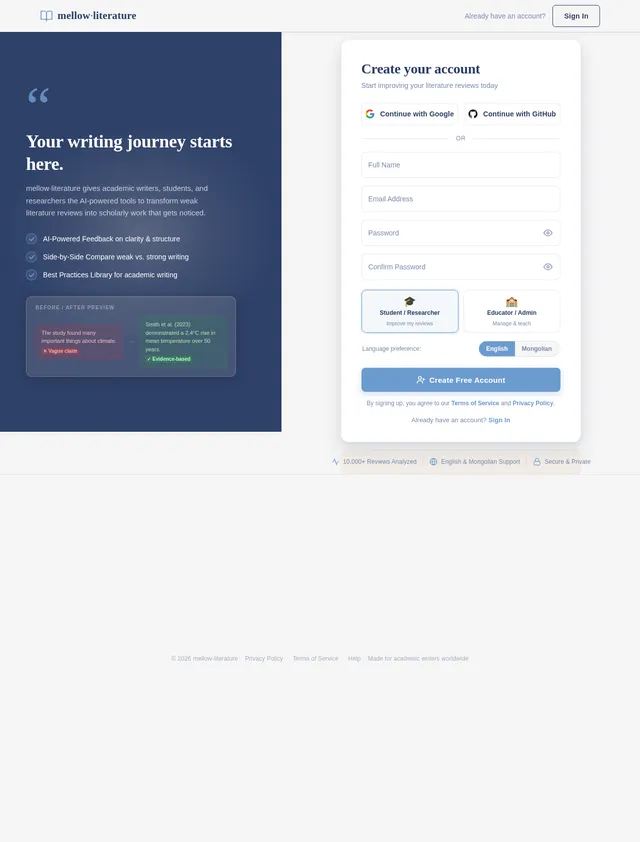
The mellow-literature project aims to create an innovative and user-friendly platform for academic and literary enthusiasts, providing tools to analyze, critique, and improve literature reviews. This document outlines the system requirements for the project, ensuring clarity, functionality, and alignment with the needs of users like Cyril Marcus in Mongolia (MN). The platform will incorporate advanced features to assist users in understanding and improving academic writing, with a focus on literature reviews.
2. System Overview
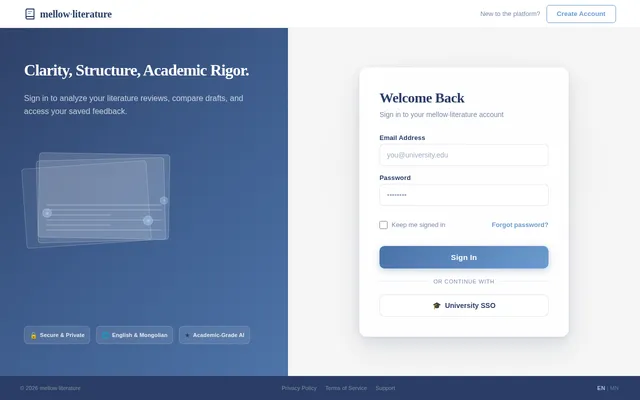
The mellow-literature platform will serve as a comprehensive tool for academic writers, students, and researchers. It will provide functionalities to analyze literature reviews, compare examples, and offer constructive feedback. The system will also include educational resources to help users identify and implement best practices in academic writing. The platform will be accessible via web and mobile applications, ensuring usability across devices. Locale-specific defaults, such as time zones (UTC+8 for Mongolia) and currency (Mongolian Tögrög), will be considered where applicable.
3. Functional Requirements
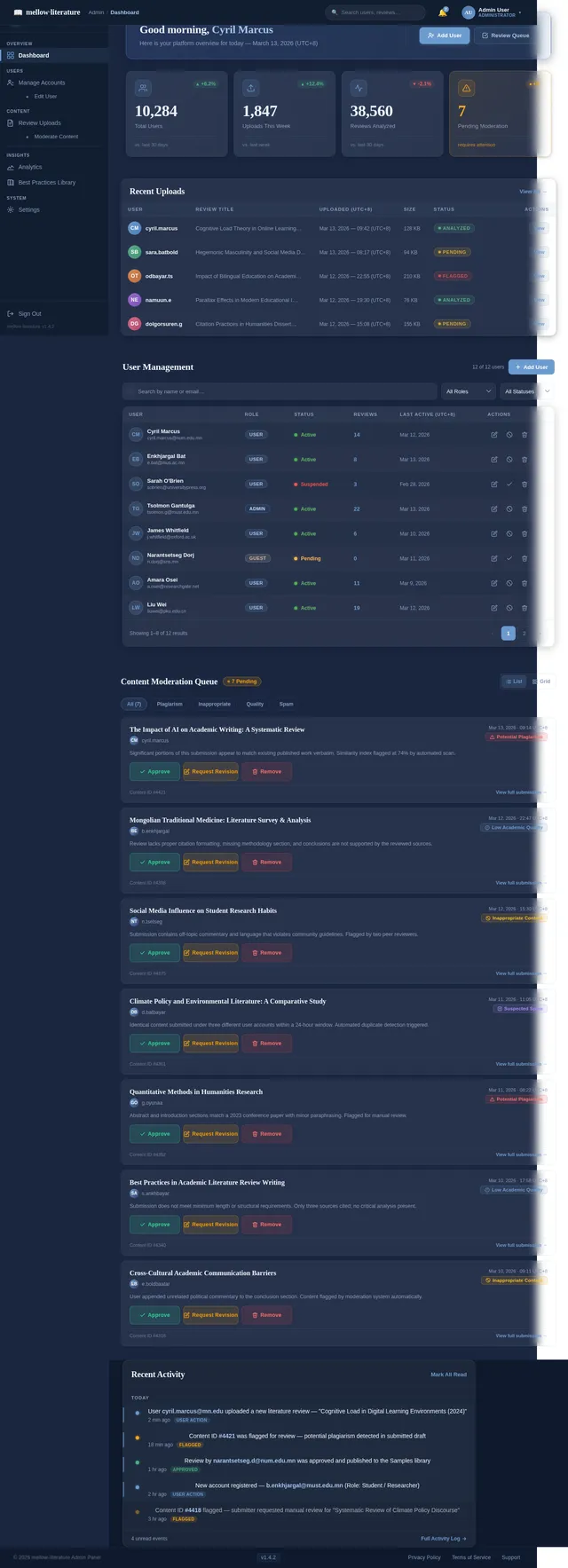
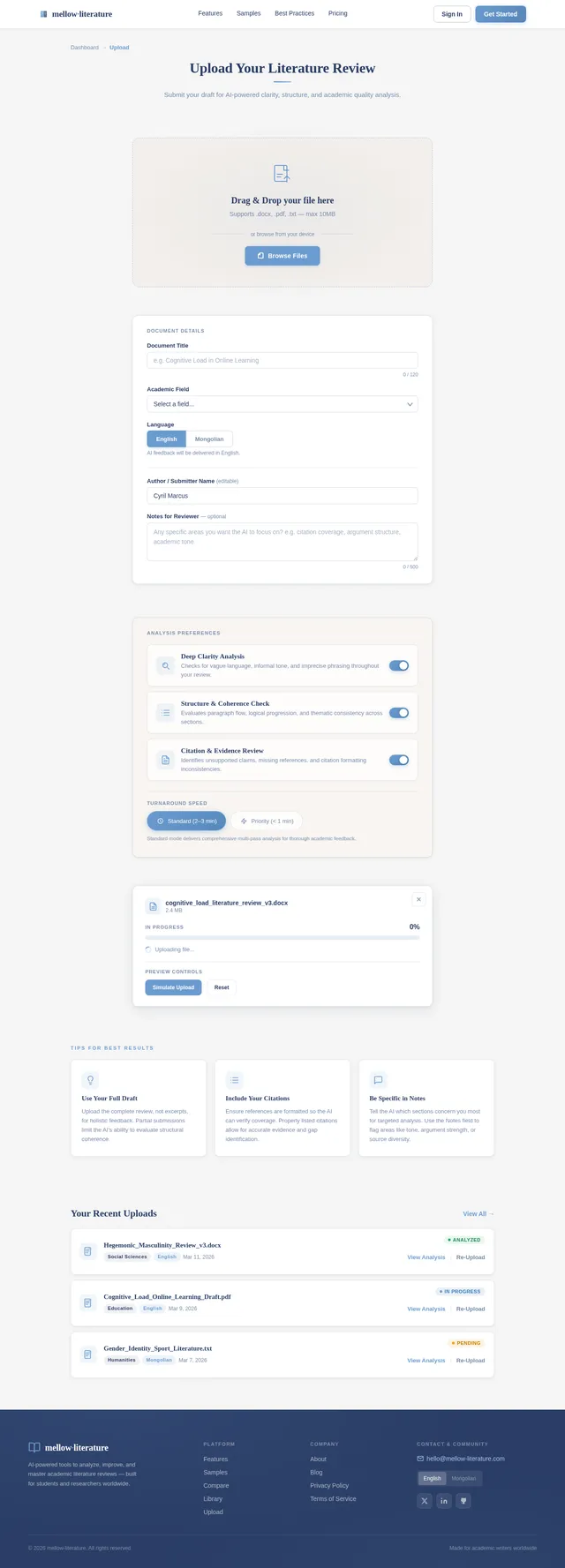
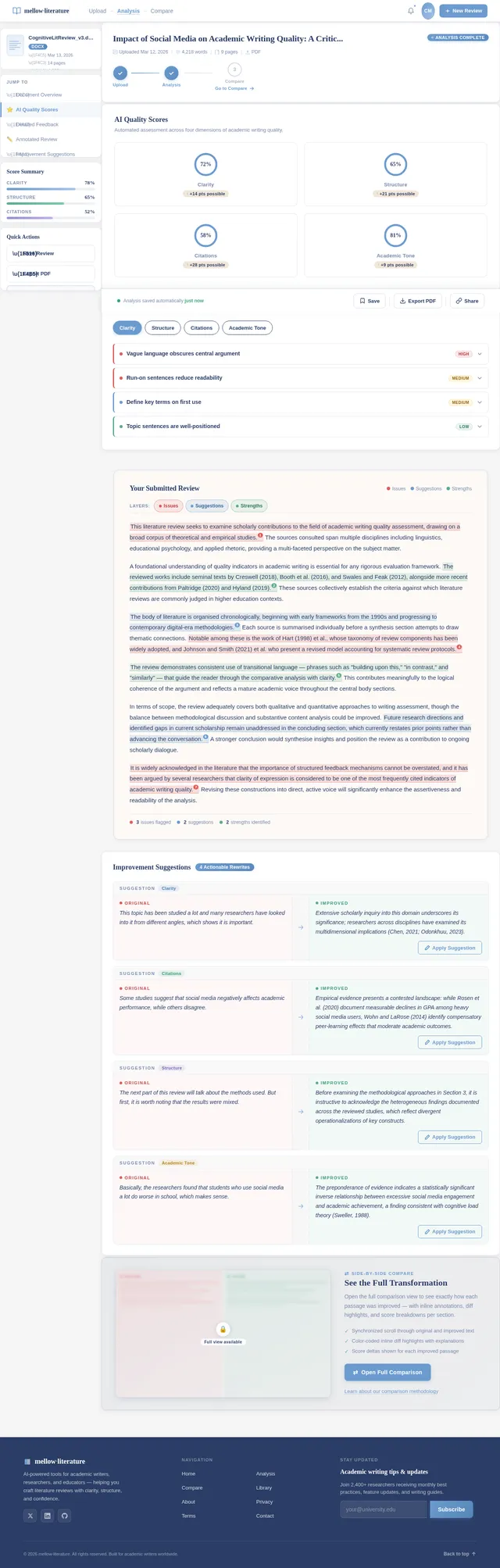
- As a User, I should be able to upload a literature review for analysis.
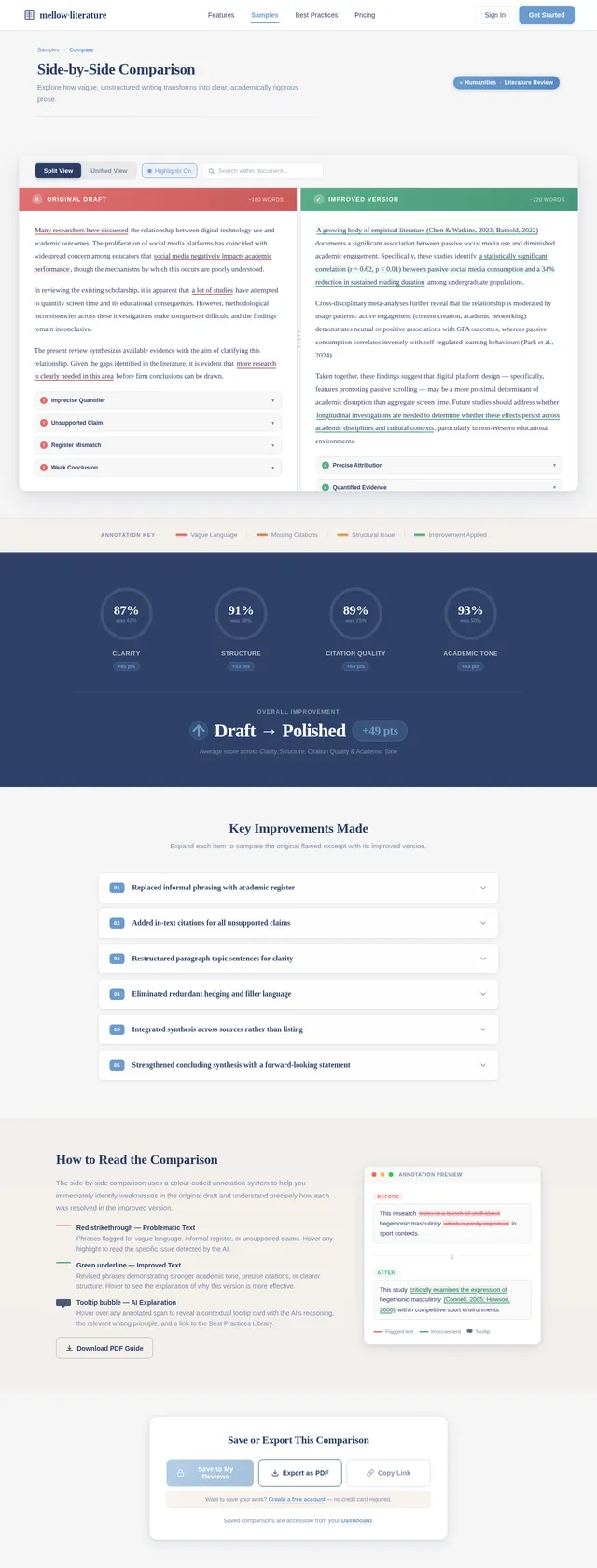
- As a User, I should be able to compare a poor literature review with an improved one side-by-side.
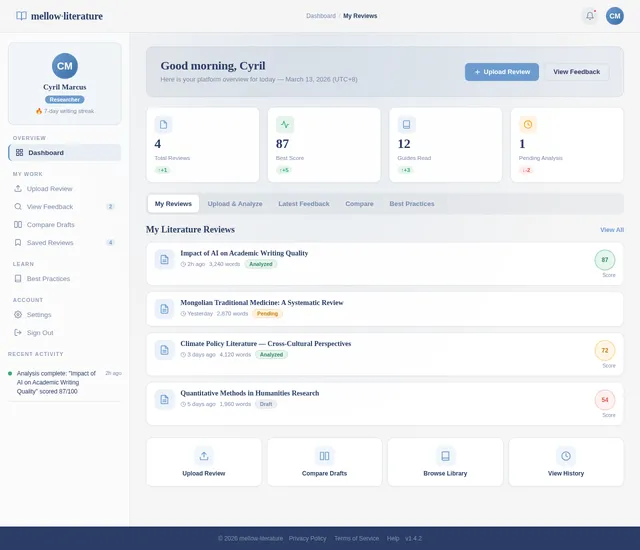
- As a User, I should be able to receive detailed feedback on clarity, structure, and academic quality.
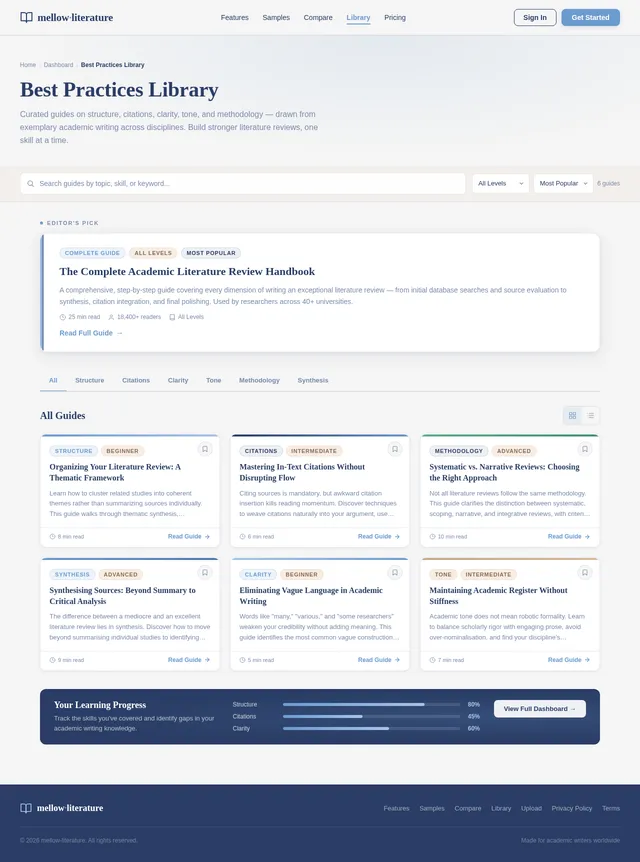
- As a User, I should be able to access a library of best practices for writing literature reviews.
- As a User, I should be able to save and revisit my analyzed reviews.
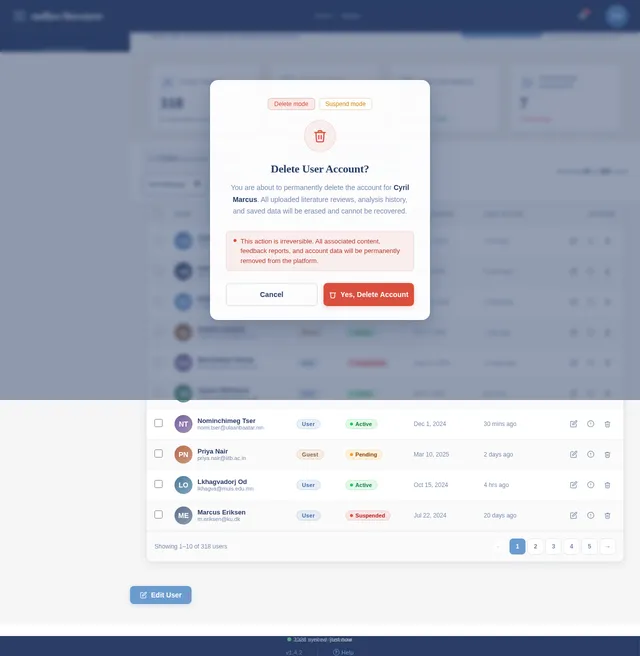
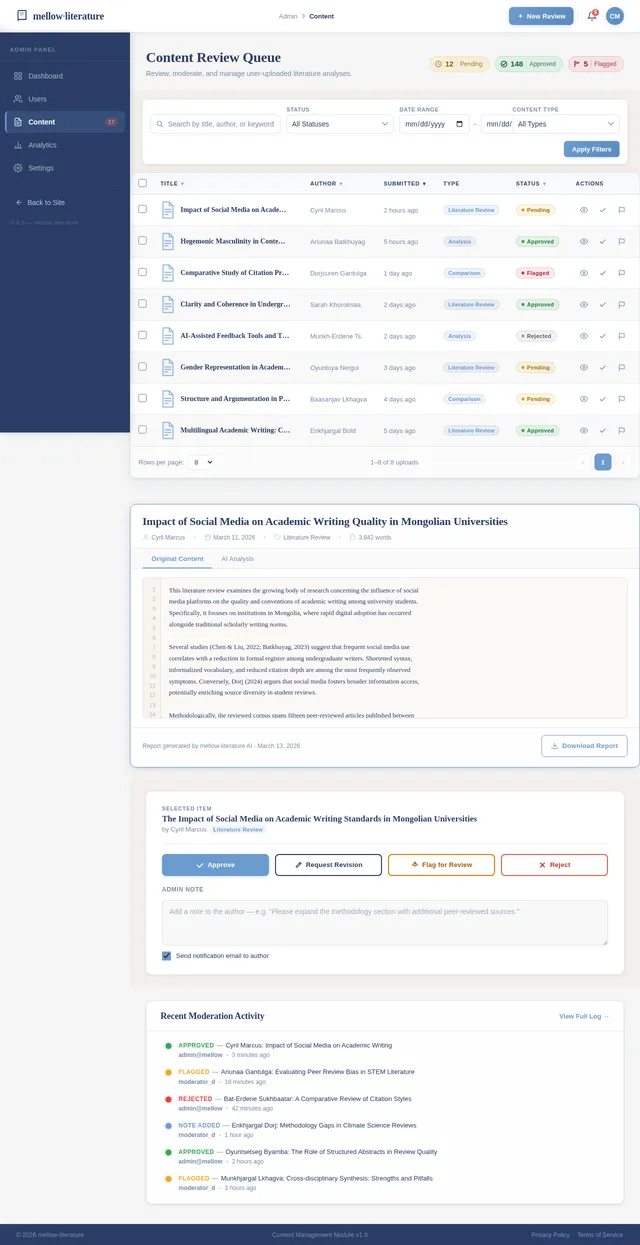
- As an Admin, I should be able to manage user accounts and uploaded content.
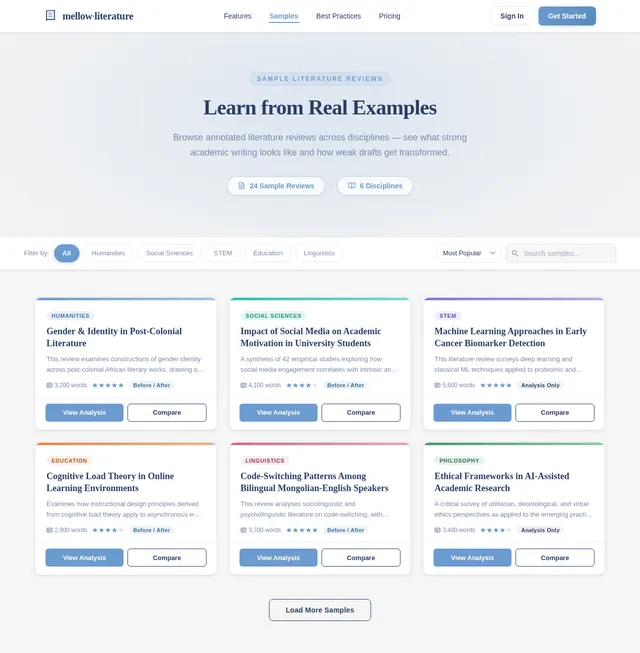
- As a Guest, I should be able to view sample literature reviews and their analyses.
4. User Personas
-
User:
- Academic writers, students, and researchers looking to improve their literature reviews.
- Needs: Feedback on writing quality, access to examples, and educational resources.
-
Admin:
- Platform managers responsible for maintaining user accounts and content moderation.
- Needs: Tools to manage user data and ensure content quality.
-
Guest:
- Visitors exploring the platform without creating an account.
- Needs: Access to sample content and a preview of platform features.
5. Visuals Colors and Theme
The mellow-literature platform will adopt a calming and professional aesthetic to reflect its academic focus:
- Primary Colors:
- Soft Blue (#6C9BCF): Represents trust and professionalism.
- Light Gray (#F5F5F5): Provides a neutral background for content.
- Secondary Colors:
- Deep Navy (#2A3D66): Adds depth and contrast.
- Warm Beige (#F2E6D9): Offers a subtle, inviting tone.
- Typography:
- Serif fonts (e.g., Georgia) for headings to evoke a scholarly feel.
- Sans-serif fonts (e.g., Open Sans) for body text to ensure readability.
6. Signature Design Concept
Interactive Literature Review Journey:
The homepage of mellow-literature will feature an interactive scrollable timeline that visually represents the evolution of a literature review. Users will see a "bad" literature review at the start of the timeline, with annotations pointing out its flaws. As they scroll, the review transforms into a "better" version, with highlighted improvements and explanations appearing dynamically.
-
Animations:
- Text will "rewrite itself" in real-time, showing how vague or informal phrases are replaced with precise, academic language.
- Key terms and citations will "pop out" with subtle animations to emphasize their importance.
-
Transitions:
- Smooth scrolling with parallax effects to create depth.
- Sections will "fade in" as users progress through the timeline.
-
Micro-Interactions:
- Hovering over annotations will display detailed explanations.
- Clicking on examples will open side-by-side comparisons of "bad" and "better" reviews.
This immersive design will make the learning process engaging and memorable, ensuring users understand the value of clarity, structure, and academic rigor.
7. Non-Functional Requirements
- The system must support both English and Mongolian languages.
- The platform should load within 3 seconds on standard internet connections.
- Ensure data security and privacy for all user-uploaded content.
- The system must be scalable to support up to 10,000 concurrent users.
8. Tech Stack
- Frontend: React for web application.
- Backend: Python with FastAPI for handling requests and providing feedback.
- Database: MySQL for structured data storage and Alembic for migrations.
- AI Models:
- GPT 5.2 for user-friendly feedback.
- Claude 4.5 Opas for academic analysis.
- AI Tools: Langchain for managing AI workflows.
- Orchestration: Docker and Kubernetes for deployment and scalability.
9. Assumptions and Constraints
- Users will primarily access the platform via modern web browsers.
- The platform will initially focus on literature reviews in the humanities and social sciences.
- AI-generated feedback will require periodic updates to improve accuracy.
- The system will comply with data protection regulations in Mongolia and internationally.
10. Glossary
- Literature Review: A critical evaluation of existing research on a specific topic.
- Hegemonic Masculinity: A concept in gender studies describing the dominant social position of men and the subordinate position of women.
- Parallax Effect: A design technique where background images move slower than foreground images, creating a 3D effect.
- Annotations: Notes or comments added to a text to explain or critique it.
This updated SRD ensures that mellow-literature meets the needs of its users while delivering a unique and engaging experience. Cyril, this platform will empower users to master the art of academic writing, one literature review at a time!

Transform Your Literature Reviews
Upload, analyze, and refine your academic writing with intelligent feedback and side-by-side comparisons.
Watch Your Writing Transform
Drag the slider to see how mellow·literature refines vague drafts into precise, citation-rich academic prose.
Literature Review: Impact of Peer Feedback on Academic Writing Quality
The original phrasing uses hedging words like "many" and "various" without providing specific evidence, weakening the academic rigor.
Claims of effectiveness lack quantitative evidence. "Works well" and "better" are subjective without measurable benchmarks.
The conclusion is a generic placeholder that adds no insight. It fails to specify what research is needed or why the area matters.
Everything You Need to Master Academic Writing
Powerful tools designed to elevate your literature reviews from draft to publication-ready.
Upload & Analyze
Submit your literature review in any common format and receive a comprehensive analysis of clarity, structure, and academic rigor within seconds.
Side-by-Side Compare
View your original draft alongside an improved version with highlighted differences, so you can see exactly where and how your writing evolves.
AI Feedback
Get detailed, actionable feedback powered by AI on tone, citation quality, argument flow, and academic conventions tailored to your discipline.
Best Practices Library
Explore curated guides on structure, citations, clarity, and tone drawn from exemplary academic writing across multiple fields and journals.
Save & Revisit
Keep a history of every analysis and revision. Return to previous drafts at any time to track your progress and refine your work iteratively.
Bilingual Support
Write and analyze in both English and Mongolian. Our platform adapts its feedback engine to support academic conventions in either language.
See the Difference Instantly
Watch how AI-powered analysis transforms vague, unsupported writing into precise, well-cited academic prose.
The authors talked about a lot of thingsvague related to the topic. Their research was kind of importantweak claim and contributed to the field in some waysimprecise.
Many studies have been doneno citations on this subject. The findings basically show that it worksinformal and further research might be needed or somethinguncertain.
The authors conducted a comprehensive meta-analysis of 42 peer-reviewed studiesspecific related to cognitive load theory. Their research established a statistically significant correlation (p < 0.01)precise and contributed to the field by introducing a novel framework for multimedia learning assessmentclear.
Prior empirical studies (Chen et al., 2022; Batbold & Erdenebat, 2023)cited examined this subject extensively. The findings demonstrate a 34% improvement in retention outcomes across three controlled experimentsevidence, warranting longitudinal studies to assess sustained impact over academic semestersactionable.
No account required • Instant results
How It Works — Three Simple Steps
From draft to polished prose in minutes. Our streamlined process makes academic writing improvement effortless.
Upload
Submit your literature review or academic draft in any common format. Our platform securely processes your document in seconds.
Analyze
Our AI engine evaluates clarity, structure, citations, and academic quality, highlighting areas that need attention.
Improve
Receive actionable feedback with side-by-side comparisons and best practice suggestions to elevate your writing.
Learn from the Best — Curated Academic Writing Guides
Explore our hand-picked collection of writing guides designed to help you craft stronger, clearer literature reviews.
Organizing Your Literature Review
Learn how to build a coherent narrative that connects themes, identifies gaps, and guides the reader through your research landscape.
Read More→Mastering Academic Citations
Best practices for integrating sources seamlessly, avoiding over-reliance on direct quotes, and maintaining scholarly credibility.
Read More→Writing with Precision & Clarity
Techniques to eliminate vague language, strengthen your arguments, and communicate complex ideas in accessible academic prose.
Read More→Finding Your Academic Voice
Strike the right balance between formal rigor and engaging writing while maintaining objectivity throughout your review.
Read More→Browse Full Library
Access our complete collection of academic writing guides and best practices.
Explore All →Trusted by Academic Writers Worldwide
See how researchers and students are elevating their literature reviews with mellow-literature.
mellow-literature completely transformed how I approach my thesis. The AI feedback pinpointed exactly where my arguments lacked clarity, and the side-by-side comparison showed me how to strengthen every paragraph.
As a PhD candidate, I struggled with structuring my literature reviews. This platform not only identified my weaknesses but taught me best practices through real examples. My supervisor noticed the improvement immediately.
The bilingual support is a game-changer for our students in Mongolia. Being able to analyze reviews in both English and Mongolian means no one gets left behind. The best practices library alone is worth it.
Ready to Elevate Your Literature Review?
Join thousands of researchers and students improving their academic writing today.
No credit card required. Supports English & Mongolian.
No comments yet. Be the first!