mellow-literature
 Cyril Marcus
Can you explain why this is a bad litrature review A Bad Example of a Literature Review This literature review will cover the themes which are most useful for my dissertation; this is because it will help to guide my analysis chapter. Men and Masculinity This section will outline the work on gender which I think is interesting. Hegemonic theorising will be introduced because it is important for my work. Hegemonic masculinity theorising and its critiques Theorising on hegemonic masculinity dominates. This is also talked about a lot in work on men and sport. I am going to look at men and how they think about hegemonic masculinity. I want to know if they get it. Because of this, I will start with talking about the theory. Hegemonic masculinity is quite new and people might argue what it means. But a certain thing is that it comes from work of people who are Marxists. Gramsci talked about hegemony first of all and this has been borrowed in masculinity work. He says hegemony helps to understand power. Connell does agree with this too and says that there are some groups and institutes in society which make the masculinity dominant. The term hegemonic masculinity arrived late. It has been described by Connell (2005) to be a ‘synthesis’ of lots of things. Even though there have been people who disagree with the theory and who say it has lots of issues and problems which make it difficult to use it still seems to be used by lots of people. But all of these people using it means that it is difficult to find one definition as people like to disagree and argue. Having said all this, a definition is that it can be the same as what Connell page 832 in 2005 argued ‘the pattern of practice that allowed men’s dominance over women to continue’. Currently Hearn (2004) has said that hegemonic masculinity ideas are still useful and that they can still be applied in research. The newest thinking on this theory states that the concept is changeable and that it is useful because of the way it can be adapted and applied. Not everyone agrees with some criticisms of this theory starting too. Mckay and others say that men do not experience things the same, especially in sport so they suggest that more work and attention needs to be looked at in relation to men and their experiences especially seeing if men follow hegemonic masculinity. Ian Wellard is a person who says some more about this in his discussion of ‘exclusive’ masculinity. He is different from the others as he brings in new themes such as resistance and agency. He tells us that men can make choices. So in conclusion where does this leave us? Hegemonic masculinity is still useable even though it has some problems with it. I can use this but with caution. This is what I will do in my project









Comments (0)
Sign in to leave a comment

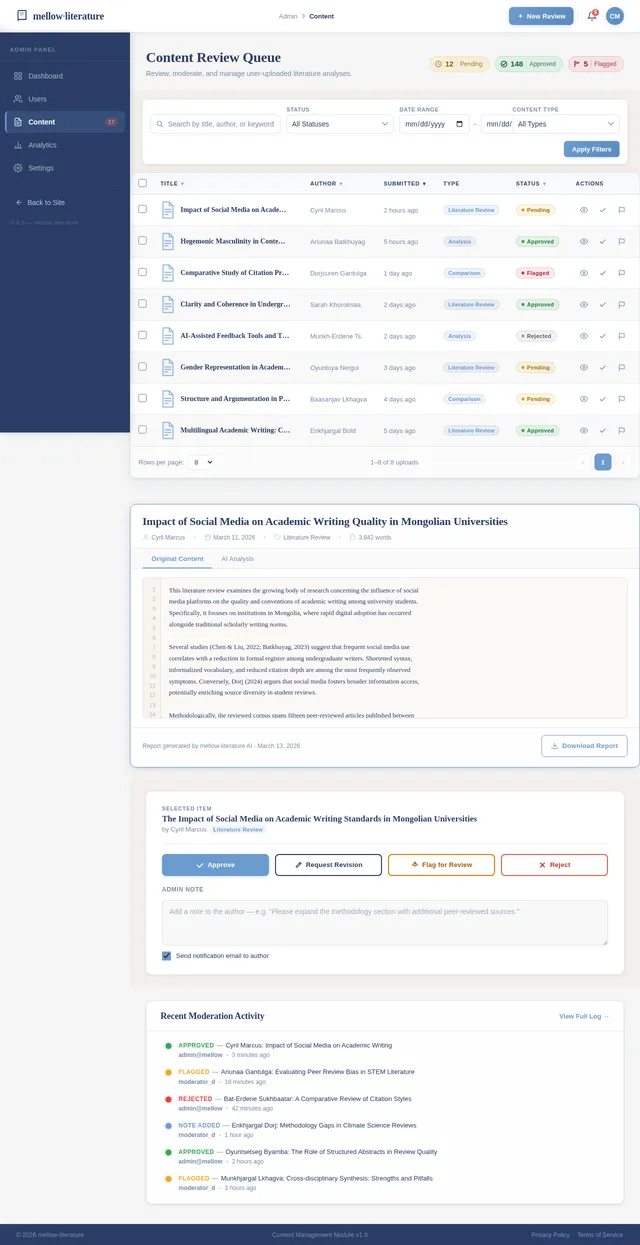
Content Review Queue
Review, moderate, and manage user-uploaded literature analyses.
| Title | Author | Submitted | Type | Status | Actions | |
|---|---|---|---|---|---|---|
Impact of Social Media on Academic Writing Quality in Higher Education | Literature Review | Pending | ||||
Hegemonic Masculinity in Contemporary Mongolian Literature | Analysis | Approved | ||||
Comparative Study of Citation Practices Across Disciplines | Comparison | Flagged | ||||
Clarity and Coherence in Undergraduate Thesis Writing: A Systematic Review | Literature Review | Approved | ||||
AI-Assisted Feedback Tools and Their Effect on Writing Revision Rates | Analysis | Rejected | ||||
Gender Representation in Academic Publishing: Evidence from Humanities Journals | Literature Review | Pending | ||||
Structure and Argumentation in Post-Soviet Academic Discourse | Comparison | Pending | ||||
Multilingual Academic Writing: Challenges for Mongolian Scholars | Literature Review | Approved |
Impact of Social Media on Academic Writing Quality in Mongolian Universities
This literature review examines the growing body of research concerning the influence of social
media platforms on the quality and conventions of academic writing among university students.
Specifically, it focuses on institutions in Mongolia, where rapid digital adoption has occurred
alongside traditional scholarly writing norms.
Several studies (Chen & Liu, 2022; Batkhuyag, 2023) suggest that frequent social media use
correlates with a reduction in formal register among undergraduate writers. Shortened syntax,
informalized vocabulary, and reduced citation depth are among the most frequently observed
symptoms. Conversely, Dorj (2024) argues that social media fosters broader information access,
potentially enriching source diversity in student reviews.
Methodologically, the reviewed corpus spans fifteen peer-reviewed articles published between
2019 and 2025, with three longitudinal studies specifically tracking Mongolian cohorts. The
review adopts a thematic synthesis approach, categorizing findings under: (1) vocabulary and
register shift, (2) structural integrity, and (3) source evaluation practices.
Recent Moderation Activity
View Full Log →- Approved—Cyril Marcus: Impact of Social Media on Academic Writing
- Flagged—Ariunaa Gantulga: Evaluating Peer Review Bias in STEM Literature
- Rejected—Bat-Erdene Sukhbaatar: A Comparative Review of Citation Styles
- Note Added—Enkhjargal Dorj: Methodology Gaps in Climate Science Reviews
- Approved—Oyuntsetseg Byamba: The Role of Structured Abstracts in Review Quality
- Flagged—Munkhjargal Lkhagva: Cross-disciplinary Synthesis: Strengths and Pitfalls
No comments yet. Be the first!