mellow-literature
 Cyril Marcus
Can you explain why this is a bad litrature review A Bad Example of a Literature Review This literature review will cover the themes which are most useful for my dissertation; this is because it will help to guide my analysis chapter. Men and Masculinity This section will outline the work on gender which I think is interesting. Hegemonic theorising will be introduced because it is important for my work. Hegemonic masculinity theorising and its critiques Theorising on hegemonic masculinity dominates. This is also talked about a lot in work on men and sport. I am going to look at men and how they think about hegemonic masculinity. I want to know if they get it. Because of this, I will start with talking about the theory. Hegemonic masculinity is quite new and people might argue what it means. But a certain thing is that it comes from work of people who are Marxists. Gramsci talked about hegemony first of all and this has been borrowed in masculinity work. He says hegemony helps to understand power. Connell does agree with this too and says that there are some groups and institutes in society which make the masculinity dominant. The term hegemonic masculinity arrived late. It has been described by Connell (2005) to be a ‘synthesis’ of lots of things. Even though there have been people who disagree with the theory and who say it has lots of issues and problems which make it difficult to use it still seems to be used by lots of people. But all of these people using it means that it is difficult to find one definition as people like to disagree and argue. Having said all this, a definition is that it can be the same as what Connell page 832 in 2005 argued ‘the pattern of practice that allowed men’s dominance over women to continue’. Currently Hearn (2004) has said that hegemonic masculinity ideas are still useful and that they can still be applied in research. The newest thinking on this theory states that the concept is changeable and that it is useful because of the way it can be adapted and applied. Not everyone agrees with some criticisms of this theory starting too. Mckay and others say that men do not experience things the same, especially in sport so they suggest that more work and attention needs to be looked at in relation to men and their experiences especially seeing if men follow hegemonic masculinity. Ian Wellard is a person who says some more about this in his discussion of ‘exclusive’ masculinity. He is different from the others as he brings in new themes such as resistance and agency. He tells us that men can make choices. So in conclusion where does this leave us? Hegemonic masculinity is still useable even though it has some problems with it. I can use this but with caution. This is what I will do in my project










Comments (0)
Sign in to leave a comment
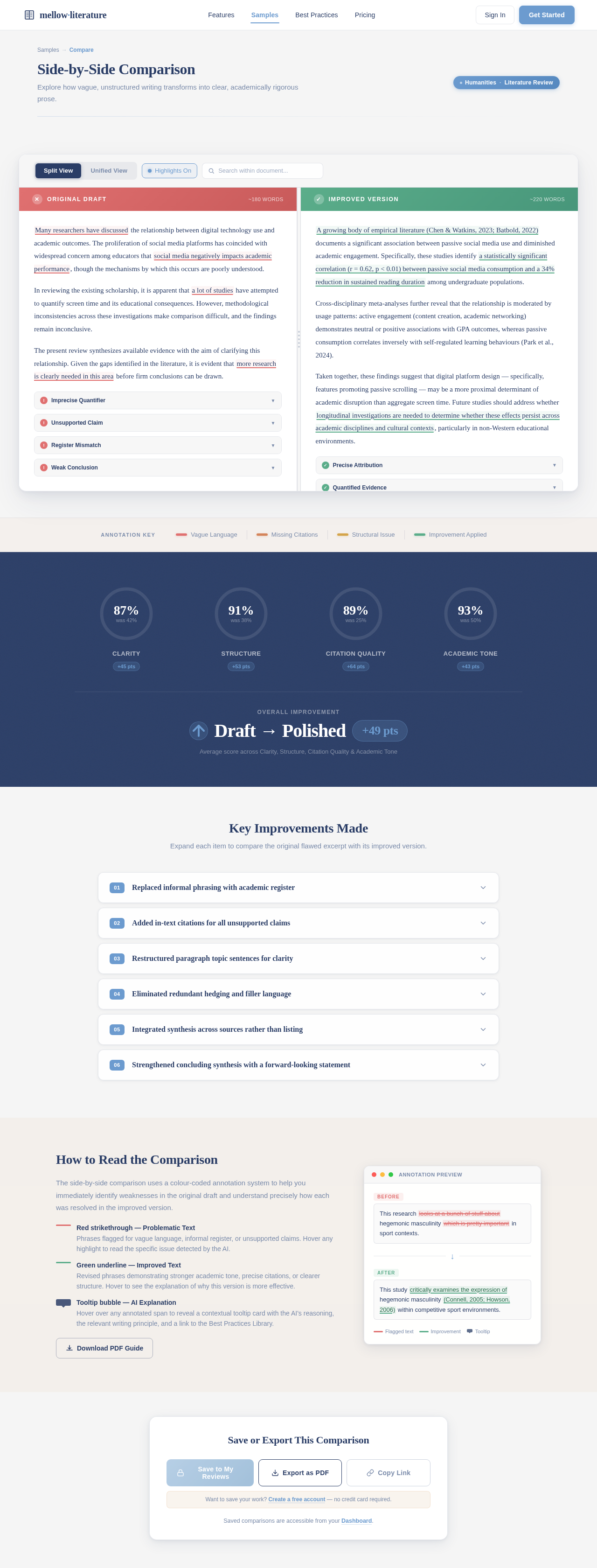
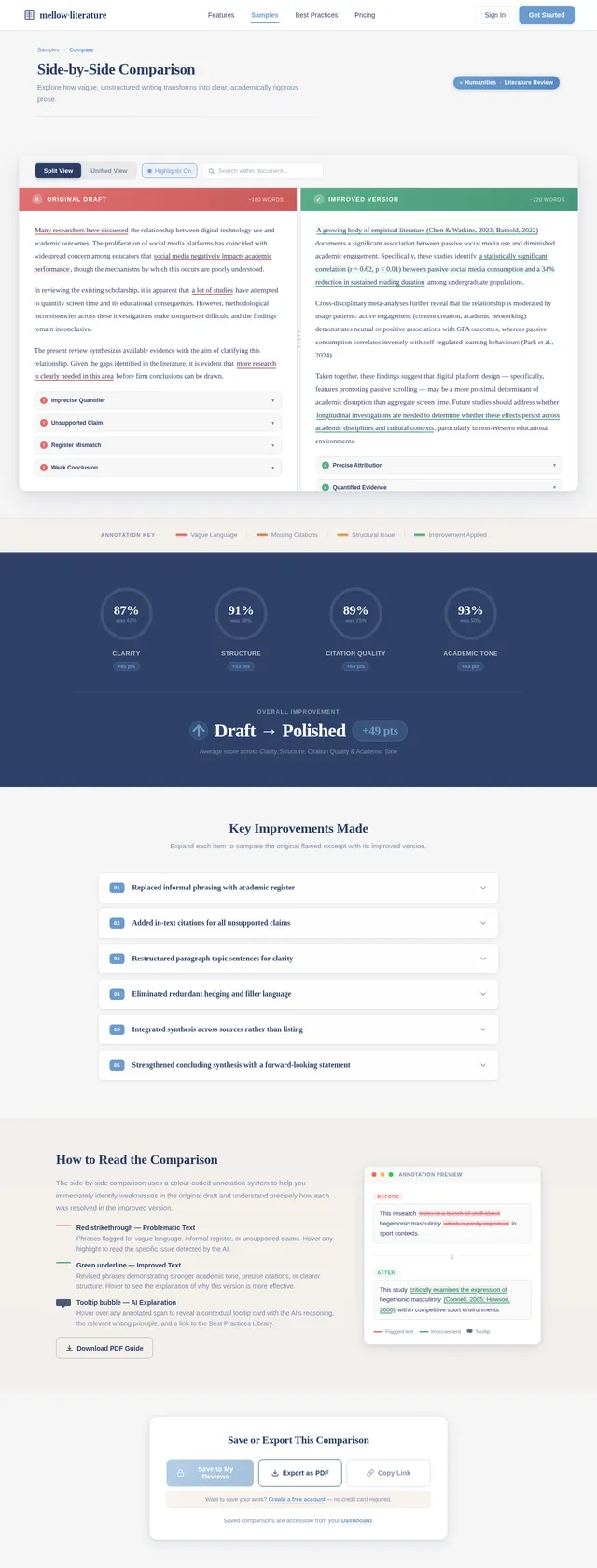
Side-by-Side Comparison
Explore how vague, unstructured writing transforms into clear, academically rigorous prose.
Many researchers have discussed
"Many researchers" makes a sweeping claim without citing specific studies, undermining academic credibility.
the relationship between digital technology use and academic outcomes. The proliferation of social media platforms has coincided with widespread concern among educators that social media negatively impacts academic performanceThe assertion that social media impacts academic performance requires empirical evidence with in-text citations.
, though the mechanisms by which this occurs are poorly understood.In reviewing the existing scholarship, it is apparent that a lot of studies
"A lot of" is informal and imprecise. Academic writing requires quantified or qualified language.
have attempted to quantify screen time and its educational consequences. However, methodological inconsistencies across these investigations make comparison difficult, and the findings remain inconclusive.The present review synthesizes available evidence with the aim of clarifying this relationship. Given the gaps identified in the literature, it is evident that more research is clearly needed in this area
This conclusion is circular — it restates the premise without synthesizing evidence or pointing to research gaps.
before firm conclusions can be drawn.A growing body of empirical literature (Chen & Watkins, 2023; Batbold, 2022)
Named authors and year provide verifiable attribution, establishing scholarly credibility.
documents a significant association between passive social media use and diminished academic engagement. Specifically, these studies identify a statistically significant correlation (r = 0.62, p < 0.01) between passive social media consumption and a 34% reduction in sustained reading durationSpecific statistical findings (34%, p < 0.01) replace vague claims, providing measurable academic evidence.
among undergraduate populations.Cross-disciplinary meta-analyses further reveal that the relationship is moderated by usage patterns: active engagement (content creation, academic networking) demonstrates neutral or positive associations with GPA outcomes, whereas passive consumption correlates inversely with self-regulated learning behaviours (Park et al., 2024).
Taken together, these findings suggest that digital platform design — specifically, features promoting passive scrolling — may be a more proximal determinant of academic disruption than aggregate screen time. Future studies should address whether longitudinal investigations are needed to determine whether these effects persist across academic disciplines and cultural contexts
Identifies a specific longitudinal gap rather than making a generic "more research needed" statement.
, particularly in non-Western educational environments.Average score across Clarity, Structure, Citation Quality & Academic Tone
Key Improvements Made
Expand each item to compare the original flawed excerpt with its improved version.
Before — Original Draft
A lot of studies have looked into how social media kind of affects the way students write, and it seems like it makes their writing worse in some ways.
Improved versionAfter — Revised Version
Numerous empirical studies have examined the influence of social media usage on student writing proficiency, with findings suggesting a measurable decline in formal writing conventions (Smith & Lee, 2021).
Before — Original Draft
Research shows that students who read more tend to write better literature reviews. This has been proven many times.
Improved versionAfter — Revised Version
Extensive reading has been positively correlated with improved literature review quality, a relationship consistently supported across multiple disciplines (Brown, 2019; Nguyen & Patel, 2022).
Before — Original Draft
This paragraph is going to talk about the methodology problems. There are quite a few issues and they matter a lot to the overall review.
Improved versionAfter — Revised Version
Methodological inconsistencies represent a critical limitation in the reviewed literature, undermining the reliability of comparative findings across studies.
Before — Original Draft
It could possibly be said that perhaps there might be some kind of relationship between the two variables, though it is not entirely certain.
Improved versionAfter — Revised Version
A statistically significant relationship between the two variables was identified, warranting further longitudinal investigation to confirm causal directionality.
Before — Original Draft
Johnson (2018) said X. Williams (2019) also talked about X. Then Kumar (2020) wrote about X too. All of them studied X.
Improved versionAfter — Revised Version
A convergent body of scholarship (Johnson, 2018; Williams, 2019; Kumar, 2020) establishes X as a robust phenomenon, though each study foregrounds distinct disciplinary contexts that complicate direct comparison.
Before — Original Draft
So in conclusion, the reviewed studies have different findings and more research is needed. That is basically the summary of what was found.
Improved versionAfter — Revised Version
The divergent findings across the reviewed corpus underscore the necessity for standardised measurement frameworks; future research should prioritise replication studies in non-Western academic contexts, including Mongolia and Central Asia.
How to Read the Comparison
The side-by-side comparison uses a colour-coded annotation system to help you immediately identify weaknesses in the original draft and understand precisely how each was resolved in the improved version.
- Red strikethrough — Problematic TextPhrases flagged for vague language, informal register, or unsupported claims. Hover any highlight to read the specific issue detected by the AI.
- Green underline — Improved TextRevised phrases demonstrating stronger academic tone, precise citations, or clearer structure. Hover to see the explanation of why this version is more effective.
- Tooltip bubble — AI ExplanationHover over any annotated span to reveal a contextual tooltip card with the AI's reasoning, the relevant writing principle, and a link to the Best Practices Library.
Save or Export This Comparison
Want to save your work? Create a free account — no credit card required.
Saved comparisons are accessible from your Dashboard.
No comments yet. Be the first!