hollow-task
 Davood sharifi
1. What your app really is (core idea) Your app = Task + Action + Automation Engine Instead of just: “Write a task” You want: “When I press start → do actions automatically” Example: Task: “Morning routine” Open email Send report Open Word Start a game install 2. Core Features (architecture) A. Task Manager Basic structure: Task ├── id ├── name ├── trigger (manual / time / event) └── actions[] B. Actions (very important) Each task contains actions like: Action ├── type (email, open_app, write_file, install_app) ├── parameters └── status Examples: Send Email: type: "email" params: to: "test@email.com" subject: "Hello" body: "Message" Open App: type: "open_app" params: app_name: "Word" C. Automation Engine (the brain) This is the algorithm that runs tasks. Pseudo-code: for each task: if trigger condition is true: run task.actions sequentially Execution: function runTask(task): for action in task.actions: execute(action) 3. Triggers (how tasks start) You need different triggers: Manual (user clicks button) Time-based (e.g. 8:00 AM) Event-based (file created, app opened) Example: if current_time == task.time: runTask(task) 4. PC Control vs Phone Control (important difference) PC (easier) You can use: Python (automation) Node.js OS APIs Examples: Open apps → subprocess Write files → file system Control mouse/keyboard → libraries like pyautogui Phone (harder ⚠️) Android: Use accessibility services Use automation APIs iOS: Very restricted (Apple blocks most automation) 5. System Design (high-level) Frontend (UI) ↓ Backend / Logic Engine ↓ Execution Layer (OS interaction) 6. Suggested Tech Stack Beginner-friendly: Frontend: React / Flutter Backend: Node.js OR Python Database: SQLite (simple) Firebase (cloud) 7. Example Algorithm (full flow) User creates task: Task: "Work Start" Trigger: 09:00 Actions: 1. Open Outlook 2. Send Email 3. Open Word Execution loop: while true: for task in tasks: if task.trigger == current_time: runTask(task) sleep(1 minute) 8. Security (VERY important) You are dealing with: Email sending App control Possibly passwords So: NEVER store passwords in plain text Use OAuth for email (like Gmail API) Ask user permission clearly 9. MVP (start small) Don’t try everything at once. Start with: Create tasks Add simple actions: Open app Show notification Add time trigger Add execution engine Then expand. 10. Reality check (important) What you want is powerful—but: Full control of phone + PC = complex Cross-platform automation is hard OS restrictions will limit you Start with: 👉 PC automation first 👉 Then Android 👉 Then cloud sync Design a full database schema Give you real code (Python or Node.js) Help you build a prototype step-by-step

Comments (0)
Sign in to leave a comment
System Requirements
System Requirements Document (SRD) for hollow-task
1. Introduction
The hollow-task project, envisioned by Davood Sharifi, is a cutting-edge Task + Action + Automation Engine designed to simplify and automate workflows. The system allows users to create tasks with associated actions and triggers, enabling seamless execution of complex routines with minimal user intervention. Starting with PC automation, the project aims to expand to mobile platforms and cloud synchronization, ensuring a scalable and user-friendly experience.
This document outlines the system requirements for hollow-task, including functional and non-functional specifications, user personas, design concepts, and technical architecture. The goal is to deliver a robust, secure, and intuitive automation platform tailored to Davood's vision.
2. System Overview
The hollow-task system is an automation engine that combines task management, action execution, and trigger-based workflows. It is designed to:
- Automate repetitive tasks by chaining actions (e.g., opening apps, sending emails).
- Support multiple trigger types: manual, time-based, and event-based.
- Provide a user-friendly interface for creating, managing, and monitoring tasks.
- Ensure security and privacy, especially for sensitive operations like email automation.
- Start with PC automation and expand to mobile platforms (Android/iOS) and cloud synchronization.
The system architecture consists of three primary layers:
- Frontend (UI): A responsive interface for task creation and monitoring.
- Backend (Logic Engine): Handles task management, trigger evaluation, and action execution.
- Execution Layer (OS Interaction): Interfaces with the operating system to perform actions.
3. Functional Requirements
As a User:
- I should be able to create tasks with a name, description, and associated actions.
- I should be able to define triggers for tasks (manual, time-based, or event-based).
- I should be able to add actions to tasks, such as:
- Sending an email.
- Opening an application.
- Writing to a file.
- Installing an application.
- I should be able to manually start a task and execute its actions sequentially.
- I should be able to view the status of each action (e.g., pending, in progress, completed, failed).
- I should be able to edit or delete tasks and actions.
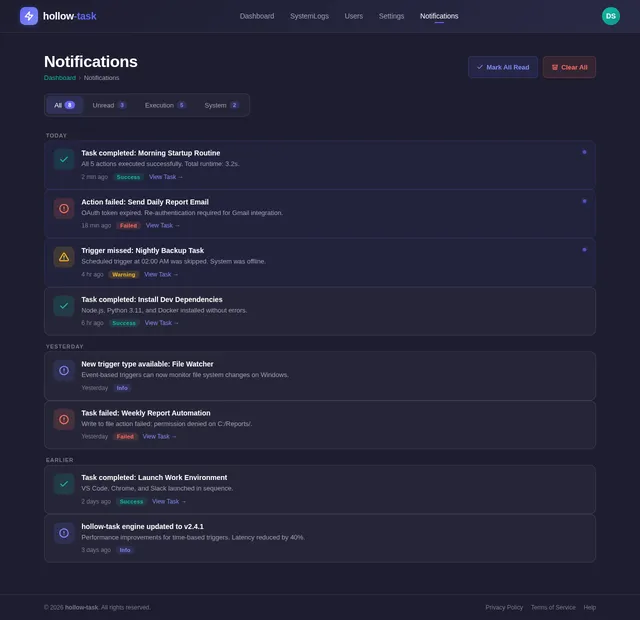
- I should be notified of task execution results (e.g., success or failure).
- I should be able to pause or stop a task during execution.
As an Admin:
- I should be able to configure system-wide settings, such as default triggers and action types.
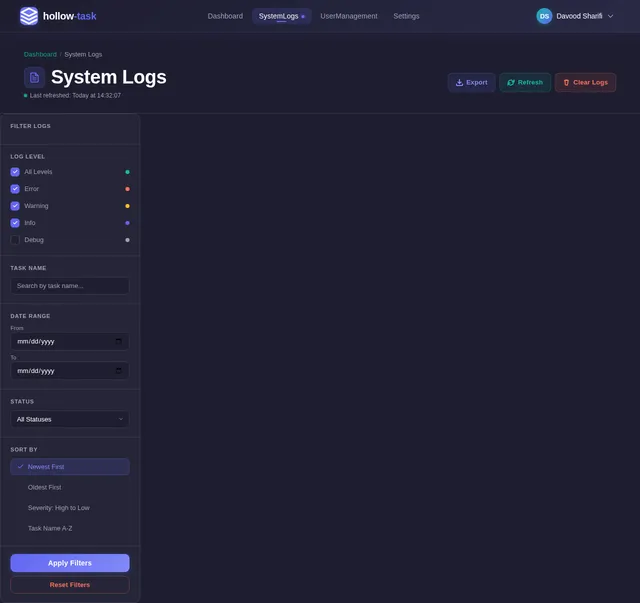
- I should be able to monitor system logs for task execution and errors.
- I should be able to manage user permissions and roles.
4. User Personas
1. Regular User
- Description: A typical user who creates and manages tasks for personal or professional use.
- Goals: Simplify daily routines, automate repetitive tasks, and save time.
- Needs: Intuitive UI, reliable task execution, and clear notifications.
2. Admin
- Description: A system administrator responsible for maintaining the platform.
- Goals: Ensure system stability, monitor usage, and manage user access.
- Needs: Advanced configuration options, detailed logs, and robust security controls.
5. Visuals Colors and Theme
The hollow-task project will feature a unique, modern, and professional color palette that reflects its focus on productivity and automation. The colors are designed to be visually appealing while maintaining clarity and accessibility.
| Element | Hex Code | Description |
|---|---|---|
| Background | #1E1E2F | A deep navy blue for a calming base. |
| Surface | #2C2C3E | A slightly lighter shade for panels. |
| Text | #FFFFFF | Crisp white for high contrast. |
| Accent | #FF6F61 | A vibrant coral for highlights and buttons. |
| Muted | #A1A1B5 | A soft gray for secondary text. |
6. Signature Design Concept
Interactive Workflow Canvas
The homepage of hollow-task will feature an interactive workflow canvas where users can visually design their tasks and actions. Here's how it works:
- Dynamic Task Nodes: Each task is represented as a draggable node on the canvas. Users can connect nodes to define dependencies or sequences.
- Action Cards: Clicking on a task node opens a card that displays its actions. Users can add, edit, or delete actions directly from the card.
- Real-Time Feedback: As users design workflows, the system provides real-time feedback on trigger conditions and action statuses.
- Micro-Animations: Smooth transitions and animations enhance the user experience, such as nodes glowing when active or connections pulsing during execution.
- Dark Mode Default: The interface defaults to a sleek dark mode, with the option to switch to light mode.
This design concept ensures that the homepage is not only functional but also visually engaging and memorable.
7. Non-Functional Requirements
- Performance: The system should execute tasks with minimal latency (<1 second for most actions).
- Scalability: Support up to 10,000 tasks per user without performance degradation.
- Security: Use OAuth for email actions and encrypt sensitive data.
- Usability: Ensure the UI is accessible and intuitive for all user personas.
- Reliability: Maintain 99.9% uptime for the backend and execution engine.
8. Tech Stack
Frontend
- React: For building a responsive web interface.
- React Native: For future mobile app development.
Backend
- Python: For the logic engine and automation scripts.
- FastAPI: For building a lightweight and fast API.
Database
- MySQL: For relational data storage.
- Alembic: For database migrations.
AI Models (Future Expansion)
- GPT 5.4: For user-friendly responses.
- Claude 4.6 Opas: For coding and academic assistance.
Orchestration
- Docker: For containerization.
- Kubernetes: For server-side orchestration.
9. Assumptions and Constraints
- Assumptions:
- Users will primarily use the system on Windows PCs initially.
- Internet connectivity is required for email actions and cloud synchronization.
- Constraints:
- iOS automation is limited due to Apple's restrictions.
- Event-based triggers depend on OS-level APIs, which may vary across platforms.
10. Glossary
- Task: A collection of actions executed based on a trigger.
- Action: A specific operation within a task (e.g., send email, open app).
- Trigger: A condition that starts a task (manual, time-based, or event-based).
- OAuth: An open standard for access delegation, used for secure API authentication.
- Execution Layer: The system component that interacts with the OS to perform actions.
This document provides a comprehensive roadmap for the development of hollow-task, ensuring clarity and alignment with Davood's vision. Let me know if you'd like to dive deeper into any specific section!

Automate Your Workflows with Intelligent Task Engines
Design, trigger, and monitor complex automations visually. hollow-task chains actions, manages triggers, and executes tasks so you can focus on what matters.
Design Your Workflows Visually
Build powerful automation pipelines with our intuitive drag-and-drop canvas. Connect triggers, actions, and monitors into seamless workflows — no code required.
Why Choose hollow-task?
Built for productivity. Designed to save you hours every week by turning complex routines into one-click automations.
Automate Repetitive Tasks
Chain actions like sending emails, opening apps, and writing files into seamless workflows that execute with zero manual effort.
Multi-Trigger Support
Kick off tasks manually, on a schedule, or based on system events. Combine trigger types to build intelligent, context-aware automations.
Real-Time Monitoring
Track every action as it executes with live status updates. Get instant notifications on completion, failures, and performance insights.
Trusted by Leading Teams
Built for Everyone
Whether you are automating personal workflows or managing an entire platform, hollow-task adapts to your role.
Regular User
A typical user who creates and manages tasks for personal or professional use. Focused on simplifying daily routines through automation.
- Simplify daily routines
- Automate repetitive tasks
- Save time with smart workflows
- Intuitive UI
- Reliable Execution
- Clear Notifications
- Easy Task Builder
Admin
A system administrator responsible for maintaining the platform, ensuring stability, monitoring usage, and managing user access across the organization.
- Ensure system stability
- Monitor usage and logs
- Manage user access and roles
- Advanced Configuration
- Detailed Logs
- Security Controls
- Role Management
Your Automation Workflow
From login to live monitoring — create powerful automated workflows in four simple steps.
Login
Securely authenticate and access your workspace
Dashboard
View active tasks, triggers, and system status
Create Task
Define actions, set triggers, and chain workflows
Monitor Execution
Track progress in real-time with live status updates
What Our Users Say
Teams of all sizes trust hollow-task to automate their most critical workflows.
hollow-task transformed how our team handles repetitive processes. What used to take hours of manual work now runs automatically in the background. The visual workflow builder is incredibly intuitive.
The multi-trigger system is a game changer. We set up event-based automations that respond to file changes, scheduled reports, and manual approvals — all in a single workflow. Truly powerful.
As an admin, the monitoring dashboard gives me full visibility into every running task. I can track execution logs, manage user roles, and ensure system stability from one place. Outstanding platform.
Built with Modern Technology
hollow-task is powered by a carefully chosen stack designed for performance, scalability, and intelligent automation.
Platform Expansion
hollow-task is growing beyond the desktop. Here is our journey from PC to a fully connected, cross-platform automation ecosystem.
Full desktop automation engine with system-level task execution, file operations, app launching, and email workflows. Currently live and battle-tested.
LiveMobile companion app for managing and triggering tasks on-the-go. Push notifications, remote execution triggers, and mobile-optimized dashboard.
In DevelopmentNative iOS integration with Shortcuts support, Apple Watch notifications, and seamless cross-device task synchronization via iCloud.
PlannedCentralized cloud platform for task synchronization, team collaboration, shared workflow templates, and cross-device execution history.
ExploringReady to Automate?
Stop repeating yourself. Build powerful workflows that run your tasks automatically — from opening apps to sending emails, all on autopilot.
Stay in the Loop
Get the latest updates on new features, platform expansions, and automation tips delivered straight to your inbox.
No spam, ever. Unsubscribe at any time.
Frequently Asked Questions
Everything you need to know about building and running automated workflows with hollow-task.
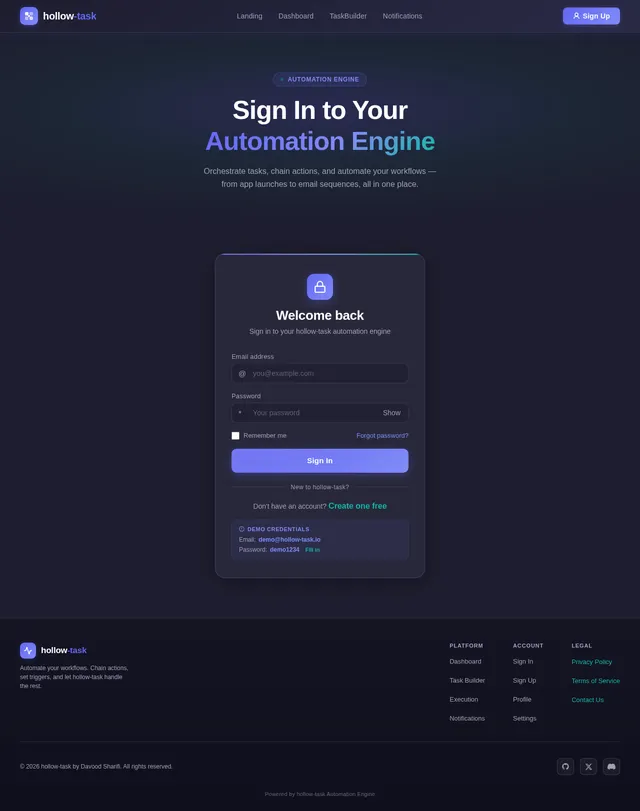
Creating a task is simple. Navigate to the Dashboard, click "Create Task," and give it a name and description. Then add actions like sending emails, opening applications, or writing to files. Finally, set a trigger (manual, time-based, or event-based) and save. Your task is ready to execute.
hollow-task supports a variety of actions out of the box: sending emails via OAuth-secured connections, opening applications on your PC, writing or appending to files, and installing applications. Each action runs sequentially within a task, and you can monitor the status of every step in real time.
Absolutely. Security is a top priority. We use OAuth for all email-related actions so your credentials are never stored directly. Sensitive data is encrypted at rest and in transit. User permissions and role-based access control ensure only authorized users can modify system settings or access logs.
hollow-task supports three trigger types: Manual triggers let you start tasks with a single click. Time-based triggers execute tasks on a schedule (e.g., every day at 9:00 AM). Event-based triggers respond to system events like a file being created or an application being opened.
Yes. While a task is running, you can pause it to temporarily halt action execution or stop it entirely. The Execution monitor shows real-time progress for each action, so you always know exactly where a task is in its workflow before deciding to intervene.
Currently, hollow-task is optimized for PC automation on Windows. Mobile support for Android is on the roadmap, followed by cloud synchronization to keep your tasks in sync across devices. iOS support will be explored with consideration for Apple platform restrictions.
No comments yet. Be the first!