feral-presentation
 RAJAN PAREKH
can you develop a ppt presentation for our RTD WIRES, we are attaching here our word file for your reference, we need a cover page and end page with contact details containing address, website, email ID, TELEPHONE NO etc. LOGO on each page, 1st file for RTD WIRES DESCRIPTION, 2nd file for logo AND 3rd file for contact details, pl. use professional colors like blue, brown, black, red, etc


Comments (0)
Sign in to leave a comment
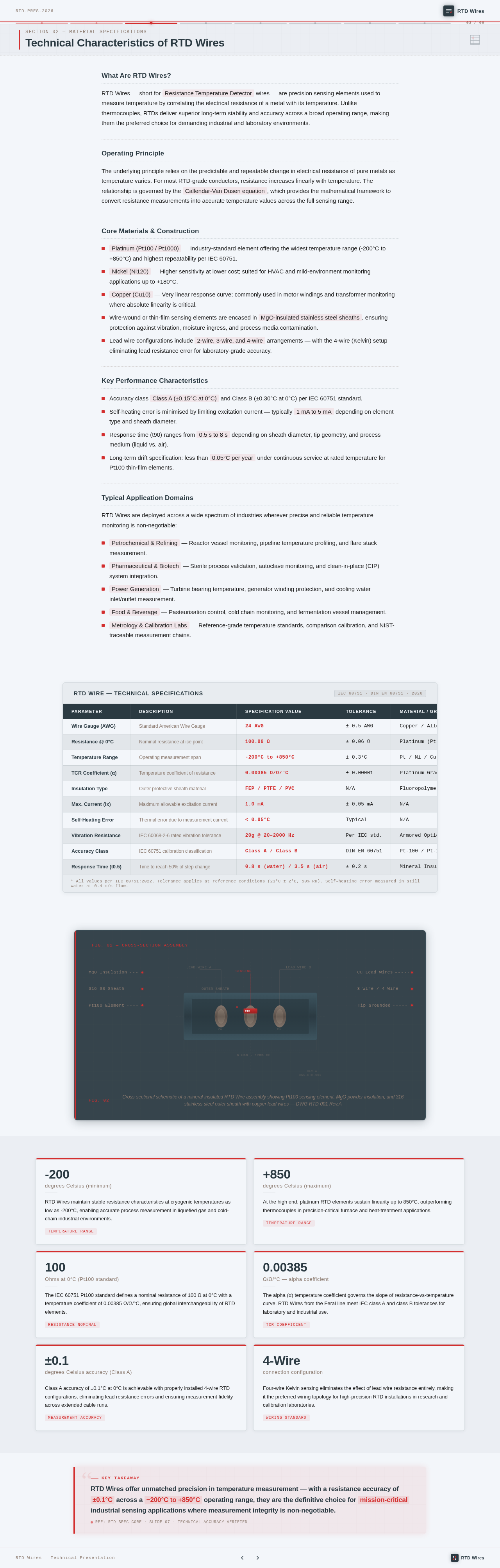
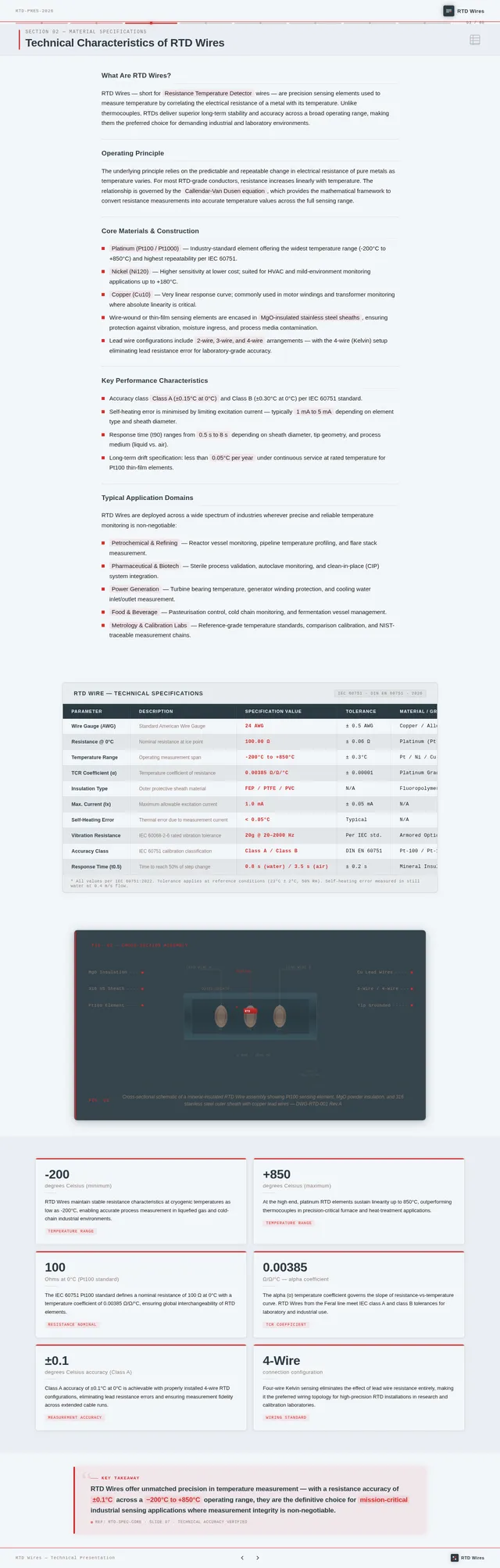
Technical Characteristics of RTD Wires
What Are RTD Wires?
RTD Wires — short for Resistance Temperature Detector wires — are precision sensing elements used to measure temperature by correlating the electrical resistance of a metal with its temperature. Unlike thermocouples, RTDs deliver superior long-term stability and accuracy across a broad operating range, making them the preferred choice for demanding industrial and laboratory environments.
Operating Principle
The underlying principle relies on the predictable and repeatable change in electrical resistance of pure metals as temperature varies. For most RTD-grade conductors, resistance increases linearly with temperature. The relationship is governed by the Callendar-Van Dusen equation, which provides the mathematical framework to convert resistance measurements into accurate temperature values across the full sensing range.
Core Materials & Construction
- Platinum (Pt100 / Pt1000) — Industry-standard element offering the widest temperature range (-200°C to +850°C) and highest repeatability per IEC 60751.
- Nickel (Ni120) — Higher sensitivity at lower cost; suited for HVAC and mild-environment monitoring applications up to +180°C.
- Copper (Cu10) — Very linear response curve; commonly used in motor windings and transformer monitoring where absolute linearity is critical.
- Wire-wound or thin-film sensing elements are encased in MgO-insulated stainless steel sheaths, ensuring protection against vibration, moisture ingress, and process media contamination.
- Lead wire configurations include 2-wire, 3-wire, and 4-wire arrangements — with the 4-wire (Kelvin) setup eliminating lead resistance error for laboratory-grade accuracy.
Key Performance Characteristics
- Accuracy class Class A (±0.15°C at 0°C) and Class B (±0.30°C at 0°C) per IEC 60751 standard.
- Self-heating error is minimised by limiting excitation current — typically 1 mA to 5 mA depending on element type and sheath diameter.
- Response time (t90) ranges from 0.5 s to 8 s depending on sheath diameter, tip geometry, and process medium (liquid vs. air).
- Long-term drift specification: less than 0.05°C per year under continuous service at rated temperature for Pt100 thin-film elements.
Typical Application Domains
RTD Wires are deployed across a wide spectrum of industries wherever precise and reliable temperature monitoring is non-negotiable:
- Petrochemical & Refining — Reactor vessel monitoring, pipeline temperature profiling, and flare stack measurement.
- Pharmaceutical & Biotech — Sterile process validation, autoclave monitoring, and clean-in-place (CIP) system integration.
- Power Generation — Turbine bearing temperature, generator winding protection, and cooling water inlet/outlet measurement.
- Food & Beverage — Pasteurisation control, cold chain monitoring, and fermentation vessel management.
- Metrology & Calibration Labs — Reference-grade temperature standards, comparison calibration, and NIST-traceable measurement chains.
| Parameter | Description | Specification Value | Tolerance | Material / Grade | Status |
|---|---|---|---|---|---|
| Wire Gauge (AWG) | Standard American Wire Gauge | 24 AWG | ± 0.5 AWG | Copper / Alloy | Nominal |
| Resistance @ 0°C | Nominal resistance at ice point | 100.00 Ω | ± 0.06 Ω | Platinum (Pt) | Nominal |
| Temperature Range | Operating measurement span | -200°C to +850°C | ± 0.3°C | Pt / Ni / Cu | Nominal |
| TCR Coefficient (α) | Temperature coefficient of resistance | 0.00385 Ω/Ω/°C | ± 0.00001 | Platinum Grade A | Nominal |
| Insulation Type | Outer protective sheath material | FEP / PTFE / PVC | N/A | Fluoropolymer | Nominal |
| Max. Current (Ix) | Maximum allowable excitation current | 1.0 mA | ± 0.05 mA | N/A | Caution |
| Self-Heating Error | Thermal error due to measurement current | < 0.05°C | Typical | N/A | Nominal |
| Vibration Resistance | IEC 60068-2-6 rated vibration tolerance | 20g @ 20–2000 Hz | Per IEC std. | Armored Option | Nominal |
| Accuracy Class | IEC 60751 calibration classification | Class A / Class B | DIN EN 60751 | Pt-100 / Pt-1000 | Nominal |
| Response Time (t0.5) | Time to reach 50% of step change | 0.8 s (water) / 3.5 s (air) | ± 0.2 s | Mineral Insulated | Nominal |
RTD Wires maintain stable resistance characteristics at cryogenic temperatures as low as -200°C, enabling accurate process measurement in liquefied gas and cold-chain industrial environments.
Temperature RangeAt the high end, platinum RTD elements sustain linearity up to 850°C, outperforming thermocouples in precision-critical furnace and heat-treatment applications.
Temperature RangeThe IEC 60751 Pt100 standard defines a nominal resistance of 100 Ω at 0°C with a temperature coefficient of 0.00385 Ω/Ω/°C, ensuring global interchangeability of RTD elements.
Resistance NominalThe alpha (α) temperature coefficient governs the slope of resistance-vs-temperature curve. RTD Wires from the Feral line meet IEC class A and class B tolerances for laboratory and industrial use.
TCR CoefficientClass A accuracy of ±0.1°C at 0°C is achievable with properly installed 4-wire RTD configurations, eliminating lead resistance errors and ensuring measurement fidelity across extended cable runs.
Measurement AccuracyFour-wire Kelvin sensing eliminates the effect of lead wire resistance entirely, making it the preferred wiring topology for high-precision RTD installations in research and calibration laboratories.
Wiring StandardRTD Wires offer unmatched precision in temperature measurement — with a resistance accuracy of ±0.1°C across a −200°C to +850°C operating range, they are the definitive choice for mission-critical industrial sensing applications where measurement integrity is non-negotiable.
No comments yet. Be the first!