laser-clinic
 Ayesha Khan
Act as a Senior Full-Stack Developer. Build a comprehensive web application titled "Ahmad's Basic Health Care." The core goal is to develop a lightweight, user-friendly MVP (Minimum Viable Product) for a small clinic. Functional Requirements: * Role-Based Access: Create a secure authentication system for Patients (viewing history/booking) and Staff/Ahmad (managing appointments/updating patient vitals). * Appointment Management: A simple booking system that prevents double-booking and displays available time slots. * Patient Health Cards: A digital record for each user displaying blood type, allergies, current medications, and a history of past visits. * Prescription Viewer: A dedicated section where patients can download or view PDF versions of their prescribed treatments. Technical Specifications: * Frontend: Use React.js with Tailwind CSS. The UI must be mobile-responsive, accessible, and use a calming palette of medical blues and whites. * Backend/Database: Suggest a schema for a NoSQL or SQL database that handles relational data between doctors and patients efficiently. * Security: Implement basic HIPAA-compliant logic, ensuring data encryption at rest and in transit. Output Required: * Architecture Map: A high-level overview of how the frontend and backend interact. * Database Schema: A detailed structure for Users, Appointments, and MedicalRecords. * Frontend Code: A functional React boilerplate for the Patient Dashboard including a sidebar and "Recent Activity" feed. * UI/UX Guide: A brief style guide for maintaining a professional "Health Care" aesthetic.
Comments (0)
Sign in to leave a comment
System Requirements
System Requirements Document (SRD)
1. Introduction
"Ahmad's Basic Health Care" is a lightweight, user-friendly web application designed to serve as a Minimum Viable Product (MVP) for a small clinic. The application aims to streamline clinic operations by providing secure role-based access for Patients, Staff, and Ahmad (Admin). The system will allow for efficient appointment management, digital health records, and prescription viewing, all while maintaining a professional and calming user experience.
2. System Overview
The system will consist of a responsive web application built using React.js for the frontend and a Python-based backend with FastAPI. The database will handle relational data efficiently, ensuring secure storage and retrieval of patient and clinic information. The application will adhere to basic HIPAA-compliant standards, ensuring data encryption at rest and in transit.
Key features include:
- Role-based access for Patients, Staff, and Ahmad.
- Appointment management with conflict prevention.
- Digital health cards for patients.
- Prescription viewer for downloading or viewing prescribed treatments.
3. Functional Requirements as Story Points
- As a Patient, I should be able to view my health card, including blood type, allergies, current medications, and visit history.
- As a Patient, I should be able to book appointments and view available time slots.
- As a Patient, I should be able to view and download my prescriptions in PDF format.
- As Staff, I should be able to manage appointments, including creating, updating, and canceling them.
- As Staff, I should be able to update patient records, including vitals and medical history.
- As Ahmad (Admin), I should be able to oversee all appointments and patient records.
- As Ahmad (Admin), I should be able to manage user roles and permissions.
4. User Personas
- Patient: A user who can view their health card, book appointments, and access prescriptions.
- Staff: Clinic personnel responsible for managing appointments and updating patient records.
- Ahmad (Admin): The clinic administrator with full access to oversee operations, manage user roles, and permissions.
5. Visuals Colors and Theme
The application will use a calming palette of medical blues and whites to create a professional and soothing aesthetic. Accent colors such as soft greens and greys will be used sparingly for buttons and highlights. Typography will prioritize readability, with a clean sans-serif font like "Roboto" or "Open Sans."
Suggested Color Palette:
- Primary Blue: #4A90E2
- Secondary Blue: #D9EFFF
- White: #FFFFFF
- Soft Green (Accent): #A3D9A5
- Grey (Text): #6B7280
6. Signature Design Concept
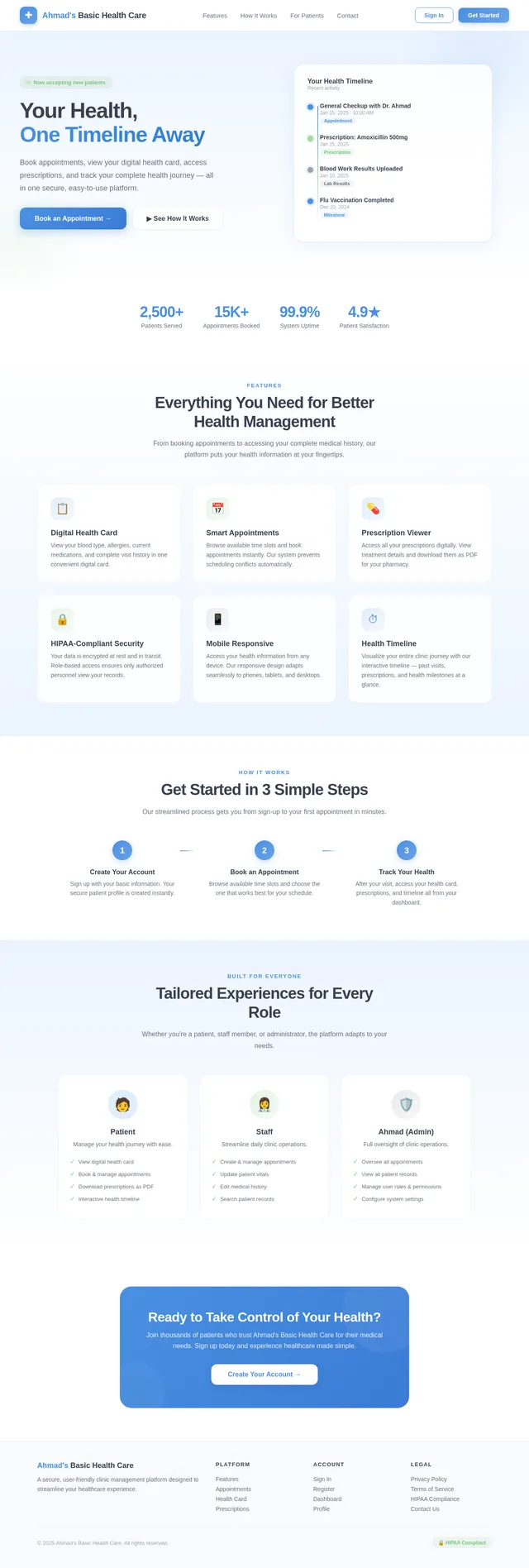
The homepage will feature an interactive "Health Timeline" visualization. This timeline will act as a dynamic, scrollable interface where users can see their clinic journey at a glance.
Details:
- For Patients: The timeline will display past appointments, prescriptions, and health milestones (e.g., vaccinations, test results). Each event will be represented as a clickable node that expands into detailed information.
- For Staff and Ahmad: The timeline will adapt to show clinic-wide activity, such as upcoming appointments, patient check-ins, and system updates.
- Animations: Nodes will "pulse" gently when hovered over, and transitions between timeline events will feature smooth sliding animations.
- Color Shifts: The timeline will use the primary blue and soft green accents, with a gradient background that subtly shifts from light blue to white as the user scrolls.
- Micro-Interactions: Clicking on a node will open a modal with detailed information, including buttons for actions like "Download Prescription" or "Edit Appointment."
This interactive timeline will make the homepage visually engaging and provide immediate value to users by summarizing their most relevant information.
7. Non-Functional Requirements
- The system must be mobile-responsive and accessible, adhering to WCAG 2.1 standards.
- Data must be encrypted at rest and in transit to comply with basic HIPAA standards.
- The application should handle at least 1,000 concurrent users without performance degradation.
- The system should have a 99.9% uptime guarantee.
8. Tech Stack
- Frontend: React.js with Tailwind CSS for a responsive and modern UI.
- Backend: Python with FastAPI for efficient API development.
- Database: MySQL for relational data storage, using Alembic for migrations.
- AI Tools: Not applicable for this MVP.
- Orchestration: Docker and docker-compose for local development.
9. Assumptions and Constraints
- The system will initially support only English as the language.
- The MVP will not include payment processing for appointments.
- The application will be deployed on a cloud platform with built-in support for Kubernetes.
- The system will not include advanced analytics or reporting in the MVP phase.
10. Glossary
- MVP: Minimum Viable Product, the simplest version of the application that delivers core functionality.
- HIPAA: Health Insurance Portability and Accountability Act, a U.S. regulation for protecting sensitive patient health information.
- JWT: JSON Web Token, a compact, URL-safe means of representing claims to be transferred between two parties.
- Responsive Design: A design approach that ensures the application works well on devices of various sizes, including mobile phones and tablets.
- Role-Based Access Control (RBAC): A method of regulating access to a system based on the roles of individual users.
This updated SRD includes the division of roles and permissions for Patients, Staff, and Ahmad, as requested. Let me know if there are additional details or changes you'd like to include!
No comments yet. Be the first!