daily-stand-up
 Maitry Mehta
Build a web-based Daily Stand-up Management System with three role-based portals: Developer, PM/Management, and Admin. Developers can submit daily stand-ups and view their own history. PM/Management can monitor submitted, missing, leave, blocker, help, and concern data; filter by developer, team lead, designation, project, and date; generate private monthly developer summaries; and export filtered data to Excel, CSV, and PDF. Admin can manage users, designations, projects, team lead mapping, leave, holidays, working days, roles, and permissions. Missing stand-up calculations must exclude approved leave, holidays, weekends, and non-required days. Monthly summaries and management dashboard data must remain hidden from developers. The UI should be clean, responsive, and dashboard-oriented.


Comments (0)
Sign in to leave a comment
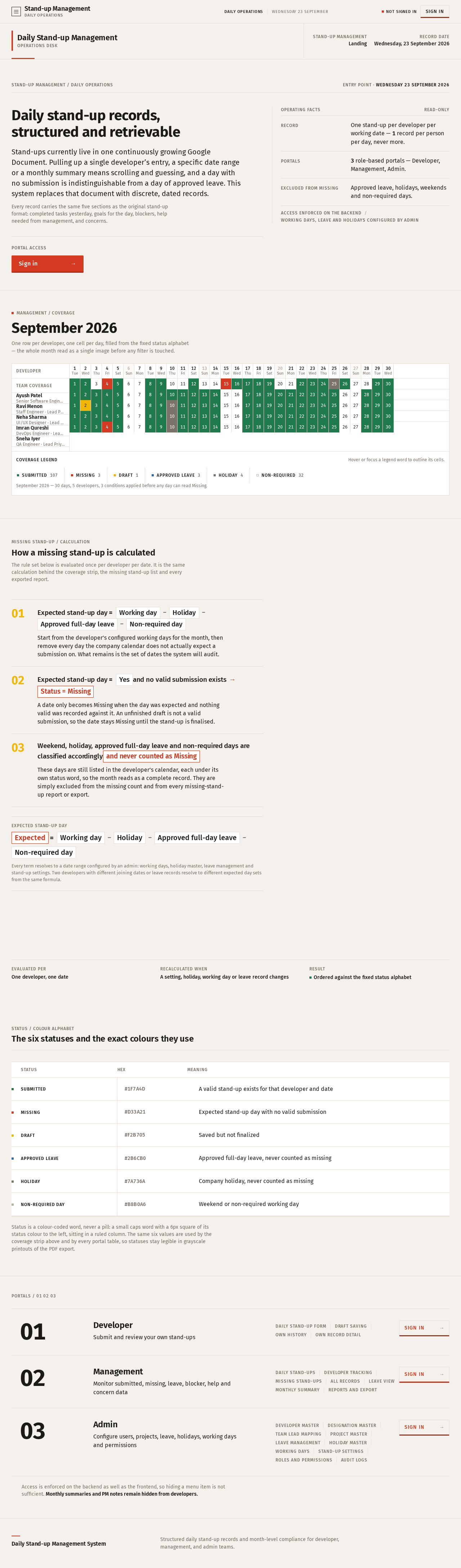
Daily Stand-up Management
Operations deskStand-up management / Daily operations
Entry pointWednesday 23 September 2026
Daily stand-up records, structured and retrievable
Stand-ups currently live in one continuously growing Google Document. Pulling up a single developer’s entry, a specific date range or a monthly summary means scrolling and guessing, and a day with no submission is indistinguishable from a day of approved leave. This system replaces that document with discrete, dated records.
Every record carries the same five sections as the original stand-up format: completed tasks yesterday, goals for the day, blockers, help needed from management, and concerns.
Operating facts
Read-only
- Record
- One stand-up per developer per working date — 1 record per person per day, never more.
- Portals
- 3 role-based portals — Developer, Management, Admin.
- Excluded from missing
- Approved leave, holidays, weekends and non-required days.
Access enforced on the backendWorking days, leave and holidays configured by Admin
Management / Coverage
September 2026
One row per developer, one cell per day, filled from the fixed status alphabet — the whole month read as a single image before any filter is touched.
Coverage legend
Hover or focus a legend word to outline its cells.
September 2026 — 30 days, 5 developers, 3 conditions applied before any day can read Missing.
Missing stand-up / Calculation
How a missing stand-up is calculated
The rule set below is evaluated once per developer per date. It is the same calculation behind the coverage strip, the missing stand-up list and every exported report.
Expected stand-up day=Working day−Holiday−Approved full-day leave−Non-required day
Start from the developer’s configured working days for the month, then remove every day the company calendar does not actually expect a submission on. What remains is the set of dates the system will audit.
Expected stand-up day=Yesand no valid submission exists→Status = Missing
A date only becomes Missing when the day was expected and nothing valid was recorded against it. An unfinished draft is not a valid submission, so the date stays Missing until the stand-up is finalised.
Weekend, holiday, approved full-day leave and non-required days are classified accordinglyand never counted as Missing
These days are still listed in the developer’s calendar, each under its own status word, so the month reads as a complete record. They are simply excluded from the missing count and from every missing-stand-up report or export.
Expected stand-up day
Expected=Working dayHolidayApproved full-day leaveNon-required day
Every term resolves to a date range configured by an admin: working days, holiday master, leave management and stand-up settings. Two developers with different joining dates or leave records resolve to different expected day sets from the same formula.
Evaluated per
One developer, one date
Recalculated when
A setting, holiday, working day or leave record changes
Result
Ordered against the fixed status alphabet
Status / Colour Alphabet
The six statuses and the exact colours they use
| Swatch | Status | Hex | Meaning |
|---|---|---|---|
| Submitted | #1F7A4D | A valid stand-up exists for that developer and date | |
| Missing | #D33A21 | Expected stand-up day with no valid submission | |
| Draft | #F2B705 | Saved but not finalized | |
| Approved Leave | #2B6CB0 | Approved full-day leave, never counted as missing | |
| Holiday | #7A736A | Company holiday, never counted as missing | |
| Non-required day | #B8B0A6 | Weekend or non-required working day |
Status is a colour-coded word, never a pill: a small caps word with a 6px square of its status colour to the left, sitting in a ruled column. The same six values are used by the coverage strip above and by every portal table, so statuses stay legible in grayscale printouts of the PDF export.
Portals / 01 02 03
Developer
Submit and review your own stand-ups
- Daily stand-up form
- draft saving
- own history
- own record detail
Management
Monitor submitted, missing, leave, blocker, help and concern data
- Daily stand-ups
- developer tracking
- missing stand-ups
- all records
- leave view
- monthly summary
- reports and export
Admin
Configure users, projects, leave, holidays, working days and permissions
- Developer master
- designation master
- team lead mapping
- project master
- leave management
- holiday master
- working days
- stand-up settings
- roles and permissions
- audit logs
Access is enforced on the backend as well as the frontend, so hiding a menu item is not sufficient. Monthly summaries and PM notes remain hidden from developers.
Daily Stand-up Management
Operations deskStand-up management / Daily operations
Entry pointWednesday 23 September 2026
Daily stand-up records, structured and retrievable
Stand-ups currently live in one continuously growing Google Document. Pulling up a single developer’s entry, a specific date range or a monthly summary means scrolling and guessing, and a day with no submission is indistinguishable from a day of approved leave. This system replaces that document with discrete, dated records.
Every record carries the same five sections as the original stand-up format: completed tasks yesterday, goals for the day, blockers, help needed from management, and concerns.
Operating facts
Read-only
- Record
- One stand-up per developer per working date — 1 record per person per day, never more.
- Portals
- 3 role-based portals — Developer, Management, Admin.
- Excluded from missing
- Approved leave, holidays, weekends and non-required days.
Access enforced on the backendWorking days, leave and holidays configured by Admin
Management / Coverage
September 2026
One row per developer, one cell per day, filled from the fixed status alphabet — the whole month read as a single image before any filter is touched.
Coverage legend
Hover or focus a legend word to outline its cells.
September 2026 — 30 days, 5 developers, 3 conditions applied before any day can read Missing.
Missing stand-up / Calculation
How a missing stand-up is calculated
The rule set below is evaluated once per developer per date. It is the same calculation behind the coverage strip, the missing stand-up list and every exported report.
Expected stand-up day=Working day−Holiday−Approved full-day leave−Non-required day
Start from the developer’s configured working days for the month, then remove every day the company calendar does not actually expect a submission on. What remains is the set of dates the system will audit.
Expected stand-up day=Yesand no valid submission exists→Status = Missing
A date only becomes Missing when the day was expected and nothing valid was recorded against it. An unfinished draft is not a valid submission, so the date stays Missing until the stand-up is finalised.
Weekend, holiday, approved full-day leave and non-required days are classified accordinglyand never counted as Missing
These days are still listed in the developer’s calendar, each under its own status word, so the month reads as a complete record. They are simply excluded from the missing count and from every missing-stand-up report or export.
Expected stand-up day
Expected=Working dayHolidayApproved full-day leaveNon-required day
Every term resolves to a date range configured by an admin: working days, holiday master, leave management and stand-up settings. Two developers with different joining dates or leave records resolve to different expected day sets from the same formula.
Evaluated per
One developer, one date
Recalculated when
A setting, holiday, working day or leave record changes
Result
Ordered against the fixed status alphabet
Status / Colour Alphabet
The six statuses and the exact colours they use
| Swatch | Status | Hex | Meaning |
|---|---|---|---|
| Submitted | #1F7A4D | A valid stand-up exists for that developer and date | |
| Missing | #D33A21 | Expected stand-up day with no valid submission | |
| Draft | #F2B705 | Saved but not finalized | |
| Approved Leave | #2B6CB0 | Approved full-day leave, never counted as missing | |
| Holiday | #7A736A | Company holiday, never counted as missing | |
| Non-required day | #B8B0A6 | Weekend or non-required working day |
Status is a colour-coded word, never a pill: a small caps word with a 6px square of its status colour to the left, sitting in a ruled column. The same six values are used by the coverage strip above and by every portal table, so statuses stay legible in grayscale printouts of the PDF export.
Portals / 01 02 03
Developer
Submit and review your own stand-ups
- Daily stand-up form
- draft saving
- own history
- own record detail
Management
Monitor submitted, missing, leave, blocker, help and concern data
- Daily stand-ups
- developer tracking
- missing stand-ups
- all records
- leave view
- monthly summary
- reports and export
Admin
Configure users, projects, leave, holidays, working days and permissions
- Developer master
- designation master
- team lead mapping
- project master
- leave management
- holiday master
- working days
- stand-up settings
- roles and permissions
- audit logs
Access is enforced on the backend as well as the frontend, so hiding a menu item is not sufficient. Monthly summaries and PM notes remain hidden from developers.
No comments yet. Be the first!