crossconnect
 Joshua Khristi
I’m building **the ultimate cross-reference Bible**: a Bible-first platform that lets people read Scripture naturally while revealing the vast web of relationships that exists within the biblical canon. The goal is not simply to create another Bible app with a larger collection of cross-references. It is to build a **living map of Scripture**—a system where every passage can be understood not only in isolation, but within the conversations, patterns, images, words, people, events, promises, and theological trajectories that run throughout the Bible. A reader should be able to open any passage and simply **read**. The Bible remains the centre of the experience. But whenever they notice something interesting, they can click a word, phrase, verse, person, place, event, image, or theme and begin exploring what lies behind it and where it leads. A phrase in Revelation might open connections to Isaiah, Ezekiel, Daniel, Psalms, Genesis, Exodus, or the Gospels. A word might reveal its Hebrew or Greek lemma and show how its meaning develops across Scripture. A person might open a genealogical and narrative trail. A place might reveal its geographic and biblical significance. An event might connect earlier occurrences with later reinterpretations. A prophecy might be traced from promise, through expectation and development, to its later use or claimed fulfilment. A recurring image—temple, mountain, garden, river, lamb, throne, wilderness, light, darkness, bride, city—could be followed through the entire canon. The platform should distinguish between **what the biblical text actually says, what documented data connects, what scholars argue, and what AI suggests**. AI should never quietly become the authority. Every connection should carry its relationship type, evidence, confidence, provenance, and review status. Strong documented relationships should be distinguishable from probable or possible relationships, and disputed interpretations should remain visibly disputed. The system should understand many different kinds of biblical relationships: direct quotations, Old Testament allusions, echoes, imagery, prophetic expectation, theological concepts, typology, narrative patterns, New Testament parallels, internal canonical connections, lexical relationships, people, places, events, genealogies, chronology, laws and rituals, literary structures, textual variants, manuscript relationships, and Septuagint connections. The deeper purpose is to make the **architecture of Scripture visible**. Instead of merely asking, “What does this verse mean?”, the reader can ask: **Where did this idea come from? What earlier passage is being echoed? How is this image developed? Where does this promise go? How does this word change or deepen across Scripture? What happens to this person, event, institution, or theme later? How does the New Testament reuse the Old Testament? What passages converge behind this one? What are scholars actually saying about this connection? And how does the whole biblical story develop toward its conclusion?** The experience should therefore move naturally: **READ → NOTICE → CLICK → EXPLORE → COMPARE → TRACE → MAP → RETURN TO READ** The reader can move from a single phrase to its source, from its source to related passages, from those passages to a larger canonical trajectory, and finally return to the Bible without losing their place. At its deepest level, this becomes a **graph of the Bible**: millions of possible relationships between passages, words, people, places, events, themes, literary structures, prophecies, and textual traditions—while still presenting Scripture as a readable book rather than turning it into a database. The platform should allow users to **trace biblical ideas forward and backward**. They could follow something like: **Eden → Tabernacle → Temple → Prophetic Temple → Christ → Church → New Jerusalem** or: **Creation → Israel → Davidic Kingdom → Prophets → Jesus → Church → New Creation** or: **Egypt → Passover → Exodus → Wilderness → Sinai → Land → New Exodus → Christ → Revelation** These are not merely lists of verses. They are **canonical trajectories** showing how biblical themes, images, promises, institutions, and narratives develop. The app should also provide comparison without disrupting reading: multiple translations side by side, synchronized passages, original-language information, lexical connections, textual variants, Septuagint relationships, and scholarly discussions where appropriate. The visual experience should feel less like an AI dashboard and more like a **beautiful scholarly Bible**: literary, elegant, contemplative, minimal, spacious, typographically excellent, and deeply focused on the text. The complexity should appear when the reader asks for it—not overwhelm them when they simply want to read. The ultimate ambition is that a reader could open **Revelation 21:1**, see “a new heaven and a new earth,” tap the phrase, and immediately begin exploring its relationship to Isaiah 65, Isaiah 66, Genesis 1–3, prophetic new-creation expectations, New Testament development, and the larger biblical trajectory—then compare translations, examine the evidence, trace the theme, see the relationship visually on a map, read scholarly perspectives, and return to Revelation 21 without ever leaving the Bible. In other words: **I’m building a Bible that can reveal its own interconnectedness.** Not merely a Bible with cross-references. **A navigable, evidence-based map of the entire biblical canon—where every passage can reveal what lies behind it, what develops from it, and how it participates in the larger story of Scripture.**

Comments (0)
Sign in to leave a comment
System Requirements
System Requirements Document for crossconnect
1. Introduction
crossconnect is a Bible-first platform for reading Scripture naturally while revealing the vast web of relationships that exists within the biblical canon. Its intent is not to be another Bible app with a larger collection of cross-references, but a living map of Scripture: a system where every passage can be understood not only in isolation, but within the conversations, patterns, images, words, people, events, promises, and theological trajectories that run throughout the Bible.
The Bible remains the centre of the experience. A reader opens any passage and simply reads; when they notice something interesting, they click a word, phrase, verse, person, place, event, image, or theme and begin exploring what lies behind it and where it leads. The platform's deeper purpose is to make the architecture of Scripture visible — to let a reader ask where an idea came from, what earlier passage is being echoed, how an image is developed, where a promise goes, how a word changes or deepens across Scripture, what happens to a person, event, institution, or theme later, how the New Testament reuses the Old Testament, what passages converge behind a text, what scholars actually say about a connection, and how the whole biblical story develops toward its conclusion.
The audience is serious lay readers, students, pastors, and academics: readers who want a beautiful scholarly Bible — literary, elegant, contemplative, minimal, spacious, typographically excellent, and deeply focused on the text — with complexity appearing only when they ask for it. The platform must distinguish between what the biblical text actually says, what documented data connects, what scholars argue, and what AI suggests; AI must never quietly become the authority.
2. System Overview
crossconnect is delivered as a first-party custom web application with a backend that serves Scripture passages and relationship data. The current delivery shape is a set of cohesive, first-party destinations that together carry the accepted experience flow READ → NOTICE → CLICK → EXPLORE → COMPARE → TRACE → MAP → RETURN TO READ:
- Landing — the anonymous public entry that explains the Bible-first platform, its intended readers, and its readable relationship-exploration experience.
- Bible Reader — the primary reading destination where Scripture remains central and readers preserve their place while exploring.
- Connections — the exploration destination for selected words, phrases, verses, people, places, events, images, themes, and their biblical relationships.
- Evidence — the review destination for relationship type, evidence, confidence, provenance, review status, source distinctions, AI suggestions, and disputed interpretations.
- Compare — the passage comparison destination for synchronized translations, original-language information, lexical connections, textual variants, Septuagint relationships, and scholarly discussion.
- Trajectories — the destination for tracing themes, images, promises, institutions, and narratives forward and backward across the canon.
- Map — the visual destination for viewing biblical relationships and canonical trajectories as an interconnected map.
The accepted active human personas are the Scripture Reader, the Connection Explorer, the Translation and Text Comparer, and the Scholarly Evidence Reviewer. All current destinations are openly reachable; the reader's current passage and position must remain available while they explore, compare, trace, map, and return, so the application preserves reading position across the exploration lifecycle without requiring an account.
Narrow exclusions. crossconnect is not a database presented in place of a book: Scripture must be presented as a readable book rather than turning it into a database. It is not an AI dashboard, and AI-suggested content is never presented without an explicit provenance and confidence label. It does not present a force-directed node cloud on the reading surface; relationships remain typographic until the reader explicitly opens Map. It does not use a light or near-white ground, blue/indigo/violet palette, rounded cards, pill buttons, soft shadows, glassmorphism, hover-lift grids, gradient-blob heroes, 3D renders, or stock photography of people.
2a. Product Interpretation and Delivery Boundary
Delivery ownership. crossconnect is a first-party custom application. The reading surface, the relationship ledger, the evidence apparatus, the comparison columns, the trajectory timeline, and the map are all owned and rendered by the application itself. The backend supplies Scripture passages and relationship data so that reading and exploration are executable; this is supporting infrastructure, not a separate product surface.
Access ownership. All current destinations are openly reachable. The accepted journeys — reading a passage, noticing something, clicking it, exploring its relationships, comparing translations, tracing a trajectory, viewing the map, and returning to the text — do not require the reader to establish or verify an identity, and no accepted capability creates a durable obligation, entitlement, or value transfer that must remain bound to a particular participant. The reader's current passage and position are preserved as in-session reading state so that the reader can return to the Bible without losing their place; this continuity is a property of the reading experience, not an account. No account creation, sign-in, invitation, provisioning, or account-management capability is part of the current scope.
Current and future boundaries. Everything described in this document is current. No future-horizon requirements were accepted in the authoritative thread; nothing in this document is deferred, and nothing outside the accepted capabilities is implied by the product category.
2b. Source Content Inventory
Not applicable. No reference directive with a content_source authority was supplied; the authoritative material is the user-authored requirement thread and the accepted Planning Scope, whose content is carried in the requirements, personas, page coverage, and flows below.
2c. Page Content and Component Coverage
Landing
- Information and state. The anonymous public entry. A full-viewport ink-black screen whose dominant element is a single Scripture line — Revelation 21:1, "a new heaven and a new earth" — set in Cormorant Garamond at 140px, left-aligned, occupying columns 2–9, with the phrase "new heaven and a new earth" underlined by the ochre rule. Beneath it, in the right-hand columns 9–12, a hairline-ruled metadata block in 11px small caps lists the exact relationship set the user described: ISAIAH 65:17 · ISAIAH 66:22 · GENESIS 1:1–3 · 2 PETER 3:13 · REVELATION 21:1 — each with a confidence tier and provenance label. Bottom-left, a single ochre text link: "Begin reading". No button, no subheadline, no gradient, no illustration.
- Primary action. "Begin reading" — the single ochre text link that carries the reader into the Bible Reader.
- Supporting actions. Reading the relationship metadata block as a worked example of the platform's provenance-and-confidence language; reading the fine-line canonical diagram (books of the Bible as ruled segments on a horizontal axis with relationship arcs drawn in ochre) as the one decorative artefact.
- Domain entities. Scripture passage (Revelation 21:1), relationship set (Isaiah 65:17, Isaiah 66:22, Genesis 1:1–3, 2 Peter 3:13, Revelation 21:1), confidence tier, provenance label.
- Component responsibilities. Hero Scripture line with ochre rule; hairline-ruled metadata block; canonical diagram; "Begin reading" link; provenance legend as a Saville-style catalogue key (documented, probable, possible, disputed, AI-suggested) with the 2px dot.
- States. Loading: the hero line and metadata block resolve as a composed first frame; no skeleton cards, no spinners over the text. Empty: not applicable — the hero content is fixed accepted content. Success: the reader understands the Bible-first premise and the provenance code, and follows "Begin reading". Error: if the metadata block cannot be resolved, the hero Scripture line and "Begin reading" remain fully usable and the metadata block is omitted rather than shown with unlabeled or invented data. Recovery: the reader can still enter the Bible Reader directly.
Bible Reader
- Information and state. The primary reading destination. A strict asymmetric editorial grid: 12 columns, the Scripture reading column occupying columns 3–8 at a fixed 66ch measure with vast outer margins; the left rail (columns 1–2) holds book/chapter navigation set vertically in small caps. Scripture body in Spectral 400 at 19–21px with 1.75 line-height. Every verse carries a hairline-ruled left margin holding its cross-reference count, confidence tier, and review status in 11px small caps — the graph of Scripture present on every page as typographic metadata, never as a floating UI element. A persistent ochre chapter mark preserves the reader's position. A minimap renders the fine-line canonical diagram.
- Primary action. Read Scripture naturally, with the Bible remaining the centre of the experience.
- Supporting actions. Navigate by book and chapter from the left rail; click a word, phrase, verse, person, place, event, image, or theme to begin exploring; open the relationship ledger in columns 9–12; open Compare, Trajectories, or Map; return to reading without losing place.
- Domain entities. Scripture passage, book, chapter, verse, verse reference, cross-reference count, confidence tier, review status, reading position, selected word/phrase/verse/person/place/event/image/theme.
- Component responsibilities. Scripture reading column; left-rail book/chapter navigation; per-verse margin apparatus; ochre rule cursor (2px #F2C14E, drawn left to right over 260ms on selection); relationship ledger column (hairline-ruled, entering columns 9–12, never a floating card); persistent ochre chapter mark; minimap.
- States. Loading: the reading column resolves first; the margin apparatus and ledger resolve after, without displacing the text. Empty: a passage with no recorded relationships shows its margin apparatus as an explicit zero/absent state rather than a blank or fabricated count. Success: the reader reads, notices, clicks, and the ledger opens with the selected item's relationships. Error: if relationship data for a passage cannot be resolved, the Scripture text remains fully readable and the margin apparatus states that relationships are unavailable for that passage. Recovery: the reader continues reading and can retry the selection; reading position is unaffected.
Connections
- Information and state. The exploration destination for a selected word, phrase, verse, person, place, event, image, or theme and its biblical relationships. Presents the selected item, its relationship types, and the connected passages, with each connection carrying its relationship type, evidence, confidence, provenance, and review status. Supports the many accepted relationship kinds: direct quotations, Old Testament allusions, echoes, imagery, prophetic expectation, theological concepts, typology, narrative patterns, New Testament parallels, internal canonical connections, lexical relationships, people, places, events, genealogies, chronology, laws and rituals, literary structures, textual variants, manuscript relationships, and Septuagint connections.
- Primary action. Explore what lies behind the selected item and where it leads.
- Supporting actions. Move from a phrase to its source, from its source to related passages, and from those passages to a larger canonical trajectory; open a connection's Evidence; open Compare for a connected passage; open Trajectories from a connection; open Map; return to the Bible Reader at the preserved position.
- Domain entities. Selected item (word, phrase, verse, person, place, event, image, theme), relationship, relationship type, connected passage, evidence, confidence, provenance, review status, Hebrew/Greek lemma, genealogical and narrative trail, geographic and biblical significance.
- Component responsibilities. Selected-item header; relationship ledger with hairline rules; relationship-type labels in Spectral 500 small caps at 11px with 0.16em tracking; confidence and provenance coding in ochre/oxblood/muted; lemma and Strong's numbers in JetBrains Mono; links into Evidence, Compare, Trajectories, and Map.
- States. Loading: the selected item and its relationship ledger resolve as a crossfade of the ledger, never a page slide. Empty: an item with no recorded relationships states that no relationships are recorded, and does not substitute AI-suggested or invented connections. Success: the reader sees the relationship set with type, evidence, confidence, provenance, and review status, and can continue outward. Error: if a relationship's evidence cannot be resolved, that connection is shown with its unresolved evidence state rather than being silently dropped or upgraded. Recovery: the reader can return to the Bible Reader at the preserved position and re-select.
Evidence
- Information and state. The review destination for a connection's relationship type, evidence, confidence, provenance, review status, source distinctions, AI suggestions, and disputed interpretations. It separates what the biblical text actually says, what documented data connects, what scholars argue, and what AI suggests. Strong documented relationships are distinguishable from probable or possible relationships, and disputed interpretations remain visibly disputed.
- Primary action. Examine the evidence behind a connection and judge its standing.
- Supporting actions. Read the relationship type; read the evidence; read the confidence tier; read the provenance; read the review status; distinguish text / documented data / scholarly argument / AI suggestion; see disputed interpretations remain disputed; open the connected passage in the Bible Reader or Compare.
- Domain entities. Relationship type, evidence, confidence, provenance, review status, source class (biblical text, documented data, scholarly argument, AI suggestion), dispute state, citation label, manuscript sigla.
- Component responsibilities. Evidence ledger with hairline rules; source-class labels in small caps; confidence legend with the 2px dot; oxblood marking for disputed or low-confidence connections; JetBrains Mono for manuscript sigla and verse references; links back to the connection and its passages.
- States. Loading: the evidence ledger resolves without displacing the connection context. Empty: a connection with no recorded evidence states that no evidence is recorded rather than presenting an unsupported claim. Success: the reviewer can distinguish documented, probable, possible, disputed, and AI-suggested relationships and see disputes remain disputed. Error: if a source class cannot be resolved, the connection is shown with an explicit unresolved-provenance state and is never presented as documented. Recovery: the reviewer returns to Connections or the Bible Reader with position preserved.
Compare
- Information and state. The passage comparison destination. Comparison mode splits the reading column into two or three synchronized Scripture columns separated by hairlines, with the verse number pinned in the margin of each. Presents multiple translations side by side, synchronized passages, original-language information, lexical connections, textual variants, Septuagint relationships, and scholarly discussion where appropriate. A persistent ochre chapter mark preserves the reader's position.
- Primary action. Compare translations and original-language detail without disrupting reading.
- Supporting actions. Add or remove synchronized translation columns; read the original-language text alongside translations; follow lexical connections; read textual variants and Septuagint relationships; read scholarly discussion; return to the Bible Reader at the preserved position.
- Domain entities. Translation, synchronized passage, original-language text, Hebrew/Greek lemma, Strong's number, lexical connection, textual variant, manuscript siglum, Septuagint relationship, scholarly discussion, verse number, reading position.
- Component responsibilities. Parallel hairline-separated Scripture columns; per-column pinned verse numbers; original-language column; lexical and variant apparatus set as typographic objects; scholarly discussion block; persistent ochre chapter mark.
- States. Loading: the primary translation column resolves first, then additional columns, without moving the reader's position. Empty: a passage with no recorded variants or Septuagint relationships states that none are recorded rather than showing an empty apparatus. Success: the comparer examines differences and original-language detail in place and returns to the text. Error: if a translation or apparatus source cannot be resolved, the remaining columns stay readable and the unavailable column states its unavailability. Recovery: the comparer removes the unavailable column and continues; position is preserved.
Trajectories
- Information and state. The destination for tracing themes, images, promises, institutions, and narratives forward and backward across the canon. Canonical trajectories render as a single horizontal rule with nodes hung above and below in alternating rhythm, each node a verse reference in small caps with its confidence coded in ochre or oxblood. Accepted examples include Eden → Tabernacle → Temple → Prophetic Temple → Christ → Church → New Jerusalem; Creation → Israel → Davidic Kingdom → Prophets → Jesus → Church → New Creation; and Egypt → Passover → Exodus → Wilderness → Sinai → Land → New Exodus → Christ → Revelation.
- Primary action. Trace a biblical idea forward and backward as a canonical trajectory.
- Supporting actions. Open a trajectory; follow it forward and backward; open a node's passage in the Bible Reader; open a node's connection in Connections; open a node's evidence in Evidence; open the trajectory on the Map; return to the Bible Reader at the preserved position.
- Domain entities. Trajectory, theme, image, promise, institution, narrative, node, verse reference, confidence tier, direction (forward/backward), canonical sequence.
- Component responsibilities. Horizontal timeline rule; alternating node rhythm above and below the rule; node labels in small caps; ochre/oxblood confidence coding; sequential node illumination when a trajectory is opened; links into the Bible Reader, Connections, Evidence, and Map.
- States. Loading: the timeline rule resolves first, then nodes illuminate one by one in sequence. Empty: a theme with no recorded trajectory states that no trajectory is recorded rather than assembling an unsupported sequence. Success: the explorer sees a passage's canonical trajectory become visible and navigable. Error: if a node's passage cannot be resolved, the node is shown as unresolved and the rest of the trajectory remains traceable. Recovery: the explorer continues along the trajectory or returns to the Bible Reader with position preserved.
Map
- Information and state. The visual destination for viewing biblical relationships and canonical trajectories as an interconnected map. This is the only surface where relationships are presented as a graph; the reading surface never shows a force-directed node cloud. The fine-line canonical diagram — books of the Bible as ruled segments on a horizontal axis with relationship arcs drawn in ochre — is the map's visual language.
- Primary action. See a relationship or trajectory visually as an interconnected map.
- Supporting actions. Open the map from a connection or trajectory; read relationship arcs; open a mapped passage in the Bible Reader; open a mapped connection in Connections; open a mapped connection's evidence in Evidence; return to the Bible Reader at the preserved position.
- Domain entities. Relationship, trajectory, canonical axis, book segment, relationship arc, node, verse reference, confidence tier, provenance.
- Component responsibilities. Ruled canonical axis; book segments; ochre relationship arcs; node labels in small caps; confidence coding; links into the Bible Reader, Connections, Evidence, and Trajectories.
- States. Loading: the canonical axis resolves first, then arcs. Empty: a selection with no mapped relationships states that nothing is mapped rather than drawing an invented arc. Success: the explorer sees the relationship or trajectory as an interconnected map and can navigate from it. Error: if an arc's relationship cannot be resolved, the arc is omitted and the map states which relationships are unavailable. Recovery: the explorer returns to Connections or Trajectories, or to the Bible Reader with position preserved.
3. Functional Requirements
Each requirement is a distinct story point with provenance, lifecycle facts, and observable acceptance. Provenance is explicit (source-stated), basic_default (accepted default), or required_inference (indispensable inferred mechanics).
FR-1 — Read Scripture naturally, Bible-first. As a Scripture Reader I should open any passage and simply read, with the Bible remaining the centre of the experience. Provenance: explicit. Trigger/input: the reader opens a passage. Observable result: the passage renders as readable Scripture in the reading column at the fixed 66ch measure, with the reading surface dominant. Access state: openly reachable. Failure/recovery: if relationship data cannot be resolved, the Scripture text remains fully readable. Continuation: the reader continues reading or notices something to click. Owner: Bible Reader.
FR-2 — Notice and click any element. As a Scripture Reader I should click a word, phrase, verse, person, place, event, image, or theme when I notice something interesting, and begin exploring what lies behind it and where it leads. Provenance: explicit. Trigger/input: the reader selects an element in the text. Observable result: the ochre rule draws from left to right over 260ms over the selection and the relationship ledger opens in the right columns as a hairline-ruled column. Access state: openly reachable. Failure/recovery: if the selection's relationships cannot be resolved, the ledger states that relationships are unavailable for that selection. Continuation: the reader explores the ledger or returns to reading. Owner: Bible Reader, with the ledger continuing into Connections.
FR-3 — Explore the web of relationships. As a Connection Explorer I should explore the relationships behind a selected word, phrase, verse, person, place, event, image, or theme and where they lead. Provenance: explicit. Trigger/input: a selected item. Observable result: the connected passages and their relationship types are presented. Access state: openly reachable. Failure/recovery: an item with no recorded relationships states that none are recorded and does not substitute invented connections. Continuation: the explorer moves from a phrase to its source, from its source to related passages, and onward to a larger canonical trajectory. Owner: Connections.
FR-4 — Support the full range of biblical relationship kinds. As a Connection Explorer I should see relationships of many kinds — direct quotations, Old Testament allusions, echoes, imagery, prophetic expectation, theological concepts, typology, narrative patterns, New Testament parallels, internal canonical connections, lexical relationships, people, places, events, genealogies, chronology, laws and rituals, literary structures, textual variants, manuscript relationships, and Septuagint connections. Provenance: explicit. Trigger/input: a selected item. Observable result: each connection is labeled with its relationship type. Access state: openly reachable. Failure/recovery: an unrecognized or unresolved relationship type is shown as unresolved rather than mislabeled. Continuation: the explorer filters or follows connections by type. Owner: Connections.
FR-5 — Every connection carries its full apparatus. As a Connection Explorer I should see, on every connection, its relationship type, evidence, confidence, provenance, and review status. Provenance: explicit. Trigger/input: any displayed connection. Observable result: all five attributes are present and readable on the connection. Access state: openly reachable. Failure/recovery: a connection whose evidence cannot be resolved shows an explicit unresolved-evidence state rather than being dropped or upgraded. Continuation: the explorer opens the connection's Evidence. Owner: Connections, with full detail in Evidence.
FR-6 — Distinguish text, documented data, scholarly argument, and AI suggestion. As a Scholarly Evidence Reviewer I should distinguish what the biblical text actually says, what documented data connects, what scholars argue, and what AI suggests. Provenance: explicit. Trigger/input: a connection under review. Observable result: the source class of the connection is stated explicitly. Access state: openly reachable. Failure/recovery: if a source class cannot be resolved, the connection is shown with an explicit unresolved-provenance state and is never presented as documented. Continuation: the reviewer judges the connection's standing. Owner: Evidence.
FR-7 — AI never quietly becomes the authority. As a Scholarly Evidence Reviewer I should never encounter AI-suggested content presented without an explicit provenance and confidence label. Provenance: explicit. Trigger/input: any AI-suggested connection. Observable result: the AI suggestion is labeled as AI-suggested with its confidence, and is visually distinguishable from text, documented data, and scholarly argument. Access state: openly reachable. Failure/recovery: if an AI suggestion cannot be labeled, it is not shown. Continuation: the reviewer treats it as a suggestion, not an authority. Owner: Evidence, with the label carried wherever the connection appears.
FR-8 — Strong, probable, possible, and disputed relationships are distinguishable. As a Scholarly Evidence Reviewer I should distinguish strong documented relationships from probable or possible relationships, and see disputed interpretations remain visibly disputed. Provenance: explicit. Trigger/input: a connection under review. Observable result: the confidence tier is shown, and disputed or low-confidence connections are marked in oxblood; disputes are never silently resolved. Access state: openly reachable. Failure/recovery: a connection with no resolved confidence tier is shown as unresolved rather than defaulted to strong. Continuation: the reviewer follows the dispute or returns to the text. Owner: Evidence.
FR-9 — Trace biblical ideas forward and backward. As a Connection Explorer I should trace a theme, image, promise, institution, or narrative forward and backward across the canon as a canonical trajectory. Provenance: explicit. Trigger/input: a theme, image, promise, institution, or narrative. Observable result: the trajectory renders as a horizontal timeline rule with nodes hung above and below in alternating rhythm, each node a verse reference in small caps with its confidence coded in ochre or oxblood. Access state: openly reachable. Failure/recovery: a theme with no recorded trajectory states that none is recorded rather than assembling an unsupported sequence; an unresolved node is shown as unresolved. Continuation: the explorer opens a node's passage or returns to reading. Owner: Trajectories.
FR-10 — Accepted canonical trajectories are traceable. As a Connection Explorer I should be able to follow accepted trajectories such as Eden → Tabernacle → Temple → Prophetic Temple → Christ → Church → New Jerusalem; Creation → Israel → Davidic Kingdom → Prophets → Jesus → Church → New Creation; and Egypt → Passover → Exodus → Wilderness → Sinai → Land → New Exodus → Christ → Revelation. Provenance: explicit. Trigger/input: opening one of these trajectories. Observable result: the trajectory's nodes illuminate one by one in sequence and are navigable in both directions. Access state: openly reachable. Failure/recovery: an unresolved node does not break the rest of the trajectory. Continuation: the explorer follows the trajectory to its next node or returns to reading. Owner: Trajectories.
FR-11 — Compare translations side by side without disrupting reading. As a Translation and Text Comparer I should compare multiple translations side by side with synchronized passages, without disrupting reading. Provenance: explicit. Trigger/input: opening comparison for a passage. Observable result: the reading column splits into two or three synchronized Scripture columns separated by hairlines, with the verse number pinned in the margin of each and a persistent ochre chapter mark preserving position. Access state: openly reachable. Failure/recovery: if a translation cannot be resolved, the remaining columns stay readable and the unavailable column states its unavailability. Continuation: the comparer returns to the text at the preserved position. Owner: Compare.
FR-12 — Original-language information and lexical connections. As a Translation and Text Comparer I should examine original-language information and lexical connections for a passage. Provenance: explicit. Trigger/input: a word or passage in comparison. Observable result: the Hebrew or Greek lemma is shown, with Strong's numbers set in JetBrains Mono, and lexical connections are presented. Access state: openly reachable. Failure/recovery: a word with no resolved lemma states that no lemma is recorded. Continuation: the comparer follows a lexical connection into Connections. Owner: Compare, with lexical relationships continuing into Connections.
FR-13 — Textual variants, manuscript relationships, and Septuagint relationships. As a Translation and Text Comparer I should examine textual variants, manuscript relationships, and Septuagint relationships where appropriate. Provenance: explicit. Trigger/input: a passage in comparison. Observable result: the variant apparatus and manuscript sigla are
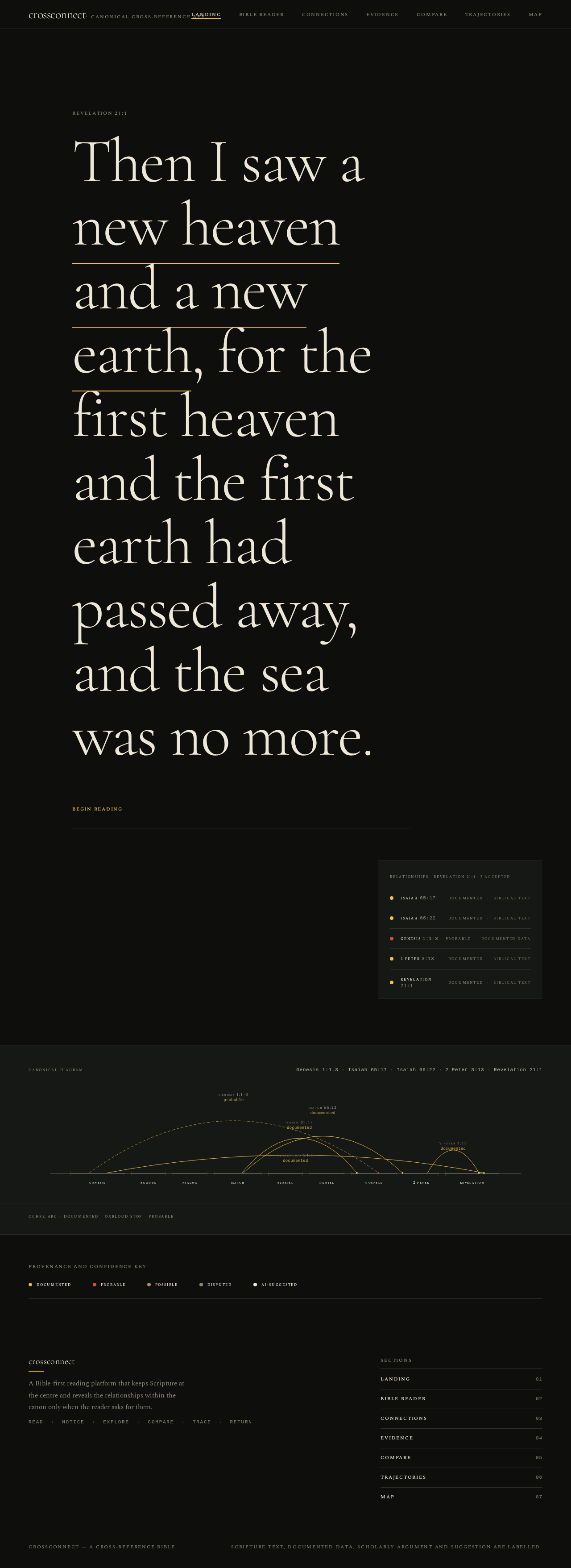
Then I saw a new heaven and a new earth, for the first heaven and the first earth had passed away, and the sea was no more.
Canonical diagram
Genesis 1:1–3 · Isaiah 65:17 · Isaiah 66:22 · 2 Peter 3:13 · Revelation 21:1
Provenance and confidence key
- DocumentedText or documented data attests the connection
- ProbableStrong evidence, not yet established as certain
- PossibleA plausible reading held at lower confidence
- DisputedScholarly argument remains visibly contested
- AI-suggestedMachine-proposed, awaiting review
No comments yet. Be the first!