crossconnect
 Joshua Khristi
I’m building **the ultimate cross-reference Bible**: a Bible-first platform that lets people read Scripture naturally while revealing the vast web of relationships that exists within the biblical canon. The goal is not simply to create another Bible app with a larger collection of cross-references. It is to build a **living map of Scripture**—a system where every passage can be understood not only in isolation, but within the conversations, patterns, images, words, people, events, promises, and theological trajectories that run throughout the Bible. A reader should be able to open any passage and simply **read**. The Bible remains the centre of the experience. But whenever they notice something interesting, they can click a word, phrase, verse, person, place, event, image, or theme and begin exploring what lies behind it and where it leads. A phrase in Revelation might open connections to Isaiah, Ezekiel, Daniel, Psalms, Genesis, Exodus, or the Gospels. A word might reveal its Hebrew or Greek lemma and show how its meaning develops across Scripture. A person might open a genealogical and narrative trail. A place might reveal its geographic and biblical significance. An event might connect earlier occurrences with later reinterpretations. A prophecy might be traced from promise, through expectation and development, to its later use or claimed fulfilment. A recurring image—temple, mountain, garden, river, lamb, throne, wilderness, light, darkness, bride, city—could be followed through the entire canon. The platform should distinguish between **what the biblical text actually says, what documented data connects, what scholars argue, and what AI suggests**. AI should never quietly become the authority. Every connection should carry its relationship type, evidence, confidence, provenance, and review status. Strong documented relationships should be distinguishable from probable or possible relationships, and disputed interpretations should remain visibly disputed. The system should understand many different kinds of biblical relationships: direct quotations, Old Testament allusions, echoes, imagery, prophetic expectation, theological concepts, typology, narrative patterns, New Testament parallels, internal canonical connections, lexical relationships, people, places, events, genealogies, chronology, laws and rituals, literary structures, textual variants, manuscript relationships, and Septuagint connections. The deeper purpose is to make the **architecture of Scripture visible**. Instead of merely asking, “What does this verse mean?”, the reader can ask: **Where did this idea come from? What earlier passage is being echoed? How is this image developed? Where does this promise go? How does this word change or deepen across Scripture? What happens to this person, event, institution, or theme later? How does the New Testament reuse the Old Testament? What passages converge behind this one? What are scholars actually saying about this connection? And how does the whole biblical story develop toward its conclusion?** The experience should therefore move naturally: **READ → NOTICE → CLICK → EXPLORE → COMPARE → TRACE → MAP → RETURN TO READ** The reader can move from a single phrase to its source, from its source to related passages, from those passages to a larger canonical trajectory, and finally return to the Bible without losing their place. At its deepest level, this becomes a **graph of the Bible**: millions of possible relationships between passages, words, people, places, events, themes, literary structures, prophecies, and textual traditions—while still presenting Scripture as a readable book rather than turning it into a database. The platform should allow users to **trace biblical ideas forward and backward**. They could follow something like: **Eden → Tabernacle → Temple → Prophetic Temple → Christ → Church → New Jerusalem** or: **Creation → Israel → Davidic Kingdom → Prophets → Jesus → Church → New Creation** or: **Egypt → Passover → Exodus → Wilderness → Sinai → Land → New Exodus → Christ → Revelation** These are not merely lists of verses. They are **canonical trajectories** showing how biblical themes, images, promises, institutions, and narratives develop. The app should also provide comparison without disrupting reading: multiple translations side by side, synchronized passages, original-language information, lexical connections, textual variants, Septuagint relationships, and scholarly discussions where appropriate. The visual experience should feel less like an AI dashboard and more like a **beautiful scholarly Bible**: literary, elegant, contemplative, minimal, spacious, typographically excellent, and deeply focused on the text. The complexity should appear when the reader asks for it—not overwhelm them when they simply want to read. The ultimate ambition is that a reader could open **Revelation 21:1**, see “a new heaven and a new earth,” tap the phrase, and immediately begin exploring its relationship to Isaiah 65, Isaiah 66, Genesis 1–3, prophetic new-creation expectations, New Testament development, and the larger biblical trajectory—then compare translations, examine the evidence, trace the theme, see the relationship visually on a map, read scholarly perspectives, and return to Revelation 21 without ever leaving the Bible. In other words: **I’m building a Bible that can reveal its own interconnectedness.** Not merely a Bible with cross-references. **A navigable, evidence-based map of the entire biblical canon—where every passage can reveal what lies behind it, what develops from it, and how it participates in the larger story of Scripture.**

Comments (0)
Sign in to leave a comment
Architecture
No Services Diagrams Yet
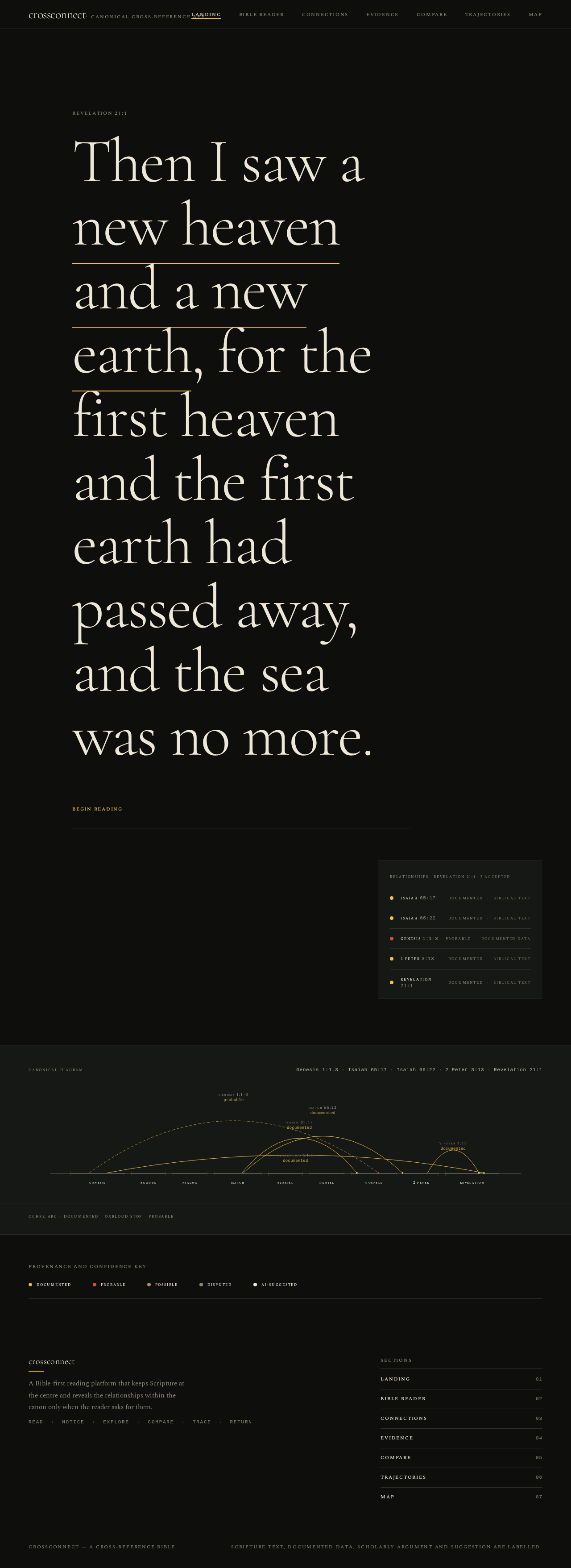
Then I saw a new heaven and a new earth, for the first heaven and the first earth had passed away, and the sea was no more.
Canonical diagram
Genesis 1:1–3 · Isaiah 65:17 · Isaiah 66:22 · 2 Peter 3:13 · Revelation 21:1
Provenance and confidence key
- DocumentedText or documented data attests the connection
- ProbableStrong evidence, not yet established as certain
- PossibleA plausible reading held at lower confidence
- DisputedScholarly argument remains visibly contested
- AI-suggestedMachine-proposed, awaiting review
No comments yet. Be the first!