brave-existing
 manikanta varma
Build my existing **CampusConnect** project into a polished, production-quality **SaaS platform for college events**. Do NOT treat it as a basic college CRUD project. It should look like a real startup product suitable for recruiters, colleges, and users. ### STACK Frontend: React 18, TypeScript, Vite, Tailwind CSS, shadcn/ui, Lucide React, React Router, TanStack Query, React Hook Form, Zod, Recharts. Backend: Node.js, Express.js, TypeScript, REST APIs, JWT, Bcrypt.js, Zod. Database: PostgreSQL with Supabase. Deployment: Vercel frontend, Render backend, Supabase database. First inspect the existing codebase and reuse working functionality. Do not unnecessarily rewrite existing features. ### PRODUCT CampusConnect connects students with college events and gives clubs/organizers tools to create, manage, and analyze events. Tagline: **Connecting Students Beyond Classrooms. Every Event. Every Student. One Platform.** Make the UI modern, minimal, premium, responsive, and SaaS-like. Take general inspiration from products such as Linear, Vercel, Notion, and Stripe without copying them. ### ROLES Student: * Discover/search/filter events * View event details * Register/cancel registration * Bookmark events * View upcoming and attended events * View tickets and certificates * Receive notifications * Manage profile Organizer: * Create/edit/publish events * Manage registrations * Generate and scan QR attendance * View analytics * Export participants * Issue certificates * Send announcements College Admin: * Manage users, clubs, organizers and events * Moderate events * View analytics and reports Super Admin: * Manage colleges/organizations * Manage plans * View platform analytics Implement proper backend RBAC. ### SAAS ARCHITECTURE Make the system multi-tenant. Organization → Users → Clubs → Events → Registrations → Attendance → Analytics. Users must never access another organization's private data. Prepare architecture for: Free / Pro / Enterprise Do not create fake payment functionality. ### AUTH Implement: * Registration * Login/logout * Forgot/reset password * Email/OTP verification * JWT authentication * Protected routes * Role-based authorization Use Bcrypt.js. Never expose secrets, passwords, tokens, database errors, or stack traces. ### UI/UX Create a consistent design system. Use: * Excellent typography * Generous whitespace * Rounded cards * Subtle borders * Soft shadows * Clean icons * Strong visual hierarchy * Subtle animations * Responsive layouts Support Light / Dark / System themes. Create reusable components for buttons, inputs, cards, dialogs, tables, badges, forms, modals, toasts, skeletons and empty states. Every page must look like part of the same product. ### LANDING PAGE Create: Navbar: CampusConnect, Features, Events, Students, Organizers, Pricing, About, Login, Get Started. Hero: **Connect. Participate. Grow.** Explain the product clearly. Buttons: Explore Events Create an Event Add: * Product/dashboard preview * Features * How it works * Student benefits * Organizer benefits * Analytics preview * Final CTA * Footer Do not invent fake customers or company logos. ### DASHBOARD Create a SaaS dashboard with responsive sidebar, top navigation, search, notifications and profile menu. Student: Dashboard, Discover Events, My Events, Bookmarks, Certificates, Notifications, Profile. Organizer: Dashboard, Events, Create Event, Registrations, Attendance, Analytics, Notifications, Settings. Admin: Overview, Users, Organizations, Clubs, Events, Analytics, Reports, Settings. ### STUDENT EXPERIENCE Dashboard should show: * Registered events * Upcoming events * Events attended * Certificates * Recommended events * Recent activity * Calendar Event cards should include image, category, title, date, time, location, organizer, seats, bookmark and registration status. ### EVENTS Create event discovery with: Search Category filter Date filter Location filter Event type Availability Sort by: Recommended Upcoming Popular Recently added Event details should include banner, title, organizer, date/time, location, description, schedule, requirements, FAQs and registration card. After registration show: **You're registered ✓** Actions: View Ticket Add to Calendar Cancel Registration ### EVENT CREATION Use a multi-step wizard: 1. Basic information 2. Schedule 3. Location 4. Registration settings 5. Review/publish Support: Save Draft Publish Event ### ORGANIZER Create analytics dashboard with: Total Events Registrations Attendance Rate Engagement Charts: Registrations over time Attendance Popular events Events by category Add participant table and CSV export. ### QR ATTENDANCE Generate a unique QR code for every registration. Student ticket contains: Name, event, registration ID, QR code. Organizer scans QR using camera. Validate: * Registration exists * Correct event * Correct organization * No duplicate attendance Then mark attendance. ### TICKETS & CERTIFICATES Create professional digital event tickets containing event/student details and QR code. Allow organizers to issue certificates after completed events. Certificate should contain: Student name, event, organizer, date, certificate ID. Create: `/verify/certificate/:id` for public verification. ### NOTIFICATIONS Support: Registration confirmation Event reminder Event update Event cancellation Attendance confirmation Certificate issued Organizer announcement Include unread count, mark read and mark all read. ### CLUBS Create club profiles with: Logo Name Description Category Social links Members Events Students can follow clubs. ### ADMIN Admin dashboard should include: Students Organizers Events Registrations Attendance Organizations Add charts for user growth, event growth, registrations and engagement. Admin can manage users, organizations, clubs, categories and events. ### DATABASE Use PostgreSQL tables such as: organizations users clubs club_members events event_categories event_registrations event_attendance event_bookmarks notifications certificates plans subscriptions audit_logs Use UUIDs, foreign keys, indexes, constraints, timestamps and organization-level relationships. ### API Create clean REST APIs for: Auth Users Organizations Events Registrations Attendance Certificates Notifications Clubs Analytics Admin Use consistent responses: { success: true, data: {}, message: "..." } Use centralized error handling. ### SECURITY Implement: JWT RBAC Tenant isolation Bcrypt Zod validation Rate limiting CORS Helmet Secure headers Input validation File validation Backend must enforce permissions. ### QUALITY The application must be: * Fully responsive * Accessible * Fast * Type-safe * Modular * Maintainable Every feature needs loading, empty, error and success states. Use pagination, caching, lazy loading and database indexes where appropriate. Create `.env.example` and never commit real secrets. ### DEVELOPMENT PHASES Build incrementally: 1. Inspect existing project + architecture + design system + database + authentication 2. Landing page + event discovery 3. Student dashboard + registration + bookmarks + tickets 4. Organizer dashboard + event management 5. QR attendance + analytics + certificates 6. Notifications + clubs + admin 7. Multi-tenant SaaS + subscription-ready architecture 8. Security + responsive polish + accessibility + performance + testing Do not implement everything at once. Before every phase, inspect the current code and reuse existing functionality. ### FINAL GOAL CampusConnect should feel like a **real SaaS startup product**, not a college project. Prioritize: **Functionality → Security → Architecture → UX → Visual quality → Performance**

Comments (0)
Sign in to leave a comment
System Requirements
System Requirements Document for brave-existing
1. Introduction
CampusConnect is a SaaS platform designed to connect students with college events and provide clubs and organizers with tools to create, manage, and analyze events. The platform aims to offer a polished, production-quality experience suitable for recruiters, colleges, and users, with a modern, minimal, and premium UI inspired by products like Linear, Vercel, Notion, and Stripe.
2. System Overview
CampusConnect is a multi-tenant SaaS platform that facilitates event management and participation for students, organizers, and college administrators. The system is designed to ensure tenant isolation, robust security, and a scalable architecture. It supports various user roles, including Students, Organizers, College Admins, and Super Admins, each with distinct functionalities. The platform is built using a modern tech stack and aims to deliver a seamless user experience with a consistent design system.
2a. Product Interpretation and Delivery Boundary
CampusConnect will be delivered as a SaaS platform with a multi-tenant architecture, ensuring that users from different organizations cannot access each other's private data. The platform will support Free, Pro, and Enterprise plans, although payment functionality is not included. The system will be deployed with Vercel for the frontend, Render for the backend, and Supabase for the database. The platform will adhere to strict security protocols, including JWT authentication, RBAC, and tenant isolation.
2b. Source Content Inventory
Not applicable as no explicit content_source directive is provided.
2c. Page Content and Component Coverage
Landing Page
- Navbar: Links to CampusConnect, Features, Events, Students, Organizers, Pricing, About, Login, Get Started.
- Hero Section: Oversized headline "Connect. Participate. Grow." with buttons for "Explore Events" and "Create an Event."
- Product/Dashboard Preview: Visual overview of the platform's capabilities.
- Features Section: Highlights key features and benefits for students and organizers.
- How It Works: Step-by-step explanation of the platform's functionality.
- Analytics Preview: Overview of analytics capabilities.
- Final CTA: Encouragement to join or explore the platform.
- Footer: Shared component across all pages.
Student Dashboard
- Overview: Registered events, upcoming events, attended events, certificates, recommended events, recent activity, calendar.
- Event Cards: Image, category, title, date, time, location, organizer, seats, bookmark, registration status.
- Notifications: Registration confirmation, event reminders, updates, cancellations, attendance confirmation, certificate issued, organizer announcements.
Organizer Dashboard
- Event Management: Create, edit, publish events using a multi-step wizard.
- Analytics: Total events, registrations, attendance rate, engagement, with charts for registrations over time, attendance, popular events, events by category.
- QR Attendance: Generate and scan QR codes for attendance validation.
- Certificates: Issue certificates post-event, with public verification endpoint.
Admin Dashboard
- User Management: Manage students, organizers, clubs, categories, and events.
- Analytics and Reports: User growth, event growth, registrations, engagement.
- Settings: Platform-wide configurations and management.
3. Functional Requirements
- As a Student, I should be able to discover, search, and filter events to find those that interest me. (explicit)
- As a Student, I should be able to view event details to understand what the event entails. (explicit)
- As a Student, I should be able to register for or cancel registration for events to manage my participation. (explicit)
- As a Student, I should be able to bookmark events for easy access later. (explicit)
- As a Student, I should be able to view my upcoming and attended events to keep track of my engagements. (explicit)
- As a Student, I should be able to view my tickets and certificates for events I have registered for or attended. (explicit)
- As a Student, I should receive notifications about event updates and confirmations. (explicit)
- As an Organizer, I should be able to create, edit, and publish events using a multi-step wizard. (explicit)
- As an Organizer, I should be able to manage registrations and generate QR codes for attendance to streamline event management. (explicit)
- As an Organizer, I should be able to view analytics and export participant data to analyze event performance. (explicit)
- As an Organizer, I should be able to issue certificates to participants after events. (explicit)
- As a College Admin, I should be able to manage users, clubs, organizers, and events to ensure smooth operations. (explicit)
- As a Super Admin, I should be able to manage colleges and organizations to maintain platform integrity. (explicit)
- As a Super Admin, I should be able to manage plans and view platform analytics to oversee the platform's performance. (explicit)
4. User Personas
- Student: Engages with events by discovering, registering, and managing participation. Receives notifications and manages their profile.
- Organizer: Manages event creation, registration, attendance, and analytics. Issues certificates and sends announcements.
- College Admin: Oversees user, club, organizer, and event management. Moderates events and views analytics.
- Super Admin: Manages organizations, plans, and platform-wide analytics.
5. Core User Flows
Student Flow
- Discover Events: Access the event discovery page, apply filters, and search for events.
- View Event Details: Select an event to view detailed information.
- Register for Event: Click "Register" to sign up for an event, receive confirmation notification.
- Manage Bookmarks: Bookmark events for future reference.
- View Dashboard: Access the dashboard to see registered, upcoming, and attended events.
- Receive Notifications: Get notified about event updates and confirmations.
Organizer Flow
- Create Event: Use the multi-step wizard to create and publish an event.
- Manage Registrations: View and manage participant registrations.
- Generate QR Codes: Create QR codes for event attendance.
- View Analytics: Access analytics dashboard to view event performance.
- Issue Certificates: Generate and distribute certificates post-event.
Admin Flow
- Manage Users and Events: Access the admin dashboard to manage users, clubs, organizers, and events.
- View Reports: Analyze user growth, event growth, and engagement through reports.
6. Visuals Colors and Theme
- Muse: Tobias van Schneider
- Palette:
- Light Mode: Background #FFFFFF, Surface #F9FAFB, Text #333333, Primary #E63946, Accent #F4A261, Muted #E5E5E5
- Typography:
- Headings: Playfair Display — Oversized, tight leading, uppercase for key headings
- Body: Söhne; Scale 1.5 modular, 64/48/32/24/18
- Shape Language: Sharp corners, asymmetric editorial grids, full-bleed imagery
- Layout: Sparse UI chrome with large margins, full-bleed hero sections, asymmetric grids
- Imagery: Large-scale editorial photography, monochrome treatments, generous cropping
7. Signature Design Concept
The landing page will feature an oversized headline in Playfair Display that spans the viewport over a white ground, with a full-bleed image and a bold primary button. This design will emphasize the platform's modern and premium aesthetic, aligning with the editorial minimalism inspired by Tobias van Schneider.
8. Interaction Model & Motion Direction
- Interaction Model: Static
- Motion Tempo: Restrained
- Hero Dimensionality: Flat
- Landing Hero Motion Brief: The hero section will feature an oversized headline with slow type reveals and crossfades, creating an editorial feel. Hover effects will swap between monochrome and full-color images.
9. Non-Functional Requirements
- Security: Implement JWT, RBAC, tenant isolation, Bcrypt, Zod validation, rate limiting, CORS, Helmet, secure headers, input validation, and file validation. (explicit)
- Performance: Ensure the application is fast, responsive, and accessible. Use pagination, caching, lazy loading, and database indexes where appropriate. (explicit)
- Maintainability: The application must be modular and type-safe. (explicit)
10. Tech Stack
- Frontend: React 18, TypeScript, Vite, Tailwind CSS, shadcn/ui, Lucide React, React Router, TanStack Query, React Hook Form, Zod, Recharts.
- Backend: Node.js, Express.js, TypeScript, REST APIs, JWT, Bcrypt.js, Zod.
- Database: PostgreSQL with Supabase.
- Deployment: Vercel for frontend, Render for backend, Supabase for database.
11. Assumptions and Constraints
- The existing codebase will be reused where possible to avoid unnecessary rewrites.
- The platform will not include payment functionality at this stage.
- The design system will be consistent across all pages to ensure a cohesive user experience.
12. Glossary
- SaaS: Software as a Service
- RBAC: Role-Based Access Control
- JWT: JSON Web Token
- CRUD: Create, Read, Update, Delete
- UI/UX: User Interface/User Experience
- API: Application Programming Interface
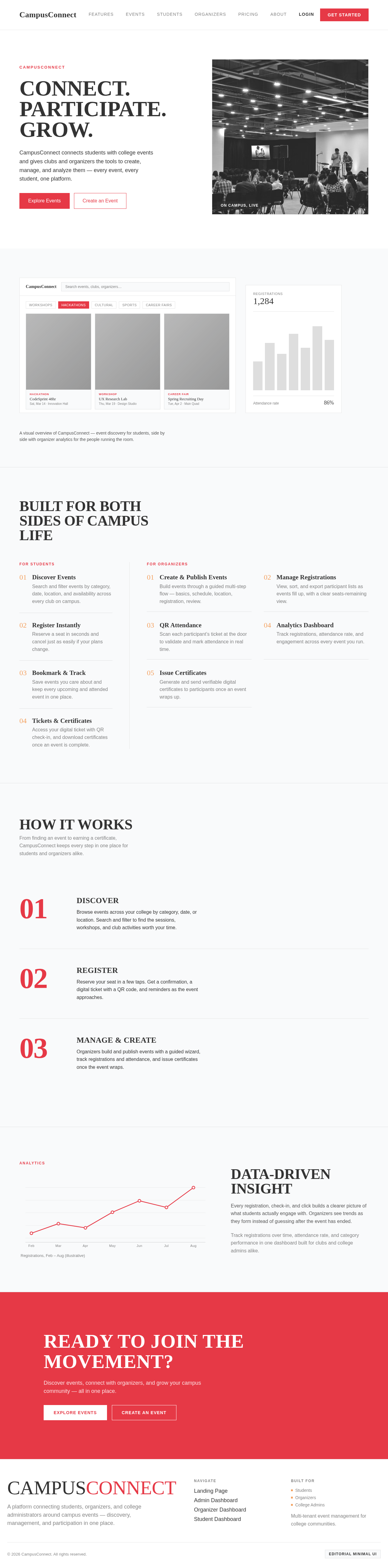
CampusConnect
CONNECT.PARTICIPATE.GROW.
CampusConnect connects students with college events and gives clubs and organizers the tools to create, manage, and analyze them — every event, every student, one platform.
 On Campus, Live
A visual overview of CampusConnect — event discovery for students, side by side with organizer analytics for the people running the room.
Built for both sides of campus life
For Students
Discover Events
Search and filter events by category, date, location, and availability across every club on campus.
Register Instantly
Reserve a seat in seconds and cancel just as easily if your plans change.
Bookmark & Track
Save events you care about and keep every upcoming and attended event in one place.
Tickets & Certificates
Access your digital ticket with QR check-in, and download certificates once an event is complete.
For Organizers
Create & Publish Events
Build events through a guided multi-step flow — basics, schedule, location, registration, review.
Manage Registrations
View, sort, and export participant lists as events fill up, with a clear seats-remaining view.
QR Attendance
Scan each participant’s ticket at the door to validate and mark attendance in real time.
Analytics Dashboard
Track registrations, attendance rate, and engagement across every event you run.
Issue Certificates
Generate and send verifiable digital certificates to participants once an event wraps up.
How It Works
From finding an event to earning a certificate, CampusConnect keeps every step in one place for students and organizers alike.
Discover
Browse events across your college by category, date, or location. Search and filter to find the sessions, workshops, and club activities worth your time.
Register
Reserve your seat in a few taps. Get a confirmation, a digital ticket with a QR code, and reminders as the event approaches.
Manage & Create
Organizers build and publish events with a guided wizard, track registrations and attendance, and issue certificates once the event wraps.
Analytics
Registrations, Feb – Aug (illustrative)
Data‑Driven
Insight
Every registration, check-in, and click builds a clearer picture of what students actually engage with. Organizers see trends as they form instead of guessing after the event has ended.
Track registrations over time, attendance rate, and category performance in one dashboard built for clubs and college admins alike.
Ready to join the movement?
Discover events, connect with organizers, and grow your campus community — all in one place.
CampusConnect
CONNECT.PARTICIPATE.GROW.
CampusConnect connects students with college events and gives clubs and organizers the tools to create, manage, and analyze them — every event, every student, one platform.
On Campus, LiveA visual overview of CampusConnect — event discovery for students, side by side with organizer analytics for the people running the room.
Built for both sides of campus life
For Students
Discover Events
Search and filter events by category, date, location, and availability across every club on campus.
Register Instantly
Reserve a seat in seconds and cancel just as easily if your plans change.
Bookmark & Track
Save events you care about and keep every upcoming and attended event in one place.
Tickets & Certificates
Access your digital ticket with QR check-in, and download certificates once an event is complete.
For Organizers
Create & Publish Events
Build events through a guided multi-step flow — basics, schedule, location, registration, review.
Manage Registrations
View, sort, and export participant lists as events fill up, with a clear seats-remaining view.
QR Attendance
Scan each participant’s ticket at the door to validate and mark attendance in real time.
Analytics Dashboard
Track registrations, attendance rate, and engagement across every event you run.
Issue Certificates
Generate and send verifiable digital certificates to participants once an event wraps up.
How It Works
From finding an event to earning a certificate, CampusConnect keeps every step in one place for students and organizers alike.
Discover
Browse events across your college by category, date, or location. Search and filter to find the sessions, workshops, and club activities worth your time.
Register
Reserve your seat in a few taps. Get a confirmation, a digital ticket with a QR code, and reminders as the event approaches.
Manage & Create
Organizers build and publish events with a guided wizard, track registrations and attendance, and issue certificates once the event wraps.
Analytics
Registrations, Feb – Aug (illustrative)
Data‑Driven
Insight
Every registration, check-in, and click builds a clearer picture of what students actually engage with. Organizers see trends as they form instead of guessing after the event has ended.
Track registrations over time, attendance rate, and category performance in one dashboard built for clubs and college admins alike.
Ready to join the movement?
Discover events, connect with organizers, and grow your campus community — all in one place.
No comments yet. Be the first!