azure-workspace
 Orion Photo
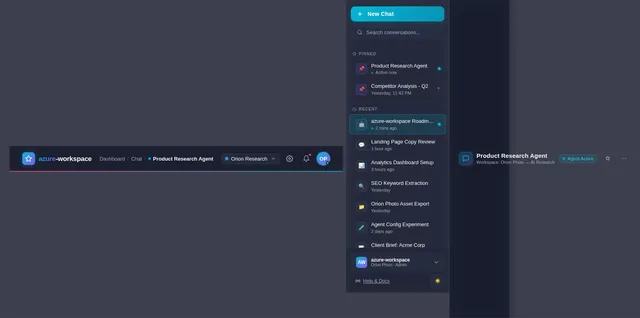
## THE THESIS Every app exists because humans can't do something fast enough. - Email exists because you can't deliver messages by hand - Excel exists because you can't calculate 10,000 rows in your head - Jira exists because you can't remember 500 tasks across 20 people - Chrome exists because you can't visit 100 websites simultaneously - CRM exists because you can't remember 10,000 customer interactions **What if ONE AI could do ALL of it — and remember everything, learn from everything, and get better every time?** Not by integrating with apps. Not by being a chatbot that answers questions. Not by being a task runner that disappears after completion. By being the PLACE where all your work happens. The AI does the work. The workspace ORGANIZES the work. The knowledge ACCUMULATES. The system LEARNS. You DIRECT and REVIEW. **We're building IntelliFish — an open-source AI agent where:** - You type what you need in natural language - AI agents execute it (browser automation, desktop control, data extraction, form filling, research) - Results are AUTOMATICALLY organized into a living workspace - Knowledge compounds — run 100 is smarter than run 1 - Everything is searchable, shareable, exportable, schedulable - The AI remembers your preferences, your projects, your entities, your patterns - Zero vendor lock-in — self-hosted, open source, your data stays yours **The workspace IS the product. Not the chat. Not the agents. The WORKSPACE.** --- ## WHAT WE'VE ALREADY BUILT (real, working code — 30K+ lines) ### Agent Engine (working, tested) - 10 parallel browser agents with live CDP video streaming - DuckDuckGo self-healing when pages block the agent - BrightData residential proxy on every agent - Stealth fingerprinting (UA rotation, WebGL spoof, timezone match) - Smart Loop V2: lightweight navigation (512 tokens) + full-power extraction (4096 tokens) - Progressive extraction — data saved at EVERY step, crash-resilient - 5-dimension quality scoring on every agent output (goal adherence, completeness, freshness, depth, content quality) - Cross-agent intelligence bus — parallel agents share discoveries in real-time - Site memory — agents learn per-site cookie selectors, data locations, navigation patterns - UNIVERSAL_EXTRACTION_MANDATE — structured V11 intelligence schema - SearXNG dynamic source discovery — 20+ sources per query in real-time ### Frontend (91 components, 87 pages built) - AG-UI chat interface with GenUI cards (approval, progress, results, error) - Live multi-screen browser streaming (watch all agents work simultaneously) - Intelligence report page with findings, entities, traceability, export - Workspace page with artifacts, entities, entity graph, canvas, timeline, search - Full sidebar navigation (Chat, Templates, Jobs, History, Settings, Help) ### Database - PostgreSQL with workspace tables: artifacts, entities, relationships, facts, canvas_items - Intelligence runs table with full audit trail - Workspace builder that auto-populates after every agent run ### Export - ZIP package: PDF + Excel + PPTX + JSON + per-agent source reports + SHA-256 manifest + audit trail --- ## THE QUESTION I NEED ANSWERED **How do I design a workspace that makes every other app unnecessary?** Not a dashboard. Not a project management tool. Not a knowledge base. Not a CRM. Not a task tracker. ALL OF THEM. In ONE place. Powered by AI agents that do the work automatically. --- ## WHAT I NEED PERPLEXITY TO RESEARCH (go DEEP, latest April 2026) ### 1. THE WORKSPACE AS OPERATING SYSTEM How would you design a workspace that functions as a personal operating system for all knowledge work? Not a file system. Not a database. A LIVING SYSTEM where: - AI agents are first-class citizens alongside humans - Every piece of information is connected to every other piece - Knowledge grows automatically from agent work - The system LEARNS what you care about and surfaces it - Tasks generate themselves from findings - Alerts trigger themselves from changes - Reports compile themselves from accumulated data What does this look like? What patterns exist? What's been tried? What failed? What would WORK? Investigate: - Notion's "connected workspace" concept — what makes it sticky? What's missing for AI agents? - ClickUp's "everything app" approach — what works? What's bloated? - Obsidian's "second brain" with bidirectional linking — why do developers love it? - Linear's opinionated design — why is it 10x better than Jira despite having fewer features? - Superhuman's speed — what makes a workspace feel FAST? - Arc browser's "spaces" — how does spatial organization help? - Figma's multiplayer — what makes real-time collaboration work? - Apple's ecosystem integration — what makes everything "just work" together?

Comments (0)
Sign in to leave a comment
No comments yet. Be the first!