azure-wordpress
 Chirag Panchal
this is mine current website in wordpress, I would like to create in reactjs now with custom code.

Comments (0)
Sign in to leave a comment
System Requirements
azure-wordpress System Requirements Document
Introduction
This document outlines the system requirements for the "azure-wordpress" project, which involves transitioning an existing WordPress-based static website to a ReactJS-based custom build. The project aims to maintain the current structure and functionality while enhancing performance and flexibility.
System Overview
The "azure-wordpress" project is designed to leverage ReactJS for the front-end while continuing to use WordPress as the CMS for content management. This approach ensures that the website remains static, with data being fetched from the WordPress CMS. The primary goal is to maintain the existing internal linking structure, with specific attention to the "legacy" section and its dedicated page.
Functional Requirements
- As a User, I should be able to navigate to different sections of the main page using internal anchor links.
- As a User, I should be able to scroll to the "legacy" section on the main page by clicking the "legacy" button.
- As a User, I should be able to access a dedicated "legacy" page at the
/legacy/path by clicking the "View All" button in the legacy section.
User Personas
- Admin: Responsible for managing content via the WordPress CMS.
- User: Visitors to the website who navigate through sections and access content.
Visuals Colors and Theme
- primary: #1A73E8 (Azure Blue)
- primary_light: #E8F0FE (Light Azure Blue)
- secondary: #FF6F61 (Coral)
- accent: #FFD700 (Gold)
- highlight: #FFA500 (Orange)
- bg: #FFFFFF (White)
- surface: rgba(240, 240, 240, 0.8)
- text: #333333 (Dark Gray)
- text_muted: #777777 (Muted Gray)
- border: rgba(200, 200, 200, 0.5)
Signature Design Concept
The homepage will feature an interactive "scrolling timeline" concept using gsap for smooth animations. As users scroll, sections will appear as part of a timeline that visually represents the site's history and content evolution. Each section will expand into view with dynamic animations, and users can click on timeline nodes to jump to specific sections. The "legacy" section will have a unique animation where it unfolds like a book, inviting users to explore further by clicking "View All" to access the dedicated legacy page.
Interaction Model & Motion Direction
The landing page will utilize a "parallax" interaction model, creating a layered depth effect as users scroll. Decorative elements will move at different speeds, enhancing the storytelling aspect. Internal pages, such as the dedicated legacy page, will adopt a "static" model to prioritize content readability and simplicity.
Non-Functional Requirements
- The website should load within 3 seconds on a standard broadband connection.
- It should be responsive and accessible on all major browsers and devices.
- The system should handle up to 10,000 concurrent users without performance degradation.
Tech Stack
- Frontend: ReactJS
- Backend: WordPress CMS
- Database: MySQL (via WordPress)
- Local Orchestration: Docker, docker-compose
Assumptions and Constraints
- The WordPress CMS will continue to be used for content management.
- The ReactJS front-end will be developed to ensure compatibility with existing WordPress data structures.
- The project will adhere to SEO best practices to maintain current search engine rankings.
Glossary
- CMS: Content Management System
- ReactJS: A JavaScript library for building user interfaces
- Parallax: A scrolling technique that creates an illusion of depth
- GSAP: GreenSock Animation Platform, a JavaScript library for animations
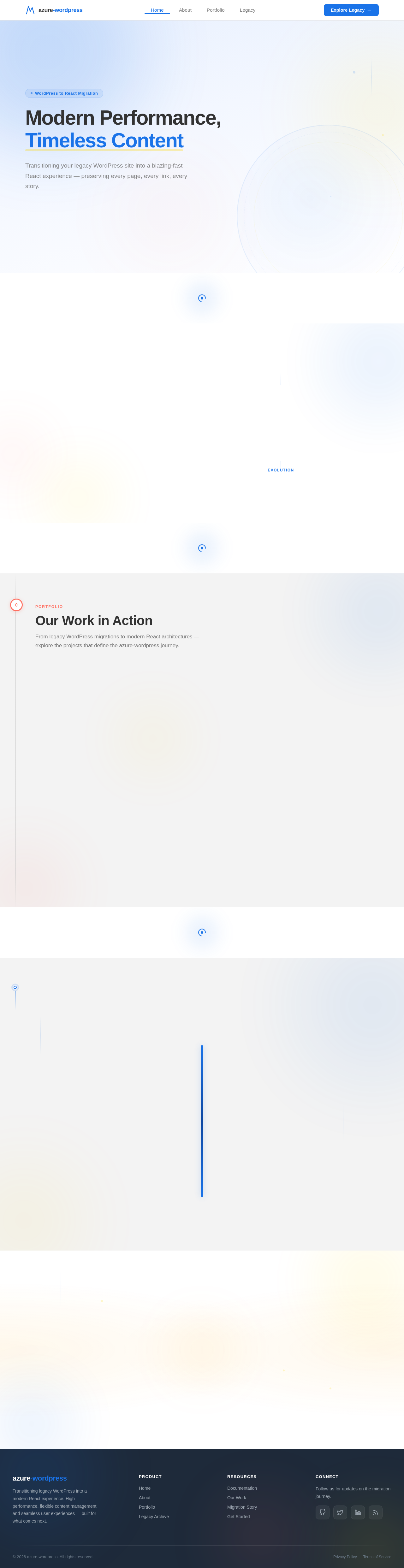
Modern Performance, Timeless Content
Transitioning your legacy WordPress site into a blazing-fast React experience — preserving every page, every link, every story.
Bridging WordPress Legacy with Modern React
The azure-wordpress project transforms a traditional WordPress site into a high-performance React application — preserving every piece of content while unlocking faster load times, richer interactions, and a developer experience built for the future.
WordPress continues to power the CMS backend, feeding structured content to a React frontend that renders at lightning speed. Internal linking, SEO integrity, and the legacy archive all carry forward seamlessly.
Our Work in Action
From legacy WordPress migrations to modern React architectures — explore the projects that define the azure-wordpress journey.
WordPress to React Migration
Seamless transition from legacy WordPress to a modern React front-end.
ArchitectureWordPress to React Migration
Complete architectural overhaul converting a monolithic WordPress theme into a component-driven React application. Maintained SEO rankings throughout the migration while achieving 3x faster page loads and improved Core Web Vitals scores.
Headless CMS Integration
WordPress as a headless CMS powering a decoupled React front-end.
IntegrationHeadless CMS Integration
Implemented a headless WordPress architecture using the REST API to serve content to a React client. Custom endpoints, optimized queries, and edge caching deliver sub-second content updates without sacrificing editorial workflows.
Performance Optimization
Achieving sub-3-second load times across all devices and browsers.
PerformancePerformance Optimization
Comprehensive performance audit and optimization pass including code splitting, lazy loading, image optimization with modern formats, and CDN configuration. Reduced initial bundle size by 68% and achieved consistent Lighthouse scores above 95.
Legacy Content Archive
Preserving years of content history in an accessible, searchable archive.
ContentLegacy Content Archive
Built a dedicated legacy archive page that preserves the full editorial history of the WordPress site. Features full-text search, category filtering, and a timeline view that lets users explore content chronologically with smooth GSAP-powered animations.
Responsive Design System
A unified design system ensuring consistency across every breakpoint.
DesignResponsive Design System
Developed a comprehensive design token system with CSS custom properties, responsive typography scales, and component variants that adapt fluidly from 320px mobile to 4K displays. Includes dark mode support and accessibility compliance.
Docker Orchestration
Containerized deployment pipeline for reliable, reproducible builds.
DevOpsDocker Orchestration
Configured a multi-container Docker Compose setup orchestrating WordPress, MySQL, and the React dev server. Includes hot-reload in development, staged builds for production, and automated health checks for zero-downtime deployments.
Preserving Our WordPress Heritage
A decade of content, carefully maintained and ready for the next chapter. Explore the archive that shaped our digital presence.
The Story So Far
From our first WordPress theme to a fully managed CMS powering hundreds of pages — each milestone brought us closer to the modern React experience you see today.
Ready to Transform Your WordPress Experience?
Migrate your legacy content into a blazing-fast React front-end — while keeping WordPress as your CMS. High performance, flexible content management, and seamless user experiences await.
No comments yet. Be the first!