Page 1 of 5
Pixl-ray System Requirements Document
1. Introduction
Pixl-ray is a SaaS platform designed to provide developers with a Screenshot/Preview API. This API allows users to input a URL and receive a screenshot, thumbnail, or Open Graph preview. The service is optimized for developers who need reliable and scalable screenshot infrastructure without the hassle of building and maintaining it themselves.
2. System Overview
Pixl-ray aims to offer a robust and efficient solution for generating screenshots of web pages. The service will utilize headless browsers to capture images and provide them through a simple API. The platform will support various use cases, including link previews, portfolio site screenshots, analytics dashboards, and SEO tools.
2a. Source Content Inventory
- API Endpoint:
GET https://api.yours.com/screenshot?url=https://example.com&width=1200&height=800
- Headless Browsers: Playwright, Puppeteer
- Caching: S3 + CDN (Cloudflare, AWS CloudFront)
- Infrastructure: Serverless (Cloudflare Workers, AWS Lambda) or container-based (Kubernetes, Fly.io, Render)
- Monetization Tiers:
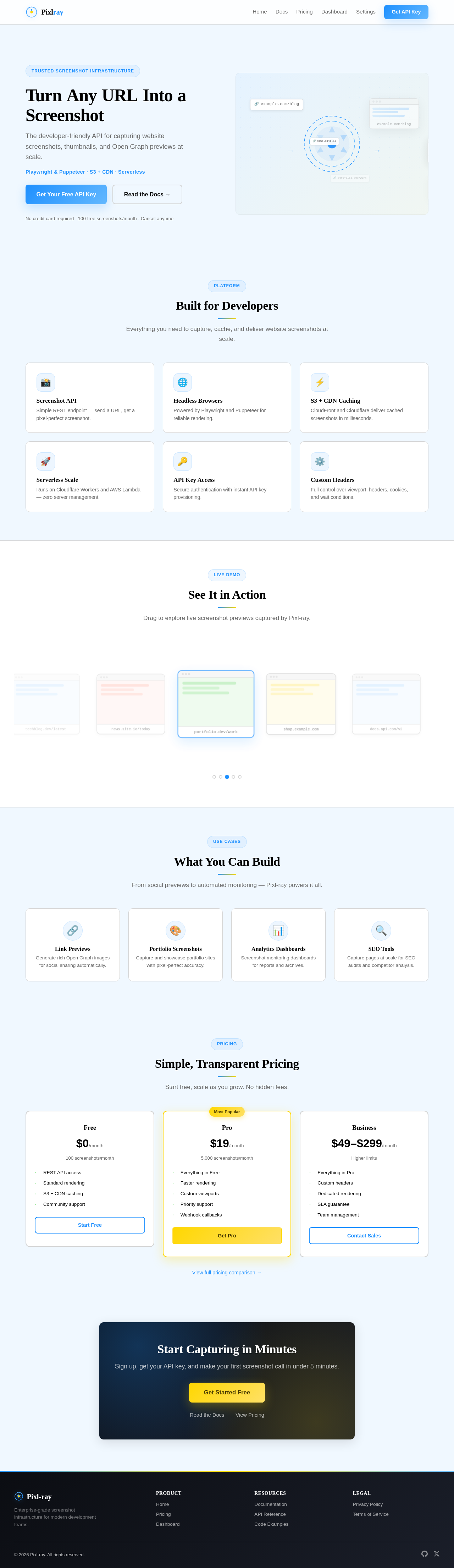
- Free: 100 screenshots/month
- $19/month: 5,000 screenshots
- $49–$299/month: higher limits, faster rendering, custom headers
Page 2 of 5
3. Functional Requirements as Story Points
- As a Developer, I should be able to sign up and receive an API key to access the screenshot service.
- As a Developer, I should be able to call the API to generate a screenshot by providing a URL and dimensions.
- As a Developer, I should be able to receive a URL or raw image of the screenshot taken.
- As a Developer, I should be able to use the screenshots for various applications such as link previews, portfolio sites, analytics dashboards, and SEO tools.
- As a Developer, I should be able to choose a subscription tier that fits my usage needs, from free to premium plans.
- As a Developer, I should be able to rely on the service's caching mechanism to improve performance and reduce latency.
4. User Personas
- Developer: The primary user of Pixl-ray, responsible for integrating the API into their applications and utilizing the screenshot capabilities for various purposes.
5. Core User Flows
- Developer signs up -> Receives API key -> Calls API with URL -> Service processes request -> Screenshot is generated and cached -> Developer receives image URL or raw image.
Page 3 of 5
6. Visuals Colors and Theme
- primary: #1E90FF (Dodger Blue)
- primary_light: #63B8FF (Light Dodger Blue)
- secondary: #FF6347 (Tomato)
- accent: #32CD32 (Lime Green)
- highlight: #FFD700 (Gold)
- bg: #F0F8FF (Alice Blue)
- surface: #FFFFFF (White)
- text: #000000 (Black)
- text_muted: #696969 (Dim Gray)
- border: #D3D3D3 (Light Gray)
7. Signature Design Concept
Interactive Screenshot Carousel
The homepage of Pixl-ray will feature an interactive carousel showcasing live previews of websites. Users can drag to rotate the carousel, click on a preview to expand it, and see the transformation from URL input to screenshot output. This dynamic feature will be built using motion/react for smooth animations and transitions. The carousel will be visually engaging, with each card flipping to reveal additional information about the screenshot process when hovered over.
Page 4 of 5
LANDING HERO MOTION BRIEF
The landing page will feature a continuous loop animation where URLs enter a central processing hub, transform into screenshots, and then display as polished previews. This animation will be created using motion/react, with layers representing URLs, processing, and final previews. The loop will last 10 seconds, showing the transformation clearly and engagingly. The animation will pause on hover, allowing users to interact with individual elements for more information.
8. Interaction Model & Motion Direction
- Intended Interaction Model: Animated
- The landing page will feature moderate scroll-triggered reveals and hover transitions, enhancing the user experience with polished animations.
- Each section will have a distinctive core mechanic, such as kinetic typography or scroll-linked reveals, to maintain user engagement.
9. Non-Functional Requirements
- The system must handle concurrent API requests efficiently.
- The service must ensure high availability and reliability.
- The API must provide secure access control through API key authentication.
- The platform must support scaling to accommodate increased demand.
Page 5 of 5
10. Tech Stack
- Frontend: React for Web
- Backend: Node.js + Express or FastAPI
- Headless Browsers: Puppeteer, Playwright
- Infrastructure: Serverless (Cloudflare Workers, AWS Lambda) or Kubernetes
- Caching: S3 + CDN (Cloudflare, AWS CloudFront)
11. Assumptions and Constraints
- The service will primarily target developers needing screenshot capabilities for web applications.
- The platform will operate in the PK timezone and support PK locale-specific defaults.
- Monetization will be based on a tiered subscription model.
12. Glossary
- API: Application Programming Interface
- CDN: Content Delivery Network
- SaaS: Software as a Service
- SEO: Search Engine Optimization
- URL: Uniform Resource Locator



No comments yet. Be the first!