Build a complete production-style PDF Chatbot using Python, Streamlit, LangChain, Google Gemini API, and FAISS. Requirements: Allow users to upload multiple PDF files. Extract text from PDFs. Split documents into chunks. Generate embeddings and store them in FAISS. Implement Retrieval-Augmented Generation (RAG). Use Gemini API to answer questions based only on the uploaded PDFs. Show source text chunks used for the answer. Create a clean and modern Streamlit UI. Include error handling and loading indicators. Generate a requirements.txt file. Generate a README.md with setup instructions. Organize the code into multiple files following best practices. Explain the project architecture.
Sign in to leave a comment

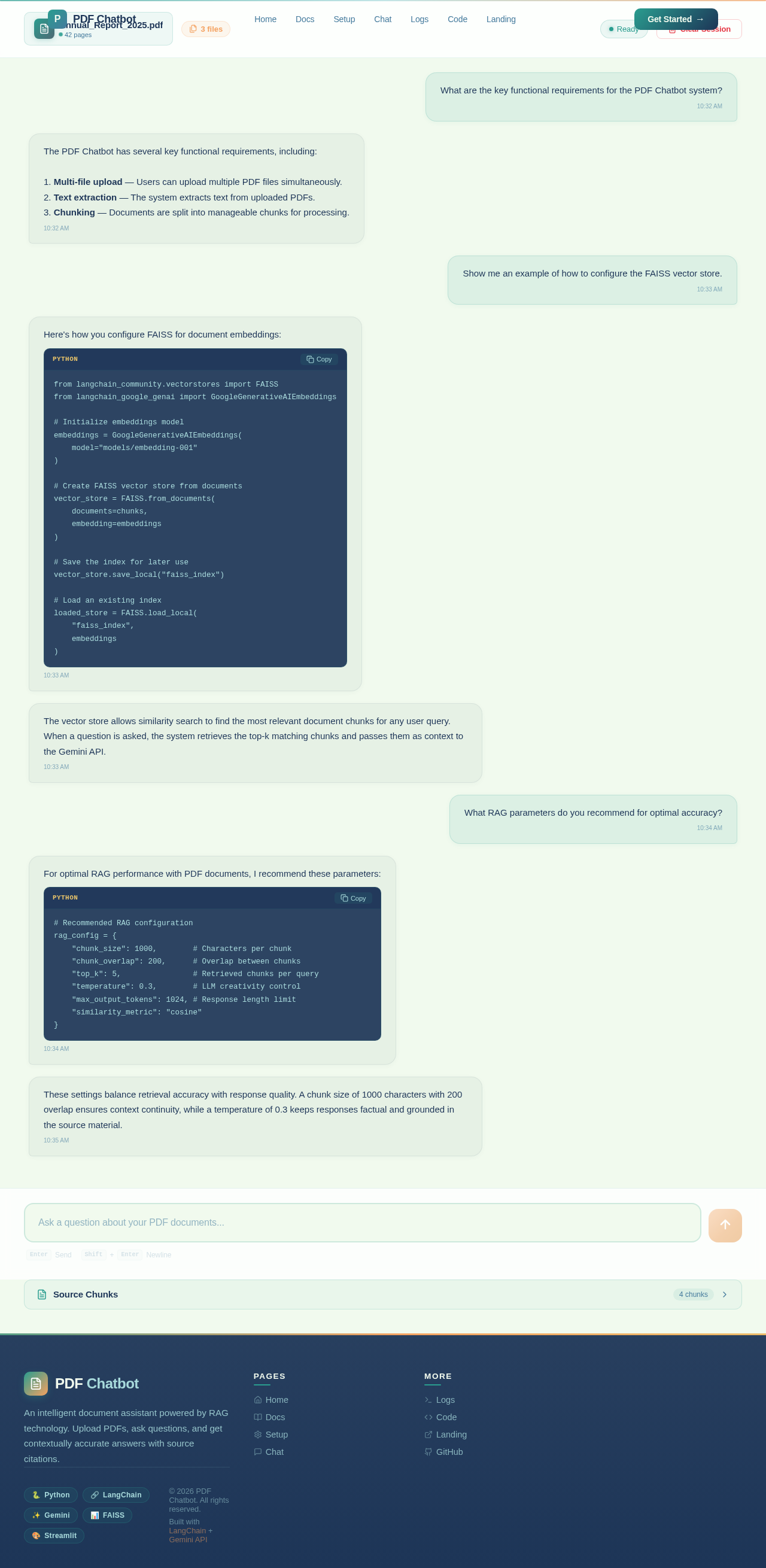
What are the key functional requirements for the PDF Chatbot system?
10:32 AMThe PDF Chatbot has several key functional requirements, including:
1. Multi-file upload — Users can upload multiple PDF files simultaneously.
2. Text extraction — The system extracts text from uploaded PDFs.
3. Chunking — Documents are split into manageable chunks for processing.
Show me an example of how to configure the FAISS vector store.
10:33 AMHere's how you configure FAISS for document embeddings:
from langchain_community.vectorstores import FAISS from langchain_google_genai import GoogleGenerativeAIEmbeddings # Initialize embeddings model embeddings = GoogleGenerativeAIEmbeddings( model="models/embedding-001" ) # Create FAISS vector store from documents vector_store = FAISS.from_documents( documents=chunks, embedding=embeddings ) # Save the index for later use vector_store.save_local("faiss_index") # Load an existing index loaded_store = FAISS.load_local( "faiss_index", embeddings )
The vector store allows similarity search to find the most relevant document chunks for any user query. When a question is asked, the system retrieves the top-k matching chunks and passes them as context to the Gemini API.
10:33 AMWhat RAG parameters do you recommend for optimal accuracy?
10:34 AMFor optimal RAG performance with PDF documents, I recommend these parameters:
# Recommended RAG configuration rag_config = { "chunk_size": 1000, # Characters per chunk "chunk_overlap": 200, # Overlap between chunks "top_k": 5, # Retrieved chunks per query "temperature": 0.3, # LLM creativity control "max_output_tokens": 1024, # Response length limit "similarity_metric": "cosine" }
These settings balance retrieval accuracy with response quality. A chunk size of 1000 characters with 200 overlap ensures context continuity, while a temperature of 0.3 keeps responses factual and grounded in the source material.
10:35 AM
No comments yet. Be the first!