Woodcraft
DYI
by Monish Raj
Monish RajI run a small DIY product business and I want to create a complete digital platform for my business. My business has a small product catalogue with a maximum of 6 products. The products are handmade/DIY products, and some products are essential/basic items while others are final/complete products. One example could be a miniature home or similar DIY creation. I want customers to discover my products, understand what each product is, explore the details, and purchase them directly from the website. Create the complete product experience for this business, including the customer-facing website and an admin dashboard for managing the business. CUSTOMER WEBSITE The website should allow customers to: - Discover the brand and understand what the business creates - Explore all available DIY products - View individual product details - Understand what is included in each product - See product images and different product information - Add products to cart - Add products to wishlist - Purchase products through checkout - Complete online payment - View their orders - Track delivery progress - View previous orders - Manage their profile The website should also include common brand/content pages such as: - About Us - How We Make / Our Process - Contact Us - Careers - Testimonials - A visual section showing the making/DIY process - Product highlights and brand story The overall experience should make the products feel special and handcrafted rather than like a generic ecommerce store. ADMIN DASHBOARD Create an admin dashboard where the business owner can manage: - Overview / business dashboard - Products - Product details and pricing - Inventory / stock - Orders - Order status and delivery progress - Customers - Wishlist/activity insights - Sales - Revenue - Best-selling products - Low-stock products - Basic business analytics The dashboard should be practical for a small business owner with only a few products. Avoid unnecessary enterprise-level complexity. IMPORTANT PRODUCT LOGIC The platform should understand that this is a small DIY business, not a large ecommerce marketplace. There are only a few products, so the experience should focus on storytelling, product discovery, craftsmanship, trust, and conversion rather than showing hundreds of products. Customers should be able to clearly understand: What is the product? What does it include? How is it made? Why is it special? How much does it cost? How long does delivery take? How can I buy it? Create a logical user journey from discovering the brand → exploring products → viewing product details → adding to wishlist/cart → checkout → payment → order tracking. For the admin journey, create a simple flow from dashboard → product/stock management → order management → sales insights. DESIGN DIRECTION The website should have a strong DIY / handmade / creative identity. Do NOT make it look like a typical ecommerce website with repetitive rectangular sections, generic cards, standard SaaS layouts, or a template-style section divider. The visual language should feel inspired by: - Handmade craft - DIY worktables - Paper, sketches and cut-outs - Craft materials - Miniature making - Workshop environments - Product assembly - Creative storytelling Use these ideas subtly in the UI rather than turning the website into an illustration-heavy children's website. The design should feel modern, premium, creative and commercially usable. Use interesting compositions, layered content, organic shapes, visual storytelling, editorial-style sections, product photography areas, subtle craft-inspired details and transitions between sections. The website should feel like a real creative DIY brand, not a generic ecommerce template. Keep the customer website visually expressive, while keeping the admin dashboard clean, practical and data-focused. Create a clear separation between: 1. Customer Website 2. Customer Account / Shopping Experience 3. Admin Dashboard Before generating the final screens, establish a logical product structure and user flow based on the requirements above.

Comments (0)
Sign in to leave a comment
System Requirements
Page 1 of 5
DYI System Requirements Document
1. Introduction
The DYI project aims to create a premium digital platform for a small DIY craft business. The focus is on delivering a visually compelling and artistically rich experience that highlights the handcrafted nature of the products. The platform will include both a customer-facing website and an admin dashboard, each tailored to the unique needs of the business and its clientele.
2. System Overview
The DYI platform will serve as a digital storefront and management tool for a small DIY craft business. It will enable customers to explore, understand, and purchase handmade products while providing the business owner with tools to manage inventory, orders, and customer interactions. The design will emphasize visual storytelling and creativity, ensuring that the platform feels both modern and artisanal.
Page 2 of 5
3. Functional Requirements as Story Points
- As a Customer, I should be able to discover the brand and understand what the business creates.
- As a Customer, I should be able to explore all available DIY products.
- As a Customer, I should be able to view individual product details and understand what is included in each product.
- As a Customer, I should be able to see product images and different product information.
- As a Customer, I should be able to add products to my cart.
- As a Customer, I should be able to add products to my wishlist.
- As a Customer, I should be able to purchase products through checkout.
- As a Customer, I should be able to complete online payment.
- As a Customer, I should be able to view my orders and track delivery progress.
- As a Customer, I should be able to view previous orders and manage my profile.
- As an Admin, I should be able to view an overview/business dashboard.
- As an Admin, I should be able to manage products, product details, and pricing.
- As an Admin, I should be able to manage inventory/stock.
- As an Admin, I should be able to manage orders, order status, and delivery progress.
- As an Admin, I should be able to manage customers and view wishlist/activity insights.
- As an Admin, I should be able to view sales, revenue, best-selling products, and low-stock products.
- As an Admin, I should be able to access basic business analytics.
4. User Personas
- Customer: Individuals interested in purchasing DIY craft products. They value creativity, storytelling, and the handcrafted nature of products.
- Admin: The business owner or manager responsible for overseeing product listings, inventory, orders, and customer interactions.
Page 3 of 5
5. Core User Flows
- Customer Flow: Discover brand → Explore products → View product details → Add to wishlist/cart → Checkout → Payment → Order tracking.
- Admin Flow: Access dashboard → Manage products/stock → Manage orders → View sales insights.
6. Visuals Colors and Theme
- primary: #8B4513 (Saddle Brown)
- primary_light: #D2B48C (Tan)
- secondary: #F5DEB3 (Wheat)
- accent: #CD853F (Peru)
- highlight: #FFD700 (Gold)
- bg: #FFF8DC (Cornsilk)
- surface: #FAEBD7 (Antique White)
- text: #2F4F4F (Dark Slate Gray)
- text_muted: #A9A9A9 (Dark Gray)
- border: #D3D3D3 (Light Gray)
7. Signature Design Concept
Interactive Craft Workshop
The homepage will feature an interactive craft workshop scene where users can explore different DIY projects. Each project will be represented by a miniature model that users can click to expand and view details. The models will be crafted from paper, wood, and other materials, reflecting the brand's handmade ethos. As users hover over each model, subtle animations will bring the scene to life, such as paper folding or wood carving.
Page 4 of 5
Landing Hero Motion Brief
The landing hero will depict a transformation of raw materials into a finished DIY product. Users will see paper, wood, and other materials gather around a central workspace. Through a series of animations, these materials will transform into a completed product, showcasing the craftsmanship involved. The animation will loop every 10 seconds, with interactive elements allowing users to pause or explore specific stages of the process.
8. Interaction Model & Motion Direction
- Intended Interaction Model: Parallax
- Layered depth via scroll with decorative layers translating at different speeds.
- Real content stays in normal flow and scrolls naturally.
- Suitable for storytelling and visually rich first impressions.
9. Non-Functional Requirements
- The platform must be responsive and accessible across all devices.
- Ensure fast loading times and optimized performance.
- Maintain high security standards for customer data and transactions.
Page 5 of 5
10. Tech Stack
- Frontend: React for Web
- Backend: Python, FastAPI
- Database: MySQL or MariaDB, use alembic for migrations
- Local Orchestration: Docker, docker-compose
11. Assumptions and Constraints
- The platform will cater to a small product catalog with a maximum of 6 products.
- The design will prioritize storytelling and craftsmanship over traditional ecommerce layouts.
- The admin dashboard will be simplified to avoid unnecessary complexity.
12. Glossary
- DIY: Do It Yourself, referring to handmade or self-assembled products.
- Parallax: A design technique where background images move slower than foreground images, creating an illusion of depth.
- Wishlist: A feature allowing customers to save products for future consideration.
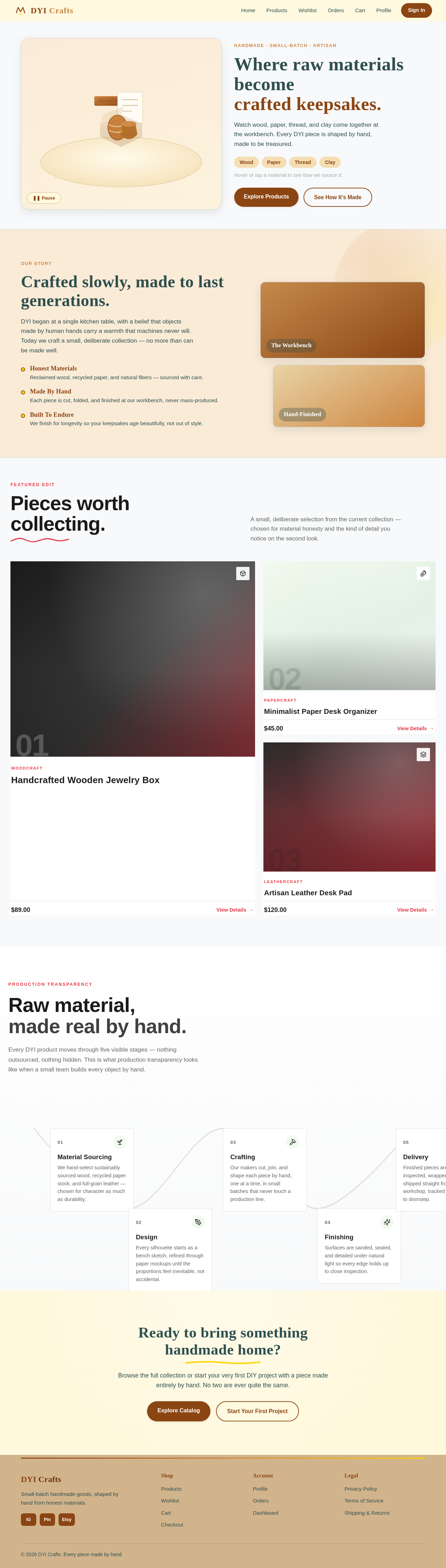
Handmade · Small-batch · ArtisanWhere raw materials become
Where raw materials become
crafted keepsakes.
Watch wood, paper, thread, and clay come together at the workbench. Every DYI piece is shaped by hand, made to be treasured.
Hover or tap a material to see how we source it.
Our Story
Crafted slowly, made to last generations.
DYI began at a single kitchen table, with a belief that objects made by human hands carry a warmth that machines never will. Today we craft a small, deliberate collection — no more than can be made well.
Honest Materials
Reclaimed wood, recycled paper, and natural fibers — sourced with care.
Made By Hand
Each piece is cut, folded, and finished at our workbench, never mass-produced.
Built To Endure
We finish for longevity so your keepsakes age beautifully, not out of style.
The Workbench
Hand-Finished
Featured EditPieces worth
Pieces worth
collecting.
A small, deliberate selection from the current collection — chosen for material honesty and the kind of detail you notice on the second look.
Papercraft
Minimalist Paper Desk Organizer
Leathercraft
Artisan Leather Desk Pad
Production TransparencyRaw material,
Raw material,
made real by hand.
Every DYI product moves through five visible stages — nothing outsourced, nothing hidden. This is what production transparency looks like when a small team builds every object by hand.
- 01
Material Sourcing
We hand-select sustainably sourced wood, recycled paper stock, and full-grain leather — chosen for character as much as durability.
- 02
Design
Every silhouette starts as a bench sketch, refined through paper mockups until the proportions feel inevitable, not accidental.
- 03
Crafting
Our makers cut, join, and shape each piece by hand, one at a time, in small batches that never touch a production line.
- 04
Finishing
Surfaces are sanded, sealed, and detailed under natural light so every edge holds up to close inspection.
- 05
Delivery
Finished pieces are inspected, wrapped, and shipped straight from our workshop, tracked from bench to doorstep.
Ready to bring something handmade home?
Browse the full collection or start your very first DIY project with a piece made entirely by hand. No two are ever quite the same.
Handmade · Small-batch · ArtisanWhere raw materials become
Where raw materials become
crafted keepsakes.
Watch wood, paper, thread, and clay come together at the workbench. Every DYI piece is shaped by hand, made to be treasured.
Hover or tap a material to see how we source it.
Our Story
Crafted slowly, made to last generations.
DYI began at a single kitchen table, with a belief that objects made by human hands carry a warmth that machines never will. Today we craft a small, deliberate collection — no more than can be made well.
Honest Materials
Reclaimed wood, recycled paper, and natural fibers — sourced with care.
Made By Hand
Each piece is cut, folded, and finished at our workbench, never mass-produced.
Built To Endure
We finish for longevity so your keepsakes age beautifully, not out of style.
The Workbench
Hand-Finished
Featured EditPieces worth
Pieces worth
collecting.
A small, deliberate selection from the current collection — chosen for material honesty and the kind of detail you notice on the second look.
Woodcraft
Handcrafted Wooden Jewelry Box
Papercraft
Minimalist Paper Desk Organizer
Leathercraft
Artisan Leather Desk Pad
Production TransparencyRaw material,
Raw material,
made real by hand.
Every DYI product moves through five visible stages — nothing outsourced, nothing hidden. This is what production transparency looks like when a small team builds every object by hand.
- 01
Material Sourcing
We hand-select sustainably sourced wood, recycled paper stock, and full-grain leather — chosen for character as much as durability.
- 02
Design
Every silhouette starts as a bench sketch, refined through paper mockups until the proportions feel inevitable, not accidental.
- 03
Crafting
Our makers cut, join, and shape each piece by hand, one at a time, in small batches that never touch a production line.
- 04
Finishing
Surfaces are sanded, sealed, and detailed under natural light so every edge holds up to close inspection.
- 05
Delivery
Finished pieces are inspected, wrapped, and shipped straight from our workshop, tracked from bench to doorstep.
Ready to bring something handmade home?
Browse the full collection or start your very first DIY project with a piece made entirely by hand. No two are ever quite the same.
No comments yet. Be the first!