Page 1 of 5
AI Learning Assistant
Introduction
The AI Learning Assistant is a modern, responsive web application designed to enhance the educational experience for students by providing personalized learning tools and resources. This document outlines the system requirements for the AI Learning Assistant, focusing on creating an intuitive and engaging platform for students in India.
System Overview
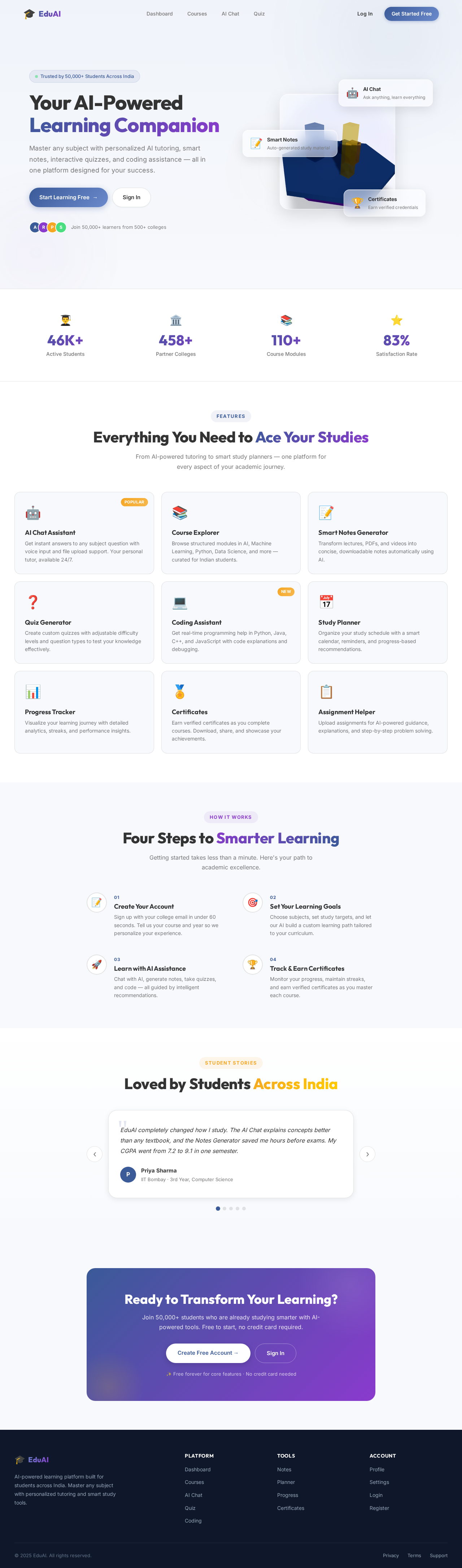
The AI Learning Assistant aims to provide a comprehensive educational platform that leverages artificial intelligence to offer personalized learning experiences. The system will include features such as AI chat assistance, course modules, notes generation, quiz generation, coding assistance, and more. The platform will be accessible on mobile, tablet, and desktop devices, ensuring a seamless user experience across all platforms.
Page 2 of 5
Functional Requirements
- As a Student, I should be able to register with my full name, username, email, phone number, college, course, year of study, and password.
- As a Student, I should be able to log in using email and password or alternative methods like Google, GitHub, or Microsoft.
- As a Student, I should be able to access a personalized dashboard with AI chat assistance, courses, study planner, notes generator, quiz generator, coding assistant, assignment helper, progress tracker, and certificates.
- As a Student, I should be able to interact with an AI chat assistant for learning support, including voice input and file uploads.
- As a Student, I should be able to explore course modules in various categories such as AI, Machine Learning, Python, etc.
- As a Student, I should be able to generate notes from various formats and download them.
- As a Student, I should be able to generate quizzes with different difficulty levels and question types.
- As a Student, I should be able to use a coding assistant for programming support in multiple languages.
- As a Student, I should be able to plan my study schedule using a calendar with reminders and progress tracking.
- As a Student, I should be able to view, download, and share earned certificates.
- As a Student, I should be able to edit my profile information and manage settings like dark mode and language preferences.
- As an Admin, I should be able to manage users, courses, and content through an admin dashboard.
- As an Admin, I should be able to view statistics on user activity, AI usage, and quizzes.
User Personas
- Student: The primary user of the platform, seeking personalized learning tools and resources.
- Admin: Responsible for managing the platform's content, users, and overall functionality.
Core User Flows
- Student registers -> logs in -> accesses dashboard -> interacts with AI chat -> explores courses -> generates notes -> takes quizzes -> tracks progress -> earns certificates.
- Admin logs in -> manages users -> updates courses -> reviews usage statistics -> adjusts platform settings.
Page 3 of 5
Visuals Colors and Theme
- primary: #3A5A98 (deep blue)
- primary_light: #6A8ACD (light blue)
- secondary: #8A3ACD (purple)
- accent: #F5A623 (vibrant orange)
- highlight: #FFCC00 (gold)
- bg: #F7F9FC (light gray)
- surface: rgba(255, 255, 255, 0.8) (white)
- text: #333333 (dark gray)
- text_muted: #777777 (medium gray)
- border: rgba(200, 200, 200, 0.5) (light gray)
Signature Design Concept
The homepage will feature an interactive 3D floating island, where each section of the platform is represented as a building. Users can navigate between buildings by clicking and dragging, creating an immersive experience. The island will be rendered using @react-three/fiber and @react-three/drei, with smooth transitions and animations powered by framer-motion. The design will incorporate glassmorphism elements, providing a modern and sleek aesthetic.
Interaction Model & Motion Direction
The landing page will utilize a "parallax" interaction model, with layered depth effects achieved through scroll-triggered animations. Decorative elements will move at different speeds to create a sense of depth, while content remains in the normal flow. Internal pages will adopt a "static" model to prioritize readability and clarity.
Page 4 of 5
Non-Functional Requirements
- The application must be responsive and accessible on mobile, tablet, and desktop devices.
- The system should support high availability and scalability to accommodate a growing user base.
- The platform should ensure data security and privacy, adhering to relevant regulations.
Tech Stack
- Frontend: React, TypeScript, Tailwind CSS, Framer Motion, Lucide Icons
- Backend: Python, FastAPI
- Database: Cloud Firestore
- AI Models: OpenAI, Gemini
- Authentication: Firebase Authentication, Google Authentication
- Orchestration: Docker, Kubernetes
Assumptions and Constraints
- The platform will primarily target students in India, considering local educational needs and preferences.
- The application must integrate with existing AI APIs for chat assistance and content generation.
- The system should be designed to handle a large number of concurrent users without performance degradation.
Page 5 of 5
Glossary
- AI: Artificial Intelligence
- UI: User Interface
- API: Application Programming Interface
- SaaS: Software as a Service
- RDBMS: Relational Database Management System
- NoSQL: Non-relational Database
This document provides a comprehensive overview of the requirements for the AI Learning Assistant, ensuring a robust and user-friendly platform for students.



No comments yet. Be the first!