strong-project
 Hemen Ashodia
new project about realestate company portfolio website
Comments (0)
Sign in to leave a comment
System Requirements
System Requirements Document (SRD)
Project Name: strong-project Version: 1.1 Date: 2026-02-27 Status: Updated — Manual Design Override Initiated
1. Introduction
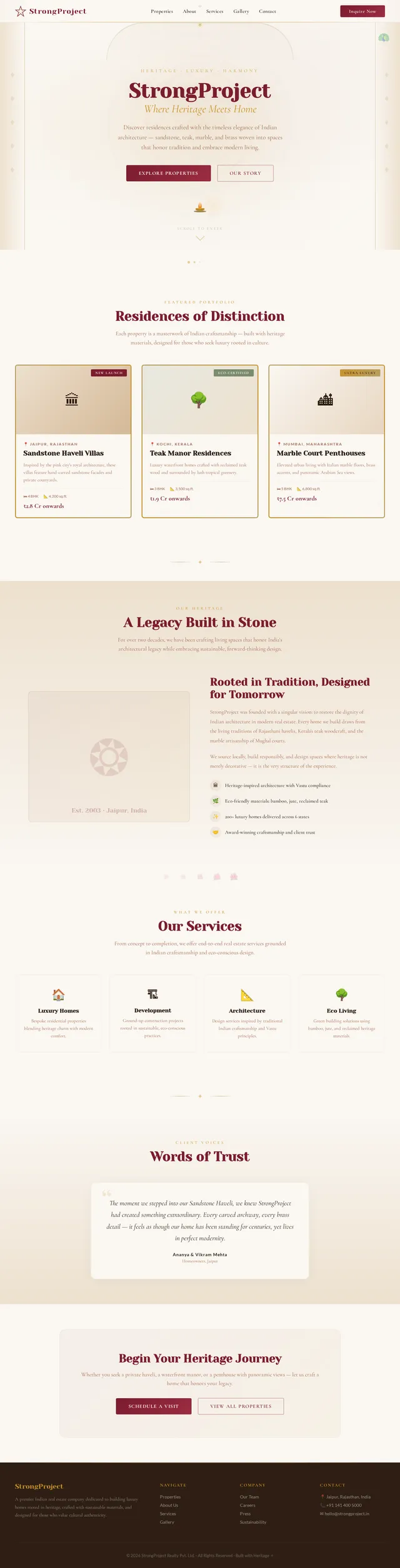
This document outlines the system requirements for strong-project, a real estate company portfolio website that blends Indian heritage aesthetics with eco-friendly, luxury-driven design principles. The platform is intended to showcase properties, communicate brand values, and create an immersive cultural experience for prospective clients and partners.
This version (1.1) reflects a manually triggered design update initiated explicitly by the user as a project update override.
2. System Overview
strong-project is a visually rich, single-brand portfolio website for an Indian real estate company. It draws deeply from Indian architectural heritage — featuring materials such as teak wood, sandstone, marble, granite, jute, bamboo, and brass — to create a luxurious yet environmentally conscious digital presence.
The site will serve as a primary digital touchpoint for the company, showcasing properties, services, team, and brand ethos. It will feature traditional Indian design motifs, animated cultural artifacts, rich typography inspired by Indian calligraphy, and a spacious minimal layout accented with ornate decorative details.
3. Functional Requirements
- As a Visitor, I should be able to browse the homepage and experience the full visual aesthetic of the company brand including animations and heritage motifs.
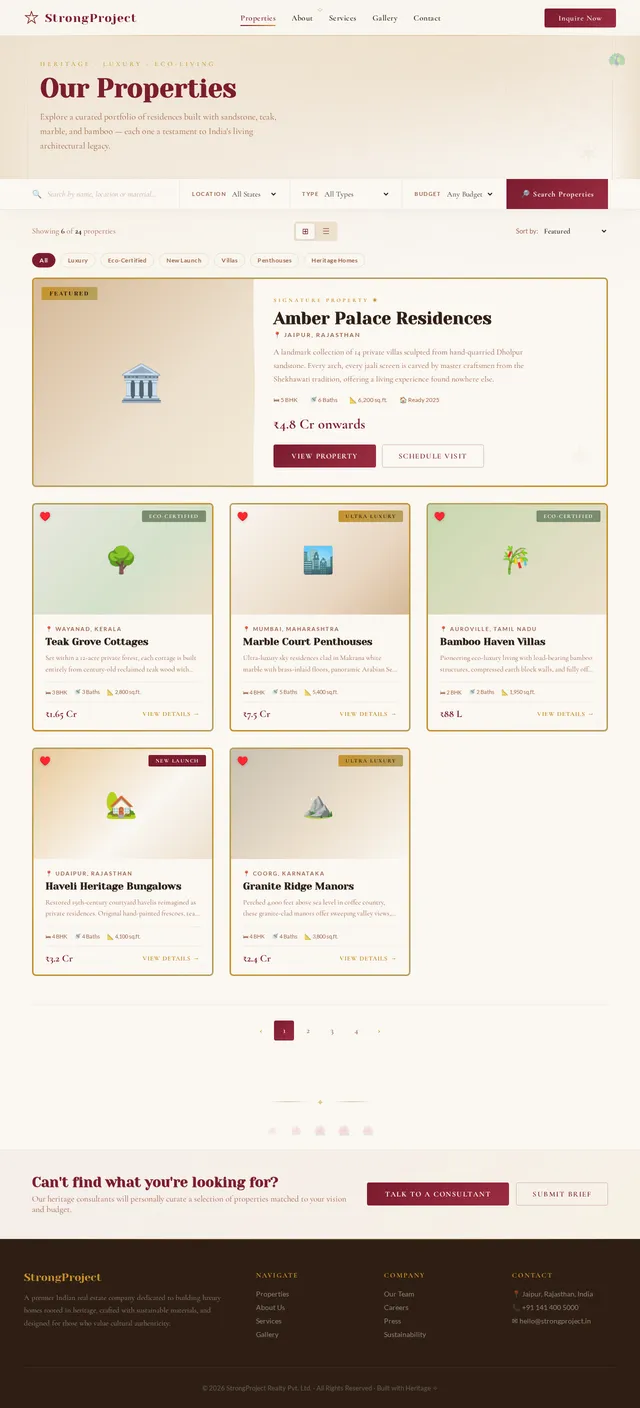
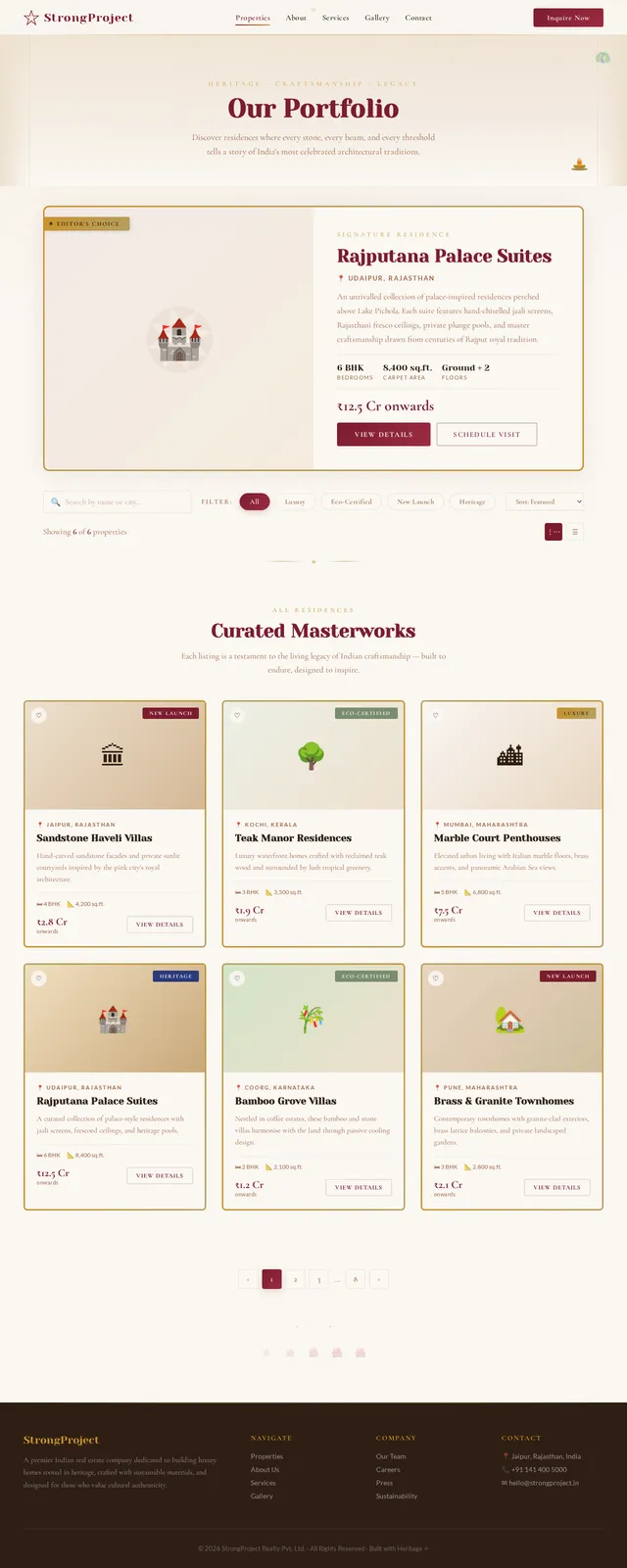
- As a Visitor, I should be able to view a portfolio/gallery of properties listed by the company.
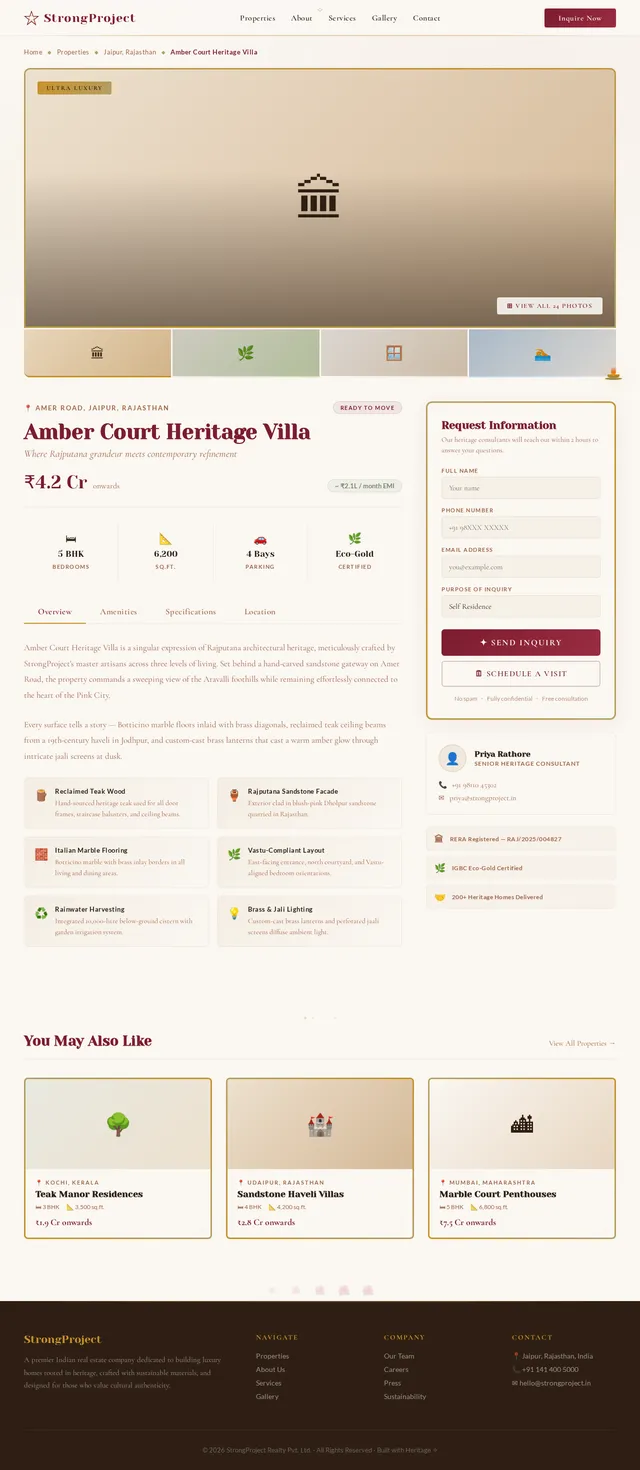
- As a Visitor, I should be able to read detailed information about each property including images, specifications, and location.
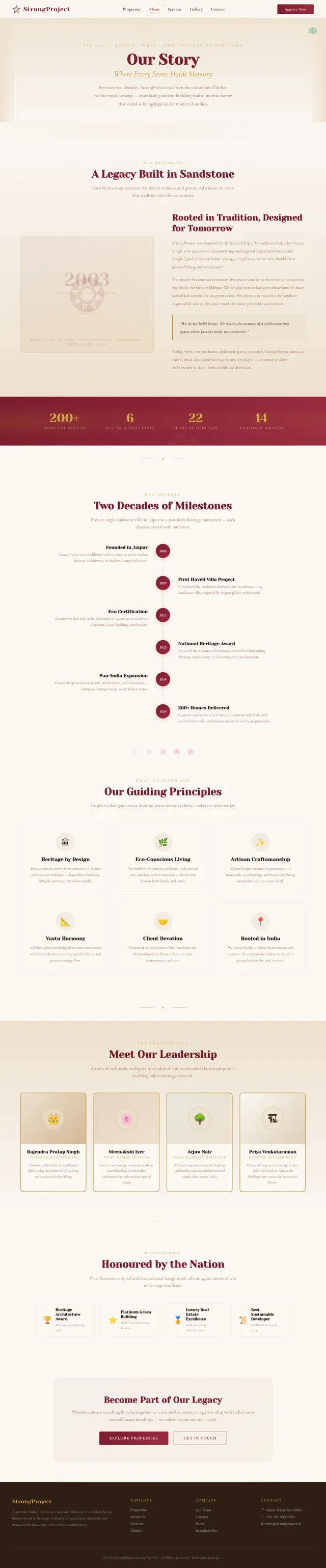
- As a Visitor, I should be able to learn about the company's history, mission, and team through an About section.
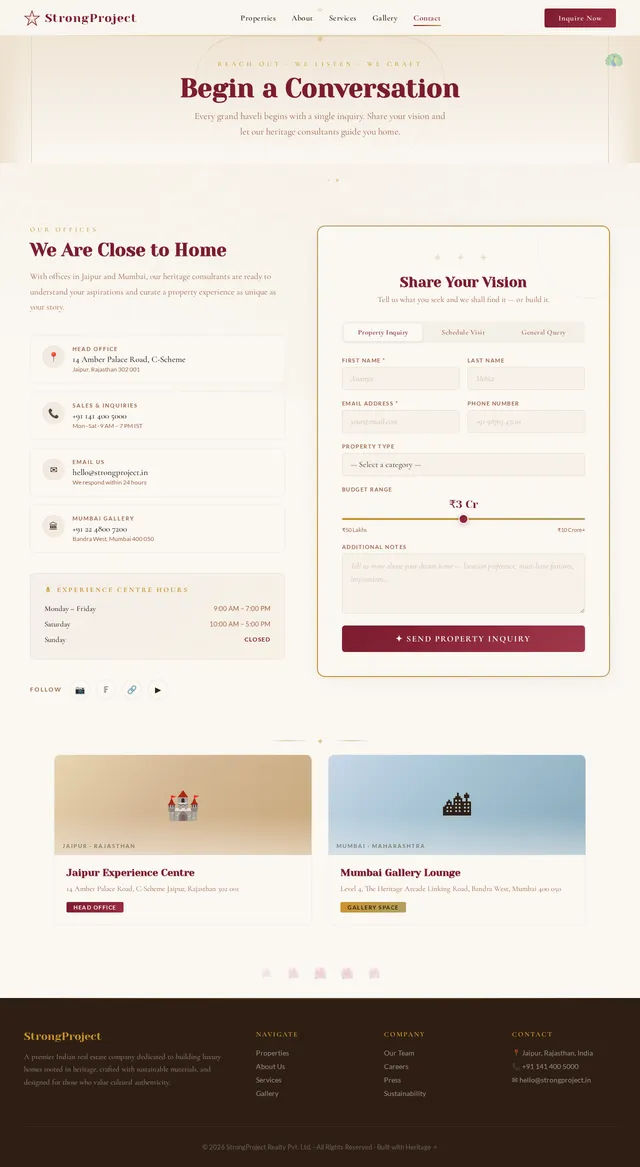
- As a Visitor, I should be able to contact the company through an inquiry or contact form.
- As a Visitor, I should be able to experience smooth passive animations such as rotating mandala designs, glowing diyas, and swaying jute curtains as I browse the site.
- As a Visitor, I should be able to trigger interactive animations through hover effects and scroll interactions on properties and decorative artifacts.
- As a Visitor, I should be able to navigate the site seamlessly via a clearly structured navigation menu.
- As a Visitor, I should be able to view the website comfortably on desktop, tablet, and mobile devices.
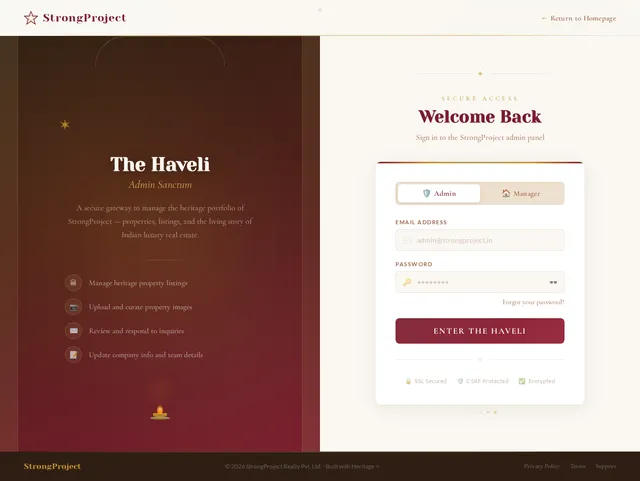
- As an Admin, I should be able to log in to a secure admin panel.
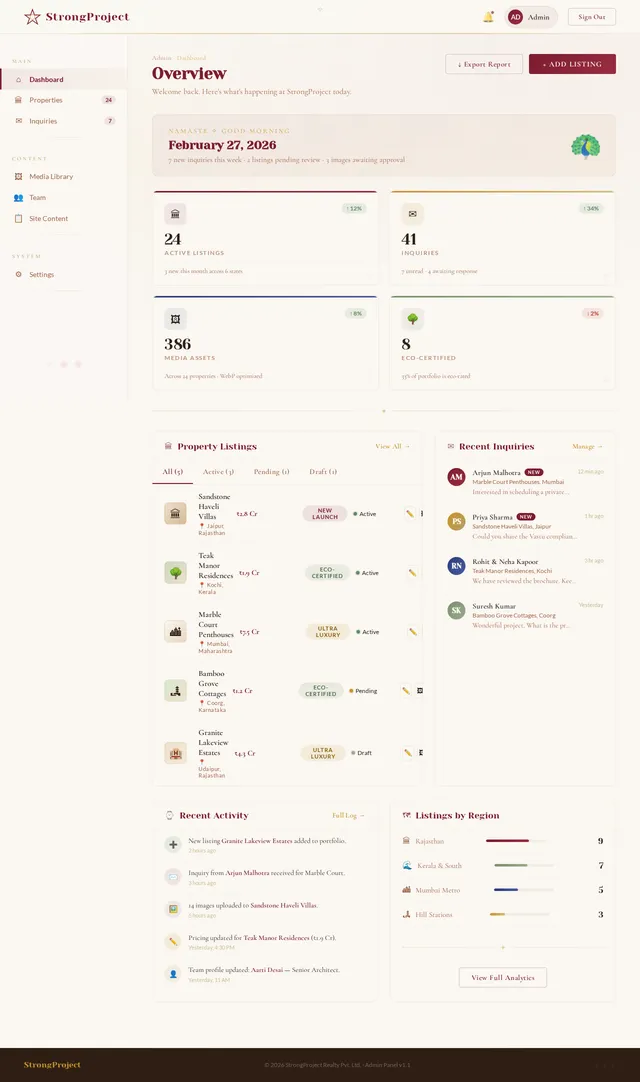
- As an Admin, I should be able to add, edit, and remove property listings from the portfolio.
- As an Admin, I should be able to upload and manage images associated with each property.
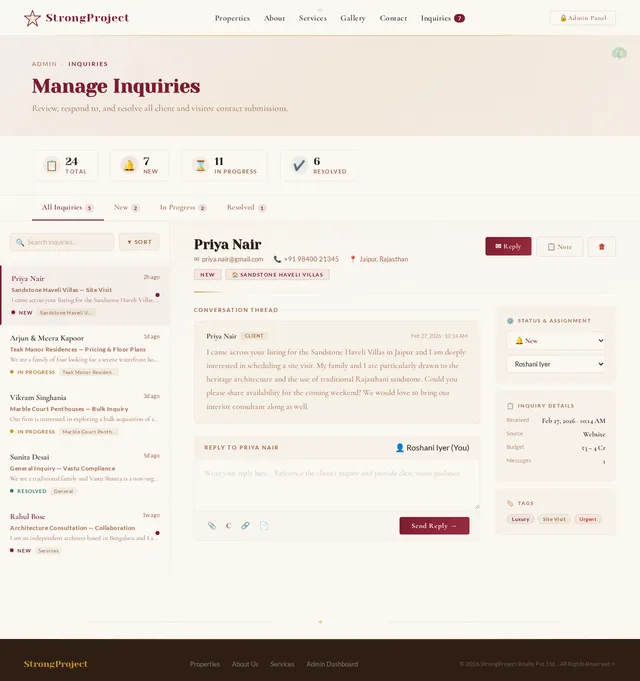
- As an Admin, I should be able to manage contact form submissions and inquiries.
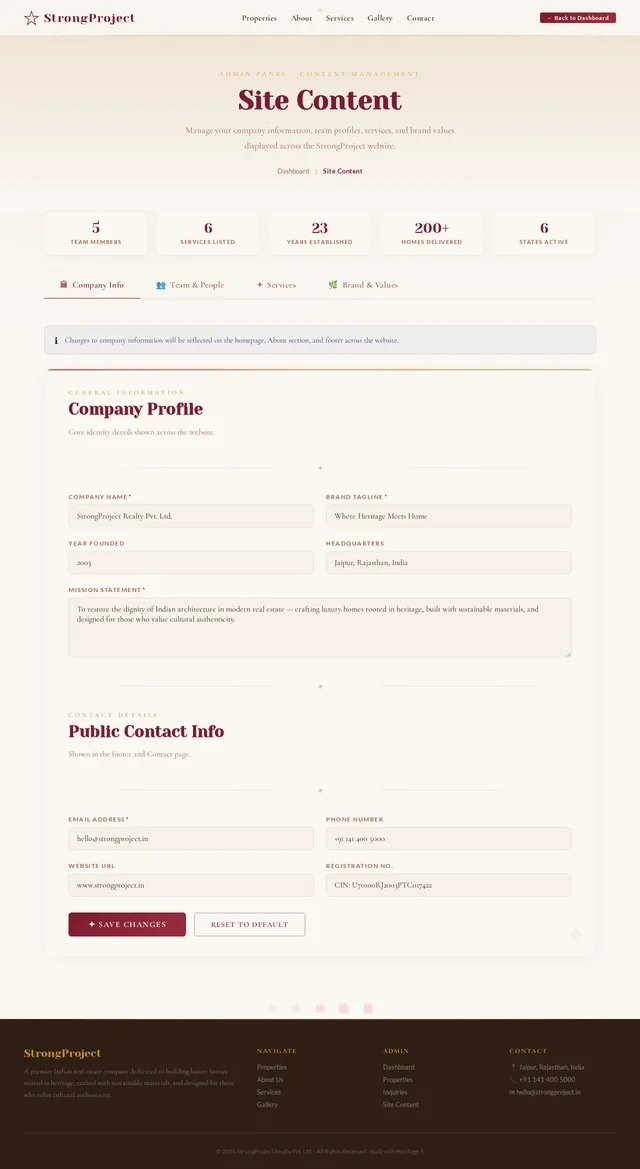
- As an Admin, I should be able to update company information, team details, and service descriptions displayed on the site.
4. User Personas
4.1 Visitor (Prospective Client / General Public)
- A person browsing to explore properties or learn about the company.
- Interested in luxury real estate with cultural authenticity.
- Expects a visually stunning, easy-to-navigate experience.
- May access via desktop or mobile.
4.2 Admin (Company Staff / Website Manager)
- Internal user responsible for managing content on the website.
- Needs to update listings, images, and company information without developer assistance.
- Accesses the admin panel via secure login.
- Has full CRUD capabilities over site content.
5. Visuals, Colors, and Theme
5.1 Design Philosophy
The design reflects Indian heritage luxury — minimal layout with rich decorative accents. Inspired by traditional Indian materials: marble, teak wood, sandstone, granite, jute, bamboo, and brass. Generous white space is used throughout to convey exclusivity and refinement. Backgrounds feature subtle textures reminiscent of aged parchment, stone, and distressed wood.
5.2 Color Palette
| Role | Color Name | Hex |
|---|---|---|
| Primary | Deep Maroon | #7B1C2E |
| Secondary | Mustard Gold | #C9922A |
| Accent | Indigo Blue | #2B3A7A |
| Nature Accent | Muted Sage Green | #7A8C6E |
| Background | Warm Ivory / White | #FAF7F2 |
| Surface | Aged Parchment | #EDE0CE |
| Text Primary | Charcoal Brown | #2E1F13 |
| Text Secondary | Dusty Copper | #A0674A |
| Highlight | Antique Brass | #B5A062 |
5.3 Typography
- Headings: Elegant serif fonts inspired by Indian calligraphy (e.g., Cormorant Garamond, Yeseva One)
- Body: Clean, readable serif or humanist sans (e.g., EB Garamond, Lato)
- Accent / Decorative: Custom or hand-lettered style for section titles
5.4 Iconography & Motifs
- Icons inspired by traditional Indian design: lotus flowers, temple arches, jaali screens, diyas, peacocks
- Section dividers and borders referencing Indian carvings and intricate tile work
- Rangoli-inspired decorative patterns as background accents
6. Signature Design Concept
✦ "The Living Haveli" — An Immersive Heritage Portal
The homepage of strong-project is not a webpage — it is the grand entrance of an ancient Indian Haveli, rendered digitally.
On Load: The screen fades in from darkness, revealing a warm, softly lit stone archway — rendered in aged sandstone texture — through which the user "enters" the website. A faint, ambient sound of distant temple bells and wind chimes plays softly (toggle-able). A slow parallax scroll reveals depth: carved stone pillars on either side, a brass oil lamp (diya) gently flickering in the foreground using CSS flame animation, and a sprawling courtyard of marble and teak wood beyond.
Hero Section: At the heart of the hero is a large rotating mandala — hand-illustrated, rendered in deep maroon and antique gold — that slowly spins in the background at 0.3 RPM. It glows subtly, pulsing in brightness every 6 seconds as if lit by candlelight. Overlaid on this mandala is the company name in large calligraphic serif type, with a tagline in dusty copper.
Scroll Interactions: As the user scrolls down, carved stone panels "slide apart" (CSS clip-path animation) to reveal each section beneath — properties, about, services — as if opening ancient wooden doors. Each section entrance is accompanied by a brief waft of a floral rangoli pattern blooming from the center outward, then fading into the background.
Floating Artifacts: Across the page, culturally symbolic micro-artifacts float passively:
- A peacock in the top-right corner fans its tail feathers slowly on hover.
- Lotus flowers bloom along section borders when the user scrolls past them.
- A hanging brass jharokha (balcony screen) element at the top of the navigation sways gently in a simulated breeze.
Property Cards: Each property card is styled as a framed miniature painting — inspired by Mughal miniature art — with an ornate brass-colored border. On hover, the card lifts (box-shadow depth increase) and the background of the card shifts to a warm amber glow, as if illuminated by a diya placed behind it.
Cursor: The mouse cursor is replaced by a small animated diya flame — a warm amber teardrop shape that leaves a brief golden trail as the user moves across the page.
Overall Feeling: The user should feel as if they have stepped into a beautifully restored Indian palace — timeless, regal, warm, and welcoming — while browsing a modern real estate portfolio. The heritage is not decorative; it is the architecture of the experience itself.
7. Non-Functional Requirements
- Performance: The website must load within 3 seconds on a standard broadband connection. Animations must maintain 60fps on modern browsers.
- Responsiveness: Fully responsive across desktop (1920px+), laptop (1280px), tablet (768px), and mobile (375px+).
- Accessibility: WCAG 2.1 AA compliance. All animations must respect
prefers-reduced-motionmedia query. - SEO: Server-side rendering or static generation for key pages to ensure search engine indexing.
- Security: Admin panel protected by authentication. All forms protected against CSRF and injection attacks.
- Scalability: The backend and CMS must support adding up to 500+ property listings without performance degradation.
- Browser Compatibility: Support for latest two versions of Chrome, Firefox, Safari, and Edge.
- Maintainability: Codebase structured for easy content updates without developer intervention via admin panel.
- Uptime: Target 99.9% availability.
- Animation Performance: All CSS and JS animations must be GPU-accelerated where possible; no janky scroll or interaction lag.
8. Tech Stack
8.1 Frontend
- React — Component-based UI for the portfolio website
- CSS Modules / Tailwind CSS — For utility-first styling with custom heritage theme overrides
- Framer Motion — For smooth, GPU-accelerated animations and scroll interactions
8.2 Backend
- Python with FastAPI — RESTful API for admin content management, form submissions, and property data
8.3 Database
- MySQL / MariaDB — Primary relational database for property listings, admin users, contact inquiries, and site content
- Alembic — Database migrations
8.4 Local Orchestration
- Docker + Docker Compose — Containerized local development environment for frontend, backend, and database services
8.5 Server-Side Orchestration
- Kubernetes — For production deployment, scaling, and service orchestration
9. Assumptions and Constraints
- The website is a portfolio/brochure site — not a full property transaction or booking platform (no payment processing in scope).
- The client will provide all property images, company content, and brand assets.
- The heritage-themed animations are intended for modern browsers; a graceful fallback (static visuals) will be provided for older or unsupported browsers.
- Audio elements (ambient sounds) will be opt-in only and muted by default to avoid accessibility or user experience conflicts.
- The admin panel is a simple CMS interface, not a full ERP or CRM system.
- Initial launch targets the Indian domestic market; multi-language support (e.g., Hindi) is out of scope for v1 but should be architecturally considered.
- Performance budgets must account for rich texture assets and animations — image optimization (WebP, lazy loading) is mandatory.
- This document reflects a manually triggered update override as explicitly initiated by the user.
10. Glossary
| Term | Definition |
|---|---|
| SRD | System Requirements Document — outlines functional and non-functional requirements for a software project |
| Haveli | A traditional Indian mansion or townhouse, typically with a courtyard and ornate carvings |
| Mandala | A geometric spiritual and ritual symbol in Hinduism and Buddhism, used here as a decorative motif |
| Diya | A small oil lamp made from clay, traditionally used in Indian festivals; used here as an animated UI artifact |
| Jaali | An ornamental lattice screen used in Indian architecture, used here as a design motif |
| Jharokha | A type of overhanging enclosed balcony used in Indian architecture |
| Rangoli | A decorative art form using colored powders or flowers, used here as animated section transitions |
| Mughal Miniature | A style of detailed painting developed in the Mughal era, referenced for property card aesthetics |
| CRUD | Create, Read, Update, Delete — standard database operations |
| WCAG | Web Content Accessibility Guidelines — international standards for web accessibility |
| CSR/SSR | Client-Side Rendering / Server-Side Rendering — approaches to rendering web content |
| Admin Panel | A secure backend interface for managing website content |
| Portfolio Site | A website designed to showcase a company's work, properties, or services without transactional functionality |
Document prepared by: System Requirements Agent Last updated: 2026-02-27 Update trigger: Manual design update override — explicitly initiated by user
No comments yet. Be the first!