cobalt-website
 Ali Haider
i want a website
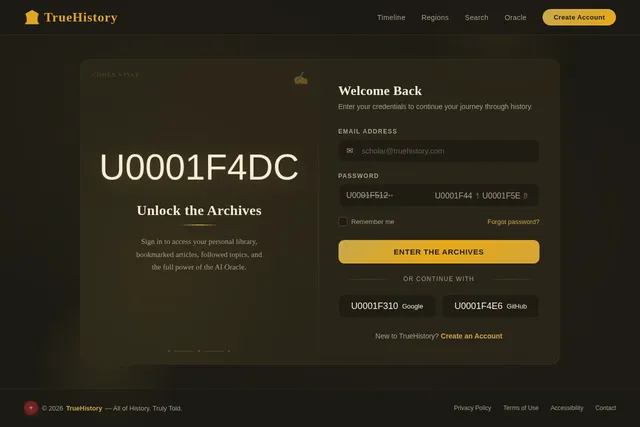
Comments (0)
Sign in to leave a comment
System Requirements
System Requirements Document (SRD)
Project Name: TrueHistory — AI-Powered Human History Platform Version: 1.0 Date: 2026-02-27 Status: Draft
1. Introduction
TrueHistory is an AI-powered web platform dedicated to presenting accurate, well-sourced, and comprehensive coverage of all human history. The platform leverages advanced AI models to generate, verify, and present historical content in an engaging and accessible format. Users can explore history through multiple lenses — timelines, topics, and geographic regions — with every piece of content backed by credible citations.
This document outlines the system requirements for the first version of the TrueHistory platform.
2. System Overview
TrueHistory is a content-rich web application that:
- Uses AI to generate detailed historical content covering all of human history
- Ensures content accuracy through AI-assisted verification and source citation
- Allows users to search and explore history by topic, timeline (era/date), and geographic region
- Presents information in a visually compelling and historically themed interface
- Targets history enthusiasts, researchers, students, and curious learners worldwide
The system consists of a React-based frontend, a Python/FastAPI backend, a relational database for structured data, and AI model integration via LiteLLM routing.
3. Functional Requirements
3.1 Content Generation & AI
- As a User, I should be able to read AI-generated historical articles and entries covering all eras of human history
- As a User, I should be able to see cited sources and references for every AI-generated piece of content
- As a User, I should be able to request AI to expand or elaborate on a specific historical event or figure
- As a User, I should be able to ask the AI questions about history and receive accurate, sourced answers
- As an Admin, I should be able to trigger AI content generation for a specific historical topic, region, or era
- As an Admin, I should be able to review and approve or reject AI-generated content before it is published
- As an Admin, I should be able to flag content for re-generation if it contains inaccuracies
3.2 Search & Exploration
- As a User, I should be able to search history by topic (e.g., wars, religion, science, culture)
- As a User, I should be able to explore history through an interactive timeline spanning all human eras
- As a User, I should be able to browse history by geographic region using an interactive map
- As a User, I should be able to filter search results by era, region, topic, and civilization
- As a User, I should be able to view related historical events and cross-references on any content page
3.3 User Accounts & Personalization
- As a User, I should be able to register and create a personal account
- As a User, I should be able to bookmark and save historical articles to my personal library
- As a User, I should be able to follow specific historical topics or regions and receive updates
- As a Guest, I should be able to browse and read published historical content without logging in
- As a Guest, I should be able to use basic search functionality without an account
3.4 Admin & Content Management
- As an Admin, I should be able to manage user accounts and permissions
- As an Admin, I should be able to view AI content generation logs and audit trails
- As an Admin, I should be able to publish, unpublish, or archive historical content
- As an Admin, I should be able to configure AI model settings and routing preferences
4. User Personas
| Persona | Description |
|---|---|
| Guest | An anonymous visitor who browses content without an account. Can search and read articles but cannot save or interact deeply. |
| Registered User | A logged-in history enthusiast, student, or researcher. Can bookmark, follow topics, ask AI questions, and engage with content. |
| Admin | A platform operator or content moderator. Manages AI generation, content approval, user accounts, and system configuration. |
5. Visuals, Colors & Theme
5.1 Design Philosophy
The visual identity of TrueHistory blends ancient grandeur with modern clarity. The design should feel like stepping into a prestigious historical archive — aged, scholarly, and trustworthy — while remaining clean and digitally contemporary.
5.2 Color Palette
| Role | Color Name | Hex |
|---|---|---|
| Primary Background | Deep Parchment | #1C1A14 |
| Secondary Background | Aged Vellum | #2B2719 |
| Primary Accent | Antique Gold | #C9A84C |
| Secondary Accent | Faded Crimson | #8B2E2E |
| Text Primary | Warm Ivory | #F5EDD6 |
| Text Secondary | Dusty Stone | #A89F8C |
| Interactive Highlight | Burnished Amber | #E6A817 |
| Dividers / Borders | Weathered Bronze | #5C4A28 |
5.3 Typography
- Headings: Serif font (e.g., Playfair Display or IM Fell English) — evokes classical manuscripts
- Body Text: Clean humanist sans-serif (e.g., Source Serif 4 or Lora) — readable and warm
- UI Elements / Labels: Modern geometric sans-serif (e.g., Inter) — clear and functional
5.4 General Aesthetic
- Subtle parchment textures and ink-stain patterns as background elements
- Map and timeline elements styled with a cartographic / antique map aesthetic
- Use of wax seal, scroll, and quill iconography as decorative motifs
- Smooth, deliberate transitions — nothing flashy; every animation should feel weighty and intentional
6. Signature Design Concept 🏛️
"The Codex Vitae" — A Living Ancient Manuscript Homepage
The homepage is a living, breathing ancient codex — an impossibly grand illuminated manuscript that stretches infinitely downward like an unrolling scroll of time itself.
What the user sees on arrival:
The screen fades in from darkness to reveal aged parchment — but it's alive. Faint ink illustrations of ancient civilizations (Egyptian pyramids, Roman columns, Mayan temples, Chinese dynasties) are slowly hand-drawing themselves across the background in real time, like an invisible scholar is sketching the world's history right before your eyes. The illustrations are ghost-like, in sepia and burnt umber tones, and they shift and evolve as the user scrolls.
The Hero Section:
At the top, an enormous illuminated capital letter "H" — in the style of medieval manuscript drop caps — pulses with a golden glow. Inside the letter, a micro-animation plays: a tiny civilization rises and falls in a loop (buildings emerge, flourish, then crumble to dust, then bloom again). The tagline "All of History. Truly Told." types itself letter-by-letter in an aged serif font with an ink-bleeding effect, as if quill on parchment.
Scroll Interaction:
As the user scrolls down, the parchment physically rolls away, revealing the next section underneath — like unrolling a scroll. Each major section of the homepage (Search, Timeline, Regions, AI Features) is presented as a distinct illuminated page of the codex, bordered by intricate hand-drawn filigree that animates in as the section enters the viewport.
The Timeline River:
Midway down the homepage, a horizontal river of time flows across the full width of the screen. Eras float as floating islands above the river — ancient civilizations rendered in tiny isometric pixel art. Users can drag left/right to travel through time. Hovering on an island shows a glowing tooltip with key facts. Clicking dives the user into that era.
The AI Oracle:
A central call-to-action is presented as an ancient oracle flame — a gently animated golden fire in a stone brazier. Above it reads: "Ask the Oracle." Clicking expands it into a full-screen AI chat interface styled like an ancient stone tablet. The AI's responses appear as if carved in stone, letter by letter, then smooth into readable text.
Micro-interactions:
- Hovering over any historical illustration causes it to glow amber and gain detail, as if candlelight is illuminating it
- Navigation links are styled as wax-seal stamps that press and release on click
- Page transitions use a page-turn animation — the current page curls at the corner and flips to the next
- A subtle ambient sound toggle (off by default) plays distant temple bells and wind — the sound of ancient places
The overall effect: Users feel they have discovered a magical artifact — not a website, but a portal into history itself. It is immediately unlike anything they have ever seen on the web.
7. Non-Functional Requirements
| Category | Requirement |
|---|---|
| Performance | Pages must load within 2 seconds on standard broadband connections |
| Scalability | System must support up to 100,000 concurrent users without degradation |
| Availability | 99.9% uptime SLA; planned maintenance windows communicated in advance |
| Security | All user data encrypted at rest and in transit (TLS 1.3+); OWASP Top 10 compliance |
| AI Reliability | AI content generation must include fallback routing if primary model is unavailable |
| Content Accuracy | All AI-generated content must include citations; flagging system for inaccuracies |
| Accessibility | WCAG 2.1 AA compliance across all public-facing pages |
| SEO | Server-side rendering or static generation for all public content pages |
| Auditability | Full logs maintained for all AI-generated content with version history |
| GDPR Compliance | User data management aligned with GDPR and major international privacy laws |
8. Tech Stack
8.1 Frontend
| Layer | Technology | Purpose |
|---|---|---|
| Web App | React | Primary web interface |
| Styling | Tailwind CSS | Utility-first styling system |
| Animations | Framer Motion | Scroll animations, page transitions, micro-interactions |
| Map / Globe | Leaflet.js or Mapbox GL | Interactive historical region maps |
8.2 Backend
| Layer | Technology | Purpose |
|---|---|---|
| API Framework | Python + FastAPI | RESTful and streaming API endpoints |
| AI Orchestration | LangChain | AI pipeline management, prompt chaining, citation retrieval |
| LLM Routing | LiteLLM | Route requests across AI models with fallback logic |
8.3 AI Models
| Use Case | Model | Reason |
|---|---|---|
| Historical content generation (user-facing) | GPT-5.2 | Friendly, fluent, engaging narrative content |
| Academic deep-dives & citations | Claude 4.5 Opus | Rigorous academic tone, accurate sourcing |
| Conversational AI / Oracle Q&A | Gemini 3 Pro | Natural, friendly conversational responses |
8.4 Database
| Type | Technology | Purpose |
|---|---|---|
| Relational (Primary) | MySQL / MariaDB + Alembic | Users, content metadata, bookmarks, categories |
| Vector DB | WeaviateDB | Semantic search across historical content |
8.5 Infrastructure
| Layer | Technology | Purpose |
|---|---|---|
| Local Dev | Docker + Docker Compose | Consistent local development environment |
| Production | Kubernetes | Container orchestration and scaling in production |
9. Assumptions and Constraints
Assumptions
- AI models (GPT-5.2, Claude 4.5 Opus, Gemini 3 Pro) are accessible via API with sufficient rate limits
- Content generated by AI will require admin review before public publication in v1.0
- The platform will launch in English first; multi-language support is a future consideration
- Source citations will be based on well-known historical databases, encyclopedias, and academic records available to the AI
- Users are expected to have access to modern browsers (Chrome, Firefox, Safari, Edge — latest 2 versions)
Constraints
- AI-generated content is subject to the limitations and knowledge cutoffs of the underlying models
- Initial launch will not include user-contributed content or editing (read-only for end users)
- Budget and timeline may constrain the scope of the Signature Design Concept animations in v1.0; a phased rollout of design features is acceptable
- All third-party map and image assets must be cleared for historical/educational use
10. Glossary
| Term | Definition |
|---|---|
| SRD | System Requirements Document — this document |
| AI Oracle | The conversational AI feature on the homepage, allowing users to ask historical questions |
| Codex Vitae | The signature design concept — a living illuminated manuscript homepage aesthetic |
| LiteLLM | An open-source LLM proxy/router used to manage multiple AI model endpoints |
| LangChain | A Python framework for building AI pipelines, used here for prompt orchestration and retrieval |
| WeaviateDB | An open-source vector database used for semantic similarity search |
| Alembic | A Python-based database migration tool used with SQLAlchemy and MariaDB/MySQL |
| WCAG 2.1 AA | Web Content Accessibility Guidelines — the accessibility standard targeted by this platform |
| Era | A named period of human history (e.g., Bronze Age, Medieval Period, Industrial Revolution) |
| Illuminated Manuscript | A historical style of decorated handwritten text; the visual inspiration for the platform's design |
| GDPR | General Data Protection Regulation — European data privacy law governing user data handling |
Document prepared by: System Requirements Engineer Next Review Date: 2026-03-13
No comments yet. Be the first!