zinc-food
 Diaa
DiaaHere's the full breakdown of the idea — click any box above to dive deeper on a specific part. --- **The core idea** is a mobile-first platform that lets food donors (restaurants, grocers, households) list surplus food in under 30 seconds, and lets recipients (NGOs, individuals, composters) claim it before it hits the bin. Think of it as a real-time neighbourhood food marketplace — except everything is free. **How it works end-to-end:** A restaurant finishes its dinner service and has 15 portions of biryani left. They open the app, take a photo, set a pickup window (say, 9–10pm), and post it. The platform instantly notifies nearby registered NGOs and individuals. Someone claims it, shows a QR code at pickup, and the food is gone — tracked, logged, and counted toward both the donor's and the platform's impact score. **The listing flow** is designed to be dead simple — name, photo (optional), quantity, expiry time, pickup window. Under 30 seconds. Friction is the enemy of participation. **Smart matching** prioritises NGOs for large quantities, and individuals for small ones. It factors in distance, dietary tags (vegan, halal, gluten-free), and urgency (how close to expiry). **Colour direction** — the brand lives in Fresh Green (#1D9E75) as the primary, with Warm Amber (#F2A623) as the accent. Green signals freshness and sustainability; amber signals warmth and urgency (food expiring soon). Cream white and charcoal keep the UI clean and readable. No red — red implies waste and negativity, which is exactly what the brand is fighting. **Tech stack to build it:** - Frontend: React Native (iOS + Android from one codebase) - Backend: Node.js + PostgreSQL for listings and user data - Maps + distance: Google Maps API or Mapbox - Push notifications: Firebase Cloud Messaging - Auth: phone number OTP (low friction, no email required) **Monetisation** kicks in once you have donors and volume. The free tier covers basic listing and claiming. Premium donors (restaurants, chains) pay a small monthly fee for analytics, a "Zero Waste Partner" badge visible on their profile, and a tax-deductible donation certificate. NGOs pay for bulk API access. Corporates pay for branded CSR impact reports they can share with stakeholders. **What makes it different from existing solutions** like Too Good To Go — that app charges consumers for discounted food. This one is entirely free for recipients, which unlocks NGOs and low-income individuals who can't pay even a discounted price. The social mission is the product. Want me to design the actual app screens (UI mockups), the database schema, or the onboarding flow next?

Comments (0)
Sign in to leave a comment
System Requirements
System Requirements Document (SRD)
Project Name: zinc-food
1. Introduction
zinc-food is a mobile-first platform designed to combat food waste by connecting food donors (restaurants, grocers, households) with recipients (NGOs, individuals, composters) in real-time. The platform enables donors to list surplus food in under 30 seconds and recipients to claim it before it goes to waste. By fostering a hyper-local, trust-driven ecosystem, zinc-food aims to create a sustainable and impactful solution to food insecurity and waste management in India.
This document outlines the system requirements for zinc-food, incorporating Diaa's vision for a lean admin moderation layer and a map-centric user experience.
2. System Overview
zinc-food operates as a real-time food rescue marketplace, where donors can post surplus food and recipients can claim it for free. The platform prioritizes simplicity, trust, and urgency, with features like instant notifications, smart matching, and a map-first interface.
Key components include:
- Donor Flow: Quick listing of surplus food with minimal friction.
- Recipient Flow: Claiming food via proximity-based matching and QR code verification.
- Admin Moderation: Thin oversight model for NGO verification, reactive flagging, and automated account suspension.
- Map-Centric UX: The map serves as the primary interface, showing nearby food listings visually.
The platform is designed to scale across urban and rural areas in India, leveraging local trust networks and community-driven moderation.
3. Functional Requirements
Donor Requirements:
- As a Donor, I should be able to list surplus food in under 30 seconds by entering name, photo (optional), quantity, expiry time, and pickup window.
- As a Donor, I should receive instant notifications when my listing is claimed.
- As a Donor, I should be able to view my impact score based on the food I’ve donated.
- As a Donor, I should be able to earn a "Trusted Donor" badge after consistent positive ratings.
Recipient Requirements:
- As a Recipient, I should be able to claim food by scanning a QR code at pickup.
- As a Recipient, I should be notified of nearby food listings based on urgency and proximity.
- As a Recipient, I should be able to filter listings by dietary tags (vegan, halal, gluten-free).
- As a Recipient, I should be able to rate donors after pickup.
Admin Requirements:
- As an Admin, I should be able to verify NGOs during onboarding by reviewing registration documents.
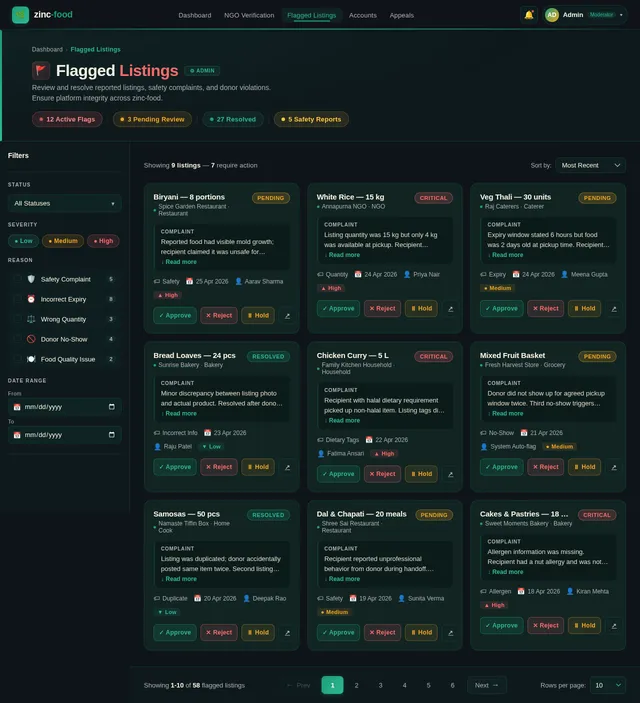
- As an Admin, I should be able to review flagged listings and complaints.
- As an Admin, I should be able to manage automated account suspensions after three no-shows.
- As an Admin, I should be able to adjudicate ban appeals and safety complaints.
General Requirements:
- As a User, I should land on a map interface showing nearby food listings when I open the app.
- As a User, I should be able to toggle between map view and list view for food listings.
- As a User, I should be able to view my profile, including badges, ratings, and history.
4. User Personas
Donor Persona:
- Name: Restaurant Owner / Household Member
- Goals: Reduce food waste, contribute to the community, and earn recognition for sustainability efforts.
- Pain Points: Time-consuming donation processes, lack of trust in recipients, and food safety concerns.
Recipient Persona:
- Name: NGO Worker / Individual in Need
- Goals: Access free food quickly and reliably, plan pickups efficiently, and ensure dietary compatibility.
- Pain Points: Limited availability of food, difficulty in finding nearby listings, and trust issues with donors.
Admin Persona:
- Name: Platform Moderator
- Goals: Ensure platform trust and safety, verify NGOs, and resolve disputes efficiently.
- Pain Points: Balancing oversight with scalability, managing flagged content, and handling edge cases.
5. Visuals Colors and Theme
Color Palette:
- Background: Fresh Green (#1D9E75) – Represents sustainability and freshness.
- Surface: Cream White (#F9F5E3) – Clean and readable UI.
- Text: Charcoal (#333333) – High contrast for readability.
- Accent: Warm Amber (#F2A623) – Signals urgency and warmth.
- Muted Tones: Soft Gray (#B0B0B0) – For secondary elements and placeholders.
6. Signature Design Concept
Concept: Interactive Map with Dynamic Pins
The homepage of zinc-food will feature a live, interactive map that serves as the emotional and functional centerpiece of the platform.
Visuals and Interactions:
- Dynamic Pins: Food listings appear as green pins on the map, with size and brightness indicating urgency (e.g., larger, glowing pins for food close to expiry).
- Hover Animations: Tapping a pin reveals a card with food details, including name, quantity, dietary tags, and pickup window.
- Claim Flow: Users can claim food directly from the map by tapping a pin and confirming via a pop-up modal.
- Heatmap Overlay: A subtle heatmap shows areas with high donor activity, encouraging recipients to explore nearby neighborhoods.
Transitions and Micro-Interactions:
- Zoom and Pan: Smooth transitions when users zoom into their locality or pan across the map.
- Pin Drop Animation: New listings animate as pins dropping onto the map in real-time.
- Toggle View: A seamless toggle lets users switch between map view and list view without losing context.
This design ensures the platform feels alive, urgent, and hyper-local, making food rescue intuitive and engaging.
7. Non-Functional Requirements
- Performance: The platform must handle real-time updates for food listings and notifications without lag.
- Scalability: Support thousands of concurrent users across urban and rural areas.
- Security: Ensure data privacy and secure transactions, especially for NGO verification and user ratings.
- Accessibility: Design for mobile-first usability, with support for low-bandwidth environments.
8. Tech Stack
Frontend:
- React Native for mobile app development (iOS + Android).
Backend:
- Python with FastAPI for efficient API handling.
Database:
- PostgreSQL for relational data (listings, users).
- MongoDB for non-relational data (ratings, flags).
AI Models:
- GPT 5.4 for user-friendly responses and smart matching.
AI Tools:
- Langchain for workflow orchestration.
Local Orchestration:
- Docker and docker-compose for containerization.
Server-Side Orchestration:
- Kubernetes for scalable deployment.
9. Assumptions and Constraints
- Users will primarily access the platform via mobile devices.
- Food listings must go live instantly without admin approval.
- NGO verification will be manual but streamlined to avoid bottlenecks.
- The map interface must function seamlessly even in low-bandwidth environments.
10. Glossary
- Donor: A user who lists surplus food for donation.
- Recipient: A user who claims food listings.
- NGO: Non-Governmental Organization verified by admins to claim bulk food.
- Impact Score: A metric showing the positive contribution of a donor to the community.
- Trusted Donor Badge: Recognition for donors with consistent positive ratings.
- Flagged Listing: A food listing reported for issues like incorrect expiry or unsafe food.
This SRD provides a comprehensive foundation for zinc-food, ensuring alignment with Diaa's vision and the platform's mission to reduce food waste and foster community trust.

Save Food. Save Lives.
Join thousands reducing food waste in real-time. Connect surplus food with those who need it most — in under 30 seconds.
Find Food Near You, Instantly
Our interactive map shows real-time surplus food listings with urgency-coded pins. Bigger means more to share, brighter means time is running out.
Tap to Reveal Food Details
Dal Makhani & Rice
Saffron Kitchen · 0.3 km away
Tap to reveal details
Fresh Garden Salad Box
GreenGrocer Market · 1.1 km away
Tap to reveal details
Assorted Pastries
Sunrise Bakery · 0.7 km away
Tap to reveal details
How It Works
From surplus to saved in three simple steps. Zero friction, real impact.
Post in 30 Seconds
Snap a photo, add details, and list your surplus food instantly. Donors reach nearby recipients before food goes to waste.
Claim via Map
Browse nearby listings on the live map, filter by dietary needs, and claim food with a single tap. Scan the QR code at pickup.
Rate & Build Trust
After pickup, rate your experience to strengthen community trust. Consistent donors earn Trusted Donor badges and higher visibility.
One Platform, Three Perspectives
Whether you are rescuing food, claiming a meal, or keeping the community safe — zinc-food is built for your workflow.
Donor Journey
Restaurants, grocers & households
Snap & List
Post surplus food in under 30 seconds with a photo, quantity, and pickup window.
Get Notified
Receive instant alerts when a nearby recipient claims your listing.
Hand Off
Verify pickup with a QR code scan and complete the rescue.
Earn Trust
Build your impact score and earn the Trusted Donor badge.
Recipient Journey
NGOs, individuals & composters
Browse the Map
Open the app to see nearby food pins ranked by urgency and proximity.
Filter & Claim
Apply dietary filters like vegan or halal, then tap to claim instantly.
Scan & Collect
Navigate to the pickup point and scan the QR code to confirm receipt.
Rate & Review
Rate your donor to strengthen community trust and help others.
Admin Journey
Platform moderators & safety
Verify NGOs
Review registration documents and approve organizations during onboarding.
Review Flags
Triage flagged listings and user-reported complaints in the moderation queue.
Enforce Policy
Manage automated suspensions after three no-shows and safety violations.
Adjudicate Appeals
Resolve ban appeals and safety complaints with full audit context.
Real-Time Impact, Real Lives Changed
Every meal rescued is a step toward zero food waste. Here’s what our community has achieved together.
0 kg
Food Saved
Kilograms of surplus food rescued from waste
0
Communities Served
Neighborhoods connected through food sharing
0
Active Users
Donors and recipients making an impact daily
0 kg
CO₂ Prevented
Carbon emissions avoided through food rescue
Built on Trust, Driven by Community
Every layer of zinc-food is designed to keep donors, recipients, and food safe. Here is how we earn your trust.
Real-Time Moderation
AI-powered content screening flags unsafe listings instantly, keeping the platform safe for every user around the clock.
NGO Verified
Every NGO is verified during onboarding with document review, ensuring donations reach legitimate organizations.
QR Code Security
Unique QR codes for every pickup confirm the right person collects the right food — no mix-ups, no fraud.
Community Ratings
Transparent peer-to-peer ratings build trust over time. Earn your Trusted Donor badge through consistent quality.
Built for Speed, Trust & Impact
Every feature is designed to make food rescue faster, safer, and more rewarding for donors and recipients alike.
Smart Matching
Automatically pairs surplus food with the nearest recipients based on proximity, urgency, and dietary preferences.
Dietary Filters
Filter listings by vegan, halal, gluten-free, and more to find food that fits your dietary needs.
Impact Score
Track your contribution with a personal impact score showing food saved, CO₂ prevented, and communities served.
Trusted Donor Badge
Earn recognition through consistent positive ratings. Trusted badges build community confidence.
Instant Notifications
Get alerted the moment nearby food is posted or when your listing is claimed — never miss a rescue.
Map + List Toggle
Switch between an interactive map view and a detailed list view. Visual discovery or route planning — your choice.
Ready to Make a Difference?
Download zinc-food today and join thousands rescuing surplus food in real-time.
No spam, ever. Unsubscribe anytime.
Frequently Asked Questions
Everything you need to know about donating, claiming, and building trust on zinc-food.
🍽 For Donors
You can post a food listing in under 30 seconds. Simply enter the food name, quantity, expiry time, and pickup window. Adding a photo is optional but helps recipients identify your listing faster on the map.
The Trusted Donor badge is awarded to donors who maintain consistently positive ratings from recipients. It signals reliability and food safety to the community, helping your listings get claimed faster.
Yes, you receive an instant notification the moment a recipient claims your listing. You can then coordinate the pickup through the app and confirm handover when they arrive.
📍 For Recipients
Open the app and you will land directly on the interactive map showing nearby food listings as pins. Tap any pin to view food details, dietary tags, and pickup window, then claim it with one tap. You can also switch to list view to browse and plan your route.
Absolutely. You can filter food listings by dietary tags including vegan, halal, and gluten-free. This ensures you only see food that matches your needs or the needs of the people you serve.
When you claim a listing, a unique QR code is generated in your app. At pickup, the donor scans this code to confirm the handover. This keeps the process accountable and builds trust between both parties.
🏢 For NGOs
During onboarding, NGOs submit their registration documents for review. Our admin team verifies these documents to grant verified status. Verified NGOs can claim bulk food listings and access priority matching for larger donations.
Yes. Verified NGOs have access to bulk claiming features and are prioritized by our smart matching algorithm when large quantities of food are listed nearby. You can coordinate multiple pickups and plan efficient routes through the app.
🛡 Safety & Trust
Every listing includes an expiry time and pickup window set by the donor. Listings automatically expire and are removed from the map when the window closes. Community ratings and the flagging system help maintain quality, and accounts with repeated no-shows are automatically suspended.
You can flag any listing or user directly from the app. Our moderation team reviews flagged content and takes action, including removing listings or suspending accounts. Users who are suspended can submit a ban appeal for review.
No comments yet. Be the first!