windy-sudoku
 Peter Foris
build me a deployable simple sudoku application
Comments (0)
Sign in to leave a comment
System Requirements
System Requirements Document (SRD)
windy-sudoku
1. Introduction
The windy-sudoku project aims to deliver a simple, deployable Sudoku application tailored for single-player use. Sudoku is a classic logic-based puzzle game enjoyed by millions worldwide, and this project will focus on providing a clean, intuitive, and enjoyable experience for users.
This document outlines the system requirements for the initial version of the application, which will focus solely on basic single-player functionality. Future iterations may expand on this foundation, but the current scope is intentionally limited to ensure a smooth and focused development process.
2. System Overview
The windy-sudoku application will allow users to play Sudoku puzzles on their devices. The system will generate puzzles of varying difficulty levels, provide an interface for solving them, and validate the user's solutions. The application will be lightweight, user-friendly, and optimized for both desktop and mobile platforms.
Key features include:
- Puzzle generation for different difficulty levels (e.g., Easy, Medium, Hard).
- An interactive grid-based interface for solving puzzles.
- Real-time validation of user inputs.
- A clean and minimalistic design to enhance focus and usability.
The application will be designed with Hungarian locale-specific defaults, such as time and date formats, and will support deployment in Hungary (HU).
3. Functional Requirements
- As a User, I should be able to start a new Sudoku puzzle.
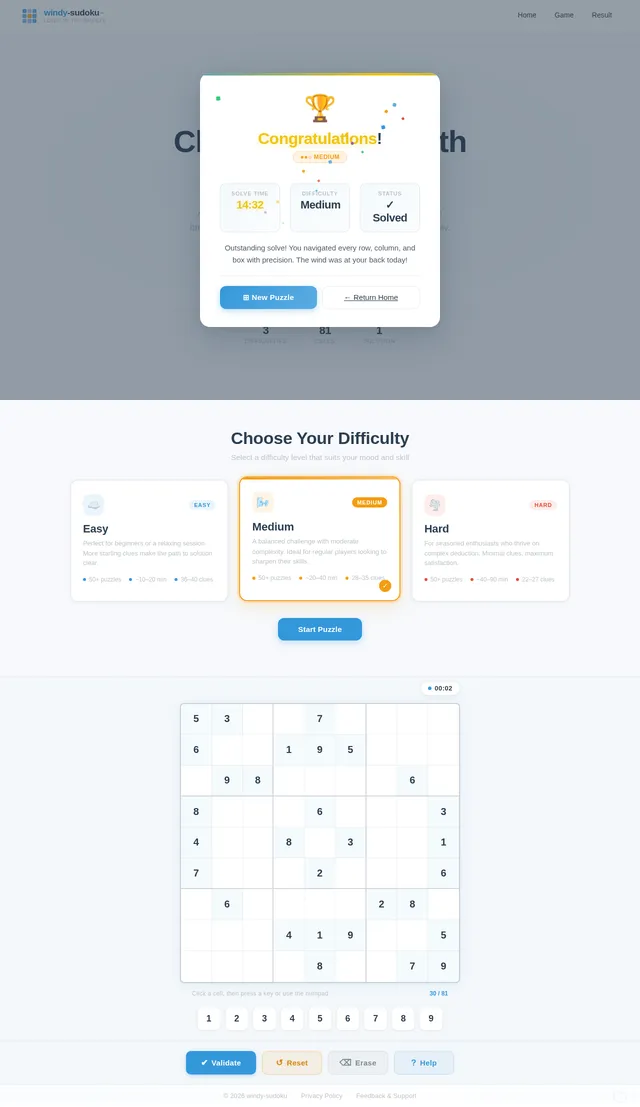
- As a User, I should be able to select the difficulty level of the puzzle (Easy, Medium, Hard).
- As a User, I should be able to input numbers into the Sudoku grid.
- As a User, I should be able to erase or modify my inputs.
- As a User, I should be able to validate my solution to the puzzle.
- As a User, I should be able to reset the puzzle to its initial state.
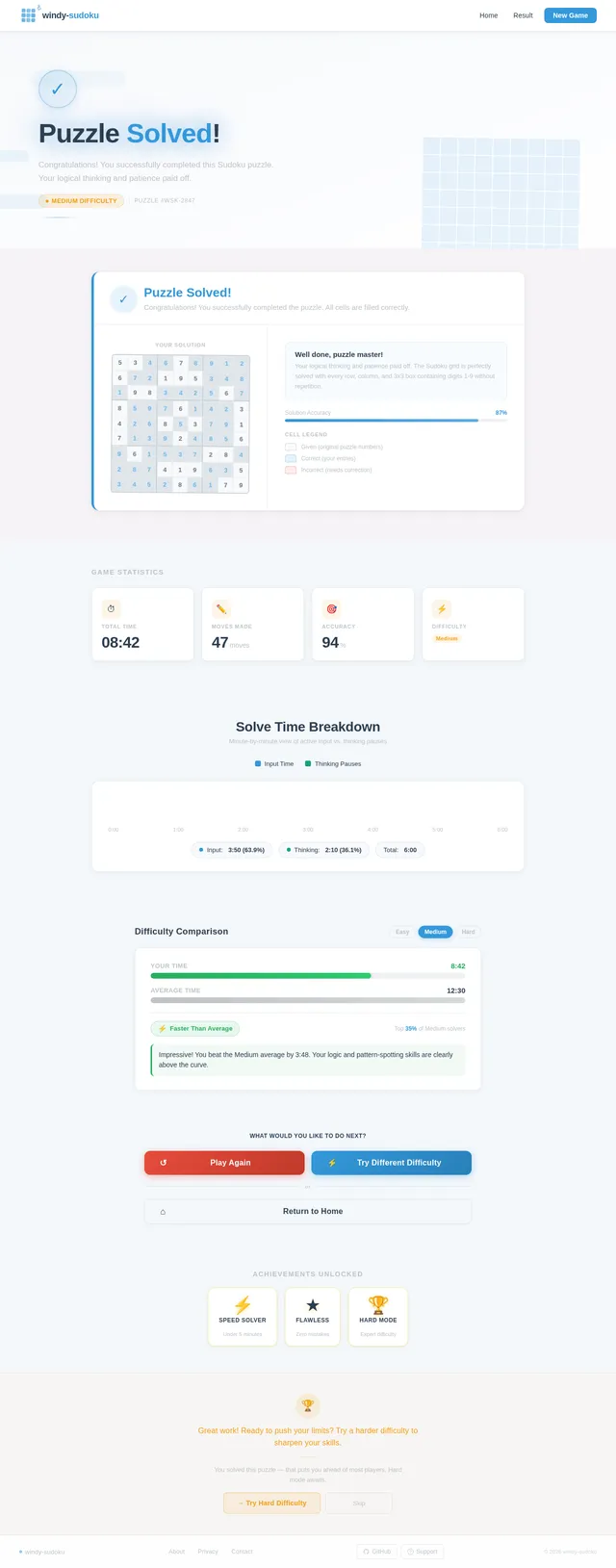
- As a User, I should be able to view a timer to track how long I take to solve the puzzle.
4. User Personas
4.1. Casual Player
- Description: A user who enjoys solving Sudoku puzzles occasionally for relaxation or mental exercise.
- Goals: Solve puzzles at their own pace and enjoy a distraction-free interface.
- Pain Points: Overly complex interfaces or unnecessary features.
4.2. Enthusiast
- Description: A user who regularly solves Sudoku puzzles and seeks a challenge.
- Goals: Access puzzles of varying difficulty and track their solving time.
- Pain Points: Lack of difficulty options or performance tracking.
5. Visuals Colors and Theme
The windy-sudoku application will feature a clean and calming aesthetic to enhance focus and usability. The color palette is inspired by a breezy, natural theme to align with the "windy" concept.
- Background: #F7F9FC (Soft Sky Blue)
- Surface: #FFFFFF (Pure White)
- Text: #2C3E50 (Deep Slate Blue)
- Accent: #3498DB (Bright Windy Blue)
- Muted Tones: #BDC3C7 (Light Gray Mist)
This palette ensures a visually appealing and distraction-free interface.
6. Signature Design Concept
The windy-sudoku homepage will feature an animated "windy grid" effect.
- Visuals: The Sudoku grid will appear as if it's gently swaying in a breeze, with subtle animations on the grid lines and cells. When users hover over a cell, it will "flutter" slightly, creating a tactile and engaging interaction.
- Transitions: Smooth transitions will occur when switching between difficulty levels or resetting the puzzle, with a "wind sweep" animation that clears the grid and redraws it.
- Micro-interactions: When users input a number, the cell will briefly glow with the accent color (#3498DB) before settling back into place.
- Background Animation: A faint, looping animation of drifting clouds will play in the background, reinforcing the "windy" theme without distracting from the gameplay.
This design will make the application feel dynamic and alive, creating a memorable first impression for users.
7. Non-Functional Requirements
- The application must load within 2 seconds on standard broadband connections.
- The interface must be responsive and optimized for both desktop and mobile devices.
- The system must support a minimum of 10,000 concurrent users.
- The application must adhere to accessibility standards (e.g., WCAG 2.1).
- The system must be deployable on cloud platforms like AWS or Azure.
8. Tech Stack
Frontend
- React for Web
Backend
- Python
- FastAPI
Database
- MySQL (with Alembic for migrations)
Local Orchestration
- Docker
- docker-compose
Server-Side Orchestration
- Kubernetes
9. Assumptions and Constraints
- The application will only support single-player functionality in the initial version.
- The system will be deployed in Hungary (HU) and optimized for Hungarian users.
- The application will not include advanced features like leaderboards or multiplayer modes at this stage.
- The design and functionality must prioritize simplicity and ease of use.
10. Glossary
- Sudoku: A logic-based puzzle game where players fill a 9x9 grid with numbers such that each row, column, and 3x3 subgrid contains all digits from 1 to 9 without repetition.
- Frontend: The part of the application that users interact with directly.
- Backend: The server-side logic and database management of the application.
- WCAG 2.1: Web Content Accessibility Guidelines, a standard for making web content accessible to people with disabilities.
- Docker: A platform for developing, shipping, and running applications in containers.
- Kubernetes: An open-source system for automating deployment, scaling, and management of containerized applications.
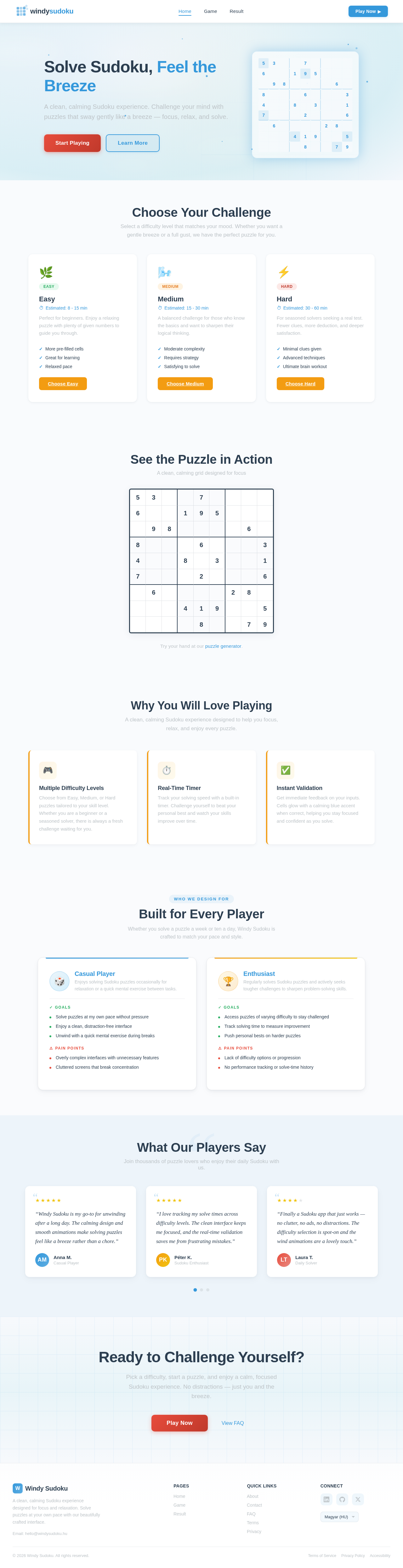
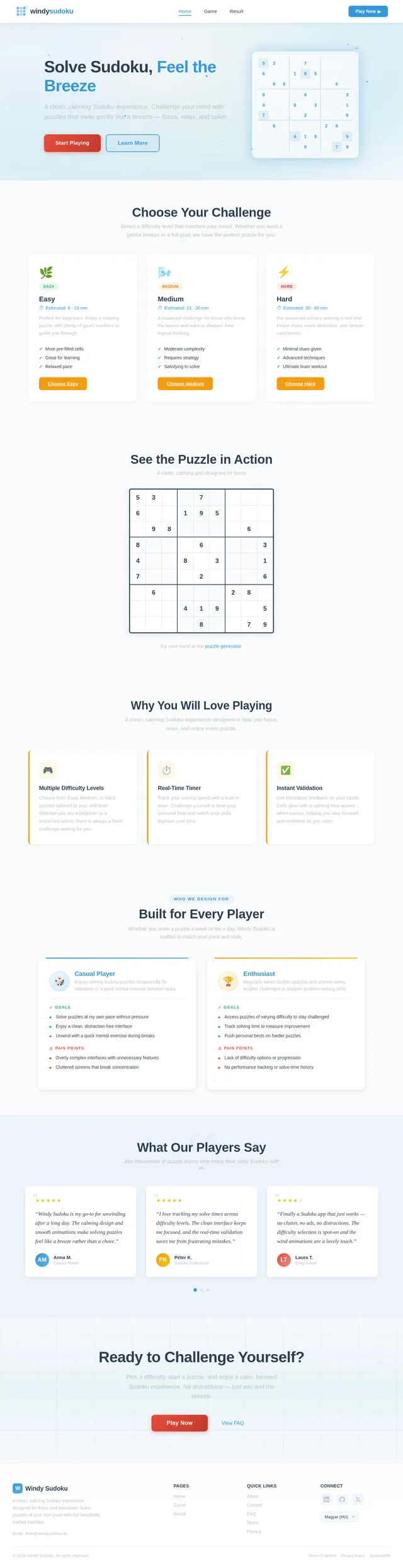
Solve Sudoku, Feel the Breeze
A clean, calming Sudoku experience. Challenge your mind with puzzles that sway gently like a breeze — focus, relax, and solve.
Choose Your Challenge
Select a difficulty level that matches your mood. Whether you want a gentle breeze or a full gust, we have the perfect puzzle for you.
Easy
Estimated: 8 - 15 minPerfect for beginners. Enjoy a relaxing puzzle with plenty of given numbers to guide you through.
- ✓More pre-filled cells
- ✓Great for learning
- ✓Relaxed pace
Medium
Estimated: 15 - 30 minA balanced challenge for those who know the basics and want to sharpen their logical thinking.
- ✓Moderate complexity
- ✓Requires strategy
- ✓Satisfying to solve
Hard
Estimated: 30 - 60 minFor seasoned solvers seeking a real test. Fewer clues, more deduction, and deeper satisfaction.
- ✓Minimal clues given
- ✓Advanced techniques
- ✓Ultimate brain workout
See the Puzzle in Action
A clean, calming grid designed for focus
Try your hand at our puzzle generator.
Why You Will Love Playing
A clean, calming Sudoku experience designed to help you focus, relax, and enjoy every puzzle.
Multiple Difficulty Levels
Choose from Easy, Medium, or Hard puzzles tailored to your skill level. Whether you are a beginner or a seasoned solver, there is always a fresh challenge waiting for you.
Real-Time Timer
Track your solving speed with a built-in timer. Challenge yourself to beat your personal best and watch your skills improve over time.
Instant Validation
Get immediate feedback on your inputs. Cells glow with a calming blue accent when correct, helping you stay focused and confident as you solve.
Built for Every Player
Whether you solve a puzzle a week or ten a day, Windy Sudoku is crafted to match your pace and style.
Casual Player
Enjoys solving Sudoku puzzles occasionally for relaxation or a quick mental exercise between tasks.
✓Goals
- Solve puzzles at my own pace without pressure
- Enjoy a clean, distraction-free interface
- Unwind with a quick mental exercise during breaks
⚠Pain Points
- Overly complex interfaces with unnecessary features
- Cluttered screens that break concentration
Enthusiast
Regularly solves Sudoku puzzles and actively seeks tougher challenges to sharpen problem-solving skills.
✓Goals
- Access puzzles of varying difficulty to stay challenged
- Track solving time to measure improvement
- Push personal bests on harder puzzles
⚠Pain Points
- Lack of difficulty options or progression
- No performance tracking or solve-time history
What Our Players Say
Join thousands of puzzle lovers who enjoy their daily Sudoku with us.
“Windy Sudoku is my go-to for unwinding after a long day. The calming design and smooth animations make solving puzzles feel like a breeze rather than a chore.”
“I love tracking my solve times across difficulty levels. The clean interface keeps me focused, and the real-time validation saves me from frustrating mistakes.”
“Finally a Sudoku app that just works — no clutter, no ads, no distractions. The difficulty selection is spot-on and the wind animations are a lovely touch.”
Ready to Challenge Yourself?
Pick a difficulty, start a puzzle, and enjoy a calm, focused Sudoku experience. No distractions — just you and the breeze.
No comments yet. Be the first!