wild-ambulance
 Shivakumar Patil
Build a production-ready web + mobile compatible application called "Smart Ambulance System". GOAL: Create a real-time ambulance booking and intelligent traffic clearance system that reduces emergency response time using live tracking and AI-based signal control. -------------------------------------- CORE FEATURES: 1. USER SIDE: - Login/Signup (JWT आधारित authentication) - Live map (Leaflet.js or Google Maps) - Show: - User location - Nearby hospitals - Available ambulances - "Book Ambulance" button 2. AMBULANCE TRACKING: - Assign nearest ambulance automatically - Show real-time movement of ambulance on map - Use WebSockets for live updates 3. SMART TRAFFIC CLEARANCE SYSTEM: Implement 3-Level Intelligent Clearance: LEVEL 1 (1000 meters away): - Identify signals in route - Turn signals green sequentially LEVEL 2 (500 meters away): - Override nearby traffic lights - Sync adjacent signals to prevent congestion LEVEL 3 (50 meters away): - Full priority mode - All signals green in ambulance path - Other lanes blocked - Simulate traffic signals using backend logic (Node.js) - Store signal data and states in database 4. ROUTE OPTIMIZATION: - Calculate fastest route using traffic data - Re-route dynamically if congestion occurs 5. HOSPITAL INTEGRATION: - Notify hospital when ambulance is booked - Send ETA and patient details 6. ADMIN DASHBOARD: - Monitor all ambulances - Control traffic signals manually if needed - View analytics (response time, distance, usage) -------------------------------------- TECH STACK: Frontend: - React.js (with Tailwind CSS) - Map integration (Leaflet.js) Backend: - Node.js + Express.js Database: - MongoDB Real-time: - WebSockets (Socket.io) Deployment: - Dockerized services - CI/CD pipeline -------------------------------------- ADVANCED FEATURES: - AI module to predict traffic congestion based on time/history - Priority scoring system for multiple ambulances - Emergency escalation mode -------------------------------------- OUTPUT REQUIREMENTS: - Complete frontend + backend code - Folder structure - API documentation - Database schema - Docker setup - Deployment guide - Test cases -------------------------------------- UI REQUIREMENTS: - Modern glassmorphism UI - Real-time map dashboard - Animated ambulance movement - Status indicators (En route, Arrived, Completed) -------------------------------------- DELIVERABLE: A fully working, deployable MVP that can be run locally and scaled to production.



Comments (0)
Sign in to leave a comment
Project Tasks26
Implement Theme and Structure
As a developer, I want to implement the global theme and structure across all scaffold pages so that they look exactly identical to the mock-design pages. This includes applying the color palette (#F5F9FF background, #FFFFFF surface, #1A1A1A text, #FF6F61 accent, #A3B4C4 muted), typography, layout structure, and removing any pages not needed by the application. Scope: update Home, Login, Signup, Welcome, Dashboard/Overview, Dashboard/AI-Assistant, Dashboard/Settings pages to match design system; remove unused pages.
Implement Ambulance Booking API
As a user, I want to use the backend API for ambulance booking so that the system automatically assigns the nearest available ambulance based on location, availability, and type (e.g., ICU-equipped) and returns booking confirmation with ETA. Includes POST /bookings endpoint, nearest ambulance assignment algorithm, ambulance availability filtering, and booking record creation in MongoDB.
Build Landing Page
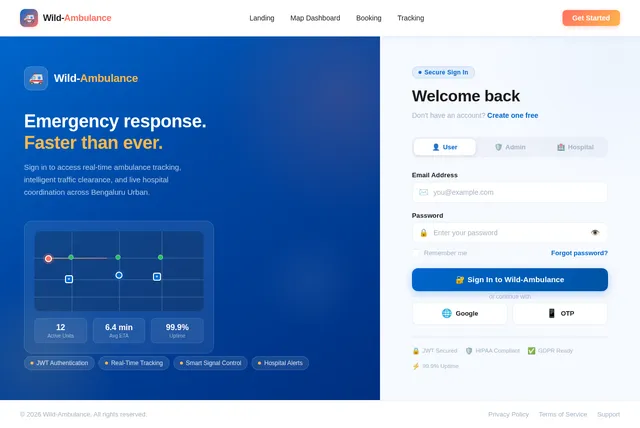
As a user, I want to use the Landing page so that I can view information about the Wild-Ambulance system, navigate to Login or Register. Implement based on existing Landing (v2) JSX design. Features include interactive 3D cityscape map view, animated ambulance icons, pulsating user location marker, traffic signal simulation visuals, ambient gradient background effects, and CTAs linking to Login and Signup pages.
Build Login Page
As a user, I want to use the Login page so that I can sign in with my credentials using JWT-based authentication and be redirected to the appropriate dashboard (User Map Dashboard, Admin Dashboard, or Hospital Dashboard). Implement based on existing Login (v2) JSX design. Connects from Landing page and links to Signup page.
Build Signup Page
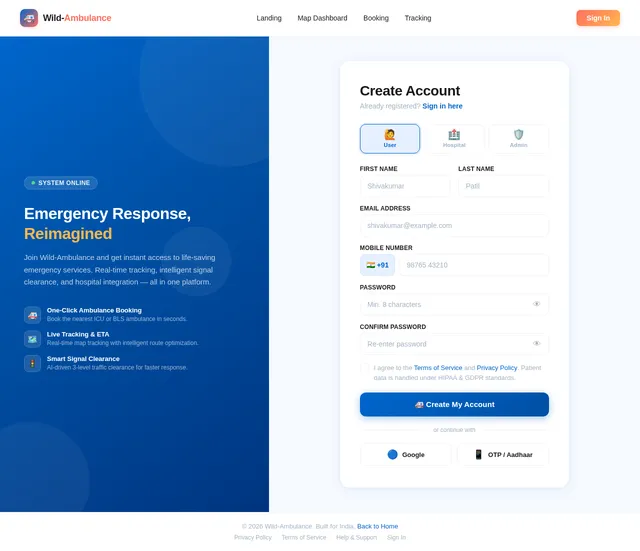
As a user, I want to use the Signup page so that I can create a new account with JWT-based authentication and access the system. Implement based on existing Signup (v2) JSX design. Accessible from Landing page registration CTA and Login page link.
Implement Real-Time Tracking API
As a user, I want to use the backend WebSocket API for real-time ambulance tracking so that live ambulance position updates are streamed to the Tracking page and Hospital Dashboard. Includes WebSocket endpoint for ambulance location broadcasts, position update ingestion from ambulance clients, and ETA recalculation on each update.
Implement Traffic Signal Simulation API
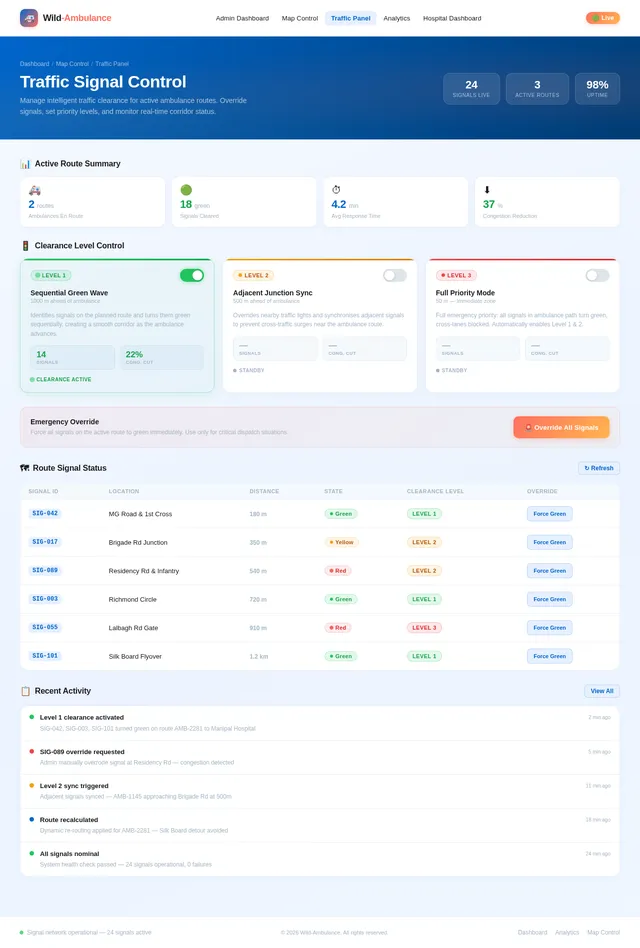
As a system, I want to use the backend API for traffic signal simulation so that signal states are stored in MySQL, and the three-level intelligent clearance logic (Level 1: 1000m, Level 2: 500m, Level 3: 50m) is applied dynamically based on ambulance proximity. Includes signal state CRUD endpoints, level-based override logic, sequential green signal sequencing, and adjacent signal sync.
Build Map Dashboard Page
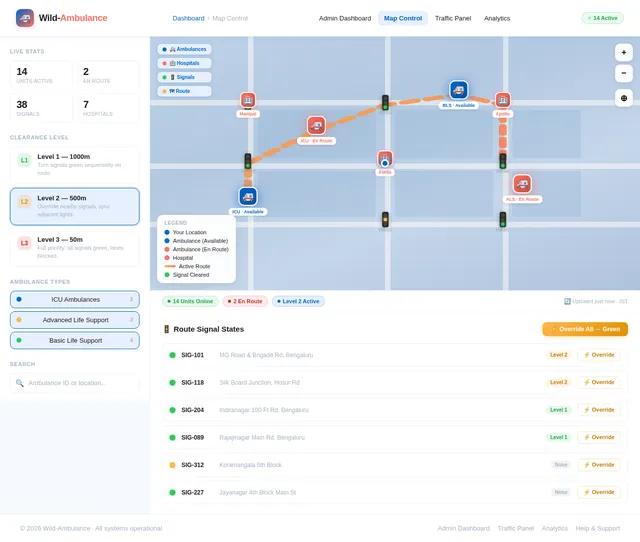
As a user, I want to use the Map Dashboard page so that I can view my location, nearby hospitals, and available ambulances on a live Leaflet.js map and initiate ambulance booking. Implement based on existing Map Dashboard (v2) JSX design. Features include live map with user location marker, nearby hospital icons, available ambulance icons with hover details, and a prominent 'Book Ambulance' button. Connects from Login and links to Booking page.
Build Admin Dashboard Page
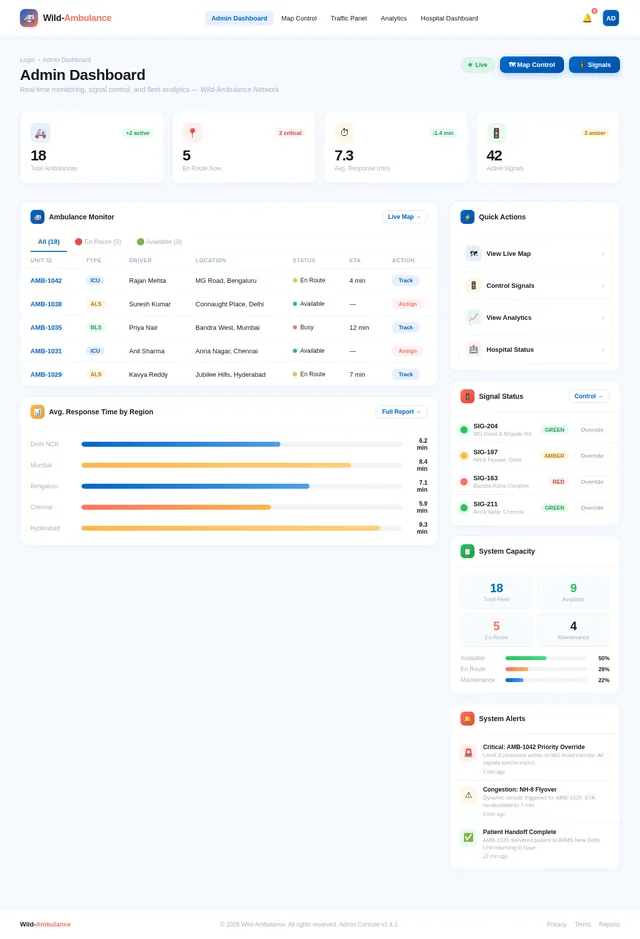
As an admin, I want to use the Admin Dashboard page so that I can view analytics, monitor all ambulances in real-time, and navigate to map control and analytics sections. Implement based on existing Admin Dashboard (v2) JSX design. Features include summary cards (active ambulances, ongoing bookings, avg response time), quick navigation to Map Control and Analytics, and real-time status overview. Connects from Login.
Build Hospital Dashboard Page
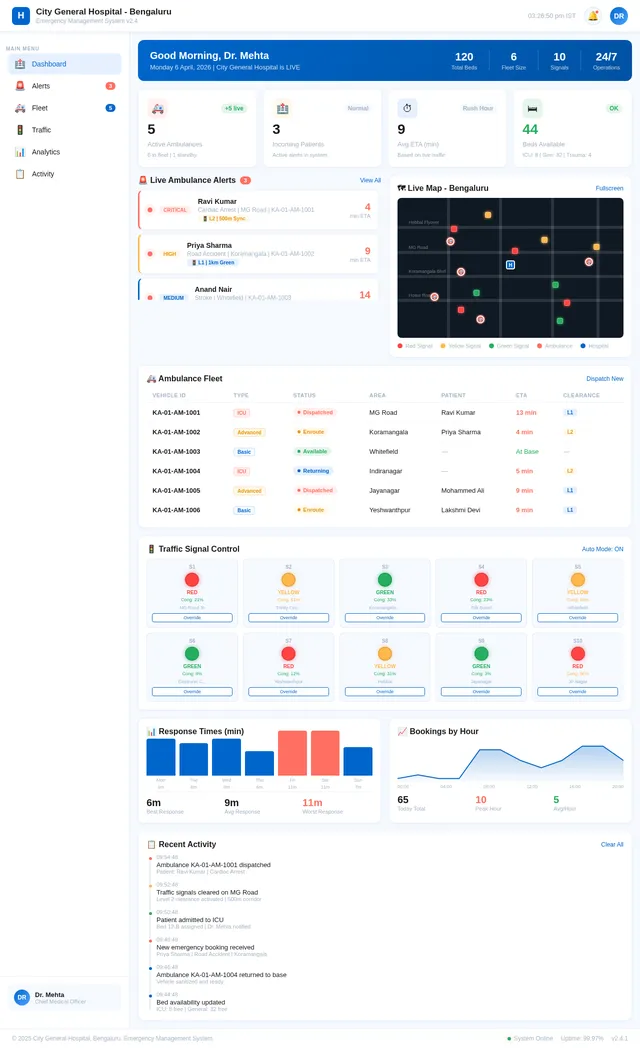
As a hospital staff member, I want to use the Hospital Dashboard page so that I can view notifications about incoming ambulances, update patient status, and manage incoming alerts. Implement based on existing Hospital Dashboard (v2) JSX design. Features include notification feed, incoming booking alerts, status update controls, and ETA display. Connects from Login.
Implement Route Optimization API
As a system, I want to use the backend API for route optimization so that the fastest ambulance route is calculated using real-time traffic data and dynamically re-routed if congestion is detected. Includes integration with traffic data source, shortest/fastest path calculation, congestion detection logic, and dynamic re-routing endpoint.
Implement Hospital Notification API
As a system, I want to use the backend API for hospital notifications so that when an ambulance is booked, the assigned hospital is automatically notified with ETA and patient details via WebSocket and/or push notification. Includes POST /notifications endpoint, hospital WebSocket channel, patient detail payload construction, and ETA update broadcasts.
Implement Admin Control API
As an admin, I want to use the backend API for admin controls so that I can manually override traffic signals, view all active ambulances and their statuses, and retrieve analytics data (response times, distances, usage stats). Includes GET /ambulances, PATCH /signals/:id/override, GET /analytics endpoints with role-based access control.
Build Booking Page
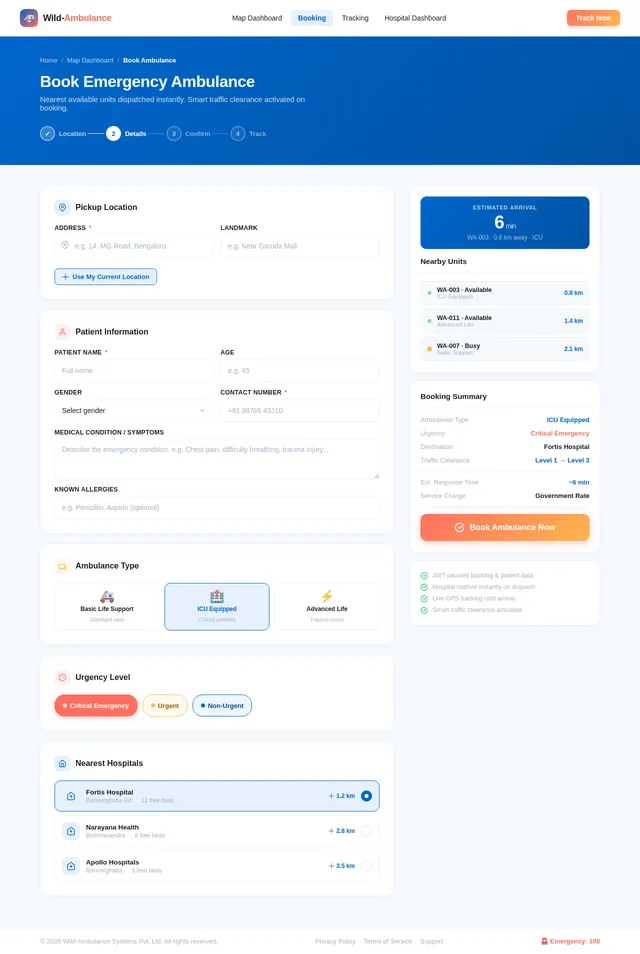
As a user, I want to use the Booking page so that I can book the nearest available ambulance with a single click and receive booking confirmation. Implement based on existing Booking (v2) JSX design. Displays nearest ambulance options (type, ETA, distance), confirms booking, and transitions to the Tracking page.
Build Map Control Page
As an admin, I want to use the Map Control page so that I can view a live map of all ambulances, traffic signals, and routes, and manually override traffic signals if needed. Implement based on existing Map Control (v2) JSX design. Features include live Leaflet.js map with ambulance positions, traffic signal overlays with manual toggle controls, route visualization, and real-time updates via WebSockets. Connects from Admin Dashboard.
Build Analytics Page
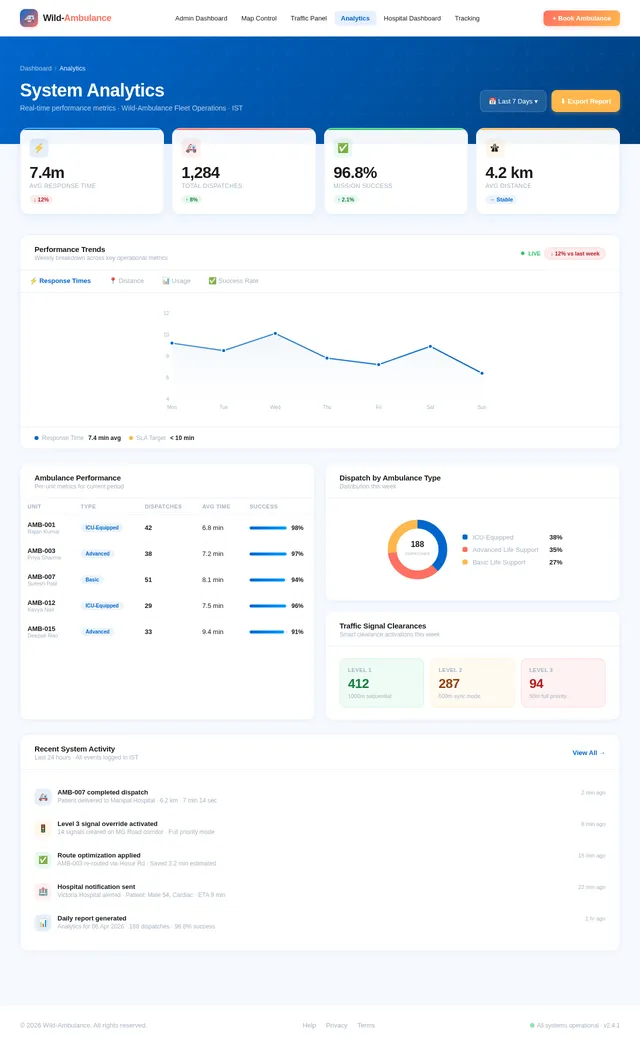
As an admin, I want to use the Analytics page so that I can view detailed reports on response times, distances covered, and usage statistics to monitor system performance. Implement based on existing Analytics (v2) JSX design. Features include response time charts, distance statistics, usage graphs, and filterable report tables. Connects from Admin Dashboard.
Build Incoming Alert Page
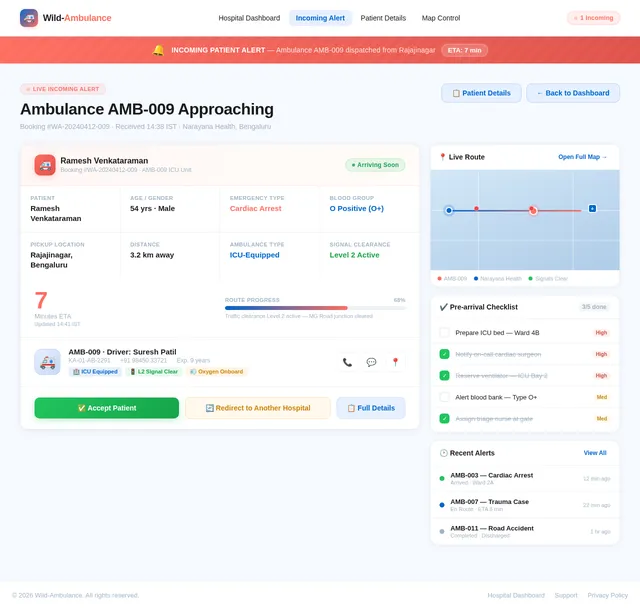
As a hospital staff member, I want to use the Incoming Alert page so that I can view details of a newly booked ambulance dispatched to my hospital including booking info and patient summary. Implement based on existing Incoming Alert (v2) JSX design. Features include booking ID, ambulance type, estimated arrival time, and initial patient info. Connects from Hospital Dashboard.
Integrate Map Dashboard with APIs
As a user, I want to use the Map Dashboard frontend so that it connects to live ambulance, hospital, and user location APIs, displaying real-time data on the Leaflet.js map. Wire up GET /ambulances/nearby, GET /hospitals/nearby, and user geolocation to the Map Dashboard (v2) page components.
Implement AI Traffic Prediction Module
As a system, I want to use an AI API for traffic congestion prediction so that historical and time-based data is used to forecast congestion, enabling proactive ambulance re-routing and signal pre-clearing. Uses GPT-based model via LiteLLM for intelligent route suggestions and priority scoring for multiple ambulances.
Build Tracking Page
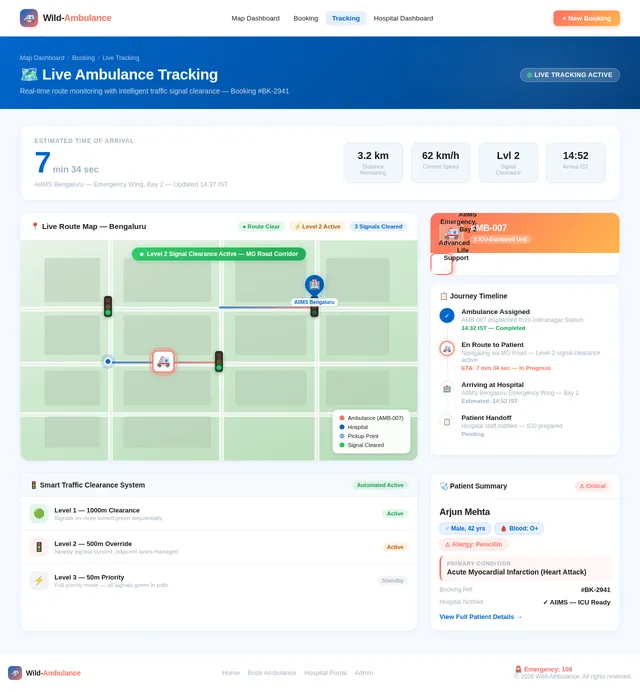
As a user, I want to use the Tracking page so that I can live-track the assigned ambulance on a map and view real-time ETA updates via WebSockets. Implement based on existing Tracking (v2) JSX design. Features include live ambulance movement on map, ETA display, status indicators (En Route, Arrived, Completed), and animated ambulance icon. Connects from Booking page.
Build Traffic Panel Page
As an admin, I want to use the Traffic Panel page so that I can view and manually control individual traffic signals, see their current states, and apply level-based overrides for ambulance routing. Implement based on existing Traffic Panel (v2) JSX design. Features include signal state grid, manual override toggles, level 1/2/3 clearance buttons, and live status updates. Connects from Map Control.
Build Patient Details Page
As a hospital staff member, I want to use the Patient Details page so that I can review comprehensive patient information and live ETA of the incoming ambulance to prepare for patient reception. Implement based on existing Patient Details (v2) JSX design. Features include patient medical info, real-time ETA countdown, ambulance tracking mini-map, and status indicators. Connects from Incoming Alert.
Integrate Analytics Page with APIs
As an admin, I want to use the Analytics frontend page so that it fetches and visualizes response time, distance, and usage data from the Admin Control API with filterable charts and tables. Wire up GET /analytics to the Analytics (v2) page components.
Integrate Tracking Page with WebSockets
As a user, I want to use the Tracking page frontend so that it receives live ambulance position updates via WebSockets and animates the ambulance movement on the map with ETA refreshes. Wire up the real-time tracking WebSocket to the Tracking (v2) page.
Integrate Traffic Panel with Signal API
As an admin, I want to use the Traffic Panel frontend so that it displays live signal states from the backend and allows manual override actions via the Traffic Signal Simulation API. Wire up signal state WebSocket and override API calls to the Traffic Panel (v2) page.
Integrate Hospital Dashboard with Notifications API
As a hospital staff member, I want to use the Hospital Dashboard frontend so that it receives real-time booking notifications via WebSocket and displays incoming alert details linked to the Incoming Alert and Patient Details pages. Wire up hospital notification WebSocket to the Hospital Dashboard (v2) and Incoming Alert (v2) pages.

Emergency Response Redefined
Real-time ambulance booking with intelligent traffic clearance. Faster routes, smarter signals, lives saved.
Live City Map
Real-time ambulance tracking and traffic clearance
Everything You Need for Faster Emergency Response
Wild-Ambulance combines real-time tracking, AI routing, and smart traffic clearance to save lives when every second counts.
Real-Time Tracking
Monitor ambulance movement live on the map with GPS-powered precision. Know exactly where your ambulance is, every second of the journey.
Intelligent Traffic Clearance
Our three-level smart signal system automatically clears traffic as the ambulance approaches, reducing delays at every intersection.
Hospital Notifications
Hospitals receive instant alerts with patient details and ETA so emergency teams can prepare before the ambulance arrives.
AI-Powered Routing
Dynamic route optimization using real-time traffic data ensures the fastest possible path, automatically re-routing if congestion occurs.
Book an Ambulance in 4 Simple Steps
From sign-in to real-time tracking, our streamlined process ensures help reaches you in the fastest time possible.
Sign In
Create your account or log in securely with JWT-based authentication to access emergency services instantly.
Find Ambulance
View your live location, nearby hospitals, and available ambulances on an interactive real-time map.
Book Instantly
Book the nearest available ambulance with a single tap. The system auto-assigns based on proximity and type.
Track in Real-Time
Follow your ambulance live on the map with smart traffic clearance ensuring the fastest route to you.
Built for Life-Saving Speed
Every second counts in an emergency. Wild-Ambulance combines cutting-edge technology with seamless hospital coordination to deliver faster, smarter response.
Faster Response Times
AI-powered dispatch ensures the nearest ambulance reaches you in minutes, cutting average response times by up to 40%.
Live Tracking
Track your assigned ambulance in real-time on an interactive map with accurate ETA updates every few seconds.
AI-Optimized Routes
Smart traffic clearance across three levels dynamically reroutes ambulances, avoiding congestion and reducing delays.
Hospital Integration
Hospitals are notified instantly with patient details and ETA, so the emergency team is prepped before arrival.
Powerful Admin Controls
Monitor your entire fleet, override traffic signals in real-time, and track performance metrics from a single unified dashboard.
Monitor All Ambulances
Track every ambulance in your fleet with live GPS positioning, status updates, and instant alerts for critical events.
24
Active
8
En Route
Manual Traffic Control
Override traffic signals manually with 3-level intelligent clearance. Ensure ambulances reach destinations without delays.
Sig A-12
Sig B-07
Override
Real-Time Analytics
View response times, route efficiency, and usage statistics with interactive charts and exportable reports.
4.2m
Avg Response
98.7%
On-Time Rate
1.2K
This Month
Trusted by Healthcare Professionals
See how Wild-Ambulance is helping hospitals, administrators, and emergency teams save more lives every day.
“Wild-Ambulance has transformed our emergency intake process. We now receive patient details and accurate ETAs before the ambulance even arrives, giving us critical preparation time.”
“The intelligent traffic clearance system is remarkable. Average response times in our district dropped by 40% within the first month of deployment. This technology saves lives every day.”
“As hospital staff, the real-time notifications are invaluable. We can prepare the right team, equipment, and bed assignment well before the patient arrives at our doors.”
“The admin dashboard gives us complete visibility over our entire ambulance fleet. Manual signal override during peak emergencies has been a game-changer for our operations.”
Ready to Transform Emergency Response?
Join hundreds of hospitals, administrators, and users who trust Wild-Ambulance for faster emergency medical transport with AI-powered routing and intelligent traffic clearance.
Frequently Asked Questions
Everything you need to know about Wild-Ambulance and how our emergency response system works.
Booking an ambulance is simple. Log in to your Wild-Ambulance account, allow location access, and tap "Book Now." Our system will automatically assign the nearest available ambulance based on your location, the ambulance type you need, and real-time traffic data. The entire process takes just seconds.
Absolutely. Wild-Ambulance is fully GDPR and HIPAA compliant. All patient data is encrypted end-to-end, and we use JWT-based authentication to protect your account. Your personal health information is never shared with third parties without your explicit consent.
Our intelligent traffic clearance system operates at three levels to minimize delays. As the ambulance approaches intersections, traffic signals are automatically turned green along its route. If unexpected congestion occurs, our AI dynamically re-routes the ambulance in real time. You can track the ambulance live on the map for up-to-the-second ETA updates.
The system operates at three proximity levels. At 1,000 meters, signals along the route begin turning green sequentially. At 500 meters, nearby traffic lights are overridden and adjacent signals sync to prevent congestion. At 50 meters, full priority mode activates, turning all signals green in the ambulance path and blocking other lanes.
Yes. As soon as an ambulance is booked, the destination hospital is automatically notified with the estimated time of arrival and available patient details. This allows the emergency department to prepare resources, staff, and equipment before the patient arrives, significantly improving outcomes.
Wild-Ambulance supports multiple ambulance types including basic life support (BLS), advanced life support (ALS), and ICU-equipped units. When you book, the system considers both proximity and the type of medical emergency to assign the most appropriate vehicle for your situation.
Yes. Our platform is designed for both urban and rural coverage. While response times may vary based on ambulance availability and distance, our AI-powered route optimization ensures the fastest possible response regardless of location. We are continuously expanding our network of partner hospitals and ambulance providers.
Still have questions? Get in touch with our team
No comments yet. Be the first!