vivid-microservice
 Netfotech Team AI
Microservice Kubernetes Deployment Agent

Comments (0)
Sign in to leave a comment
System Requirements
System Requirements Document (SRD) for vivid-microservice
1. Introduction
This document outlines the system requirements for the vivid-microservice project, a microservice deployment automation agent designed to streamline and manage deployments on Kubernetes. The project focuses on automating CI/CD pipelines, ensuring efficient, consistent, and scalable deployment processes. This document serves as a guide for the development and implementation of the vivid-microservice system.
2. System Overview
The vivid-microservice project is a deployment automation agent tailored for Kubernetes environments. It aims to simplify the deployment process by integrating with CI/CD tools, automating workflows, and ensuring seamless scalability for distributed microservices. The system will support multiple CI/CD tools, enabling flexibility and adaptability for diverse development pipelines. The project is designed with a focus on deployment automation, reliability, and ease of use, catering to the needs of development and operations teams.
Key features include:
- Integration with popular CI/CD tools such as Jenkins, GitHub Actions, and ArgoCD.
- Automated deployment workflows for Kubernetes clusters.
- Scalability to handle distributed microservices.
- Support for both manual and automated deployment processes.
3. Functional Requirements
The functional requirements for the vivid-microservice project are as follows:
- As a DevOps Engineer, I should be able to integrate the system with multiple CI/CD tools like Jenkins, GitHub Actions, and ArgoCD.
- As a Developer, I should be able to trigger automated deployments to Kubernetes clusters via the CI/CD pipeline.
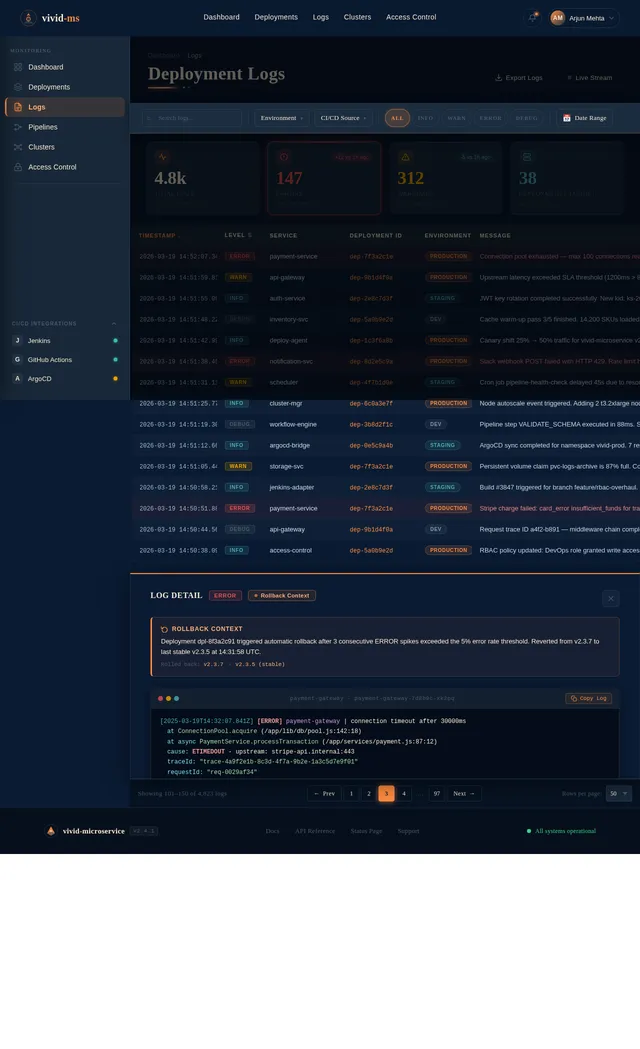
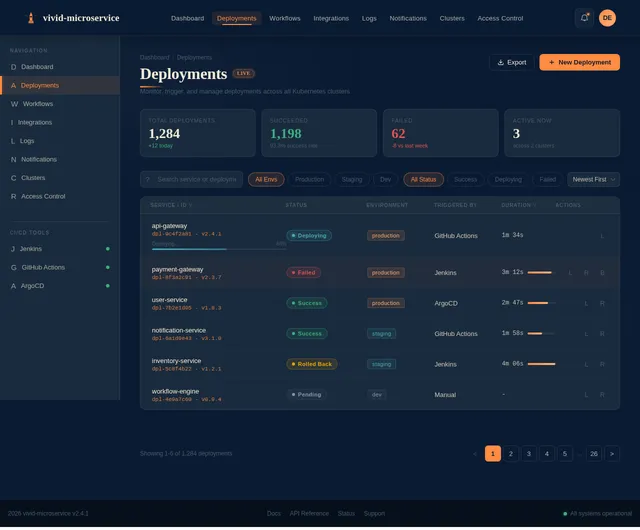
- As a System Administrator, I should be able to monitor deployment logs and statuses in real-time.
- As a DevOps Engineer, I should be able to configure deployment workflows for different environments (e.g., staging, production).
- As a Developer, I should be able to roll back deployments to a previous stable version in case of failure.
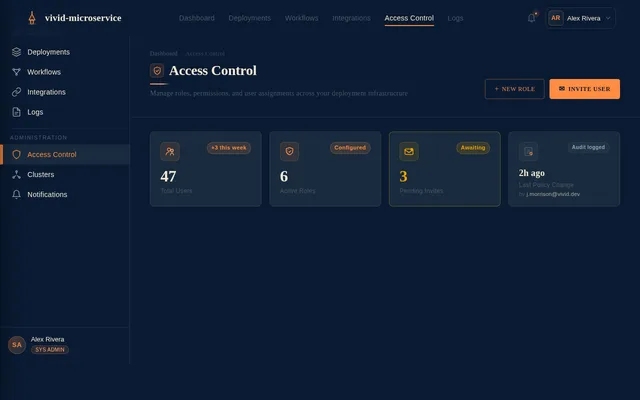
- As a System Administrator, I should be able to manage access control and permissions for deployment operations.
- As a DevOps Engineer, I should be able to define custom deployment strategies (e.g., blue-green, canary).
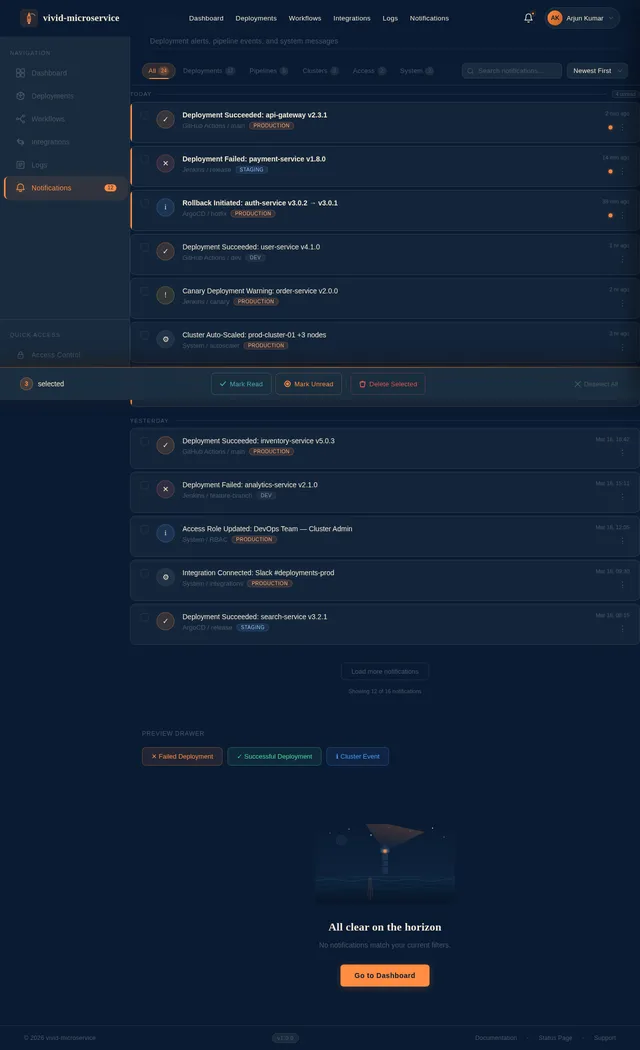
- As a Developer, I should be notified of deployment success or failure through integrated notification systems (e.g., Slack, email).
- As a System Administrator, I should be able to scale the system to support multiple Kubernetes clusters.
4. User Personas
The vivid-microservice system is designed for the following user personas:
-
DevOps Engineer
Responsible for configuring and maintaining CI/CD pipelines, managing deployment workflows, and ensuring smooth integration with Kubernetes. -
Developer
Focused on deploying code changes, monitoring deployment statuses, and receiving notifications about deployment outcomes. -
System Administrator
Oversees the system's operational health, manages access control, and ensures scalability and reliability of the deployment process.
5. Creative Reference Stories (AI Inspiration)
Based on the project's focus on deployment automation and Kubernetes, the Stormy Ocean Authority design story is selected as inspiration. This story's cinematic, powerful, and resilient mood aligns well with the robust and scalable nature of the vivid-microservice system.
6. Visuals Colors and Theme
The visual design for vivid-microservice will reflect the project's focus on stability, resilience, and authority. A unique, ocean-inspired dark theme will be used, with fresh and original color codes:
- Background: #0A1B33 (deep navy with a hint of indigo)
- Surface: #1C2E40 (muted blue-gray tones)
- Text: #F5E9D2 (warm ivory)
- Accent: #FF8C42 (soft tangerine for highlights)
- Muted Tones: #4A5A6A (subtle gray-blue for secondary elements)
The typography will feature:
- Headings: Dramatic serif font, weight 700, for a commanding presence.
- Body Text: Clean light sans-serif font, weight 300, for readability.
The layout will emphasize generous negative space, low density, and a cinematic fullscreen hero section.
7. Signature Design Concept
The homepage of vivid-microservice will feature a dynamic ocean storm visualization. The background will depict a layered, dark ocean scene with subtle wave animations and a lighthouse beam sweeping across the screen. The headline will emerge slowly from the darkness, accompanied by a glowing call-to-action (CTA) button styled like a guiding light. Subtle parallax effects will create depth, and the motion design will be slow and intentional, reflecting the system's stability and authority.
Interactive elements, such as buttons and cards, will have a soft glow and translate upward slightly on hover, reinforcing the theme of resilience and guidance. The overall experience will feel cinematic and powerful, leaving a lasting impression on users.
8. Non-Functional Requirements
- Performance: The system must handle up to 10,000 concurrent deployment requests without performance degradation.
- Scalability: The system must support scaling across multiple Kubernetes clusters.
- Reliability: The system must achieve 99.9% uptime to ensure continuous deployment availability.
- Security: The system must implement role-based access control (RBAC) and secure communication protocols (e.g., HTTPS).
- Compatibility: The system must integrate seamlessly with Jenkins, GitHub Actions, and ArgoCD.
- Usability: The system must provide an intuitive user interface for configuring and monitoring deployments.
9. Tech Stack
The following technologies will be used for the vivid-microservice project:
Frontend
- React: For building the web-based user interface.
Backend
- Python: For backend logic and API development.
- FastAPI: For creating high-performance APIs.
Database
- MySQL: For relational data storage, with Alembic for migrations.
AI Tools
- Litellm: For LLM routing.
- Langchain: For workflow orchestration.
Orchestration
- Docker: For local containerization.
- Kubernetes: For server-side orchestration and scaling.
10. Assumptions and Constraints
- The system assumes that users have access to Kubernetes clusters with appropriate permissions.
- The system will primarily target CI/CD tools like Jenkins, GitHub Actions, and ArgoCD, with limited support for other tools.
- The system will operate in the Indian timezone (IST) by default.
- The system will use INR as the default currency for any cost-related metrics.
11. Glossary
- CI/CD: Continuous Integration and Continuous Deployment, a methodology for automating software development and deployment.
- Kubernetes: An open-source platform for managing containerized workloads and services.
- RBAC: Role-Based Access Control, a method of restricting system access to authorized users.
- Parallax: A design effect where background elements move slower than foreground elements, creating a sense of depth.
This document provides a comprehensive overview of the vivid-microservice project, ensuring alignment with the user's requirements and delivering a robust, scalable, and visually compelling system.
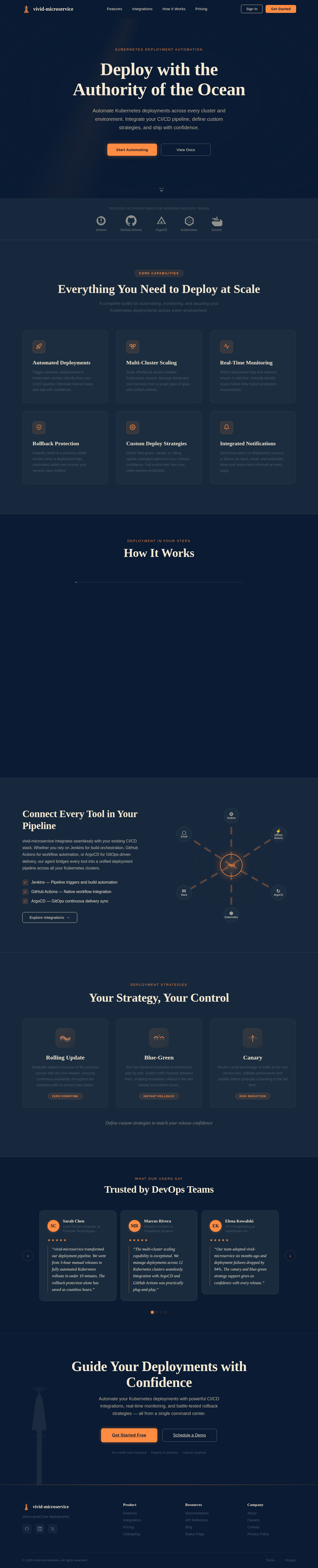
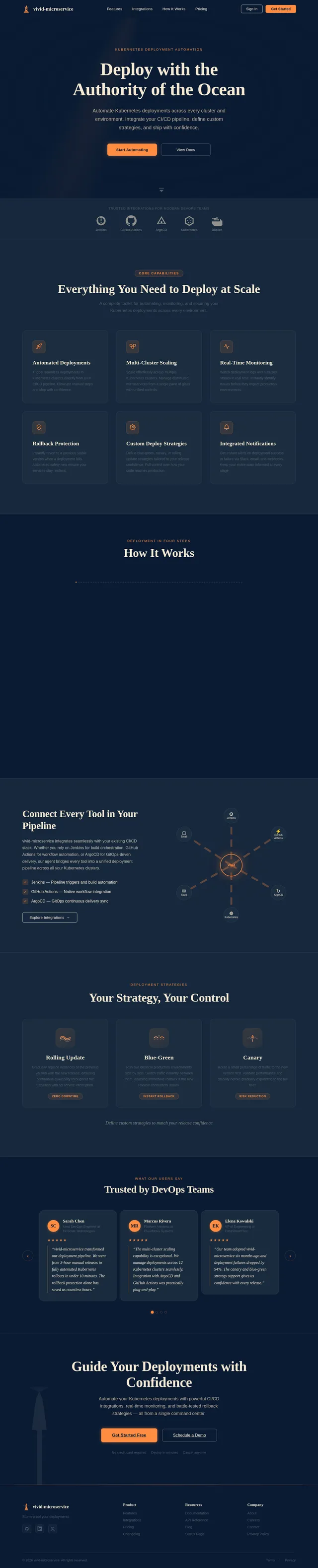
Deploy with the
Authority of the Ocean
Automate Kubernetes deployments across every cluster and environment. Integrate your CI/CD pipeline, define custom strategies, and ship with confidence.
Trusted integrations for modern DevOps teams
Everything You Need to Deploy at Scale
A complete toolkit for automating, monitoring, and securing your Kubernetes deployments across every environment.
Automated Deployments
Trigger seamless deployments to Kubernetes clusters directly from your CI/CD pipeline. Eliminate manual steps and ship with confidence.
Multi-Cluster Scaling
Scale effortlessly across multiple Kubernetes clusters. Manage distributed microservices from a single pane of glass with unified controls.
Real-Time Monitoring
Watch deployment logs and statuses stream in real time. Instantly identify issues before they impact production environments.
Rollback Protection
Instantly revert to a previous stable version when a deployment fails. Automated safety nets ensure your services stay resilient.
Custom Deploy Strategies
Define blue-green, canary, or rolling update strategies tailored to your release confidence. Full control over how your code reaches production.
Integrated Notifications
Get instant alerts on deployment success or failure via Slack, email, and webhooks. Keep your entire team informed at every stage.
How It Works
Connect Your CI/CD Tool
Link Jenkins, GitHub Actions, or ArgoCD to your vivid-microservice workspace in a single click.
Configure Environments
Define staging, production, and custom environments with namespace mapping and resource limits.
Trigger Deployment
Push to your pipeline or manually deploy with blue-green, canary, or rolling strategies.
Monitor & Rollback
Track deployment health in real time and instantly roll back to any stable version if needed.
# vivid-microservice deployment configapiVersion: vivid/v1kind: DeploymentPlanmetadata:name: api-gatewayenvironment: productionspec:strategy: blue-greenreplicas: 3rollback:enabled: truemaxRevisions: 5notifications:- channel: slack- channel: email
Connect Every Tool in Your Pipeline
vivid-microservice integrates seamlessly with your existing CI/CD stack. Whether you rely on Jenkins for build orchestration, GitHub Actions for workflow automation, or ArgoCD for GitOps-driven delivery, our agent bridges every tool into a unified deployment pipeline across all your Kubernetes clusters.
- Jenkins — Pipeline triggers and build automation
- GitHub Actions — Native workflow integration
- ArgoCD — GitOps continuous delivery sync
Your Strategy, Your Control
Rolling Update
Gradually replace instances of the previous version with the new release, ensuring continuous availability throughout the transition with no service interruption.
Zero DowntimeBlue-Green
Run two identical production environments side by side. Switch traffic instantly between them, enabling immediate rollback if the new release encounters issues.
Instant RollbackCanary
Route a small percentage of traffic to the new version first. Validate performance and stability before gradually expanding to the full fleet.
Risk ReductionDefine custom strategies to match your release confidence
Trusted by DevOps Teams
“vivid-microservice transformed our deployment pipeline. We went from 3-hour manual releases to fully automated Kubernetes rollouts in under 10 minutes. The rollback protection alone has saved us countless hours.”
“The multi-cluster scaling capability is exceptional. We manage deployments across 12 Kubernetes clusters seamlessly. Integration with ArgoCD and GitHub Actions was practically plug-and-play.”
“Our team adopted vivid-microservice six months ago and deployment failures dropped by 94%. The canary and blue-green strategy support gives us confidence with every release.”
“Real-time monitoring and instant Slack notifications mean we catch issues before they impact users. The access control features are perfect for our compliance requirements.”
“We evaluated five deployment tools before choosing vivid-microservice. The Jenkins integration was seamless, and our developers love the intuitive workflow configuration. Truly storm-proof.”
“From staging to production across multiple environments, vivid-microservice handles it all. Custom deployment strategies let us match our exact release cadence and risk tolerance.”
Guide Your Deployments with Confidence
Automate your Kubernetes deployments with powerful CI/CD integrations, real-time monitoring, and battle-tested rollback strategies — all from a single command center.
No credit card required·Deploy in minutes·Cancel anytime
No comments yet. Be the first!