verdant-system
 East Los
Act as a Principal MEV (Maximal Extractable Value) R&D Engineer and a Senior Solidity Security Auditor specializing in low-latency EVM arbitrage systems on high-throughput networks. I want to build a highly competitive, production-grade cross-DEX flash loan arbitrage bot for Polygon Mainnet. The architecture must be heavily inspired by the core structural philosophy of the 'pmuens/midas' framework but radically modernized to compete in today's cutthroat MEV environment. Generate the code base according to the exact architectural specifications, structural parameters, and execution protocols outlined below. --- ### 1. SYSTEM PARAMETERS & ENVIRONMENTAL BOUNDS - Network: Polygon Mainnet (Gas asset: POL / Base trading asset: Native USDC) - Flash Loan Source: Balancer V2 Vault (Address: 0xBA12222222228d8Ba445958a75a0704d566BF2C8) for 0% fee asset borrowing. - Target DEX Liquidity Pools: QuickSwap V2 (Uniswap V2 Clone) and SushiSwap V2. - Development Framework: Foundry (Solidity ^0.8.20) for the smart contracts; TypeScript (ethers.js v6) for the off-chain orchestration engine. --- ### 2. CORE COMPONENTS REQUIRED #### COMPONENT A: The Smart Contract ('MidasPolygonEngine.sol') Write a highly gas-optimized, production-ready Solidity contract that implements the Balancer V2 Flash Loan receiver interface ('IFlashLoanRecipient'). - Gas Optimization Rules: Optimize for bytecode compactness and minimal runtime overhead. Use custom errors instead of string require statements. Use 'unchecked {}' blocks for arithmetic loops and balance changes where overflow is mathematically impossible. Avoid high-level abstractions like routers. - Direct Pool Routing: The contract must execute swaps by calling the liquidity pool pair contracts directly via '.swap()' instead of using high-level router contracts (like QuickSwapRouter). - Strict Execution Safety: Implement a bulletproof safeguard. At the end of the callback function—immediately before the Balancer Vault pulls back the loan principal—the contract must verify that the ending balance of the profit token (USDC) is greater than the starting balance plus an off-chain parameterized 'minProfitThreshold'. If this condition fails, the contract must explicitly revert the entire transaction transaction string to prevent capital loss. - Access Control: Secure the trigger mechanism so that only the owner's monitoring bot address can call the execution entry point, completely preventing external actors from frontrunning or hijacking the execution. #### COMPONENT B: The Node Engine ('monitor.ts') Write a highly optimized TypeScript orchestration script that acts as the real-time data ingestion and calculations hub. - Event-Driven Architecture: Do not use interval JSON-RPC block polling. Use a high-fidelity WebSocket provider ('wss://') to subscribe directly to the 'Sync(uint112,uint112)' or 'Swap' event logs emitted directly by the target QuickSwap and SushiSwap pair contracts. - Math Engine (Optimal Input Calculation): Implement the standard AMM optimal input amount formula for two constant-product (x * y = k) Uniswap V2 pairs to calculate the mathematically perfect input amount (A_in) that maximizes arbitrage yield given the exact reserves extracted from the latest 'Sync' logs. The equation must natively factor in the standard 0.3% fee modifier (gamma = 0.997). - MEV Guardrail & Private Relaying: Structure the transaction submission logic to bypass the public Polygon mempool entirely to prevent frontrunning and sandwich attacks. Integrate the transaction dispatch code with the FastLane Protocol API or Flashbots Polygon Builder endpoint, sending the execution payload as a private bundle. --- ### 3. OUTPUT SPECIFICATION Please provide the complete, functional code for both 'MidasPolygonEngine.sol' and 'monitor.ts'. Include explicit inline comments detailing the low-level data handoff between the off-chain TypeScript script and the contract's flash loan callback payload. Do not use placeholders or omit complex logic loops.


Comments (0)
Sign in to leave a comment
System Requirements
Verdant-System
Introduction
The Verdant-System is a highly competitive, production-grade cross-DEX flash loan arbitrage bot designed for the Polygon Mainnet. It is inspired by the core structural philosophy of the 'pmuens/midas' framework, but it has been modernized to thrive in today's competitive MEV (Maximal Extractable Value) environment. This document outlines the system requirements for the Verdant-System, focusing on its architecture, components, and operational protocols.
System Overview
The Verdant-System is designed to execute flash loan arbitrage opportunities across decentralized exchanges (DEXs) on the Polygon Mainnet. It leverages the Balancer V2 Vault for 0% fee asset borrowing and targets liquidity pools on QuickSwap V2 and SushiSwap V2. The system is built using Foundry for smart contracts and TypeScript for off-chain orchestration, ensuring high performance and security.
Functional Requirements
- As a Developer, I should be able to deploy a gas-optimized Solidity contract that implements the Balancer V2 Flash Loan receiver interface.
- As a Developer, I should ensure the contract executes swaps directly via liquidity pool pair contracts using '.swap()'.
- As a Developer, I should implement a safeguard to verify that the ending balance of the profit token (USDC) is greater than the starting balance plus a 'minProfitThreshold'.
- As a Developer, I should secure the contract's execution entry point so that only the owner's monitoring bot address can trigger it.
- As a Developer, I should write a TypeScript orchestration script that uses a WebSocket provider to subscribe to 'Sync' or 'Swap' event logs.
- As a Developer, I should implement the AMM optimal input amount formula for Uniswap V2 pairs to maximize arbitrage yield.
- As a Developer, I should structure transaction submission logic to bypass the public Polygon mempool and prevent frontrunning attacks.
User Personas
- Developer: Responsible for deploying and maintaining the smart contract and orchestration script. Ensures system security and performance.
- Bot Owner: Monitors the system and triggers execution entry points. Ensures the system operates within defined parameters.
Core User Flows
- Developer deploys the smart contract -> Developer writes and configures the TypeScript orchestration script -> Bot Owner monitors event logs -> Bot Owner triggers execution entry point -> Smart contract executes flash loan and swaps -> System verifies profit conditions -> Transaction is completed or reverted based on conditions.
Visuals Colors and Theme
- primary: #1A535C (Deep Teal)
- primary_light: #4ECDC4 (Light Teal)
- secondary: #FF6B6B (Coral Red)
- accent: #FFE66D (Sunshine Yellow)
- highlight: #FF9F1C (Vibrant Orange)
- bg: #F7FFF7 (Mint Cream)
- surface: rgba(26, 83, 92, 0.8)
- text: #011627 (Rich Black)
- text_muted: #7A7A7A (Gray)
- border: rgba(233, 69, 96, 0.2)
Signature Design Concept
The Verdant-System's landing page will feature an interactive 3D network map of the Polygon Mainnet, where each node represents a DEX or liquidity pool. Users can click on nodes to view real-time data and arbitrage opportunities. The map will be built using @react-three/fiber and @react-three/drei, allowing users to zoom, rotate, and explore the network. Hovering over nodes will display live data feeds, and clicking will trigger animations that visualize transaction flows and profit calculations.
Interaction Model & Motion Direction
- Interaction Model: Parallax
- Landing Page: The landing page will feature layered depth via scroll, with decorative layers translating at different speeds. Real content will scroll naturally, providing a visually rich first impression.
- Internal Pages: Static, focusing on layout clarity and minimal motion for data-heavy pages.
Non-Functional Requirements
- The system must operate with minimal latency to capitalize on arbitrage opportunities.
- Security measures must prevent unauthorized access and ensure transaction integrity.
- The system should handle high throughput without performance degradation.
Tech Stack
- Frontend: React for Web
- Backend: Solidity for smart contracts, TypeScript for orchestration
- Database: Not applicable
- AI Models: Not applicable
- Local Orchestration: Docker, docker-compose
- Server-side Orchestration: Kubernetes
Assumptions and Constraints
- The system assumes the availability of the Balancer V2 Vault and target DEX liquidity pools.
- The system is constrained by the Polygon Mainnet's network conditions and gas fees.
Glossary
- MEV (Maximal Extractable Value): The maximum value that can be extracted from block production in excess of the standard block reward and gas fees.
- DEX (Decentralized Exchange): A peer-to-peer marketplace where transactions occur directly between crypto traders.
- Flash Loan: A type of uncollateralized loan that must be borrowed and repaid within a single transaction block.
- Polygon Mainnet: A protocol and framework for building and connecting Ethereum-compatible blockchain networks.
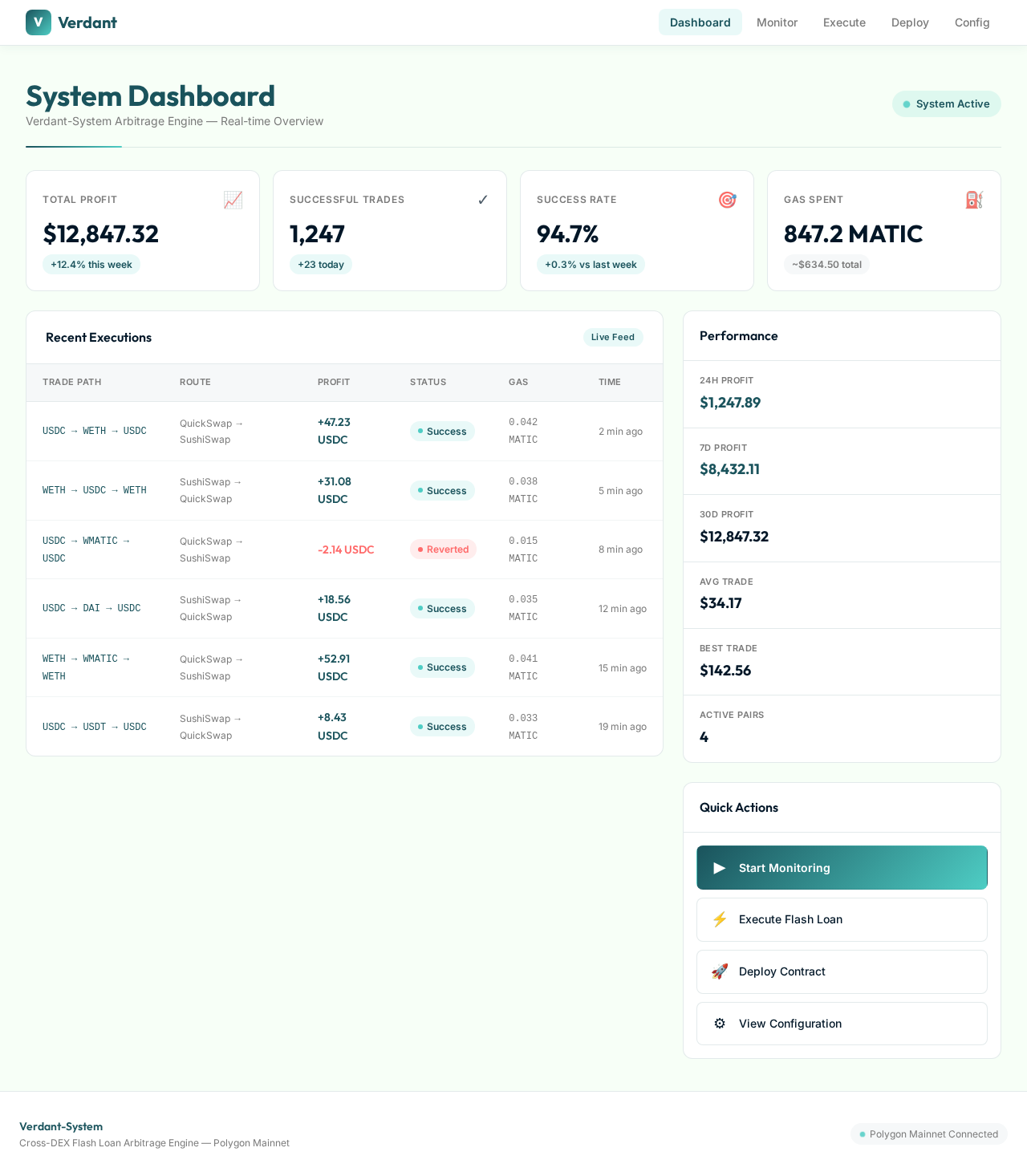
System Dashboard
Verdant-System Arbitrage Engine — Real-time Overview
Recent Executions
Live Feed| Trade Path | Route | Profit | Status | Gas | Time |
|---|---|---|---|---|---|
| USDC → WETH → USDC | QuickSwap → SushiSwap | +47.23 USDC | Success | 0.042 MATIC | 2 min ago |
| WETH → USDC → WETH | SushiSwap → QuickSwap | +31.08 USDC | Success | 0.038 MATIC | 5 min ago |
| USDC → WMATIC → USDC | QuickSwap → SushiSwap | -2.14 USDC | Reverted | 0.015 MATIC | 8 min ago |
| USDC → DAI → USDC | SushiSwap → QuickSwap | +18.56 USDC | Success | 0.035 MATIC | 12 min ago |
| WETH → WMATIC → WETH | QuickSwap → SushiSwap | +52.91 USDC | Success | 0.041 MATIC | 15 min ago |
| USDC → USDT → USDC | SushiSwap → QuickSwap | +8.43 USDC | Success | 0.033 MATIC | 19 min ago |
Performance
System Dashboard
Verdant-System Arbitrage Engine — Real-time Overview
Recent Executions
Live Feed| Trade Path | Route | Profit | Status | Gas | Time |
|---|---|---|---|---|---|
| USDC → WETH → USDC | QuickSwap → SushiSwap | +47.23 USDC | Success | 0.042 MATIC | 2 min ago |
| WETH → USDC → WETH | SushiSwap → QuickSwap | +31.08 USDC | Success | 0.038 MATIC | 5 min ago |
| USDC → WMATIC → USDC | QuickSwap → SushiSwap | -2.14 USDC | Reverted | 0.015 MATIC | 8 min ago |
| USDC → DAI → USDC | SushiSwap → QuickSwap | +18.56 USDC | Success | 0.035 MATIC | 12 min ago |
| WETH → WMATIC → WETH | QuickSwap → SushiSwap | +52.91 USDC | Success | 0.041 MATIC | 15 min ago |
| USDC → USDT → USDC | SushiSwap → QuickSwap | +8.43 USDC | Success | 0.033 MATIC | 19 min ago |
No comments yet. Be the first!