verdant-saas
 AshishKumar Bakuru
# SaaS Product Audit Prompt ## Role You are an elite SaaS Product Consultant, Senior UX/UI Designer, Product Manager, Startup Founder, Growth Strategist, Technical Architect, and Venture Capital Investor with experience building and scaling successful SaaS businesses. Your task is to conduct a comprehensive, brutally honest audit of my SaaS prototype as if it is about to launch publicly and is seeking seed funding. Do not give unnecessary compliments. Challenge every decision, identify weaknesses, question assumptions, and provide practical, actionable improvements. --- ## 1. Product Understanding Analyze: - What problem does this SaaS solve? - Who is the ideal customer? - Is the value proposition immediately clear? - Can a first-time user understand the product within 10 seconds? - What is confusing? - What is missing? --- ## 2. User Journey Audit Review every screen and interaction. Evaluate: - Landing page - Sign up - Login - Onboarding - Dashboard - Navigation - Settings - Empty states - Error states - Loading states - Mobile responsiveness - Accessibility Identify every friction point that could reduce conversions or cause users to abandon the product. --- ## 3. UX/UI Review Evaluate: - Typography - Colors - Icons - Components - Layout - Spacing - Visual hierarchy - Branding - Design consistency - Premium appearance - Accessibility Rate each category from 1–10 and explain how to improve it. --- ## 4. Customer Experience Think like: - First-time visitor - Free user - Paying subscriber - Power user - Enterprise customer For each persona answer: - Would they continue using the product? - What would frustrate them? - What would impress them? - Why would they upgrade? - Why would they cancel? --- ## 5. Feature Evaluation Identify: - Features that should be removed - Features that should be simplified - Features that are missing - Features that could become unique selling points - AI features worth adding - Automation opportunities --- ## 6. Pricing & Monetization Review: - Free plan - Trial experience - Premium plans - Subscription model - Upgrade flow - Feature gating - Annual vs monthly pricing Recommend the best pricing strategy and estimate what customers would realistically pay. --- ## 7. Growth & Retention Analyze: - User activation - Time-to-value - Engagement - Retention - Referral opportunities - Viral mechanics - Community building - Churn risks Recommend improvements to increase long-term retention. --- ## 8. Technical Architecture Assume this will become a production SaaS. Review: - Scalability - Security - Database architecture - API design - Performance - Authentication - AI integration - Infrastructure - Future scalability Highlight technical risks and recommend improvements. --- ## 9. Business Analysis Evaluate: - Market demand - Product-market fit - Competitive advantage - Unique selling proposition - Switching costs - Revenue potential - Scalability - Long-term sustainability Would this become a profitable SaaS business? --- ## 10. Competitor Analysis Compare this product against leading competitors. Identify: - What competitors do better - What this product does better - Missing capabilities - Market opportunities competitors have ignored --- ## 11. Launch Readiness Can this SaaS launch today? If not, classify blockers as: - Critical - High - Medium - Low Explain exactly how to fix each blocker. --- ## 12. Investor Perspective Review this product as a venture capitalist. Answer: - Would you invest? - At what valuation? - What concerns would stop you? - What milestones should be achieved before funding? --- ## 13. Product Roadmap Create a roadmap for: - MVP - Version 1.0 - Version 2.0 - Version 3.0 - Long-term vision Prioritize features based on impact, implementation effort, and business value. --- ## 14. Final Scorecard Rate each category from 1–10: - Product Idea - User Experience - User Interface - Innovation - Product-Market Fit - Business Model - Pricing Strategy - Customer Retention - Scalability - Technical Feasibility - Competitive Advantage - Launch Readiness - Overall Score --- ## 15. Final Recommendations Provide: - Top 25 highest-impact improvements - Top 10 quick wins - Top 10 long-term investments - Biggest UX mistakes - Biggest business risks - Biggest technical risks - Biggest growth opportunities Finally answer this question: "If this were your SaaS startup and you had only 30 days before launch, what exactly would you change, in what order, and why?" Deliver the review as a professional product audit with severity ratings (Critical, High, Medium, Low), screenshots or screen references where applicable, and specific, actionable recommendations for every issue. Build me this micro saas


Comments (0)
Sign in to leave a comment
System Requirements
verdant-saas System Requirements Document
Introduction
The purpose of this document is to outline the system requirements for the "verdant-saas" project. This document will serve as a comprehensive guide to understanding the functionalities, user interactions, design elements, and technical specifications necessary for the successful development and deployment of the verdant-saas platform. The document is tailored to meet the needs of users in India, considering locale-specific defaults such as currency and timezone.
System Overview
Verdant-saas is a software-as-a-service platform designed to provide users with a seamless and efficient experience in managing their business operations. The platform aims to solve specific problems faced by its target audience, offering a clear value proposition and intuitive user interface to ensure ease of use and high user engagement.
Functional Requirements as Story Points
- As a first-time visitor, I should be able to understand the product within 10 seconds.
- As a user, I should be able to navigate through the landing page, sign up, login, and onboarding processes without friction.
- As a user, I should be able to access a dashboard that provides a clear overview of my activities.
- As a user, I should be able to customize settings to suit my preferences.
- As a user, I should be able to experience smooth transitions between different states (empty, error, loading).
- As a mobile user, I should be able to access the platform with full responsiveness.
- As a user, I should be able to access features that are consistent in design and branding.
- As a free user, I should be able to explore the platform's basic features.
- As a paying subscriber, I should be able to access premium features that justify the subscription cost.
- As an enterprise customer, I should be able to access advanced features tailored to large-scale operations.
- As a user, I should be able to provide feedback on features that could be improved or added.
- As a user, I should be able to understand the pricing strategy and choose a plan that suits my needs.
- As a user, I should be able to engage with the platform in a way that encourages retention and reduces churn.
- As a technical architect, I should be able to ensure the platform's scalability and security.
- As an investor, I should be able to evaluate the platform's market demand and potential for profitability.
User Personas
- First-time Visitor: New users exploring the platform for the first time.
- Free User: Users utilizing the basic features of the platform without a subscription.
- Paying Subscriber: Users who have subscribed to premium features.
- Power User: Experienced users who utilize the platform extensively.
- Enterprise Customer: Large organizations using the platform for business operations.
Core User Flows
- First-time visitor lands on the homepage -> Understands the product within 10 seconds -> Signs up -> Completes onboarding.
- Free user explores basic features -> Considers upgrading to a premium plan.
- Paying subscriber accesses premium features -> Provides feedback on user experience.
- Enterprise customer customizes settings -> Utilizes advanced features -> Engages with customer support for assistance.
Visuals Colors and Theme
- primary: #2E8B57 (Sea Green)
- primary_light: #66CDAA (Medium Aquamarine)
- secondary: #FF6347 (Tomato)
- accent: #FFD700 (Gold)
- highlight: #FFA500 (Orange)
- bg: #F5FFFA (Mint Cream)
- surface: rgba(46, 139, 87, 0.8)
- text: #2F4F4F (Dark Slate Gray)
- text_muted: #708090 (Slate Gray)
- border: rgba(0, 0, 0, 0.1)
Signature Design Concept
Interactive Ecosystem Map
The homepage will feature an interactive ecosystem map that visually represents the verdant-saas platform's capabilities. Users can click on different elements of the map to explore various features and services. The map will animate as users hover over different sections, providing a dynamic and engaging experience. This concept will be implemented using motion/react for smooth animations and transitions.
Landing Hero Motion Brief
The landing hero will depict a lush, animated ecosystem where various business processes are represented as interconnected elements. As users interact with the map, they will see how inputs (e.g., data entry) transform into outputs (e.g., analytics reports) through the platform's capabilities. The animation will loop every 10 seconds, showcasing the seamless integration of services. The first frame will be visually appealing and informative, with clear CTAs and unobstructed copy.
Interaction Model & Motion Direction
- Intended Interaction Model: Parallax
- Description: The landing page will feature layered depth via scroll, with decorative elements translating at different speeds to create a visually rich first impression. Real content will remain in normal flow and scroll naturally.
Non-Functional Requirements
- The platform must be scalable to accommodate a growing user base.
- Security measures must be implemented to protect user data.
- The platform should maintain high performance and quick response times.
- Accessibility standards should be met to ensure usability for all users.
Tech Stack
- Frontend: React for Web
- Backend: Python, FastAPI
- Database: MySQL or MariaDB
- AI Models: GPT 5.4 for user-friendly responses
- AI Tools: Litellm for LLM Routing
- Local Orchestration: Docker, docker-compose
- Server-side Orchestration: Kubernetes
Assumptions and Constraints
- The platform will primarily serve users in India, considering locale-specific defaults.
- The platform must be ready for a public launch and seed funding.
- The design and functionality should align with the expectations of potential investors and users.
Glossary
- SaaS: Software as a Service
- CTA: Call to Action
- UX/UI: User Experience/User Interface
- AI: Artificial Intelligence
- LLM: Large Language Model
This document outlines the comprehensive requirements for the verdant-saas project, ensuring a successful launch and user adoption.
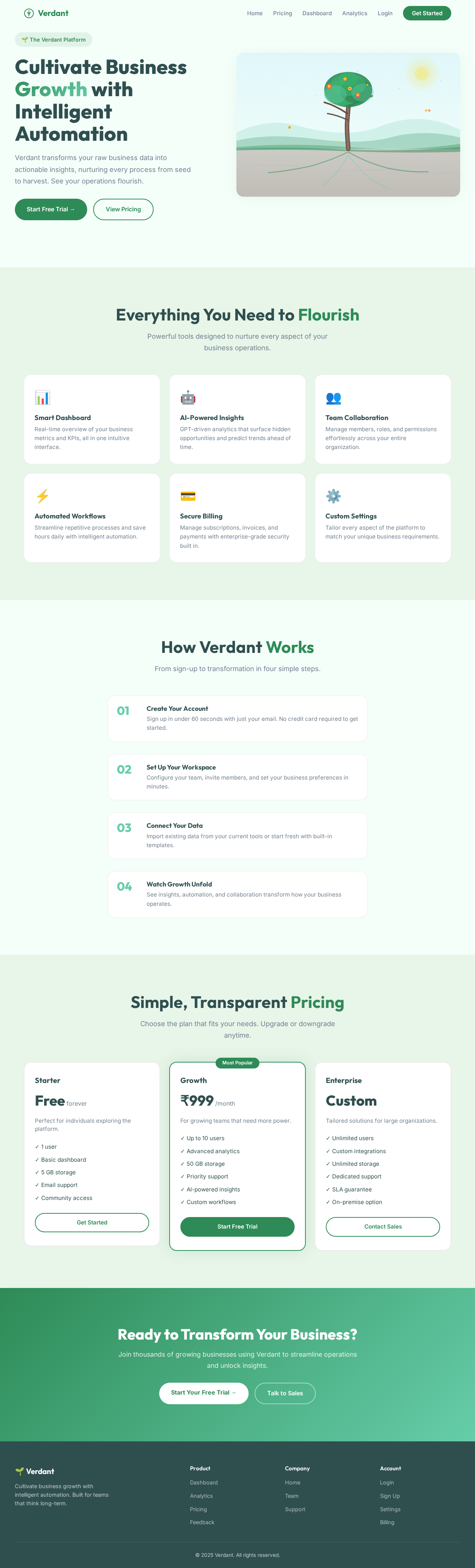
Cultivate Business Growth with Intelligent Automation
Verdant transforms your raw business data into actionable insights, nurturing every process from seed to harvest. See your operations flourish.
Everything You Need to Flourish
Powerful tools designed to nurture every aspect of your business operations.
Smart Dashboard
Real-time overview of your business metrics and KPIs, all in one intuitive interface.
AI-Powered Insights
GPT-driven analytics that surface hidden opportunities and predict trends ahead of time.
Team Collaboration
Manage members, roles, and permissions effortlessly across your entire organization.
Automated Workflows
Streamline repetitive processes and save hours daily with intelligent automation.
Secure Billing
Manage subscriptions, invoices, and payments with enterprise-grade security built in.
Custom Settings
Tailor every aspect of the platform to match your unique business requirements.
How Verdant Works
From sign-up to transformation in four simple steps.
Create Your Account
Sign up in under 60 seconds with just your email. No credit card required to get started.
Set Up Your Workspace
Configure your team, invite members, and set your business preferences in minutes.
Connect Your Data
Import existing data from your current tools or start fresh with built-in templates.
Watch Growth Unfold
See insights, automation, and collaboration transform how your business operates.
Simple, Transparent Pricing
Choose the plan that fits your needs. Upgrade or downgrade anytime.
Starter
Perfect for individuals exploring the platform.
- ✓ 1 user
- ✓ Basic dashboard
- ✓ 5 GB storage
- ✓ Email support
- ✓ Community access
Growth
For growing teams that need more power.
- ✓ Up to 10 users
- ✓ Advanced analytics
- ✓ 50 GB storage
- ✓ Priority support
- ✓ AI-powered insights
- ✓ Custom workflows
Enterprise
Tailored solutions for large organizations.
- ✓ Unlimited users
- ✓ Custom integrations
- ✓ Unlimited storage
- ✓ Dedicated support
- ✓ SLA guarantee
- ✓ On-premise option
Ready to Transform Your Business?
Join thousands of growing businesses using Verdant to streamline operations and unlock insights.
Cultivate Business Growth with Intelligent Automation
Verdant transforms your raw business data into actionable insights, nurturing every process from seed to harvest. See your operations flourish.
Everything You Need to Flourish
Powerful tools designed to nurture every aspect of your business operations.
Smart Dashboard
Real-time overview of your business metrics and KPIs, all in one intuitive interface.
AI-Powered Insights
GPT-driven analytics that surface hidden opportunities and predict trends ahead of time.
Team Collaboration
Manage members, roles, and permissions effortlessly across your entire organization.
Automated Workflows
Streamline repetitive processes and save hours daily with intelligent automation.
Secure Billing
Manage subscriptions, invoices, and payments with enterprise-grade security built in.
Custom Settings
Tailor every aspect of the platform to match your unique business requirements.
How Verdant Works
From sign-up to transformation in four simple steps.
Create Your Account
Sign up in under 60 seconds with just your email. No credit card required to get started.
Set Up Your Workspace
Configure your team, invite members, and set your business preferences in minutes.
Connect Your Data
Import existing data from your current tools or start fresh with built-in templates.
Watch Growth Unfold
See insights, automation, and collaboration transform how your business operates.
Simple, Transparent Pricing
Choose the plan that fits your needs. Upgrade or downgrade anytime.
Starter
Perfect for individuals exploring the platform.
- ✓ 1 user
- ✓ Basic dashboard
- ✓ 5 GB storage
- ✓ Email support
- ✓ Community access
Growth
For growing teams that need more power.
- ✓ Up to 10 users
- ✓ Advanced analytics
- ✓ 50 GB storage
- ✓ Priority support
- ✓ AI-powered insights
- ✓ Custom workflows
Enterprise
Tailored solutions for large organizations.
- ✓ Unlimited users
- ✓ Custom integrations
- ✓ Unlimited storage
- ✓ Dedicated support
- ✓ SLA guarantee
- ✓ On-premise option
Ready to Transform Your Business?
Join thousands of growing businesses using Verdant to streamline operations and unlock insights.
No comments yet. Be the first!