verdant-roles
 Ashish Anand
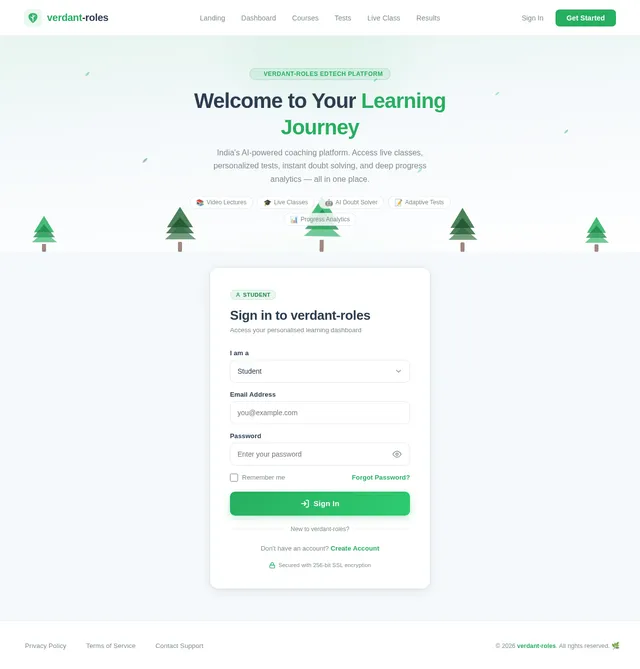
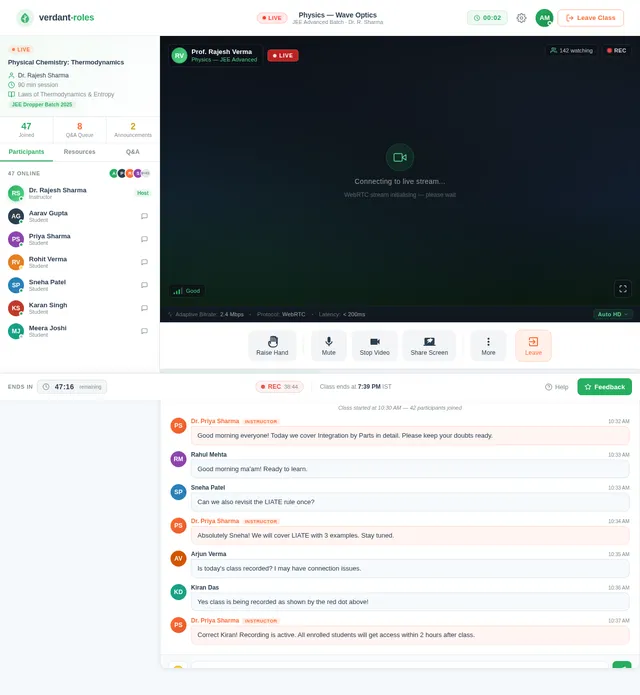
You are a senior full-stack software architect and developer. Your task is to design and build a production-ready, scalable, secure, and modern coaching institute application (web + mobile backend system) with advanced AI-powered features. ## 🎯 Objective Build a complete EdTech platform similar to Physics Wallah, Allen Digital, Doubtnut, and Aakash, but more advanced and technically scalable. --- ## 👥 User Roles Implement role-based access control (RBAC) for: * Students * Faculty * Admin * Staff * Parents Each role must have separate login, dashboard, and permissions. --- ## 🔐 Authentication & Security * JWT-based authentication with refresh tokens * OAuth (Google login optional) * Role-based authorization middleware * Secure password hashing (bcrypt) * HTTPS + encryption * Rate limiting + anti-brute force --- ## 📚 Core Modules to Implement ### 1. Learning Management System (LMS) * Upload and stream video lectures (adaptive streaming) * PDF/notes upload * Lecture categorization (course → subject → topic) * Resume playback, bookmarks * DRM protection for videos --- ### 2. Live Class System * WebRTC / Socket-based live classes * Chat during live session * Raise hand feature * Polls & quizzes * Auto recording of sessions * Attendance tracking during live class --- ### 3. Doubt Solving System * Text-based doubts * Image upload (OCR support) * 1-to-1 doubt sessions * AI chatbot for instant answers * Community discussion forum --- ### 4. Online Test System * MCQ + subjective tests * Timer, auto-submit * Negative marking * Randomized questions * Section-wise tests Advanced: * AI-based proctoring (face detection, tab switch tracking) * Adaptive difficulty system --- ### 5. Attendance System * Auto attendance using: * Login tracking * Face recognition (optional) * Live class participation * Manual override by faculty --- ### 6. Analytics & Reporting * Student dashboard: * Daily progress * Weak/strong topics * Time spent * Auto-generated reports (PDF) * Rank prediction * Comparative analytics --- ### 7. AI Features (IMPORTANT) * AI tutor chatbot * Smart study planner * Lecture summarization * Personalized recommendations * AI-generated quizzes --- ### 8. Communication System * Push notifications * Email + SMS integration * Chat system (student ↔ faculty) * Announcements --- ### 9. Payment System * Course purchase * Subscription model * Razorpay/Stripe integration * Invoice generation --- ### 10. Admin Panel * User management * Course/content management * Revenue analytics * System monitoring dashboard --- ### 11. Faculty Dashboard * Upload lectures * Create tests * Track student performance * Manage attendance --- ### 12. Parent Dashboard * Student progress tracking * Attendance alerts * Fee status * Performance reports --- ## 🏗️ Technical Requirements ### Architecture * Microservices architecture * API Gateway * REST or GraphQL APIs ### Backend * Node.js (Express/NestJS) or Django/FastAPI * WebSockets for real-time features ### Frontend * React (Next.js preferred) * Mobile-ready responsive UI ### Database * PostgreSQL (structured data) * MongoDB (optional for flexibility) * Redis (caching) ### Storage * AWS S3 / Cloud storage for videos ### DevOps * Dockerized services * CI/CD pipeline * Cloud deployment (AWS/GCP/Azure) --- ## 🔒 Security & Performance * Role-based access control * Data encryption * CDN for video streaming * Load balancing * Horizontal scaling --- ## 📦 Deliverables (MANDATORY) 1. Complete system architecture diagram 2. Database schema (ER diagram) 3. API design (endpoints with request/response) 4. Folder structure (frontend + backend) 5. Working code for: * Authentication system * One core module (LMS or Test system) 6. Deployment steps 7. README documentation --- ## 🚀 Development Approach * Step-by-step modular development * Start with MVP: * Auth * LMS * Test system * Then scale to AI + analytics --- ## ⚠️ Constraints * Code must be production-level (not toy examples) * Follow clean architecture principles * Use proper naming conventions * Include error handling and validation * Ensure scalability and maintainability --- ## 🎯 Output Format * Explain architecture first * Then database schema * Then API design * Then code (modular) * Then deployment steps --- Act like a senior engineer in a real company. Do not skip steps. Do not give shallow answers. Build systematically.


Comments (0)
Sign in to leave a comment
No comments yet. Be the first!