verdant-roles
 Ashish Anand
You are a senior full-stack software architect and developer. Your task is to design and build a production-ready, scalable, secure, and modern coaching institute application (web + mobile backend system) with advanced AI-powered features. ## 🎯 Objective Build a complete EdTech platform similar to Physics Wallah, Allen Digital, Doubtnut, and Aakash, but more advanced and technically scalable. --- ## 👥 User Roles Implement role-based access control (RBAC) for: * Students * Faculty * Admin * Staff * Parents Each role must have separate login, dashboard, and permissions. --- ## 🔐 Authentication & Security * JWT-based authentication with refresh tokens * OAuth (Google login optional) * Role-based authorization middleware * Secure password hashing (bcrypt) * HTTPS + encryption * Rate limiting + anti-brute force --- ## 📚 Core Modules to Implement ### 1. Learning Management System (LMS) * Upload and stream video lectures (adaptive streaming) * PDF/notes upload * Lecture categorization (course → subject → topic) * Resume playback, bookmarks * DRM protection for videos --- ### 2. Live Class System * WebRTC / Socket-based live classes * Chat during live session * Raise hand feature * Polls & quizzes * Auto recording of sessions * Attendance tracking during live class --- ### 3. Doubt Solving System * Text-based doubts * Image upload (OCR support) * 1-to-1 doubt sessions * AI chatbot for instant answers * Community discussion forum --- ### 4. Online Test System * MCQ + subjective tests * Timer, auto-submit * Negative marking * Randomized questions * Section-wise tests Advanced: * AI-based proctoring (face detection, tab switch tracking) * Adaptive difficulty system --- ### 5. Attendance System * Auto attendance using: * Login tracking * Face recognition (optional) * Live class participation * Manual override by faculty --- ### 6. Analytics & Reporting * Student dashboard: * Daily progress * Weak/strong topics * Time spent * Auto-generated reports (PDF) * Rank prediction * Comparative analytics --- ### 7. AI Features (IMPORTANT) * AI tutor chatbot * Smart study planner * Lecture summarization * Personalized recommendations * AI-generated quizzes --- ### 8. Communication System * Push notifications * Email + SMS integration * Chat system (student ↔ faculty) * Announcements --- ### 9. Payment System * Course purchase * Subscription model * Razorpay/Stripe integration * Invoice generation --- ### 10. Admin Panel * User management * Course/content management * Revenue analytics * System monitoring dashboard --- ### 11. Faculty Dashboard * Upload lectures * Create tests * Track student performance * Manage attendance --- ### 12. Parent Dashboard * Student progress tracking * Attendance alerts * Fee status * Performance reports --- ## 🏗️ Technical Requirements ### Architecture * Microservices architecture * API Gateway * REST or GraphQL APIs ### Backend * Node.js (Express/NestJS) or Django/FastAPI * WebSockets for real-time features ### Frontend * React (Next.js preferred) * Mobile-ready responsive UI ### Database * PostgreSQL (structured data) * MongoDB (optional for flexibility) * Redis (caching) ### Storage * AWS S3 / Cloud storage for videos ### DevOps * Dockerized services * CI/CD pipeline * Cloud deployment (AWS/GCP/Azure) --- ## 🔒 Security & Performance * Role-based access control * Data encryption * CDN for video streaming * Load balancing * Horizontal scaling --- ## 📦 Deliverables (MANDATORY) 1. Complete system architecture diagram 2. Database schema (ER diagram) 3. API design (endpoints with request/response) 4. Folder structure (frontend + backend) 5. Working code for: * Authentication system * One core module (LMS or Test system) 6. Deployment steps 7. README documentation --- ## 🚀 Development Approach * Step-by-step modular development * Start with MVP: * Auth * LMS * Test system * Then scale to AI + analytics --- ## ⚠️ Constraints * Code must be production-level (not toy examples) * Follow clean architecture principles * Use proper naming conventions * Include error handling and validation * Ensure scalability and maintainability --- ## 🎯 Output Format * Explain architecture first * Then database schema * Then API design * Then code (modular) * Then deployment steps --- Act like a senior engineer in a real company. Do not skip steps. Do not give shallow answers. Build systematically.


Comments (0)
Sign in to leave a comment
Architecture
No Services Diagrams Yet

Revolutionizing EdTech with Interactive Learning
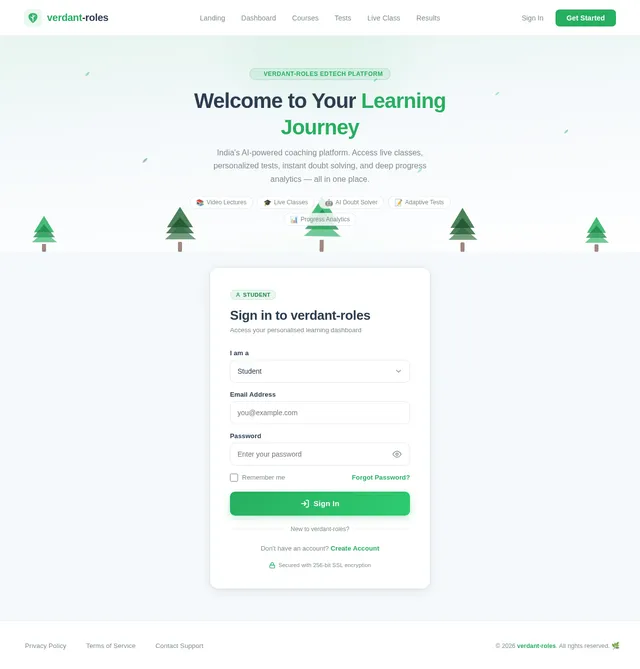
AI-powered platform for students, faculty, and coaches. Experience live classes, adaptive testing, smart doubt-solving, and real-time analytics — all in one place.
Explore Our Learning Modules
Each module is a branch in your growth journey. Dive into our five core pillars designed to transform how coaching institutes deliver education.
Learning Management
Access video lectures, notes, and bookmarks with DRM-protected content.
Live Classes
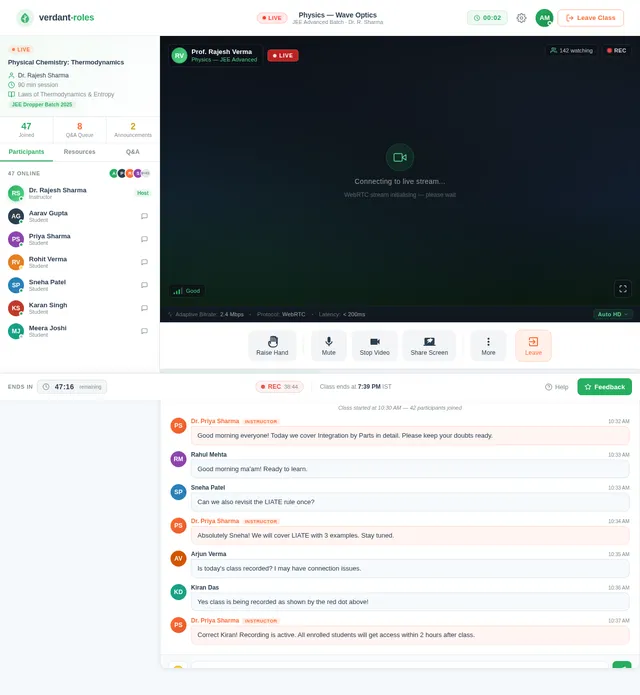
Join real-time WebRTC sessions with polls, quizzes, and interactive Q&A.
AI Doubt Solving
Get instant answers via text or image uploads powered by advanced AI models.
Adaptive Tests
Take AI-proctored exams with adaptive difficulty that adjusts to your level.
Progress Analytics
Track performance, identify weak areas, and get AI-driven rank predictions.
Everything You Need to Excel
Verdant-roles combines cutting-edge AI, real-time interaction, and powerful analytics to deliver a complete learning experience.
AI-Powered Doubt Solving
Ask doubts via text or image upload and receive instant, AI-generated explanations tailored to your learning level.
Live Interactive Classes
Attend real-time WebRTC-based classes with polls, quizzes, and direct faculty interaction for deeper engagement.
Adaptive Testing
Take AI-proctored tests with adaptive difficulty that adjust to your strengths and highlight areas for improvement.
Progress Analytics
Track your learning journey with detailed dashboards showing weak topics, rank predictions, and performance trends.
Secure Payment
Purchase courses and subscriptions through encrypted payment gateways with transparent fee tracking for students and parents.
Multi-Role Dashboard
Tailored dashboards for students, faculty, admins, and parents with role-based access control and personalized views.
Your Learning Journey
From signing up to mastering your subjects — follow a simple path designed to maximize your learning potential.
Sign Up
Create your free account in seconds using email or phone number.
Choose Course
Browse our catalog and pick courses tailored to your goals.
Learn & Practice
Watch video lectures, attend live classes, and solve AI-powered doubts.
Test Yourself
Take adaptive tests with AI proctoring to assess your understanding.
Track Progress
View analytics, weak topics, rank predictions, and performance trends.
Supercharge Learning with AI Capabilities
Our intelligent features adapt to every student, automate assessments, predict outcomes, and ensure exam integrity — all powered by cutting-edge AI.
AI Doubt Solver
AI-PoweredAsk doubts via text or image upload and receive instant, AI-generated explanations with step-by-step solutions tailored to your learning level.
Explore Doubt Solver→Smart Test Generation
AI-PoweredTake AI-crafted tests with adaptive difficulty that adjusts in real-time based on your performance, ensuring optimal challenge and growth.
Try Smart Tests→Performance Prediction
AI-PoweredVisualize your trajectory with AI-powered graph analytics that predict rank, identify weak topics, and recommend a personalized study plan.
View Predictions→AI Proctoring
AI-PoweredMaintain exam integrity with secure AI proctoring featuring real-time monitoring, tab-switch detection, and identity verification for credible results.
Learn About Security→Enterprise-Grade Security for Your Institute
verdant-roles is built with multi-layer security, ensuring your data, transactions, and academic records remain protected at every level.
RBAC & Encryption
Role-based access control ensures every user sees only what they need. All data is encrypted at rest and in transit with AES-256 standards.
Data Protection
Student records, payment info, and academic data are safeguarded with multi-layer encryption and automated backups across geo-redundant servers.
99.9% Uptime
Our cloud infrastructure is built for reliability. Auto-scaling, load balancing, and real-time monitoring keep verdant-roles running around the clock.
Compliance Ready
Aligned with ISO 27001, GDPR, and Indian data protection standards. Regular third-party audits ensure continuous compliance across all modules.
Choose the Perfect Plan
Flexible pricing designed for every learner. Start free and upgrade as you grow with verdant-roles.
Student
Ideal for self-paced learners preparing for competitive exams.
- ✓Access to all video lectures & notes
- ✓AI-powered doubt solving (text)
- ✓Weekly practice tests (10/month)
- ✓Basic progress analytics
- ✓Mobile app access
- ✓Community forum support
Faculty
Best for serious aspirants who want live classes, AI tools & mentorship.
- ✓Everything in Student plan
- ✓AI doubt solving with image upload
- ✓Unlimited adaptive mock tests
- ✓Live interactive classes
- ✓Advanced performance analytics
- ✓AI-based rank prediction
- ✓Priority email & chat support
- ✓Downloadable study materials
Enterprise
For coaching institutes looking for a complete white-label platform.
- ✓Everything in Faculty plan
- ✓Multi-role admin dashboard
- ✓Custom branding & white-label
- ✓AI proctored examinations
- ✓Dedicated account manager
- ✓API access & integrations
- ✓Bulk user management & RBAC
- ✓SLA with 99.9% uptime guarantee
Trusted by Students, Faculty & Parents
Join thousands of learners and educators who are transforming their coaching experience with verdant-roles.
“The AI-powered doubt solving is a game-changer. I uploaded a tricky calculus problem at midnight and got a step-by-step solution instantly. My rank prediction improved from 15K to under 5K!”
Allen Digital Batch“Creating adaptive tests used to take me hours. Now the AI generates question papers with calibrated difficulty in minutes. Student engagement in live classes has increased by 40% since we adopted this platform.”
Physics Department“As a working parent, I can finally track my daughter's attendance, test scores, and study hours from my phone. The weekly performance reports give me peace of mind. Fee payments are seamless too.”
Parent Dashboard User“The smart study planner identified my weak topics in Organic Chemistry and created a personalized revision schedule. Live classes with real-time polls keep me focused. Best platform I've used.”
Aakash Online Batch“Managing 5,000+ students across multiple batches was chaotic before verdant-roles. The admin dashboard gives me real-time revenue analytics, attendance tracking, and content management all in one place.”
Institute AdminReady to Transform Your Learning Journey?
Join thousands of students, faculty, and coaching institutes already using verdant-roles to unlock AI-powered learning, live interactive classes, and personalized progress tracking.
No credit card required · Start learning in minutes
No comments yet. Be the first!