verdant-ai
 Nandini Pounikar
this is my topic for review paper can you tell me which AI help me to write the review paper in retail in within some second and with refrences and free Ai : AI-Assisted Forensic Technologies for Authentication and Preservation of Indigenous Knowledge Systems
Comments (0)
Sign in to leave a comment
System Requirements
System Requirements Document (SRD)
1. Introduction
This document outlines the system requirements for an AI-powered platform designed to assist users in generating structured review papers quickly and efficiently. The system will cater to users who need assistance in academic writing, particularly in generating review papers with proper references and structure. The platform will leverage advanced AI models to provide high-quality outputs while ensuring user satisfaction. Additionally, the platform will include features to identify research gaps and generate discussion sections, which are critical components of academic review papers. The system will also provide suggestions for structuring research papers and recommend AI tools for specific academic needs.
2. System Overview
The proposed system will be an AI-driven platform that enables users to generate review papers on specific topics. It will provide structured suggestions for paper organization, generate content with references, and ensure the output is academically sound. The system will also allow users to refine the AI-generated drafts for a near-perfect final version. The platform will be accessible via a web interface and will integrate advanced AI models for content generation, citation management, research gap identification, and discussion section generation. Additionally, the platform will recommend AI tools tailored to specific academic needs and provide guidance on structuring research papers.
3. Functional Requirements as Story Points
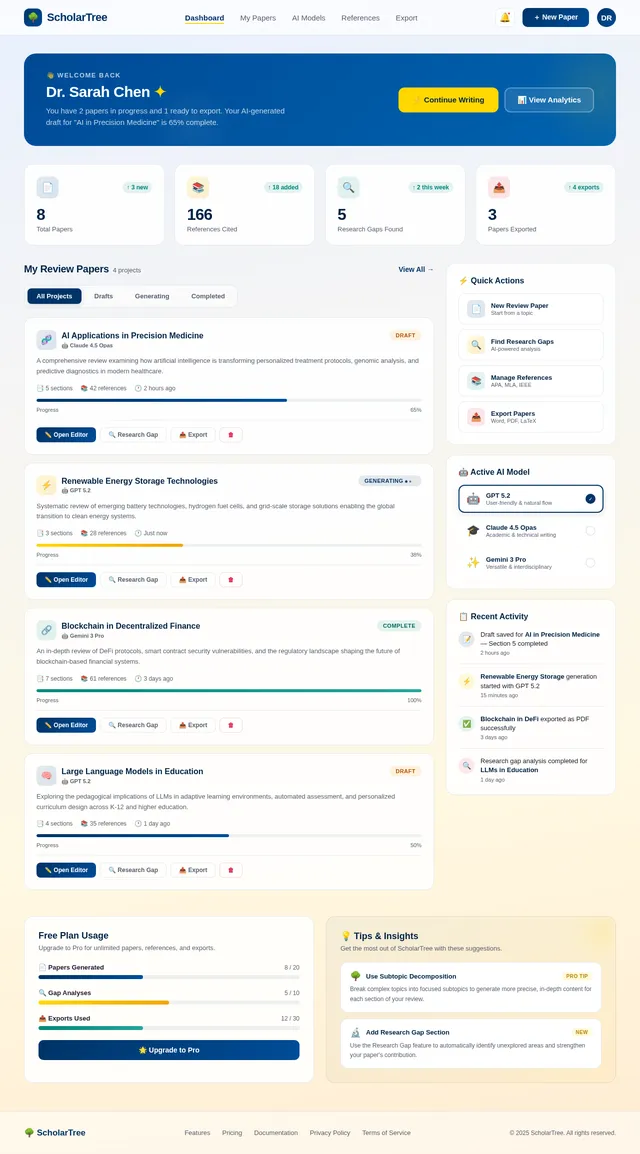
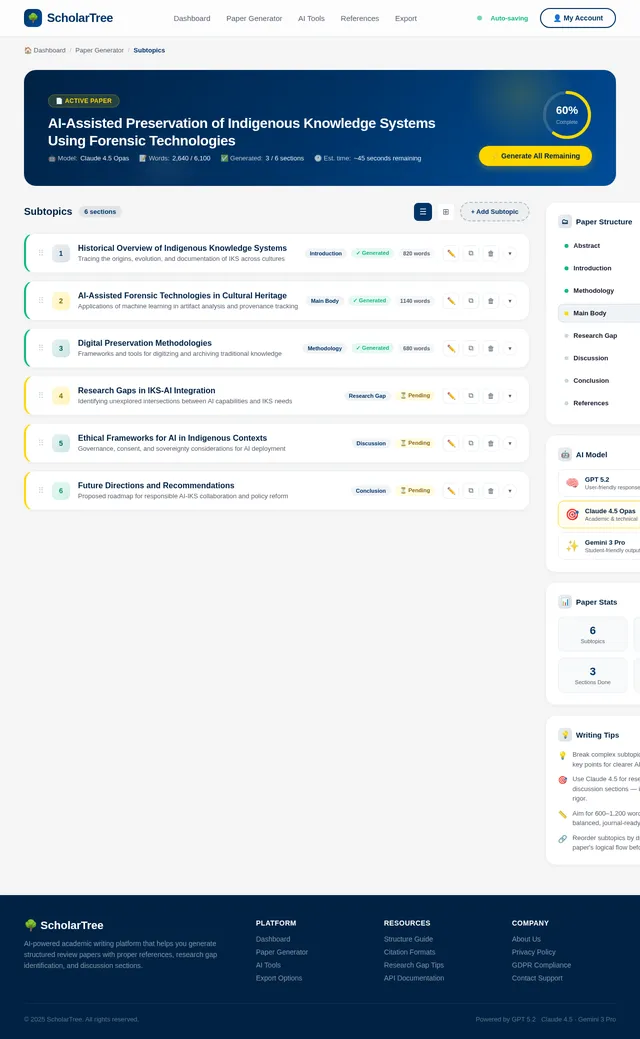
- As a User, I should be able to input my review paper topic and receive a complete draft within seconds.
- As a User, I should be able to receive structured suggestions for organizing my review paper.
- As a User, I should be able to generate content with proper academic references.
- As a User, I should be able to refine and edit the AI-generated draft within the platform.
- As a User, I should be able to break my topic into subtopics and receive focused content for each subtopic.
- As a User, I should be able to choose from multiple AI models for content generation, depending on my needs.
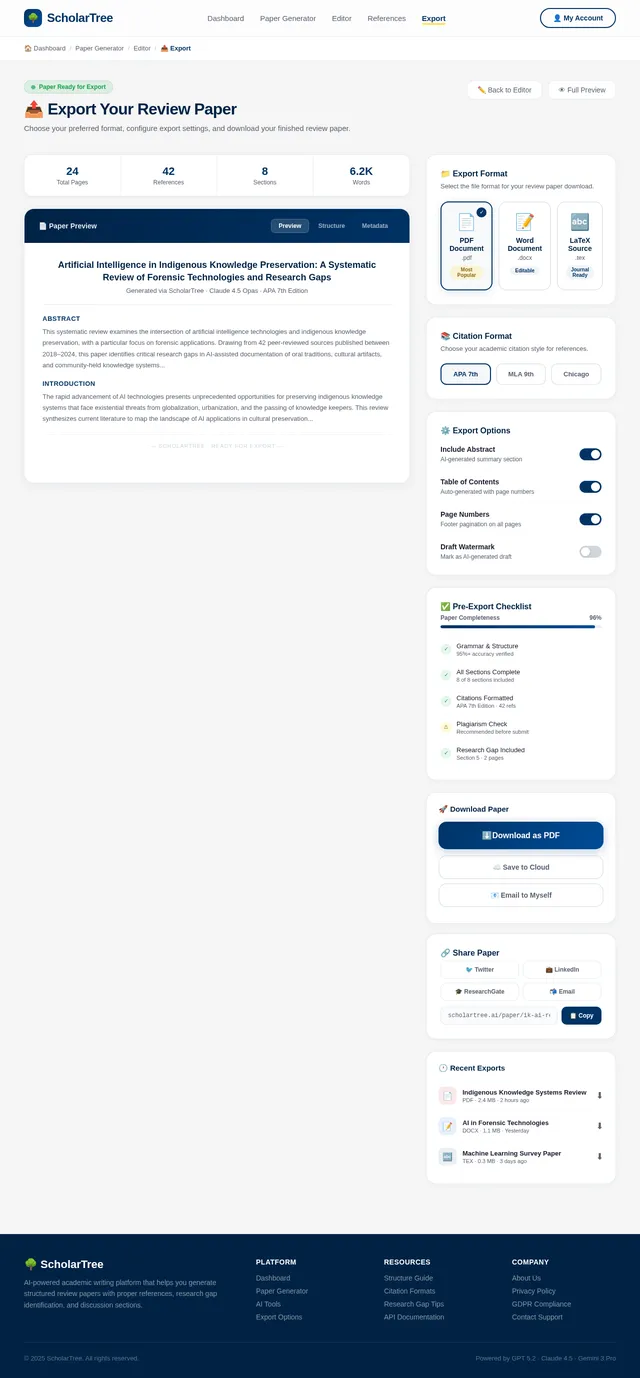
- As a User, I should be able to save and export my review paper in multiple formats (e.g., Word, PDF).
- As a User, I should be able to access free AI tools for generating review papers.
- As a User, I should be able to include sections like "Research Gap" and "Discussion" in my review paper.
- As a User, I should be able to receive AI-generated suggestions for identifying research gaps in my topic.
- As a User, I should be able to generate a detailed discussion section based on the AI's analysis of the topic.
- As a User, I should be able to receive suggestions for structuring my review paper, including sections like Abstract, Introduction, Methodology, Main Body, Conclusion, and References.
- As a User, I should be able to receive recommendations for AI tools tailored to my academic needs.
4. User Personas
1. Academic Researcher
- Description: A university professor or researcher looking to generate review papers for academic purposes.
- Needs: High-quality, well-structured papers with proper references, including sections like research gaps and discussions.
- Pain Points: Time constraints, difficulty in organizing content, and identifying research gaps.
2. Student
- Description: A college or university student needing assistance in writing review papers for assignments or projects.
- Needs: Quick and easy-to-use platform with free AI tools, including help with research gaps and discussions.
- Pain Points: Limited knowledge of academic writing, citation management, and identifying research gaps.
3. Professional Writer
- Description: A writer or content creator working on academic or technical content.
- Needs: Tools for generating drafts, organizing content efficiently, and including advanced sections like research gaps and discussions.
- Pain Points: Managing multiple topics, ensuring high-quality output, and addressing advanced academic requirements.
4. Indigenous Knowledge Advocate
- Description: A professional or researcher focused on preserving indigenous knowledge systems and exploring AI-assisted forensic technologies.
- Needs: Tools to generate review papers that highlight the importance of indigenous knowledge preservation, identify research gaps, and propose solutions.
- Pain Points: Lack of specialized tools for addressing niche topics like indigenous knowledge systems and forensic technologies.
5. Visuals Colors and Theme
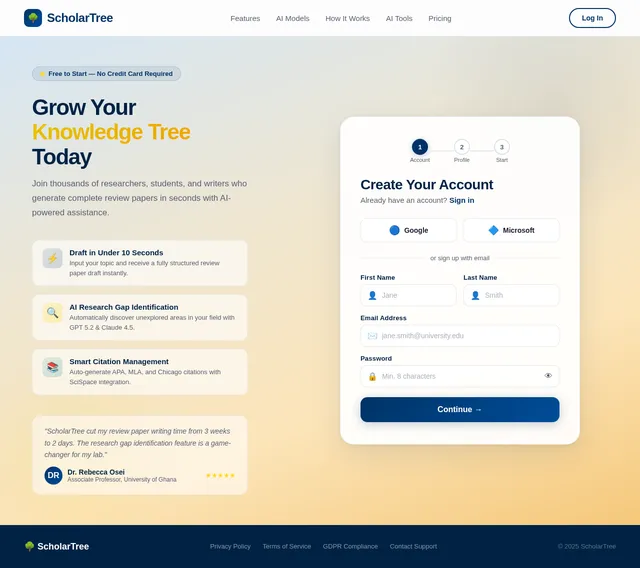
The platform will adopt a professional and academic theme with the following color palette:
- Primary Color: Deep Blue (#003366) – Represents trust and professionalism.
- Secondary Color: Light Gray (#F5F5F5) – Provides a clean and minimalistic background.
- Accent Color: Golden Yellow (#FFD700) – Highlights important features and buttons.
- Text Color: Black (#000000) – Ensures readability.
- Error/Warning Color: Red (#FF0000) – For alerts and error messages.
The interface will be clean and intuitive, with a focus on usability and accessibility.
6. Signature Design Concept
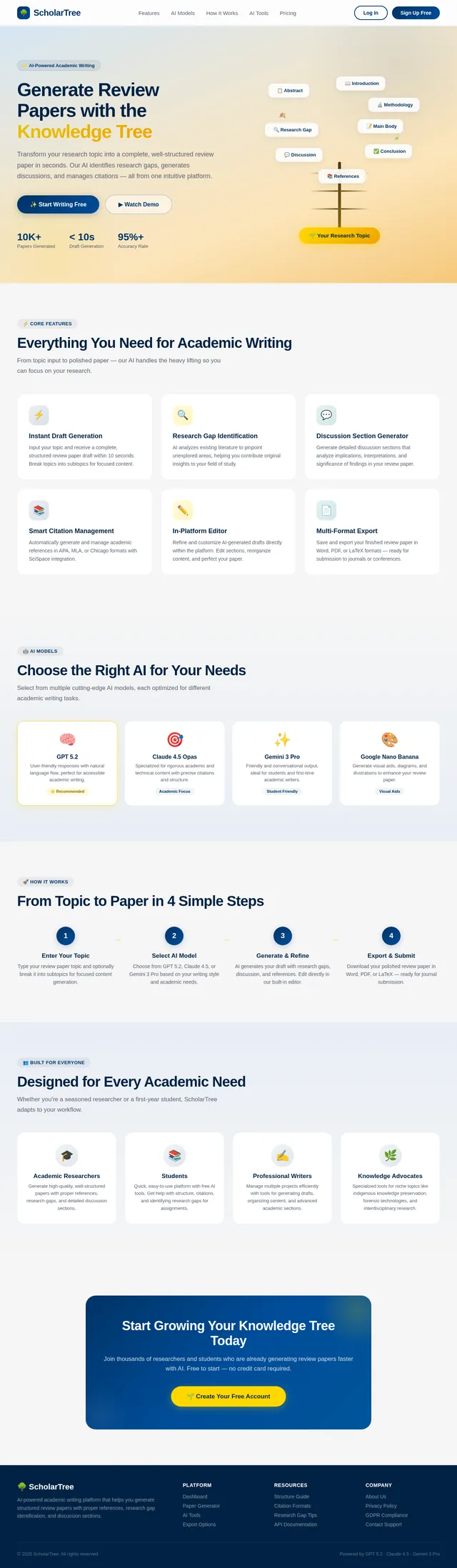
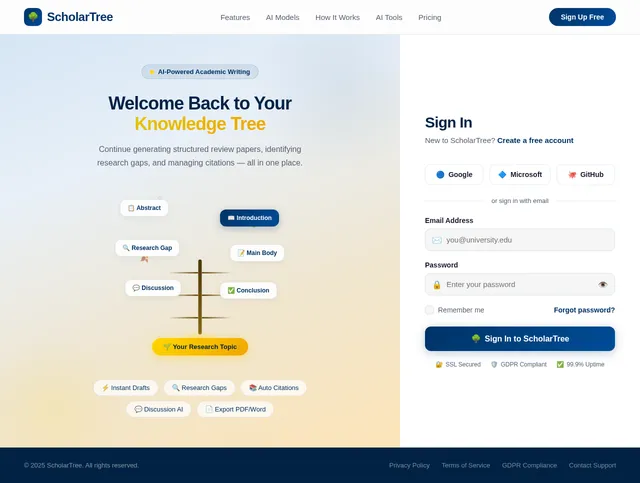
The homepage will feature an interactive "Knowledge Tree" visualization.
- Design Details:
- The tree will grow dynamically as the user interacts with it. Each branch represents a section of the review paper (e.g., Abstract, Introduction, Methodology, Research Gap, Discussion, etc.).
- Users can click on a branch to expand it, revealing subtopics and AI-generated content suggestions.
- The tree will have subtle animations, such as leaves fluttering and branches swaying, creating a calming and engaging experience.
- The background will feature a gradient that shifts from a soft morning blue to a warm evening orange, symbolizing the progression of knowledge throughout the day.
- Micro-interactions will include tooltips that appear when hovering over branches, providing quick tips or insights.
- A glowing "root" at the base of the tree will symbolize the user's main topic, with roots spreading out to show the foundational ideas.
This design will make the platform visually captivating and provide an intuitive way for users to organize and generate their review papers.
7. Non-Functional Requirements
- The system should generate a complete draft within 10 seconds of input.
- The platform should support at least 10,000 concurrent users.
- The system should ensure data privacy and comply with GDPR regulations.
- The platform should have a 99.9% uptime guarantee.
- The system should provide outputs with a minimum accuracy of 95% in terms of grammar and structure.
- The system should provide accurate and relevant suggestions for identifying research gaps and generating discussion sections.
8. Tech Stack
Frontend
- React for Web
Backend
- Python
- FastAPI
Database
- MySQL for structured data storage
- Alembic for database migrations
AI Models
- GPT 5.2 for user-friendly response
- Claude 4.5 Opas for academic or coding work
- Gemini 3 Pro for friendly response
- Google Nano Banana for image generation (if visual aids are needed)
AI Tools
- Litellm for LLM Routing
- Langchain for advanced AI workflows
- SciSpace for academic writing and citation management
- Jenni.ai for generating full research papers with proper structure and references
Local Orchestration
- Docker
- docker-compose
Server-Side Orchestration
- Kubernetes
9. Assumptions and Constraints
- The system assumes users will have a basic understanding of academic writing.
- The platform will be free to use, but advanced features may require a subscription.
- The system will rely on third-party AI models, which may have their own limitations.
- The platform will require a stable internet connection for optimal performance.
- The system assumes users will provide sufficient context or references for generating research gaps and discussion sections.
10. Glossary
- AI: Artificial Intelligence
- LLM: Large Language Model
- GDPR: General Data Protection Regulation
- RDBMS: Relational Database Management System
- NoSQL: Non-Relational Database System
- VectorDB: A database optimized for handling vector data
- Research Gap: The missing or unexplored areas in existing research that the review paper aims to address.
- Discussion: A section of the review paper where the implications, interpretations, and significance of the findings are analyzed.
- SciSpace: An AI tool designed for academic writing and citation management.
- Jenni.ai: An AI tool for generating full research papers with proper structure and references.
This document provides a comprehensive overview of the requirements for the AI-powered review paper generation platform. The system aims to deliver high-quality outputs while ensuring an engaging and user-friendly experience.
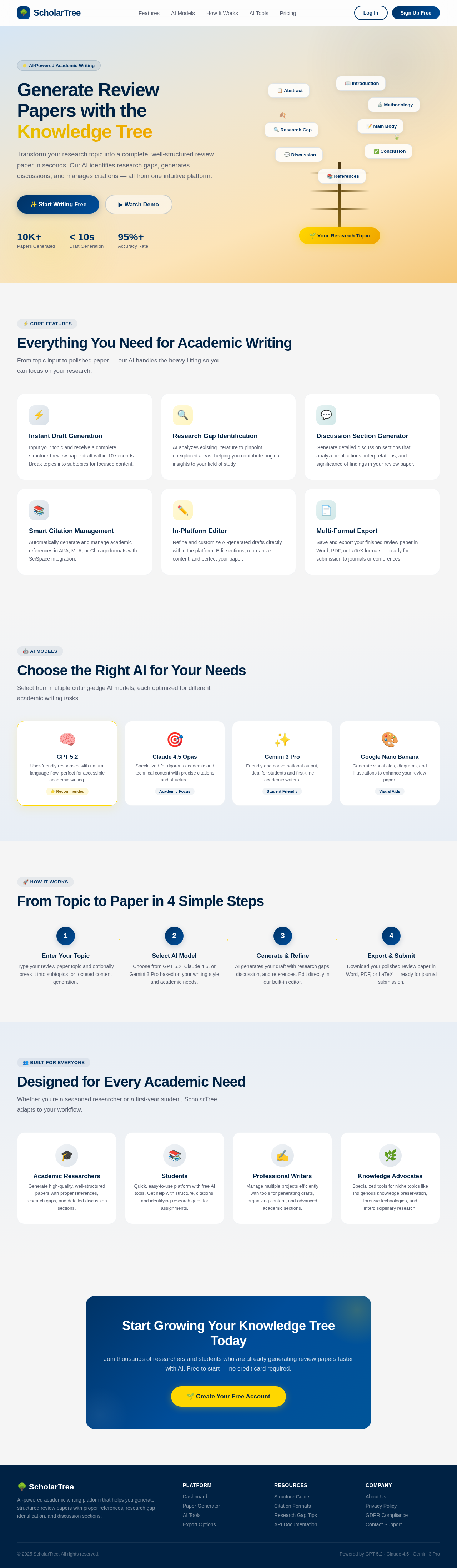
Generate Review Papers with the Knowledge Tree
Transform your research topic into a complete, well-structured review paper in seconds. Our AI identifies research gaps, generates discussions, and manages citations — all from one intuitive platform.
Everything You Need for Academic Writing
From topic input to polished paper — our AI handles the heavy lifting so you can focus on your research.
Instant Draft Generation
Input your topic and receive a complete, structured review paper draft within 10 seconds. Break topics into subtopics for focused content.
Research Gap Identification
AI analyzes existing literature to pinpoint unexplored areas, helping you contribute original insights to your field of study.
Discussion Section Generator
Generate detailed discussion sections that analyze implications, interpretations, and significance of findings in your review paper.
Smart Citation Management
Automatically generate and manage academic references in APA, MLA, or Chicago formats with SciSpace integration.
In-Platform Editor
Refine and customize AI-generated drafts directly within the platform. Edit sections, reorganize content, and perfect your paper.
Multi-Format Export
Save and export your finished review paper in Word, PDF, or LaTeX formats — ready for submission to journals or conferences.
Choose the Right AI for Your Needs
Select from multiple cutting-edge AI models, each optimized for different academic writing tasks.
GPT 5.2
User-friendly responses with natural language flow, perfect for accessible academic writing.
⭐ RecommendedClaude 4.5 Opas
Specialized for rigorous academic and technical content with precise citations and structure.
Academic FocusGemini 3 Pro
Friendly and conversational output, ideal for students and first-time academic writers.
Student FriendlyGoogle Nano Banana
Generate visual aids, diagrams, and illustrations to enhance your review paper.
Visual AidsFrom Topic to Paper in 4 Simple Steps
Enter Your Topic
Type your review paper topic and optionally break it into subtopics for focused content generation.
→Select AI Model
Choose from GPT 5.2, Claude 4.5, or Gemini 3 Pro based on your writing style and academic needs.
→Generate & Refine
AI generates your draft with research gaps, discussion, and references. Edit directly in our built-in editor.
→Export & Submit
Download your polished review paper in Word, PDF, or LaTeX — ready for journal submission.
Designed for Every Academic Need
Whether you're a seasoned researcher or a first-year student, ScholarTree adapts to your workflow.
Academic Researchers
Generate high-quality, well-structured papers with proper references, research gaps, and detailed discussion sections.
Students
Quick, easy-to-use platform with free AI tools. Get help with structure, citations, and identifying research gaps for assignments.
Professional Writers
Manage multiple projects efficiently with tools for generating drafts, organizing content, and advanced academic sections.
Knowledge Advocates
Specialized tools for niche topics like indigenous knowledge preservation, forensic technologies, and interdisciplinary research.
Start Growing Your Knowledge Tree Today
Join thousands of researchers and students who are already generating review papers faster with AI. Free to start — no credit card required.
No comments yet. Be the first!