
velvet-student

byRahul Vasi

Student academic performance prediction using ml

Landing
Landing

Comments (0)

No comments yet. Be the first!

System Requirements

System Requirement Document
Page 1 of 4

velvet-student System Requirements Document

1. Introduction

The "velvet-student" project aims to develop a comprehensive platform for predicting student academic performance using machine learning. This document outlines the system requirements, functional specifications, and design considerations for the project.

2. System Overview

The velvet-student platform will leverage machine learning algorithms to analyze various student data points and predict their academic performance. The system will provide insights to educators and students to help improve educational outcomes.

3. Functional Requirements as Story Points

  • As an Educator, I should be able to input student data to receive academic performance predictions.
  • As a Student, I should be able to view my predicted academic performance based on my data.
  • As an Administrator, I should be able to manage user access and data privacy settings.
  • As a Data Analyst, I should be able to review and adjust the machine learning model parameters for improved accuracy.
  • As a System, I should be able to securely store and process student data for prediction purposes.
Page 2 of 4

4. User Personas

  • Educator: A teacher or academic staff member who inputs student data and reviews predictions.
  • Student: An individual whose academic performance is being predicted.
  • Administrator: A person responsible for managing system access and data privacy.
  • Data Analyst: A specialist who fine-tunes machine learning models for better prediction accuracy.

5. Core User Flows

  • Educator inputs student data -> System processes data -> Educator reviews prediction results.
  • Student logs in -> Views personal academic performance prediction.
  • Administrator logs in -> Manages user roles and data privacy settings.
  • Data Analyst accesses model settings -> Adjusts parameters -> System updates prediction model.

6. Visuals Colors and Theme

  • primary: #4A90E2 (a calm blue for trust and reliability)
  • primary_light: #8AB6E6 (a lighter blue for hover states)
  • secondary: #F5A623 (a warm orange for supportive elements)
  • accent: #D0021B (a bold red for call-to-action elements)
  • highlight: #50E3C2 (a fresh green for notifications and active states)
  • bg: #FFFFFF (a clean white for the background)
  • surface: #F7F9FC (a light grey for cards and panels)
  • text: #333333 (a dark grey for primary text)
  • text_muted: #777777 (a softer grey for secondary text)
  • border: #E1E4E8 (a subtle grey for borders)
Page 3 of 4

7. Signature Design Concept

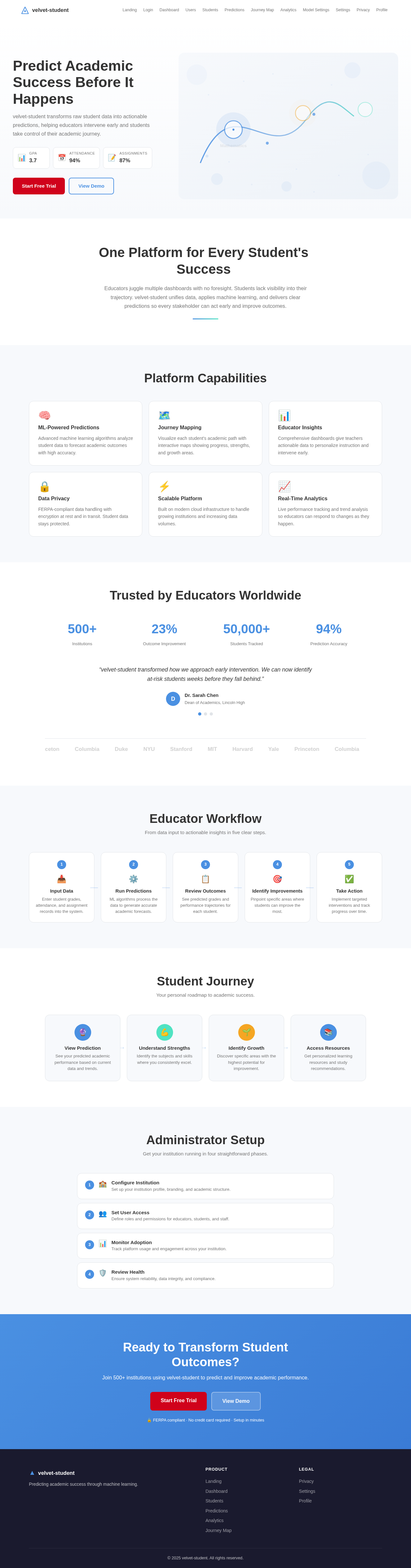
The velvet-student platform will feature an interactive "Academic Journey Map" on the homepage. This map will visually represent a student's academic path, with nodes for each subject or semester. Users can click on nodes to see predicted outcomes and suggested improvements. The map will animate transitions between nodes using motion/react, creating a dynamic experience that highlights the student's progress and potential.

LANDING HERO MOTION BRIEF

The landing page will feature a continuous animation of a student's academic journey. Starting with data inputs (e.g., grades, attendance), the animation will transform these into a dynamic map showing predicted outcomes. The map will highlight key achievements and areas for improvement, looping every 10 seconds. Users can interact with the map to explore detailed predictions and suggestions for each academic area.

8. Interaction Model & Motion Direction

  • Intended Interaction Model: Animated
    • The landing page will feature moderate scroll-triggered reveals and hover transitions.
    • Interactive elements will have spring physics for a polished user experience.
    • Each section will have a distinctive core mechanic, such as kinetic typography or morphing SVGs.
Page 4 of 4

9. Non-Functional Requirements

  • The system must ensure data privacy and comply with relevant educational data protection regulations.
  • The platform should be scalable to accommodate a growing number of users and data points.
  • The system must provide accurate predictions with a high degree of reliability.

10. Tech Stack

  • Frontend: React for Web
  • Backend: Python, FastAPI
  • Database: MySQL or MariaDB, with alembic for migrations
  • AI Models: GPT 5.4 for user-friendly responses, Claude Sonnet 5 for academic work
  • AI Tools: Litellm for LLM Routing, Langchain
  • Local Orchestration: Docker, docker-compose
  • Server-side Orchestration: Kubernetes

11. Assumptions and Constraints

  • The system assumes access to accurate and comprehensive student data for predictions.
  • Constraints include compliance with educational data protection laws and regulations.

12. Glossary

  • Machine Learning (ML): A method of data analysis that automates analytical model building.
  • Prediction Model: An algorithm used to forecast future outcomes based on historical data.
  • Data Privacy: The protection of personal data from unauthorized access and use.
Landing design preview
Landing: View Info
Login: Sign In
Dashboard: View Overview
Users: Manage Roles
Users: Edit Access
Privacy: Configure Settings
Privacy: Review Compliance
Settings: System Configuration
Landing design preview
Landing: View Info
Login: Sign In
Dashboard: View Overview
Users: Manage Roles
Users: Edit Access
Privacy: Configure Settings
Privacy: Review Compliance
Settings: System Configuration