ultra-vdr
 Morne Olivier
You are a team of collaborating AI agents (architect, tech lead, backend, frontend, DevOps, QA, product) building a Virtual Data Room (VDR) web application for a real estate and carbon removal project called ACCRA & TGR. 1. Project goal Build a production-grade, secure, browser-based VDR where investors can explore, filter, and download documents from our Data Room V3 Part 1 & Part 2, organised by section (1–10), topic (market, technical, ESG, carbon, risk), and status (final, draft, pending input). The VDR must be easy for non-technical LP/IC users to navigate and easy for admins to update as new documents and bullet points are added. Assume I will later paste in structured bullet-point data and document metadata extracted from our current Data Room V3 (Part 1 & 2) – design the system so this can be imported as JSON/CSV without changing code. 2. Core user roles Design for at least three roles: Admin (Project team – Morne/B2BC) Create/edit sections and subsections (e.g. “7. Market validation & comparables”, “9. ESG & carbon”). Upload documents (PDF, XLSX, PPTX, DOCX), tag them, and set visibility. Manage investor accounts and access rights. Edit bullet-point summaries per section (used as the “executive overview” in the UI). Investor / LP / IC member Log in securely (email + password to start; leave hooks for SSO later). Navigate by section (1–10), theme (market, technical, ESG, carbon, risk, financial model), or document type. Read short bullet-point summaries per section. Filter documents (by section, theme, status, date). Preview PDFs in-browser and download files. Read-only internal viewer Same as Investor, but with access to “internal notes” fields where we store commentary and TODOs. 3. Information architecture Model the VDR around the structure we already use in Data Room V3: Section 1–3: Executive summary, project overview, sponsors. Section 4–6: Financial model, returns, capital structure. Section 7: Market validation & comparables (Ghana retail, Airport City, Kotoka, ESG tenant demand). Section 8: Technical & construction (GFA, QS, phasing, utilities, TGR plant design). Section 9: ESG & carbon (ESG positioning, tenant premiums, carbon pathway, biochar pricing, dMRV, tokenisation, offtakes). Section 10: Risk, regulatory safeguards & contingency (risk register, risk narrative, stress cases, sensitivities). For each section and subsection, the system should support: A rich-text overview summary (where I’ll paste the curated bullets we’re building now). A list of linked documents with metadata: Title Section/subsection Theme tags (market, technical, ESG, carbon, risk, financials, legal) Status (Final, Draft, Archived, Pending external input) Version and date Confidentiality level (General, Restricted, Internal only) 4. Functional requirements Please: Design the system architecture Use a simple but scalable stack (e.g. TypeScript, React or Next.js frontend, Node/Express or similar backend, Postgres database). Model entities for: User, Role, Section, Subsection, Document, Tag, AccessRule, ActivityLog. Provide a clean API layer (REST or GraphQL) to: List sections and subsections with summaries. CRUD operations for documents and metadata. Manage users and roles. Log document views/downloads (for later analytics). Build the core UI Investor-facing layout: Left sidebar: Sections 1–10 with expandable subsections. Main pane: Section overview (bullet points I will paste in). Table/grid of documents with sorting and filters. Top bar: Search across titles, tags, and sections. Admin area: Simple “Kanban-style” status board for documents (TODO / In progress / Final / Archived). Forms for creating/editing sections, summaries, and document metadata. Authentication and access control Implement basic auth (email + password) now. Role-based access: Admin / Investor / Internal viewer. Enforce visibility rules for confidential documents. Data import / future integration Create a JSON schema (and example file) for bulk-importing: Sections and subsections. Bullet-point summaries. Document metadata (not the binary files). Design the code so that later we can: Sync document metadata from Google Drive or another storage. Plug in an S3-compatible object store for file binaries. Non-functional requirements Keep it clean and responsive for desktop and tablet. Basic audit logging: who viewed/downloaded which document and when. Reasonable security defaults (no public unauthenticated access to documents). 5. Deliverables From your multi-agent workflow, I expect: A short system design document (Markdown) describing: Overall architecture. Data model (ERD-style description). API endpoints. Auth and access-control approach. Working code for: Backend server with APIs and DB migrations. Frontend app with the investor view and admin dashboard. A README explaining how to run the project locally and how to: Create the first admin user. Seed sections and some sample documents using a JSON file. Treat this as the first production version of the ACCRA & TGR VDR that I can later extend with: Analytics (heatmaps of investor interest by section). Optional AI search/chat over the documents. Integration with our tokenised carbon data streams. Ask clarifying questions only if absolutely necessary; otherwise, propose sensible defaults and build.
Comments (0)
Sign in to leave a comment
Project Tasks47
Establish Design Token System
As a Frontend Developer, I want a centralized design token file (colors, typography, spacing, shadows, border-radius) extracted from all 15 mock-design JSX pages so that every component shares a consistent visual language. Create tailwind.config.js extensions or a CSS custom-properties sheet covering primary/secondary/accent palette, neutral grays, status colors (draft, review, approved, archived), and confidentiality-level badge colors.
Sections & Subsections CRUD API
As a Backend Developer, I want REST endpoints (POST /sections, GET /sections, GET /sections/:id, PATCH /sections/:id, DELETE /sections/:id, POST /sections/:id/subsections, PATCH /subsections/:id, DELETE /subsections/:id) with PostgreSQL persistence, ordering support, and Admin-only write guards so that the section tree is fully manageable.
File Storage Abstraction Layer
As a Backend Developer, I want a StorageService interface with methods (upload, download, delete, generateSignedUrl) backed by a local filesystem implementation today and a configuration flag to swap to S3 later so that file handling is decoupled from the storage provider.
Database Schema & Migrations
As a Data Engineer, I want complete PostgreSQL migration files for all tables: sections, subsections, documents, document_versions, document_notes, users, roles, activity_log, tags, document_tags so that the schema is version-controlled and reproducible across environments.
Build Shared Component Library
As a Frontend Developer, I want a shared component library (Button, Badge, Card, Modal, Dropdown, Avatar, Tooltip, Spinner, EmptyState, Tag) aligned to the design tokens established in t1 so that all 15 page implementations pull from a single source of truth. Include a component index file and basic Storybook-style prop documentation in comments.
Sections List & Tree Endpoint
As a Backend Developer, I want a GET /sections/tree endpoint that returns the full nested section/subsection hierarchy with document counts per node, cached with a 60-second TTL, so that the Home and Sidebar pages load quickly with a single request.
API Authorization Middleware
As a Backend Developer, I want an Express middleware chain (authenticate → attachUser → requireRole(...roles)) that validates JWT tokens, attaches the user object, and enforces role-based access per route so that all API endpoints are consistently protected without ad-hoc checks in route handlers.
Implement Landing Page
As a visitor, I want to see the ACCRA & TGR landing page that matches the Landing (v1) JSX design so that I understand the product value proposition and can navigate to Login. Wire CTA buttons to /login route. Apply design tokens from t1 and shared components from t2.
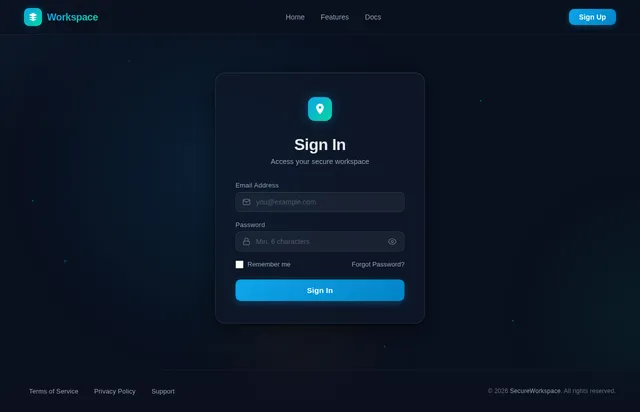
Implement Login Page
As a user, I want to see the updated Login (v2) JSX design with email/password fields, validation states, and error banners so that the auth entry point matches the approved design. Connect to the existing auth API. Apply design tokens and shared components.
Implement Sidebar Navigation
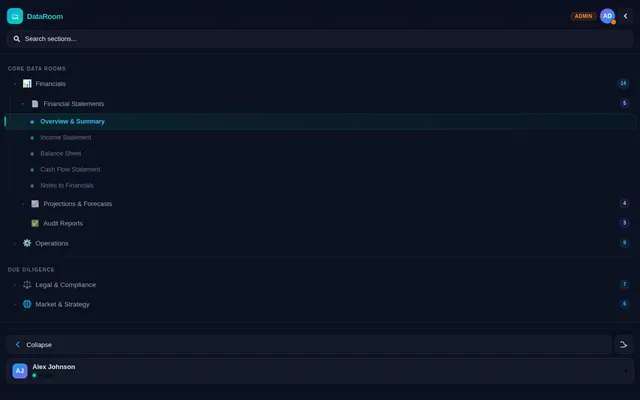
As an authenticated user, I want the Sidebar (v2) JSX design rendered as a persistent left-nav component with collapsible section/subsection tree, role-aware menu items, active-state indicators, and a collapse toggle so that I can navigate the VDR efficiently. Sidebar must accept a sections data prop and emit navigation events.
Document Management CRUD API
As a Backend Developer, I want REST endpoints for documents (POST /documents with multipart upload, GET /documents with filter/sort/pagination query params, GET /documents/:id, PATCH /documents/:id metadata, DELETE /documents/:id, POST /documents/:id/versions) storing file metadata in PostgreSQL and files in the local abstracted storage layer so that document management is fully operational.
User Management & Roles API
As a Backend Developer, I want REST endpoints (GET /users, POST /users/invite, PATCH /users/:id/role, PATCH /users/:id/status) that allow Admins to invite users by email, assign roles (Admin, InternalViewer, Investor), and activate/deactivate accounts, persisted in PostgreSQL, so that access control is manageable.
Tag Management System
As a Backend Developer, I want CRUD endpoints for tags (GET /tags, POST /tags, DELETE /tags/:id) and document-tag association endpoints (POST /documents/:id/tags, DELETE /documents/:id/tags/:tagId) so that theme tags can be maintained independently and applied to documents.
Global State & API Client Setup
As a Frontend Developer, I want a configured React Query client with default retry/stale-time settings, an Axios instance with JWT interceptor (auto-attach token, auto-refresh or logout on 401), and a Zustand or Context store for auth state so that all API calls across the app share consistent behavior.
Implement Home Browse Page
As an Investor or Internal Viewer, I want the Home (v1) JSX page to display a card grid of top-level sections with thumbnail, title, document count, and last-updated date so that I can quickly orient myself and navigate into a section. Use mock data initially; wire to API after t20 is complete.
Implement Dashboard Overview Page
As an Admin, I want the Dashboard (v1) JSX page showing KPI cards (total documents, active users, recent uploads, pending reviews), a recent-activity feed, and quick-action buttons so that I have an operational overview. Use mock data initially; wire to API after t24 is complete.
Implement Sections Management Page
As an Admin, I want the Sections (v1) JSX page with a tree view listing all sections and subsections, inline create/rename/delete controls, drag-to-reorder, and a detail panel so that I can manage the VDR information architecture. Use mock data initially; wire to API after t19 is complete.
Implement Section Detail Page
As an Investor or Internal Viewer, I want the Section (v1) JSX page showing a section overview (description, document count, sub-sections list, recently added documents) so that I understand what is available before drilling into documents. Wire to API after t20 and t21 are complete.
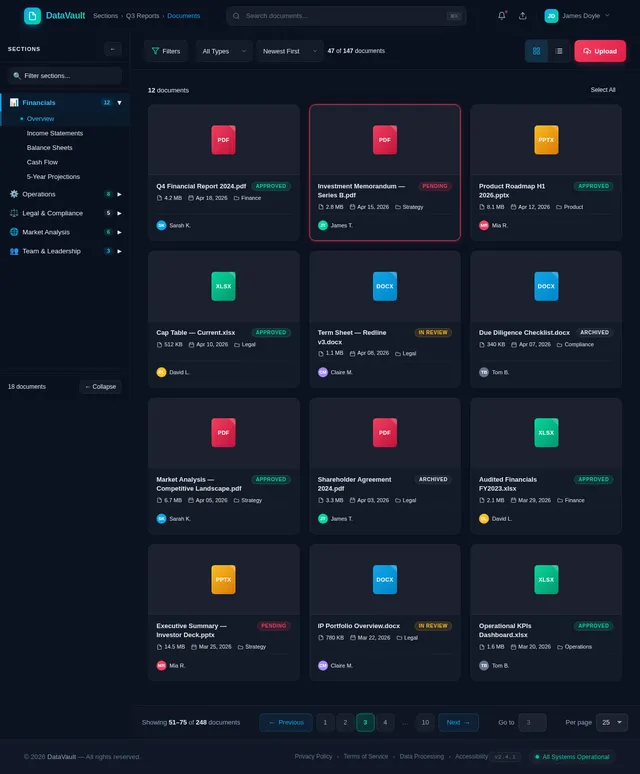
Implement Documents List Page
As any authenticated user, I want the Documents (v2) JSX page with a filterable/sortable table of documents (title, section, tags, status, version, date, confidentiality) and bulk-action toolbar so that I can manage or browse the document library. Investors see only non-confidential docs. Wire to API after t21 is complete.
Implement Document Detail Page
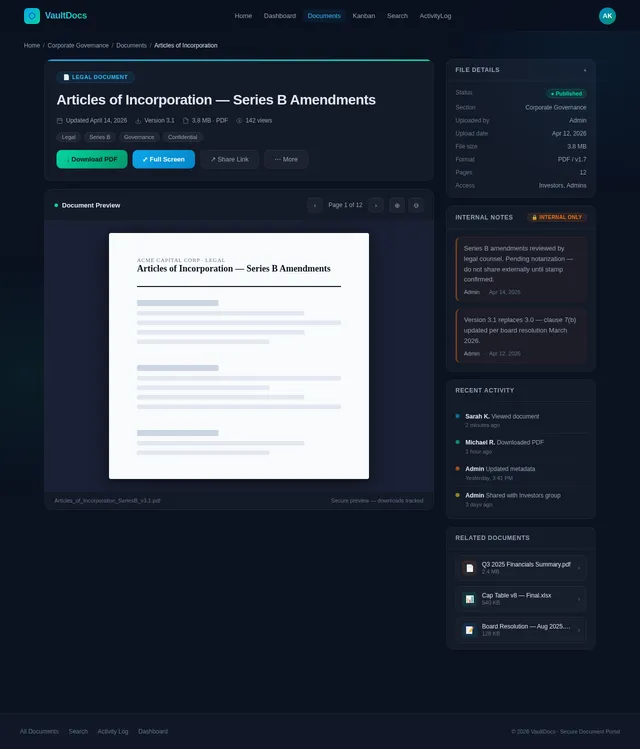
As an authenticated user, I want the Document (v2) JSX page with an in-browser PDF/DOCX/PPTX/XLSX preview panel, metadata sidebar, version history list, download button, and an Internal Notes section (visible to Admin and Internal Viewer only) so that I can review and annotate documents. Wire to API after t21 and t22 are complete.
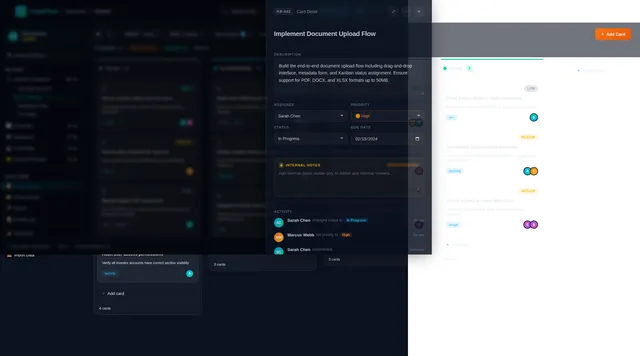
Implement Kanban Status Board
As an Admin, I want the Kanban (v2) JSX page with drag-and-drop columns (Draft, Under Review, Approved, Archived) where each card shows document title, section, assignee avatar, and tag chips so that I can manage document review workflows visually. Wire to API after t21 is complete.
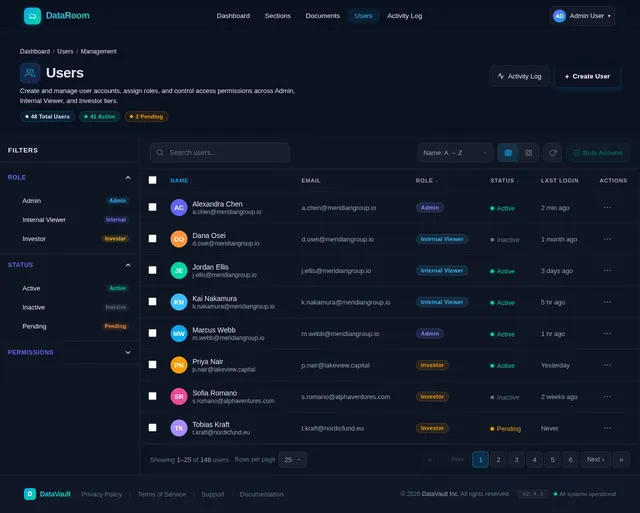
Implement Users Management Page
As an Admin, I want the Users (v2) JSX page with a table of users (name, email, role, last login, status), an invite modal, a role-change dropdown, and deactivate/reactivate actions so that I can manage access control. Wire to API after t23 is complete.
Implement Bulk Import Page
As an Admin, I want the Import (v1) JSX page with a JSON file drop-zone, schema validation preview table, error/warning row highlights, and a confirm-import button so that I can bulk-load sections and documents via structured JSON. Wire to API after t25 is complete.
Implement Activity Log Page
As an Admin, I want the ActivityLog (v1) JSX page showing a chronological audit trail (user, action, resource, timestamp) with filters by user, action type, and date range so that I can review all VDR activity. Wire to API after t26 is complete.
Implement Search Input Page
As an authenticated user, I want the Search (v1) JSX page with a full-text search bar, type-ahead suggestions, filter chips (section, tag, file type, date range, confidentiality), and a loading state so that I can discover documents quickly. Wire to API after t27 is complete.
Document Notes & Download API
As a Backend Developer, I want endpoints POST /documents/:id/notes, GET /documents/:id/notes (Admin/InternalViewer only), and GET /documents/:id/download (with signed URL generation and activity log entry) so that internal annotations and secure downloads are supported.
Dashboard KPI Aggregates API
As a Backend Developer, I want a GET /dashboard/stats endpoint returning total documents, active users, uploads in last 7 days, documents by status, and recent activity slice so that the Dashboard overview page has a single performant data source.
Bulk JSON Import API
As a Backend Developer, I want a POST /import endpoint that accepts a JSON payload conforming to a documented schema (sections, subsections, documents with metadata), validates the payload, runs the import inside a database transaction, and returns a detailed result report (created, skipped, errored rows) so that bulk data loading is safe and auditable.
Activity Log API
As a Backend Developer, I want a GET /activity endpoint with filters (userId, action, resourceType, startDate, endDate, page, limit) and an internal logActivity(userId, action, resourceType, resourceId, metadata) service function called by all write operations so that a full audit trail is queryable by Admins.
Tag UI in Document Forms
As a Frontend Developer, I want a reusable TagInput component (type-ahead, create-on-enter, color-coded chips) integrated into the document upload modal, the Document detail edit panel, and the Documents filter bar so that tags can be managed inline throughout the app.
Confidentiality Level Enforcement
As a Backend Developer, I want confidentiality level (public, internal, confidential, restricted) checked on every GET /documents and GET /documents/:id request so that Investors never receive confidential or restricted documents and Internal Viewers cannot access restricted documents, returning 403 for direct URL access attempts.
Implement Search Results Page
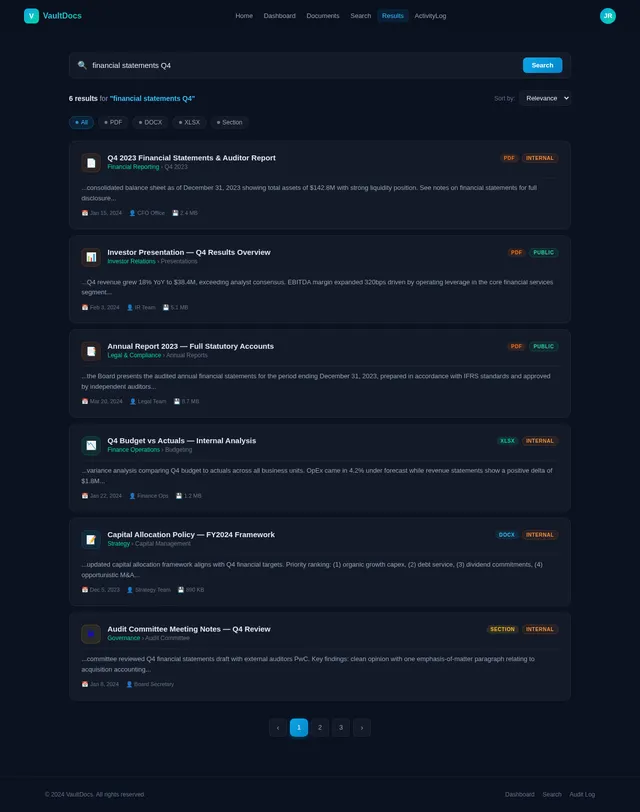
As an authenticated user, I want the Results (v2) JSX page displaying ranked search results with document title, section breadcrumb, matched-text snippet, file-type icon, and confidentiality badge so that I can evaluate relevance before opening a document. Wire to API after t27 is complete.
Full-Text Search API
As a Backend Developer, I want a GET /search?q=§ion=&tags=&fileType=&dateFrom=&dateTo=&confidentiality= endpoint using PostgreSQL full-text search (tsvector) on document title, description, and tag fields, with role-based result filtering (Investors excluded from confidential), returning ranked results with snippet extraction so that search is fast and secure.
Kanban Status Update API
As a Backend Developer, I want a PATCH /documents/:id/status endpoint accepting a status value (draft, under_review, approved, archived), validating allowed transitions, persisting the change, recording an activity log entry, and returning the updated document so that Kanban drag-and-drop operations are persisted.
Integrate Sections API Frontend
As a Frontend Developer, I want the Sections page, Sidebar, Home, and Section detail components wired to the live sections API via React Query hooks, replacing all mock data, so that section CRUD operations and navigation reflect real data.
Integrate Documents API Frontend
As a Frontend Developer, I want the Documents list, Document detail, and Section detail pages wired to the live documents API with upload progress indicators, optimistic UI updates, and error handling so that document management is fully end-to-end functional.
Integrate Users API Frontend
As a Frontend Developer, I want the Users page wired to the user management API so that invite, role-change, and deactivate actions call real endpoints, refresh the table on success, and display inline validation errors.
Integrate Import API Frontend
As a Frontend Developer, I want the Import page wired to the bulk import API so that after JSON validation the confirm action posts to the API, shows a progress state, and renders the per-row result report returned by the server.
Integrate Activity Log Frontend
As a Frontend Developer, I want the ActivityLog page wired to the activity API with working filter controls (user, action type, date range) and paginated infinite-scroll or pagination component so that Admins can audit all VDR activity from real data.
Integrate Dashboard Stats Frontend
As a Frontend Developer, I want the Dashboard page wired to the /dashboard/stats API and the activity log API so that all KPI cards and the recent-activity feed reflect live data with auto-refresh every 60 seconds.
Document Preview Renderer
As a Frontend Developer, I want an in-browser document preview component that renders PDF files via react-pdf, DOCX/PPTX/XLSX via an iframe or mammoth.js/SheetJS, with a page navigator, zoom controls, and a fallback download-only state for unsupported types so that users can review documents without downloading.
Build Role-Based Route Guards
As a Frontend Developer, I want a React Router v6 route-guard layer that reads the authenticated user's role (Admin, Internal Viewer, Investor) and redirects unauthorised access attempts to a 403 page so that role-specific pages are protected client-side. Cover all routes introduced in t3–t17.
Integrate Kanban API Frontend
As a Frontend Developer, I want the Kanban board wired to the live documents API and status update endpoint so that drag-and-drop column moves persist immediately, with optimistic updates and rollback on error.
Integrate Search API Frontend
As a Frontend Developer, I want the Search and Results pages wired to the search API so that query submission, filter application, and result rendering are driven by live data with debounced input, loading skeletons, and empty-state handling.
Email Invite Notification Service
As a Backend Developer, I want a notification service that sends transactional emails (using nodemailer with SMTP config via environment variables) for user invitations (with a one-time setup link) and document approval status changes so that users are informed of key events.
End-to-End Admin User Flow
As a Tech Lead, I want all Admin user-flow screens (Dashboard → Sections → Documents → Kanban → Users → Import → ActivityLog) smoke-tested end-to-end in a staging environment to verify no broken API calls, missing route guards, or UI regressions exist before the investor demo.
End-to-End Viewer/Investor Flow
As a Tech Lead, I want the Investor and Internal Viewer flows (Login → Home → Sidebar → Section → Documents → Document Preview → Search → Results) smoke-tested end-to-end in staging, verifying confidentiality enforcement, internal-notes visibility, and download logging, so that the product is demo-ready.
Your Virtual Data Room, Reimagined
Manage documents, control access, and collaborate securely. Built for administrators, internal teams, and investors who demand clarity and compliance.
Everything You Need to Manage a Data Room
From document uploads to audit trails, every tool your team needs is built in and ready to go.
Organized Sections
Structure your data room with hierarchical sections and subsections. Browse, expand, and navigate complex document trees effortlessly.
Document Management
Upload, tag, and manage documents with rich metadata. Preview PDFs inline, filter by type, and download files instantly.
Kanban Workflow
Track document status through customizable Kanban boards. Move items between stages and keep your team aligned on progress.
Powerful Search
Find any document instantly with full-text search. View matched results with highlights and jump directly to the source.
Bulk Import
Import entire document libraries via JSON. Map fields, validate data, and onboard thousands of records in minutes.
Activity Audit Log
Every action is tracked. Review the full audit log to see who accessed, modified, or downloaded documents and when.
Tailored Access for Your Entire Team
Whether you manage the data room or just need to review a document, every role gets the right experience.
Administrator
Full control over sections, documents, users, and system settings.
- ✓Create and manage sections
- ✓Upload and tag documents
- ✓Assign user roles and permissions
- ✓Bulk import via JSON
- ✓View complete audit logs
Internal Viewer
Browse sections, read documents, and access internal notes.
- ✓Browse all sections
- ✓Filter and preview documents
- ✓View internal notes
- ✓Download permitted files
- ✓Search across the data room
Investor
Secure access to curated documents with read-only permissions.
- ✓Browse published sections
- ✓Filter and sort documents
- ✓Preview and download PDFs
- ✓Full-text search access
- ✓View matched results
Ready to Secure Your Documents?
Sign in to your data room or contact your administrator to get access. Enterprise-grade security, zero friction.
No comments yet. Be the first!