turbo-platform
 Jared Frieden
# Request for Product (RFP) — mango-qr --- ## 1. Executive Summary **mango-qr** is a self-service WebAR platform enabling brands to transform physical product packaging into interactive augmented reality experiences. Consumers scan dynamic QR codes printed on packaging (wine bottles, food products, cosmetics) to instantly view 3D models, brand videos, and immersive storytelling content — directly in their browser, with zero app downloads. ### Market Opportunity The WebAR market has a significant gap: **8th Wall shut down its hosted platform in February 2026**, leaving brands and agencies without a self-service AR solution. Remaining competitors (ZapWorks, Blippar) are agency-dependent or SDK-only. mango-qr targets this displaced customer base with a complete self-service platform. --- ## 2. Product Vision ### North Star Principles | ID | Principle | Description | |----|-----------|-------------| | NS1 | Zero-Friction AR | QR scan to AR experience in under 5 seconds, zero app downloads | | NS2 | Print Once, Update Forever | Dynamic QR redirect — update AR content without reprinting | | NS3 | Cross-Device Parity | Meaningful AR on every device: iOS, Android, desktop | | NS4 | Brand Storytelling First | Every feature serves the product packaging storytelling use case | | NS5 | Self-Service Simplicity | Non-technical marketers can publish AR experiences without code | ### Go-to-Market **Product packaging → AR content.** Target customers include: - **Wine & spirits** — Vineyard tours, tasting notes, food pairing videos - **Food & beverage** — Recipe animations, ingredient sourcing stories, farm-to-table journeys - **Cosmetics & skincare** — Ingredient origin videos, application tutorials, sustainability stories - **Consumer electronics** — 3D product exploration, setup guides, feature demonstrations --- ## 3. Scope ### In Scope (Phase 1 MVP) | # | Capability | Description | |---|-----------|-------------| | 1 | **Dynamic QR Management** | Create, update, and track QR codes. Update linked content without reprinting physical codes | | 2 | **3D Asset Pipeline** | Upload FBX/OBJ/GLB → automatic conversion to GLB (Draco-compressed) + USDZ (iOS) | | 3 | **Video/Image Asset Pipeline** | Upload MP4/MOV/WebM videos and PNG/JPG images → optimize for mobile delivery | | 4 | **WebAR Viewer** | Browser-based AR experience: model-viewer + USDZ for iOS, Three.js + WebXR for Android, orbit viewer for desktop | | 5 | **Brand Customization** | Configurable brand overlay in AR: logo, headline, description, CTA button, primary color | | 6 | **Scan Analytics** | Real-time metrics: scan counts, device breakdown, geolocation, time-series charts | | 7 | **Self-Service Dashboard** | React web app for brands to manage QR codes, assets, experiences, and analytics | ### Out of Scope (Future Phases) | Phase | Features | |-------|---------| | Phase 2 | Interactive logic (Three.js scripting), creative editor, multi-asset experiences, white-label theming | | Phase 3 | Org AI (client-specific filtering), semantic segmentation, AI model ensemble, SLAM markerless AR | --- ## 4. Target Users | Persona | Role | MVP Priority | |---------|------|:------------:| | **Brand Manager / Marketer** | Creates QR codes, uploads assets, configures brand overlays, reviews analytics | 🔴 Primary | | **Consumer** | Scans QR on packaging → views AR experience in browser | 🔴 Primary | | **Developer** | Uploads 3D models, manages asset pipeline, integrates via API | 🟡 Secondary | | **Admin** | Manages user accounts, permissions, platform settings | 🟡 Secondary | --- ## 5. Success Criteria | Metric | Target | Measurement | |--------|--------|-------------| | QR scan → AR render time | < 5 seconds | 95th percentile on 4G network | | 3D asset load time | < 3 seconds (compressed GLB) | 95th percentile | | Asset pipeline processing | < 60 seconds (model), < 120 seconds (video) | Median | | Cross-browser compatibility | ≥ 85% of mobile browsers | iOS Safari + Android Chrome | | Dashboard usability | 3-click publish flow | Create QR → Upload → Link & Publish | | File size limit | 25MB per asset | Enforced at upload | --- ## 6. Technical Constraints | Constraint | Detail | |-----------|--------| | **Hosting** | Google Cloud Platform (GCP) — Cloud Run, Cloud Storage, Cloud SQL, Memorystore, Cloud CDN | | **Domain** | `mango-qr.com` (pending purchase) | | **iOS AR** | No native WebXR on Safari — must use `<model-viewer>` + USDZ/AR Quick Look fallback | | **Asset size** | 25MB maximum per upload | | **Frameworks** | React (dashboard), FastAPI (backend), Three.js + model-viewer (AR viewer) | | **Database** | MySQL via SQLAlchemy + Alembic migrations | | **Local dev** | Docker Compose with GCS emulator, MySQL, Redis |







Comments (0)
Sign in to leave a comment
System Requirements
System Requirements Document (SRD) — turbo-platform
Document ID: TPL-SRD-001
Version: 1.2
Date: 2026-03-16
Status: Updated
1. Introduction
turbo-platform is a cutting-edge, scalable solution for managing dynamic QR codes and delivering browser-based Augmented Reality (AR) experiences. The platform bridges physical product packaging with digital interactivity, enabling brands to create immersive storytelling experiences that engage consumers directly through their mobile browsers, without requiring app downloads.
This document outlines the system requirements for the Phase 1 MVP of turbo-platform, ensuring alignment with the project's goals and user needs. The platform is tailored for the U.S. market, with considerations for locale-specific defaults, such as currency (USD), timezone (EST), and compliance with U.S. data privacy regulations.
2. System Overview
turbo-platform is a modular, secure, and scalable WebAR platform that empowers brands to create, manage, and analyze dynamic QR codes linked to AR experiences. The MVP focuses on delivering:
- Dynamic QR Code Management: Create, update, and track QR codes without reprinting physical media.
- Media Asset Pipeline: Upload and optimize 3D models, videos, and images for seamless AR delivery.
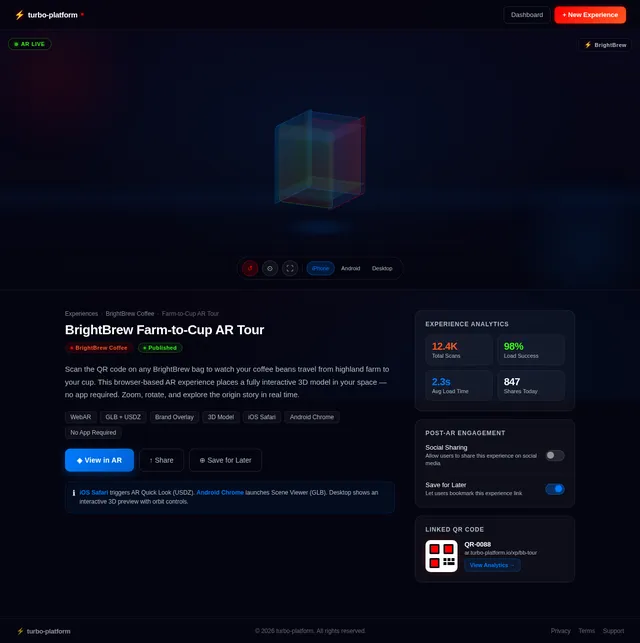
- Browser-Based AR Viewer: Cross-device compatibility for iOS, Android, and desktop browsers.
- Brand Customization: Configurable overlays (logo, headline, CTA, colors) within AR experiences.
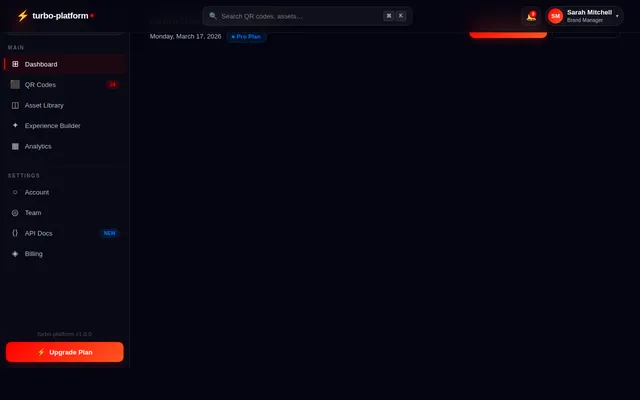
- Self-Service Dashboard: Intuitive tools for non-technical users to manage QR codes, assets, and analytics.
- Post-AR Engagement Features: Social sharing and "Save for Later" options to amplify campaign reach.
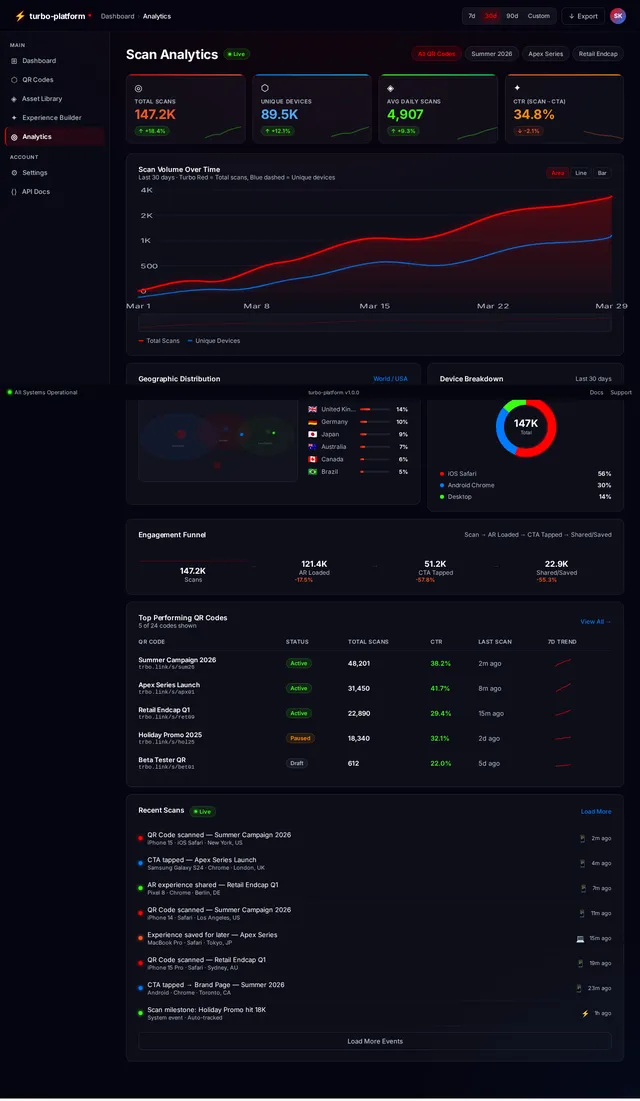
- Scan Analytics: Real-time metrics on QR code usage, including device type, location, and time-series data.
- Selective SRD Regeneration: Ability for users to manually trigger SRD updates to reflect new requirements.
3. Functional Requirements
3.1 User Stories (MVP)
- As a Consumer, I should be able to scan a QR code on product packaging and instantly view an AR experience in my browser.
- As a Brand Manager, I should be able to create a dynamic QR code and download it as PNG/SVG for printing.
- As a Brand Manager, I should be able to upload a 3D model, video, or image, and the system should automatically optimize it for AR delivery.
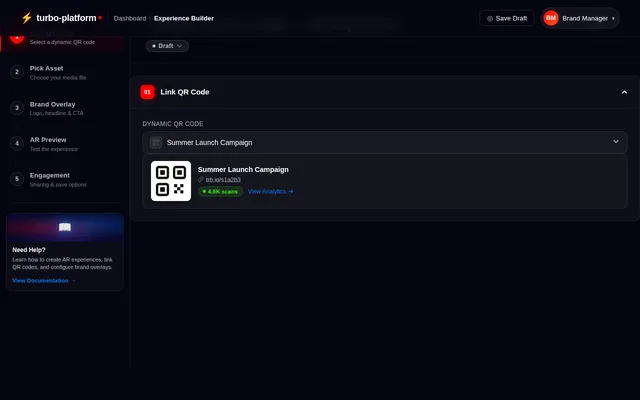
- As a Brand Manager, I should be able to link a QR code to an asset and configure my brand overlay (logo, colors, CTA).
- As a Brand Manager, I should be able to update the asset linked to a QR code without reprinting the physical code.
- As a Brand Manager, I should be able to view scan analytics (count, devices, locations, time-series) for my QR codes.
- As a Brand Manager, I should be able to enable post-AR engagement features, such as social sharing and "Save for Later."
- As a Developer, I should be able to upload raw 3D assets and receive optimized outputs (GLB + USDZ).
- As an Admin, I should be able to manage user accounts, permissions, and platform settings.
- As a Consumer, I should be able to share the AR experience on social media or save the link for later use.
- As a User, I should be able to selectively regenerate the System Requirements Document (SRD) to reflect updated requirements.
4. User Personas
Brand Manager / Marketer (Primary)
- Creates and manages QR codes for product packaging.
- Uploads brand assets (3D models, videos, images).
- Configures brand overlays and publishes AR experiences.
- Reviews scan analytics to measure campaign performance.
- Requires fully visual, self-service tools with no coding knowledge.
Consumer (Primary)
- Scans QR codes on physical product packaging.
- Expects instant AR experience in browser (< 5 seconds).
- Uses iOS or Android smartphones.
- Engages with post-AR features like social sharing or saving links.
Developer (Secondary)
- Uploads and manages 3D models programmatically.
- Interested in API access for pipeline integration.
- Understands 3D file formats (FBX, OBJ, GLB, USDZ).
Admin (Secondary)
- Platform operator managing users and settings.
- Monitors system health and usage.
5. Visuals Colors and Theme
Color Palette
| Type | Color | Hex |
|---|---|---|
| Primary | Turbo Red | #FF0000 |
| Primary | Electric Blue | #007BFF |
| Secondary | Cool Gray | #B0BEC5 |
| Secondary | White | #FFFFFF |
| Accent | Neon Green | #39FF14 |
| Accent | Vibrant Orange | #FF5722 |
Theme
The visual design combines bold, high-energy colors with sleek modern gradients to evoke a sense of speed and innovation. Subtle animations and dynamic transitions create an engaging user experience that feels premium and futuristic.
6. Signature Design Concept
Interactive Galaxy Map Homepage
The homepage will feature an interactive galaxy map where each star represents a feature or section of the platform. Users can navigate the galaxy by zooming, panning, and clicking on stars to explore features like QR code management, asset pipeline, analytics, and more.
- Visuals: A dark, cosmic background with glowing stars and nebulae. Stars pulse gently to indicate interactivity.
- Animations: Smooth transitions as users zoom into a star, revealing a detailed view of the feature it represents.
- Micro-Interactions: Hovering over a star displays a tooltip with the feature name and a brief description.
- Color Shifts: The galaxy's colors subtly morph based on the time of day (e.g., warm tones during the day, cool tones at night).
- CTA Integration: A prominent "Get Started" button floats in the center of the galaxy, inviting users to dive into the platform.
This design will make the homepage unforgettable, setting the tone for turbo-platform's innovative and dynamic branding.
7. Non-Functional Requirements
| Category | Requirement | Target |
|---|---|---|
| Performance | QR scan → AR render | < 5 seconds (95th percentile, 4G) |
| Performance | 3D asset load | < 3 seconds (compressed GLB) |
| Scalability | Concurrent QR scans | Millions without degradation |
| Security | Communication | TLS 1.3 for all traffic |
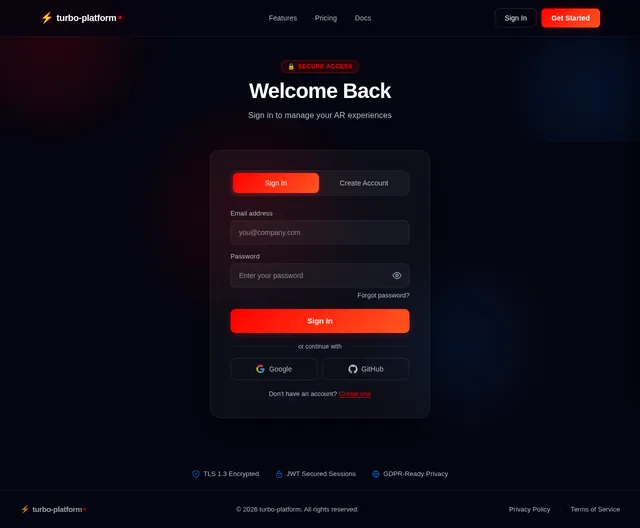
| Security | Authentication | JWT tokens, bcrypt password hashing |
| Reliability | Asset delivery | Cloud CDN with multi-region edge caching |
| Compatibility | Mobile browsers | iOS Safari 15+, Android Chrome 90+ |
| Compliance | Data privacy | GDPR-ready: anonymized analytics, consent-based tracking |
8. Tech Stack
| Layer | Technology |
|---|---|
| Frontend | React (Dashboard), Three.js + model-viewer (AR Viewer) |
| Backend API | Python + FastAPI |
| Database | MySQL + Alembic migrations |
| Object Storage | Google Cloud Storage |
| CDN | Cloud CDN |
| AI Models | GPT 5.2 (user-friendly responses), Claude 4.5 Opas (academic/coding work) |
| AI Tools | Litellm (LLM routing), Langchain |
| Local Dev | Docker, docker-compose |
| Server Orchestration | Kubernetes |
9. Assumptions and Constraints
Assumptions
- Consumers have access to standard mobile browsers (Safari, Chrome).
- QR codes will be printed at sufficient resolution for reliable scanning.
- Brands will supply their own 3D models, videos, and images.
- Initial deployment targets the U.S. market.
Constraints
- Asset file size maximum: 25MB.
- iOS Safari has no native WebXR AR — requires USDZ fallback.
- No native mobile app — browser-only.
- Single-tenant for MVP (multi-tenancy in Phase 2).
10. Glossary
| Term | Definition |
|---|---|
| WebAR | Web-Based Augmented Reality — AR experiences delivered through browsers without app downloads. |
| Dynamic QR | QR code whose destination can be updated server-side without reprinting the physical code. |
| GLB | Binary glTF — compact 3D model format optimized for web delivery. |
| USDZ | Apple's 3D file format used by AR Quick Look on iOS. |
| Draco | Google's open-source compression library for 3D meshes. |
| AR Quick Look | Apple's native AR viewer triggered by <model-viewer> or .usdz links in Safari. |
| model-viewer | Google's web component for displaying 3D models with AR support. |
| Cloud Run | GCP's serverless container platform for auto-scaling APIs. |
This updated SRD reflects the inclusion of post-AR engagement features and the ability for users to selectively regenerate the document to reflect updated requirements. Let me know if there are any additional refinements you'd like to make!

Bridge Physical & Digital Reality
Dynamic QR codes. Instant WebAR. Zero app downloads.
Static packaging can’t tell your brand’s story.
- Static QR codes locked at print time
- Costly reprints for every campaign change
- Zero scan analytics or consumer insights
- No interactive engagement after the scan
- Dynamic QR codes updated in real time
- Change linked content live, no reprinting
- Real-time analytics by device, location & time
- Instant browser-based AR engagement
Everything you need to go from packaging to AR
Six powerful capabilities working together to bridge your physical products with immersive digital experiences.
Dynamic QR Management
Create, update, and track QR codes in real time without reprinting physical packaging or labels.
Media Asset Pipeline
Upload 3D models, videos, and images. Auto-optimize for instant AR delivery across every device.
Browser-Based AR
Deliver immersive AR experiences on iOS Safari, Android Chrome, and desktop with zero app downloads.
Brand Customization
Configure brand overlays with your logo, colors, headlines, and CTAs inside every AR experience.
Scan Analytics
Real-time metrics on scan counts, device types, locations, and time-series trends at a glance.
Post-AR Engagement
Amplify campaigns with social sharing, save-for-later, and deep-link CTAs after the AR moment.
How It Works
Launch your first AR experience in minutes
Four simple steps take you from physical packaging to an immersive, trackable AR experience your customers will love.
Create QR Code
Generate a unique, trackable QR code in seconds. Download as PNG or SVG, ready for product packaging, print collateral, or signage. Update the linked experience anytime without reprinting.
Upload Your Asset
Drag and drop your 3D model, video, or image. Our pipeline automatically converts and compresses assets into AR-ready formats (GLB + USDZ) optimized for instant mobile loading.
Configure Brand Overlay
Add your logo, choose brand colors, set a headline and call-to-action button. The AR overlay ensures every scan reinforces your brand identity with a pixel-perfect presentation.
Go Live & Track
Publish your AR experience with one click. Track scans across devices, locations, and time periods. Get real-time analytics on engagement, shares, and post-AR conversions.
Create Your Dynamic QR Code
Generate a unique, trackable QR code in seconds. Download as PNG or SVG, ready for product packaging, print collateral, or signage. Update the linked experience anytime without reprinting.
Upload & Optimize Your Media
Drag and drop your 3D model, video, or image. Our pipeline automatically converts and compresses assets into AR-ready formats (GLB + USDZ) optimized for instant mobile loading.
Customize Your Brand Experience
Add your logo, choose brand colors, set a headline and call-to-action button. The AR overlay ensures every scan reinforces your brand identity with a pixel-perfect presentation.
Launch & Monitor in Real Time
Publish your AR experience with one click. Track scans across devices, locations, and time periods. Get real-time analytics on engagement, shares, and post-AR conversions.
See it before you scan it
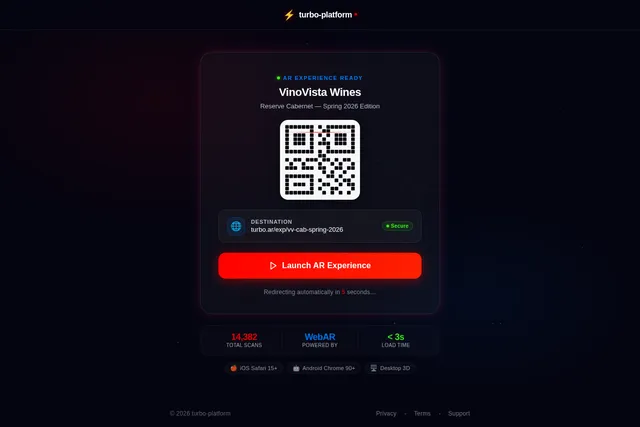
turbo-platform delivers browser-based AR experiences that load instantly — no app downloads, no friction. Consumers scan your QR code and see your product come alive in seconds, on any device.
- iOS Safari — full AR Quick Look support
- Android Chrome — Scene Viewer integration
- Desktop 3D preview with orbit controls
- Automatic USDZ fallback for Apple devices
Real-time insights from every scan
Drill down by device, location, and time period.
Brands love turbo-platform
See how innovative brands are transforming product packaging into immersive AR experiences.
Simple, scalable pricing
Start free, scale as you grow. No hidden fees, no surprises.
- ✓Up to 10 dynamic QR codes
- ✓5 GB asset storage
- ✓Browser-based AR viewer
- ✓Basic scan analytics
- ✓Email support
- ✓PNG & SVG QR downloads
- ✓Unlimited dynamic QR codes
- ✓50 GB asset storage
- ✓Brand overlay customization
- ✓Real-time analytics dashboard
- ✓Social sharing & Save for Later
- ✓3D model optimization pipeline
- ✓Priority support
- ✓API access
- ✓Everything in Growth
- ✓Unlimited asset storage
- ✓Dedicated account manager
- ✓Custom brand integrations
- ✓SLA & uptime guarantee
- ✓Advanced security & compliance
- ✓SSO / SAML authentication
- ✓Custom API rate limits
All plans include a 14-day free trial. No credit card required.
Ready to bring your packaging to life?
Start free. Launch in minutes. No app required.
No comments yet. Be the first!