truth-for-a-win
Make me a casino type game, it will be multiplayer. There will be matches that players can host, and the dealer will be a bot. It will have Texas Holdem, blackjack, and a lottery. You will login with a simple username saving it into your browser. The games currency will be tokens. Lottery tickets cost 500 tokens. Starting the game will give you 10,000 tokens, each day you will receive 1,500 tokens. The lottery will run once every three hours. There will also be a leaderboard, and a die betting game,


Comments (0)
Sign in to leave a comment
System Requirements
System Requirements Document for truth-for-a-win
1. Introduction
truth-for-a-win is a multiplayer, casino-type game played with an in-game currency called tokens. Players log in with a simple username that the browser saves, host matches that other players can join, and play against a bot dealer. The product includes Texas Holdem, blackjack, a die betting game, and a lottery that draws once every three hours with tickets costing 500 tokens. A leaderboard lets players compare results.
The audience is adult casual players who want a tense, precise, premium private-gaming experience rather than a cartoon app. The product intent is a self-contained token casino: a player arrives, establishes a username, receives a starting balance, and can host or join matches, bet on dice, buy lottery tickets, and track standing on the leaderboard.
This document is the System Requirements Document for the product requested under the project name truth-for-a-win.
2. System Overview
2a. Product Interpretation and Delivery Boundary
truth-for-a-win is delivered as a first-party web application with a React frontend and a shared FastAPI backend, backed by MariaDB for durable application data and Redis for shared live state and coordination. All game surfaces — matches, Texas Holdem, blackjack, dice, lottery, and leaderboard — are owned and rendered by the application.
Identity is deliberately minimal: the player enters a simple username, and the browser saves it so the player returns to the same identity on later visits. There is no password, email, or external identity provider. The username is the player's durable identity for token balance, daily grants, lottery tickets, match participation, and leaderboard standing.
The lottery draw is a background process that runs once every three hours; the daily 1,500-token grant is a background process that runs once per day per player. Both are system-driven, but their results are observable to the player on the Lottery surface and in the token balance.
The bot dealer is a system actor inside matches; it is not a human persona and has no page of its own.
Removed from scope: none. No concept from the authoritative requirement thread was removed or replaced.
2b. Source Content Inventory
Not applicable — no reference directive with content_source was supplied.
2c. Page Content and Component Coverage
Landing
- Information/state: Product wordmark inside a thin bezel ring; headline "Truth for a win"; subline "Host a table, take on the bot dealer and bet your tokens on the dice."; call to action "Enter the floor"; a summary of the available games (Texas Holdem, blackjack, dice, lottery) and the token economy (10,000 starting tokens, 1,500 daily, 500-token lottery tickets, three-hour draws).
- Primary action: "Enter the floor" — proceeds to Login (or directly to Matches if a saved username already exists in the browser).
- Supporting actions: Navigate to Login explicitly.
- Domain entities: none persisted; static product description.
- Component responsibilities: Hero gauge panel (decorative on Landing, showing the token/lottery concept), game summary rows with hairline rules, primary CTA.
- States: Loading (static content, no data fetch required); empty/success/error not applicable beyond static render; recovery — if a saved username exists, the CTA routes to Matches instead of Login.
Login
- Information/state: A single username input; explanation that the username is saved in this browser and used as the player's identity.
- Primary action: Submit username to establish identity.
- Supporting actions: Return to Landing.
- Domain entities: Player identity (username), browser-saved username.
- Component responsibilities: Username field with validation (non-empty, trimmed), submit control, inline validation message.
- States: Empty (no username entered — submit disabled or shows guidance); loading (identity being established); success (username saved in browser, player routed to Matches with 10,000 starting tokens if first use); error (username rejected — e.g., blank or already taken — with a clear message and the field preserved for correction); recovery (retry with a different username).
Matches
- Information/state: List of open matches with game type (Texas Holdem or blackjack), host name, player count, and a teal live-status dot with condensed uppercase label; the player's current token balance in a ruled row.
- Primary action: Host a new match (choose game type) or join an open match.
- Supporting actions: Refresh the match list; leave a match lobby before it starts.
- Domain entities: Match (id, game type, host, players, status), Player token balance.
- Component responsibilities: Match list rows with tabular figures and hairline dividers, host-match control, join control, token counter.
- States: Loading (fetching open matches); empty (no open matches — prompt to host one); success (match created or joined, routed to the corresponding game surface); error (match full or no longer available — message and refreshed list); recovery (return to list and choose another match).
Texas Holdem
- Information/state: The current match's table: community cards, each player's visible state, the bot dealer's actions, the pot, the player's hole cards, the player's token balance, and whose turn it is.
- Primary action: Take a turn action — fold, check/call, bet, or raise — when it is the player's turn.
- Supporting actions: View the pot and current bets; observe the bot dealer's dealt cards and actions.
- Domain entities: Match, Hand, Card, Pot, Bet, Player stack, Bot dealer.
- Component responsibilities: Table surface with card reveals at 180ms ease, action controls enabled only on the player's turn, pot and bet rows with tabular figures, turn indicator.
- States: Loading (joining table state); waiting (not the player's turn — controls disabled with a clear indicator); success (action accepted, table state advances); error (action rejected — e.g., insufficient tokens for a bet — with message and controls restored); recovery (re-sync table state and retry); hand-complete (pot awarded, next hand or match end).
Blackjack
- Information/state: The player's hand, the bot dealer's hand (with hidden card until reveal), hand totals, the player's bet, the player's token balance, and round status.
- Primary action: Place a bet and take a round action — hit or stand.
- Supporting actions: Observe the dealer's draw and the round result.
- Domain entities: Match, Round, Card, Bet, Player balance, Bot dealer.
- Component responsibilities: Card reveal at 180ms ease, hit/stand controls, bet control, totals with tabular figures, result banner.
- States: Loading (round state); betting (awaiting bet); in-round (awaiting hit/stand); success (round resolved — win, loss, or push — with balance updated); error (bet exceeds balance — message and bet control restored); recovery (re-bet and start a new round).
Dice
- Information/state: The die, the player's chosen bet (amount and prediction), the player's token balance, and the most recent roll result.
- Primary action: Place a bet on the die roll and roll.
- Supporting actions: Adjust bet amount; view previous results.
- Domain entities: Die roll, Bet, Player balance.
- Component responsibilities: Engraved titanium die with 180ms settle on result, bet amount and prediction controls, balance row, result display.
- States: Loading (balance fetch); idle (no bet placed); success (roll resolved, balance updated, result shown); error (bet exceeds balance or invalid amount — message and controls restored); recovery (place a new bet).
Lottery
- Information/state: Current lottery round, the countdown to the next three-hour draw, the ticket price (500 tokens), the player's owned tickets, the prize pool, and the player's token balance.
- Primary action: Buy a lottery ticket for 500 tokens.
- Supporting actions: View the countdown and past draw results.
- Domain entities: Lottery round, Ticket, Draw, Prize pool, Player balance.
- Component responsibilities: Countdown gauge with teal timer treatment, ticket purchase control, owned-ticket list, draw-result history.
- States: Loading (round and balance fetch); empty (no tickets owned); success (ticket purchased, balance reduced by 500, ticket listed); error (insufficient tokens — message and purchase control restored); draw-complete (winner announced, results shown, new round opens); recovery (retry purchase or wait for next round).
Leaderboard
- Information/state: Ranked list of players by token balance (or standing), with rank, username, and token total in ruled rows with tabular figures; the current player's own row highlighted.
- Primary action: View rankings.
- Supporting actions: Refresh rankings.
- Domain entities: Player, token balance, rank.
- Component responsibilities: Ranked rows with hairline dividers, current-player highlight, refresh control.
- States: Loading (fetching rankings); empty (no ranked players yet); success (rankings displayed); error (fetch failed — message and retry); recovery (retry refresh).
3. Functional Requirements
FR-1 — Multiplayer casino game. As a Player, I should play a multiplayer casino-type game so that I can compete with other players. (explicit)
- Trigger: Player enters the application with a saved username.
- Observable result: Player reaches the game surfaces and can see other players in matches.
- Access: login required for game surfaces.
- Failure/recovery: If the backend is unreachable, the player sees an error and can retry.
- Continuation: Player proceeds to host or join a match.
FR-2 — Host a match. As a Match host, I should host a match so that other players can join it. (explicit)
- Trigger: Host selects a game type (Texas Holdem or blackjack) on Matches and starts a match.
- Observable result: The match appears in the open match list with the host's name and a live status.
- Access: login required.
- Failure/recovery: If match creation fails, the host sees an error and can retry.
- Continuation: Host waits in the match for players to join and then plays.
FR-3 — Join a match. As a Player, I should join an open match so that I can play with other players. (explicit)
- Trigger: Player selects an open match on Matches.
- Observable result: Player enters the match's game surface and is listed among the match players.
- Access: login required.
- Failure/recovery: If the match is full or closed, the player sees a message and the list refreshes.
- Continuation: Player takes their turn in the game.
FR-4 — Bot dealer. As a Player, I should play against a bot dealer so that matches can run without a human dealer. (explicit)
- Trigger: A match begins.
- Observable result: The bot dealer deals cards and takes dealer actions in Texas Holdem and blackjack.
- Access: within a match.
- Failure/recovery: If the dealer state fails to load, the table shows an error and re-syncs.
- Continuation: Play proceeds to the next hand or round.
FR-5 — Texas Holdem. As a Player, I should play Texas Holdem in a match with the bot dealer. (explicit)
- Trigger: Player is in a Texas Holdem match and it is their turn.
- Observable result: Player's fold/check/call/bet/raise action is applied, the pot and table state update, and the hand resolves.
- Access: login required.
- Failure/recovery: An invalid bet (exceeding the player's tokens) is rejected with a message and controls restored.
- Continuation: Next hand begins or match ends.
FR-6 — Blackjack. As a Player, I should play blackjack in a match with the bot dealer. (explicit)
- Trigger: Player is in a blackjack match and places a bet.
- Observable result: Player's hit/stand actions resolve the round against the dealer, and the balance updates.
- Access: login required.
- Failure/recovery: A bet exceeding the balance is rejected with a message and the bet control restored.
- Continuation: Player starts a new round.
FR-7 — Die betting game. As a Player, I should bet tokens on a die roll. (explicit)
- Trigger: Player places a bet and rolls on Dice.
- Observable result: The die settles on a result, the bet resolves, and the balance updates.
- Access: login required.
- Failure/recovery: An invalid or over-balance bet is rejected with a message and controls restored.
- Continuation: Player places another bet.
FR-8 — Lottery. As a Player, I should buy lottery tickets and see the draw so that I can win the prize pool. (explicit)
- Trigger: Player buys a ticket on Lottery.
- Observable result: 500 tokens are deducted, the ticket is listed, and the player is entered in the current round.
- Access: login required.
- Failure/recovery: Insufficient tokens produce a message and the purchase control is restored.
- Continuation: Player waits for the three-hour draw and sees the result.
FR-9 — Lottery ticket price. As a Player, I should pay exactly 500 tokens per lottery ticket. (explicit)
- Trigger: Ticket purchase.
- Observable result: Balance decreases by exactly 500 tokens per ticket.
- Failure/recovery: If balance is below 500, purchase is blocked with a message.
- Continuation: Player may buy additional tickets if balance allows.
FR-10 — Lottery draw cadence. As a Player, I should see the lottery draw once every three hours. (explicit)
- Trigger: Three-hour interval elapses.
- Observable result: A draw occurs, a winner is determined from the round's tickets, and results are shown on Lottery.
- Failure/recovery: If a draw is missed, it runs at the next opportunity and results are shown.
- Continuation: A new round opens with a fresh countdown.
FR-11 — Simple username login. As a Player, I should log in with a simple username so that I can enter the game. (explicit)
- Trigger: Player submits a username on Login.
- Observable result: The username is accepted and the player enters the game.
- Access: Login is anonymously reachable.
- Failure/recovery: A blank or unavailable username is rejected with a message and the field preserved.
- Continuation: Player proceeds to Matches.
FR-12 — Browser-saved username. As a Player, I should have my username saved in the browser so that I return to the same identity. (explicit)
- Trigger: Successful login.
- Observable result: The username persists in the browser and is reused on return visits.
- Failure/recovery: If the saved username is missing, the player is routed to Login.
- Continuation: Returning player lands on Matches with their existing balance.
FR-13 — Token currency. As a Player, I should use tokens as the game currency for all bets and purchases. (explicit)
- Trigger: Any bet, ticket purchase, or balance change.
- Observable result: The token balance is displayed and updated consistently across surfaces.
- Failure/recovery: A balance fetch failure shows an error and retry.
- Continuation: Player continues playing.
FR-14 — Starting balance. As a Player, I should receive 10,000 tokens when I start the game. (explicit)
- Trigger: First successful identity establishment.
- Observable result: The player's balance is 10,000 tokens.
- Failure/recovery: If the grant fails, the player sees an error and the grant is retried.
- Continuation: Player can bet and buy tickets.
FR-15 — Daily grant. As a Player, I should receive 1,500 tokens each day. (explicit)
- Trigger: A new day begins for the player.
- Observable result: The balance increases by 1,500 tokens once per day.
- Failure/recovery: If the grant is missed, it is applied at the next opportunity without duplicating a day's grant.
- Continuation: Player continues playing with the updated balance.
FR-16 — Leaderboard. As a Player, I should view a leaderboard so that I can compare my results with others. (explicit)
- Trigger: Player opens Leaderboard.
- Observable result: Ranked players with token totals are displayed, with the current player highlighted.
- Failure/recovery: A fetch failure shows a message and retry.
- Continuation: Player returns to play.
4. User Personas
Player
- Product context: An adult casual player who wants a tense, premium token casino experience. The player arrives anonymously, establishes a simple username saved in the browser, and receives 10,000 starting tokens.
- Primary goal: Play casino games with other players and grow their token balance.
- Distinct accepted responsibilities: Enters a username on Login; joins open matches on Matches; plays Texas Holdem and blackjack against the bot dealer; bets on dice; buys 500-token lottery tickets and watches the three-hour draw; checks the Leaderboard.
- Relevant inputs or decisions: Username choice; which match to join; fold/check/call/bet/raise decisions; hit/stand decisions; die bet amount and prediction; whether to buy a lottery ticket.
- Interactions with other accepted participants: Plays alongside other Players in matches; competes with them on the Leaderboard and in the Lottery prize pool; plays against the bot dealer.
- Observable success: Token balance updates correctly, matches resolve, tickets are listed, draws are visible, and the player's rank appears on the Leaderboard.
Match host
- Product context: A Player who takes the initiative to start a multiplayer match. The host is the same human as a Player but performs a distinct responsibility: creating the match that others join.
- Primary goal: Start a match with a chosen game type so that other players can join and play against the bot dealer.
- Distinct accepted responsibilities: Selects a game type on Matches; creates the match; waits for players; plays the match to the end.
- Relevant inputs or decisions: Game type (Texas Holdem or blackjack); when to start the match.
- Interactions with other accepted participants: Other Players join the hosted match; the bot dealer deals and acts within it.
- Observable success: The hosted match appears in the open match list, players join, and the match runs to completion.
5. Core User Flows
Flow 1 — First visit and identity establishment (Player)
- Player opens the application and lands on Landing, which shows the wordmark, headline, subline, and "Enter the floor" call to action.
- Player selects "Enter the floor" and arrives at Login.
- Player enters a simple username and submits.
- The system validates the username; if blank or unavailable, Login shows a message and preserves the field for correction.
- On success, the browser saves the username and the player's balance is set to 10,000 tokens.
- Player is routed to Matches with the token balance visible.
- Continuation: On a later visit, the saved username is reused and the player lands on Matches with their existing balance.
Flow 2 — Host a match (Match host)
- Match host opens Matches and sees the open match list and token balance.
- Host selects a game type (Texas Holdem or blackjack) and starts a new match.
- The match is created and appears in the open match list with the host's name and a live status.
- Host waits in the match for other players to join.
- Failure/recovery: If creation fails, the host sees an error and retries.
- Continuation: Once players join, the host plays the match on the corresponding game surface.
Flow 3 — Join a match and play Texas Holdem (Player)
- Player opens Matches and reviews open matches.
- Player selects a Texas Holdem match and joins.
- Player arrives at Texas Holdem and sees the table, hole cards, pot, and turn indicator.
- When it is the player's turn, the player chooses fold, check/call, bet, or raise.
- The action is applied, the pot and table state update, and the bot dealer acts in turn.
- The hand resolves and the pot is awarded.
- Failure/recovery: An over-balance bet is rejected with a message and controls restored.
- Continuation: The next hand begins or the match ends.
Flow 4 — Play blackjack (Player)
- Player joins a blackjack match from Matches and arrives at Blackjack.
- Player places a bet within their balance.
- Player chooses hit or stand; the bot dealer draws and the round resolves.
- The result (win, loss, or push) is shown and the balance updates.
- Failure/recovery: An over-balance bet is rejected with a message and the bet control restored.
- Continuation: Player starts a new round.
Flow 5 — Bet on dice (Player)
- Player opens Dice and sees the die, bet controls, and balance.
- Player sets a bet amount and prediction and rolls.
- The die settles on a result and the bet resolves; the balance updates.
- Failure/recovery: An invalid or over-balance bet is rejected with a message and controls restored.
- Continuation: Player places another bet.
Flow 6 — Buy a lottery ticket and see the draw (Player)
- Player opens Lottery and sees the current round, three-hour countdown, 500-token ticket price, and balance.
- Player buys a ticket; 500 tokens are deducted and the ticket is listed.
- Failure/recovery: If the balance is below 500, a message is shown and the purchase control is restored.
- Every three hours the draw runs; a winner is determined from the round's tickets and results are shown on Lottery.
- A new round opens with a fresh countdown.
- Continuation: Player may buy tickets for the new round.
Flow 7 — Daily token grant (Player)
- A new day begins for the player.
- The system applies a 1,500-token grant to the player's balance once for that day.
- The updated balance is visible on the player's surfaces.
- Failure/recovery: If the grant is missed, it is applied at the next opportunity without duplicating a day's grant.
- Continuation: Player continues playing.
Flow 8 — Check the leaderboard (Player)
- Player opens Leaderboard and sees ranked players with token totals.
- The player's own row is highlighted.
- Failure/recovery: A fetch failure shows a message and retry.
- Continuation: Player returns to play.
6. Visuals Colors and Theme
Muse: MARQ by Garmin — precision instrument luxury. Headline register: tense, precise, premium private gaming instrument.
Mode: Dark only.
Colour tokens (exact hex by role):
- Background (titanium dark ground, ~70% of surface):
#14171A - Surface (panels, cards):
#1E2328 - Text (warm ivory):
#EDE6D8 - Primary (champagne — tokens and primary actions):
#C8A45C - Accent (teal — live tables and timers only):
#2FB6A8 - Muted (secondary labels, dividers text):
#8A9199
Typography:
- Headings: Saira Condensed, weight 600, uppercase, wide tracking on micro-labels.
- Body: Barlow.
- Numbers: tabular figures throughout.
- Scale: 1.25 modular — display 44/64/96, then 28/20/16 body. Hero headline
clamp(44px, 9vw, 112px).
Shape language: Circular gauges and bezels frame cards, dice, and timers. Ruled data rows and hairline dividers separate values. Corners are sharp with 2px radius.
Layout: One dark instrument panel fills the first screen. Left column holds the gauge hero; right column stacks a live table list and a token counter in ruled rows.
Imagery: Macro material shots of brushed titanium, felt, and engraved dice. Topographic line patterns sit behind data panels.
Avoid: No white or near-white ground; no blue or indigo accents; no rounded pill buttons or soft shadows; no gradient blobs or playful stickers; no centred headline with a stock subtext stack.
7. Signature Design Concept
The public entry (Landing) is a full-bleed titanium panel. On the left, an oversized circular gauge occupies 70% of the viewport height; its dial shows the token balance and the three-hour lottery countdown, with a teal needle that sweeps once on load. The wordmark sits inside a thin bezel ring, not as plain text, flush left above the gauge, with the headline "Truth for a win" and subline "Host a table, take on the bot dealer and bet your tokens on the dice." in ivory. The "Enter the floor" call to action is a champagne primary control. Down the right edge runs a ruled column of live tables, each with a teal status dot and a condensed uppercase label. Every value row aligns number to number with hairline rules and tabular figures. The concept recomposes only accepted content and controls: the gauge visualizes the token economy and lottery cadence, and the live-table column previews the Matches surface.
8. Interaction Model & Motion Direction
Interaction Model: Animated Motion Tempo: restrained Hero Dimensionality: dimensional_css
Landing Hero Motion Brief
- Focal subject: The oversized circular gauge on the left of the titanium panel, with the wordmark in its bezel ring and the ruled live-table column on the right.
- Input → transformation → outcome thesis: On load, the gauge needle sweeps once from rest to the player's token position while the countdown dial settles; the live-table rows fade in with their teal status dots; the outcome is a composed instrument panel at rest, with "Enter the floor" ready.
- Motion vocabulary: Needle sweeps and counting numbers on load; precise 180ms ease for card and die reveals; no bounce.
- Composed first frame: Titanium ground, ivory wordmark in a bezel ring flush left, headline and subline above the gauge, gauge at 70% viewport height, ruled live-table column down the right edge.
- Reduced-motion state: The gauge renders at its final needle position with no sweep, numbers appear at final values, and the live-table rows are statically arranged and fully readable.
9. Non-Functional Requirements
- NFR-1 — Durable state. Player identity, token balances, daily-grant records, matches, hands, rounds, dice results, lottery rounds, tickets, draws, and leaderboard standings persist in MariaDB. (required_inference — durable_state_required)
- NFR-2 — Shared live state. Redis holds shared live match state and coordination so multiplayer matches and the three-hour lottery draw remain consistent across the shared backend. (required_inference — redis_required)
- NFR-3 — Background automation. The three-hour lottery draw and the daily 1,500-token grant run as scheduled background processes in the shared backend. (explicit cadence; required_inference for scheduling)
- NFR-4 — Minimal identity. Login uses only a simple username; no password, email, or external identity provider is required. (explicit)
- NFR-5 — Browser persistence. The username is saved in the browser and reused on return visits. (explicit)
- NFR-6 — Readability at all viewports. Headlines, wordmarks, labels, numbers, card text, and controls stay entirely inside the viewport and their container at 375px, 768px, and 1280px, wrapping or scaling with
clamp(...)as needed. (creative direction) - NFR-7 — Reduced motion. With
prefers-reduced-motion, a usable static arrangement is provided. (creative direction)
10. Tech Stack
- Frontend: React application UI.
- Backend: Shared FastAPI process for application APIs and domain modules (matches, Texas Holdem, blackjack, dice, lottery, leaderboard, identity, token grants).
- Database: MariaDB for application-owned persistent data.
- Cache/coordination: Redis for shared live state and coordination.
- Deployment: Docker/docker-compose with the backend, database, frontend, and redis services.
11. Assumptions and Constraints
- A-1: The username is the player's durable identity; the browser saves it and reuses it on return visits. (explicit)
- A-2: A lottery ticket costs exactly 500 tokens. (explicit)
- A-3: Starting the game grants 10,000 tokens. (explicit)
- A-4: The player receives 1,500 tokens each day, once per day. (explicit)
- A-5: The lottery draws once every three hours. (explicit)
- A-6: The bot dealer is a system actor, not a human persona. (required_inference)
- A-7: Matches are hosted by a player and joined by other players; the bot dealer deals within them. (explicit)
- A-8: The leaderboard ranks players by token standing. (required_inference — the source names a leaderboard without specifying the ranking metric)
12. Glossary
- Token: The in-game currency used for all bets and purchases.
- Match: A multiplayer game session hosted by a player and joined by others, with a bot dealer.
- Bot dealer: The system actor that deals cards and takes dealer actions in Texas Holdem and blackjack.
- Texas Holdem: A poker variant played in a match against the bot dealer and other players.
- Blackjack: A card game played in a match against the bot dealer.
- Dice: The die betting game where players bet tokens on a die roll.
- Lottery: A recurring draw every three hours with 500-token tickets and a prize pool.
- Leaderboard: The ranked list of players by token standing.
- Daily grant: The 1,500-token award applied once per day per player.
- Starting balance: The 10,000 tokens granted when a player first starts the game.
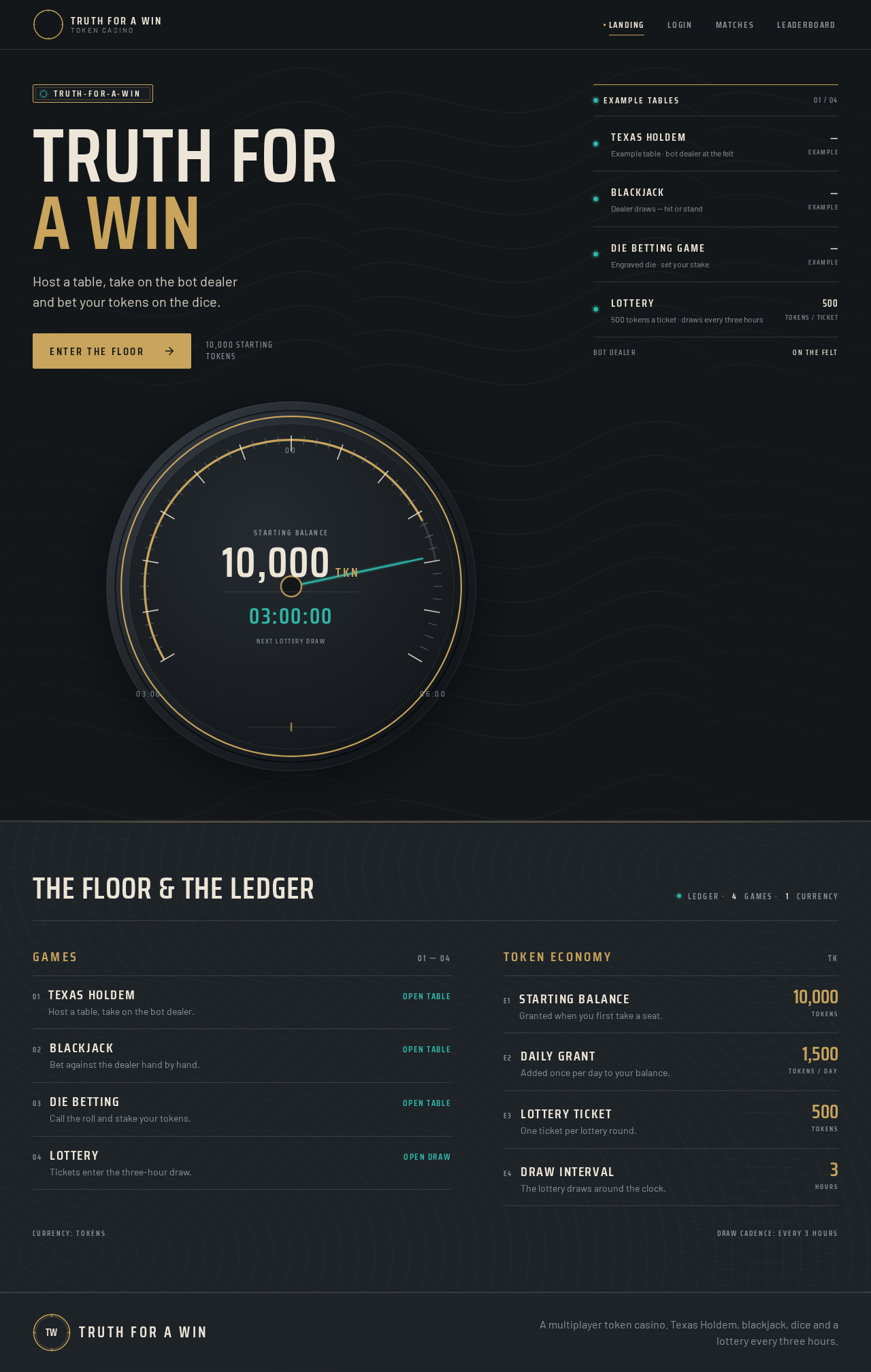
Truth for a win
Host a table, take on the bot dealer and bet your tokens on the dice.
The floor & the ledger
Games
01 — 04- 01Texas HoldemHost a table, take on the bot dealer.
- OPEN TABLE
- 02BlackjackBet against the dealer hand by hand.
- OPEN TABLE
- 03Die BettingCall the roll and stake your tokens.
- OPEN TABLE
- 04LotteryTickets enter the three-hour draw.
- OPEN DRAW
Token economy
TK- E1Starting balanceGranted when you first take a seat.
- 10,000tokens
- E2Daily grantAdded once per day to your balance.
- 1,500tokens / day
- E3Lottery ticketOne ticket per lottery round.
- 500tokens
- E4Draw intervalThe lottery draws around the clock.
- 3hours
No comments yet. Be the first!