tough-system
 maria
mariaSaudi Ministry of Health – Smart Healthcare Platform (Vision 2030) Build a professional full-stack healthcare platform called "Sehati AI" for the Saudi Ministry of Health (MOH). This platform should combine healthcare services, artificial intelligence, predictive analytics, telemedicine, and healthcare system optimization into one unified ecosystem. The application should support Patients, Doctors, Hospital Administrators, and Ministry Officials. Objective Create a next-generation healthcare platform aligned with Saudi Vision 2030 that improves healthcare access, predicts health risks, optimizes hospital operations, and provides AI-powered healthcare assistance. User Roles Patient Doctor Hospital Administrator Ministry of Health Administrator Patient Features Smart Health Dashboard Personal profile Medical history Chronic diseases Allergies Vaccination records Family medical history Lab results Radiology reports Current medications Appointment Management Book appointments Cancel appointments Reschedule appointments Track appointment status View doctor availability Telemedicine Video consultations Secure messaging with doctors Share files and reports Prescription Management E-prescriptions Medication reminders Refill requests Emergency Services Emergency SOS button Share location with nearest hospital Send critical medical information to emergency responders AI Features AI Symptom Checker Patient enters symptoms. AI should: Analyze symptoms Estimate urgency level Recommend medical specialty Suggest whether to: Visit ER Visit clinic Schedule telemedicine Use self-care Display confidence scores and explanations. AI Health Assistant Chatbot Healthcare chatbot capable of: Answering common health questions Explaining medications Explaining test results Health education Preventive care recommendations Support: Arabic English Predictive Health Analytics Using patient history, AI predicts: Diabetes Risk Heart Disease Risk Hypertension Risk Obesity Risk Display: Risk score Risk category Personalized recommendations Trend charts AI Medication Safety System Check: Drug interactions Allergy conflicts Duplicate medications Generate warnings for doctors and patients. AI Radiology Assistant Allow upload of: X-ray images CT scans MRI scans AI generates: Preliminary findings Highlighted suspicious regions Confidence scores Include disclaimer: "AI suggestions are not a final diagnosis." Doctor Portal Doctor Dashboard Show: Today's patients Upcoming appointments Patient history Notifications Patient Record Management Doctors can: View records Add diagnoses Add treatment plans Upload reports Create prescriptions AI Clinical Assistant During consultations AI can: Generate visit notes Summarize patient history Suggest possible diagnoses Recommend tests Smart Referral System Automatically recommend: Best hospital Available specialists Shortest waiting times Closest facilities Use: Patient location Doctor availability Hospital capacity Wearable Integration Connect to: Apple Watch Fitbit Smart blood pressure monitors Glucose monitors Display: Heart rate Blood sugar Blood pressure Activity levels Sleep quality Generate alerts for abnormal readings. Hospital Administration Portal Hospital Dashboard Track: Number of patients Appointments Bed occupancy Emergency room load Doctor availability Predictive Analytics Predict: Patient demand Bed shortages Staff requirements Emergency room congestion Ministry of Health Dashboard Create a national healthcare analytics dashboard. Display: Healthcare Statistics Total patients Hospital utilization Regional healthcare demand Disease trends Disease Monitoring Heat maps Outbreak detection Population health insights Resource Optimization Ambulance allocation Hospital capacity Staff deployment Healthcare Digital Twin (Flagship Feature) Create a digital twin simulation of Saudi Arabia's healthcare system. The simulation should model: Hospitals Clinics Ambulances Patients Medical resources Allow users to simulate: Pandemic outbreaks Population growth Hospital overcrowding Resource shortages Display: Interactive map Real-time charts System performance indicators Use AI predictions to suggest improvements. Technical Requirements Frontend: React TypeScript Tailwind CSS Responsive design Backend: Node.js Express.js Database: PostgreSQL Authentication: JWT Role-based access control Languages: Arabic English Theme: Saudi Ministry of Health inspired Green and white professional design Dark mode Light mode Analytics & Visualization Include: Interactive dashboards Charts Maps Health trends Risk scores AI prediction visualizations Use: Chart.js Recharts Sample Data Generate: 100 patients 25 doctors 10 hospitals Appointments Medical records Prescriptions Wearable health data Deliverables Create a fully functional prototype with: Complete frontend Complete backend Database schema API routes Authentication AI modules (simulated if necessary) Healthcare Digital Twin Dashboard Professional UI suitable for an AI Engineering capstone project and Saudi Vision 2030 healthcare transformation presentation.


Comments (0)
Sign in to leave a comment
System Requirements
Tough-System
Introduction
The "Tough-System" project aims to develop a comprehensive healthcare platform that aligns with Saudi Vision 2030. This platform will integrate healthcare services, artificial intelligence, predictive analytics, telemedicine, and healthcare system optimization into a unified ecosystem. The initial focus will be on creating a robust patient-doctor experience with essential features and simulated AI functionality.
System Overview
The Tough-System is designed to support various user roles, including Patients, Doctors, Hospital Administrators, and Ministry Officials. The platform will provide a seamless experience for managing healthcare records, appointments, telemedicine consultations, and AI-powered healthcare assistance. The system will be built using modern technologies, ensuring scalability, security, and ease of use.
Functional Requirements
Phase 1 (Highest Priority)
- As a Patient, I should be able to access a personal health dashboard to view my medical history, chronic diseases, allergies, vaccination records, family medical history, lab results, radiology reports, and current medications.
- As a Patient, I should be able to manage appointments by booking, canceling, rescheduling, and tracking appointment status, as well as viewing doctor availability.
- As a Patient, I should be able to engage in telemedicine video consultations and secure messaging with doctors, and share files and reports.
- As a Patient, I should be able to manage prescriptions, including e-prescriptions, medication reminders, and refill requests.
- As a Doctor, I should be able to access a dashboard showing today's patients, upcoming appointments, patient history, and notifications.
- As a Doctor, I should be able to manage patient records by viewing records, adding diagnoses, treatment plans, uploading reports, and creating prescriptions.
- As a User, I should be able to authenticate and access the system with role-based access control.
Phase 2
- As a Patient, I should be able to use an AI Symptom Checker to analyze symptoms, estimate urgency levels, and receive recommendations for medical specialties and care options.
- As a Patient, I should be able to interact with an AI Health Assistant Chatbot for common health questions, medication explanations, test results, health education, and preventive care recommendations.
- As a Patient, I should be able to use an AI Medication Interaction Checker to identify drug interactions, allergy conflicts, and duplicate medications.
- As a Patient, I should be able to view predictive health risk analytics for diabetes, heart disease, hypertension, and obesity, with risk scores, categories, and personalized recommendations.
Phase 3
- As a Hospital Administrator, I should be able to access a dashboard to track patient numbers, appointments, bed occupancy, emergency room load, and doctor availability.
- As a Doctor, I should be able to use a Smart Referral System to recommend hospitals, specialists, and facilities based on patient location, doctor availability, and hospital capacity.
- As a Patient, I should be able to integrate wearable devices to monitor heart rate, blood sugar, blood pressure, activity levels, and sleep quality, and receive alerts for abnormal readings.
Phase 4 (Flagship Feature)
- As a Ministry of Health Administrator, I should be able to access a national healthcare analytics dashboard for healthcare statistics, regional demand, disease trends, and resource optimization.
- As a Ministry of Health Administrator, I should be able to use a Healthcare Digital Twin to simulate pandemic outbreaks, population growth, hospital overcrowding, and resource shortages, with interactive maps and real-time charts.
Smart Inclusive Healthcare (New Flagship Feature)
- As a Patient with disabilities, I should be able to use voice navigation in Arabic and English.
- As a Patient, I should be able to use text-to-speech for prescriptions, reports, and appointments.
- As a Patient, I should be able to use speech-to-text for booking appointments.
- As a Patient, I should be able to enable large text mode and high-contrast mode for visual impairments.
- As a Patient, I should be able to engage in sign language telemedicine where AI generates real-time captions and translates speech into Saudi Sign Language animations.
- As a Patient, I should be able to create a Smart Accessibility Profile specifying visual, hearing, mobility, or cognitive impairments, allowing the app to adapt interfaces and services.
- As an Elderly or Disabled Patient, I should be able to use an AI Care Companion for medication reminders, appointment reminders, health check-ins, and emergency contact notifications.
- As a Patient, I should be able to access interactive maps showing wheelchair-accessible entrances, elevators, parking, and restrooms.
- As a Caregiver, I should be able to manage appointments, view medications, join telemedicine sessions, receive emergency alerts, and track treatment plans for the patient.
User Personas
- Patient: Individuals seeking healthcare services, managing personal health records, and engaging in telemedicine consultations.
- Doctor: Healthcare professionals managing patient records, conducting consultations, and prescribing treatments.
- Hospital Administrator: Personnel responsible for overseeing hospital operations, resource allocation, and patient management.
- Ministry of Health Administrator: Officials monitoring national healthcare statistics, disease trends, and resource optimization.
- Caregiver: Family members or professionals assisting patients with healthcare management, especially for elderly or disabled individuals.
Core User Flows
- Patient logs in -> Views health dashboard -> Books appointment -> Engages in telemedicine consultation -> Manages prescriptions
- Doctor logs in -> Views dashboard -> Reviews patient history -> Conducts consultation -> Updates patient records
- Hospital Administrator logs in -> Monitors hospital dashboard -> Manages resources and capacity
- Ministry of Health Administrator logs in -> Accesses national dashboard -> Analyzes healthcare data -> Simulates scenarios with Digital Twin
- Patient with disabilities logs in -> Uses voice navigation -> Engages in sign language telemedicine -> Manages accessibility settings
- Caregiver logs in -> Manages patient appointments -> Joins telemedicine sessions -> Tracks treatment plans
Visuals Colors and Theme
- primary: #006400 (Deep Green)
- primary_light: #32CD32 (Lime Green)
- secondary: #FFD700 (Gold)
- accent: #FF4500 (Orange Red)
- highlight: #FFA500 (Orange)
- bg: #F5F5F5 (White Smoke)
- surface: rgba(255, 255, 255, 0.8) (White)
- text: #000000 (Black)
- text_muted: #696969 (Dim Gray)
- border: rgba(0, 100, 0, 0.2) (Deep Green)
Signature Design Concept
The Tough-System's landing page will feature an interactive "Healthcare Galaxy" concept. Users will navigate through a 3D galaxy where each star represents a feature or section of the platform. By clicking on a star, users can explore detailed information about that feature. The galaxy will rotate as users drag their cursor, and hovering over stars will highlight connections between related features. This immersive experience will be powered by @react-three/fiber and @react-three/drei, creating a dynamic and engaging introduction to the platform.
Interaction Model & Motion Direction
The landing page will utilize a "parallax" interaction model, providing a layered depth experience as users scroll through the content. Decorative elements will move at different speeds, creating a visually rich first impression. Internal pages will adopt a "static" model to prioritize layout clarity and reading speed.
Non-Functional Requirements
- The system must support both Arabic and English languages.
- The platform should ensure data security and privacy compliance with relevant regulations.
- The application must be responsive and accessible across various devices and screen sizes.
Tech Stack
- Frontend: React, TypeScript, Tailwind CSS
- Backend: Node.js, Express.js
- Database: PostgreSQL
- Authentication: JWT, Role-based access control
- Analytics & Visualization: Chart.js, Recharts
Assumptions and Constraints
- The platform will initially focus on the Saudi Arabian healthcare system.
- AI functionalities will be simulated in the initial prototype.
- The system must integrate with existing healthcare infrastructure in Saudi Arabia.
Glossary
- AI: Artificial Intelligence
- JWT: JSON Web Token
- Telemedicine: Remote diagnosis and treatment of patients through telecommunications technology
- Digital Twin: A virtual model of a physical system used for simulation and analysis
This document outlines the comprehensive requirements for the Tough-System project, ensuring alignment with Saudi Vision 2030 and providing a robust foundation for the development of a next-generation healthcare platform.
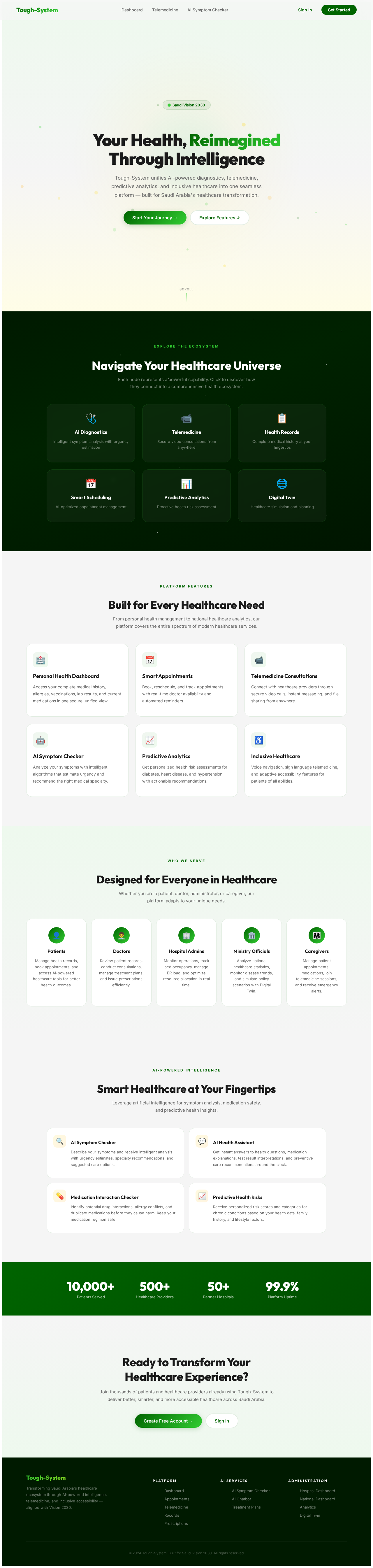
Your Health, Reimagined Through Intelligence
Tough-System unifies AI-powered diagnostics, telemedicine, predictive analytics, and inclusive healthcare into one seamless platform — built for Saudi Arabia's healthcare transformation.
Explore the Ecosystem
Navigate Your Healthcare Universe
Each node represents a powerful capability. Click to discover how they connect into a comprehensive health ecosystem.
AI Diagnostics
Intelligent symptom analysis with urgency estimation
Telemedicine
Secure video consultations from anywhere
Health Records
Complete medical history at your fingertips
Smart Scheduling
AI-optimized appointment management
Predictive Analytics
Proactive health risk assessment
Digital Twin
Healthcare simulation and planning
Platform Features
Built for Every Healthcare Need
From personal health management to national healthcare analytics, our platform covers the entire spectrum of modern healthcare services.
Personal Health Dashboard
Access your complete medical history, allergies, vaccinations, lab results, and current medications in one secure, unified view.
Smart Appointments
Book, reschedule, and track appointments with real-time doctor availability and automated reminders.
Telemedicine Consultations
Connect with healthcare providers through secure video calls, instant messaging, and file sharing from anywhere.
AI Symptom Checker
Analyze your symptoms with intelligent algorithms that estimate urgency and recommend the right medical specialty.
Predictive Analytics
Get personalized health risk assessments for diabetes, heart disease, and hypertension with actionable recommendations.
Inclusive Healthcare
Voice navigation, sign language telemedicine, and adaptive accessibility features for patients of all abilities.
Who We Serve
Designed for Everyone in Healthcare
Whether you are a patient, doctor, administrator, or caregiver, our platform adapts to your unique needs.
Patients
Manage health records, book appointments, and access AI-powered healthcare tools for better health outcomes.
Doctors
Review patient records, conduct consultations, manage treatment plans, and issue prescriptions efficiently.
Hospital Admins
Monitor operations, track bed occupancy, manage ER load, and optimize resource allocation in real time.
Ministry Officials
Analyze national healthcare statistics, monitor disease trends, and simulate policy scenarios with Digital Twin.
Caregivers
Manage patient appointments, medications, join telemedicine sessions, and receive emergency alerts.
AI-Powered Intelligence
Smart Healthcare at Your Fingertips
Leverage artificial intelligence for symptom analysis, medication safety, and predictive health insights.
AI Symptom Checker
Describe your symptoms and receive intelligent analysis with urgency estimates, specialty recommendations, and suggested care options.
AI Health Assistant
Get instant answers to health questions, medication explanations, test result interpretations, and preventive care recommendations around the clock.
Medication Interaction Checker
Identify potential drug interactions, allergy conflicts, and duplicate medications before they cause harm. Keep your medication regimen safe.
Predictive Health Risks
Receive personalized risk scores and categories for chronic conditions based on your health data, family history, and lifestyle factors.
Ready to Transform Your Healthcare Experience?
Join thousands of patients and healthcare providers already using Tough-System to deliver better, smarter, and more accessible healthcare across Saudi Arabia.
No comments yet. Be the first!